Blogs / AI for Document Intelligence in Real Business Environments
AI for Document Intelligence in Real Business Environments
Klyra AI / February 15, 2026
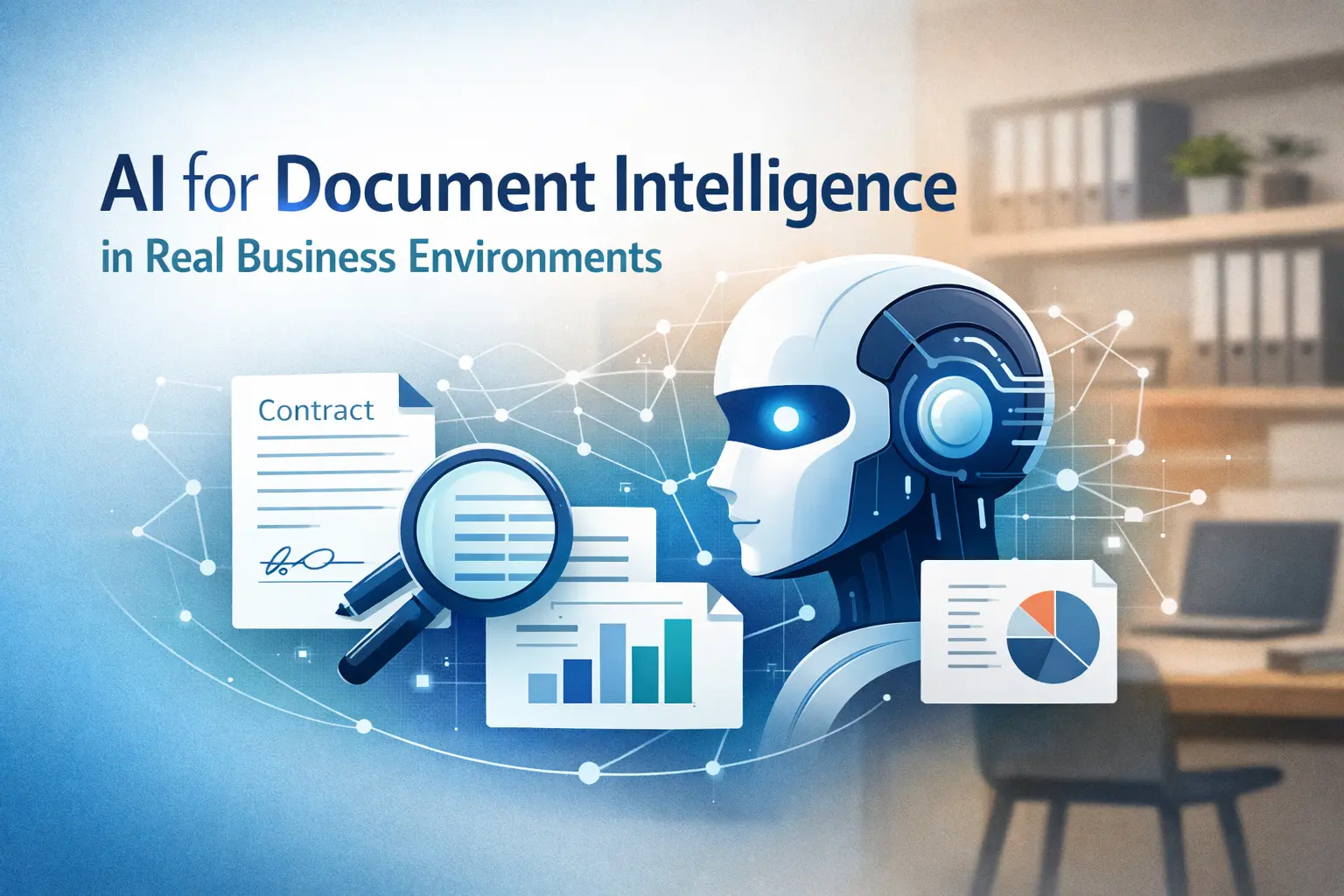
Most business knowledge lives inside documents.
Contracts, proposals, policy manuals, financial reports, research summaries, transcripts, internal memos. These files contain decisions, obligations, risks, and strategy. Yet much of this information remains underutilized because it is time-consuming to review.
AI has changed that equation.
Document intelligence systems can extract, organize, and analyze text at scale. But real value only emerges when these capabilities are embedded into structured business workflows rather than treated as isolated tools.
What Document Intelligence Actually Means
Document intelligence refers to the ability of AI systems to interpret unstructured or semi-structured text and convert it into actionable insight.
This includes identifying key clauses in contracts, extracting financial figures from reports, summarizing meeting transcripts, and detecting patterns across document sets.
The goal is not simply speed. It is structured understanding.
Why Businesses Struggle With Document Overload
As organizations scale, document volume increases faster than review capacity.
Legal teams face growing contract backlogs. Operations teams manage expanding compliance documentation. Executives review lengthy reports with limited time.
Manual review becomes a bottleneck. Important insights are delayed or overlooked.
AI reduces this bottleneck by handling the first layer of analysis.
From Raw Text to Structured Insight
AI document systems convert free-form text into structured outputs.
Clauses can be categorized. Dates and obligations extracted. Risks flagged. Themes identified across multiple documents.
This transformation allows teams to move from reading documents to interrogating data.
Structured insight accelerates downstream decision-making without removing human oversight.
Why Context Still Matters
Despite its strengths, AI cannot fully replace contextual interpretation.
A flagged clause may be standard practice in one industry but risky in another. A summarized report may omit subtle implications.
This reinforces the distinction discussed in Why AI Improves Analysis More Than Decision-Making. AI enhances analysis, but judgment remains human.
Document intelligence systems should support professionals, not substitute for them.
Embedding AI Into Business Workflows
Successful document intelligence adoption requires integration.
Outputs must feed into review processes, compliance checks, and decision frameworks. Without integration, AI becomes an isolated productivity tool rather than an operational asset.
For example, tools like AI Textract enable structured extraction of document data, allowing teams to incorporate insights directly into existing systems.
Integration transforms analysis into action.
Common Business Use Cases
Contract review is one of the most visible applications.
AI can identify renewal dates, termination clauses, liability limits, and non-compete language quickly. Legal teams then focus on negotiation and strategy rather than initial scanning.
Financial reporting is another area. Extracting key metrics from large reports enables faster executive briefings.
Internal knowledge management also benefits. Policies and procedures become searchable and comparable rather than buried in archives.
Risk Mitigation Through Structured Extraction
Document intelligence reduces risk by increasing visibility.
When obligations, deadlines, and inconsistencies are surfaced systematically, fewer issues remain hidden. This strengthens compliance and governance frameworks.
However, risk is not eliminated. AI outputs must be validated before critical decisions are made.
What Research Suggests About AI in Knowledge Work
Research from organizations such as the Organisation for Economic Co-operation and Development highlights that AI produces the greatest gains in structured knowledge tasks.
Document analysis fits this profile well because it involves pattern recognition and information extraction rather than subjective judgment.
When paired with human oversight, productivity improvements are significant and sustainable.
Preventing Overreliance on Automation
Automation introduces a new risk: complacency.
Teams may assume extracted data is complete or interpretations are definitive. Without review protocols, errors can propagate.
Clear validation stages prevent overreliance and preserve accountability.
Scaling Insight Without Scaling Headcount
One of the strongest business cases for document intelligence is leverage.
Instead of hiring additional reviewers to manage document growth, organizations can use AI to absorb volume while maintaining quality control.
This does not eliminate expertise. It reallocates it toward higher-value work.
From Efficiency to Strategic Advantage
Document intelligence begins as an efficiency tool.
Over time, it becomes strategic. Faster insight enables quicker negotiations, better compliance oversight, and more informed executive decisions.
Organizations that treat AI as infrastructure rather than experiment capture this advantage.
Final Thought
AI document intelligence does not replace professionals. It extends their reach.
By converting raw text into structured insight, businesses gain clarity without sacrificing control.
In environments defined by information overload, structured intelligence becomes a competitive asset.
And when paired with disciplined workflows, it scales responsibly.