Blogs / Why Topical Authority Beats Keywords in the Age of AI
Why Topical Authority Beats Keywords in the Age of AI
Klyra AI / January 24, 2026
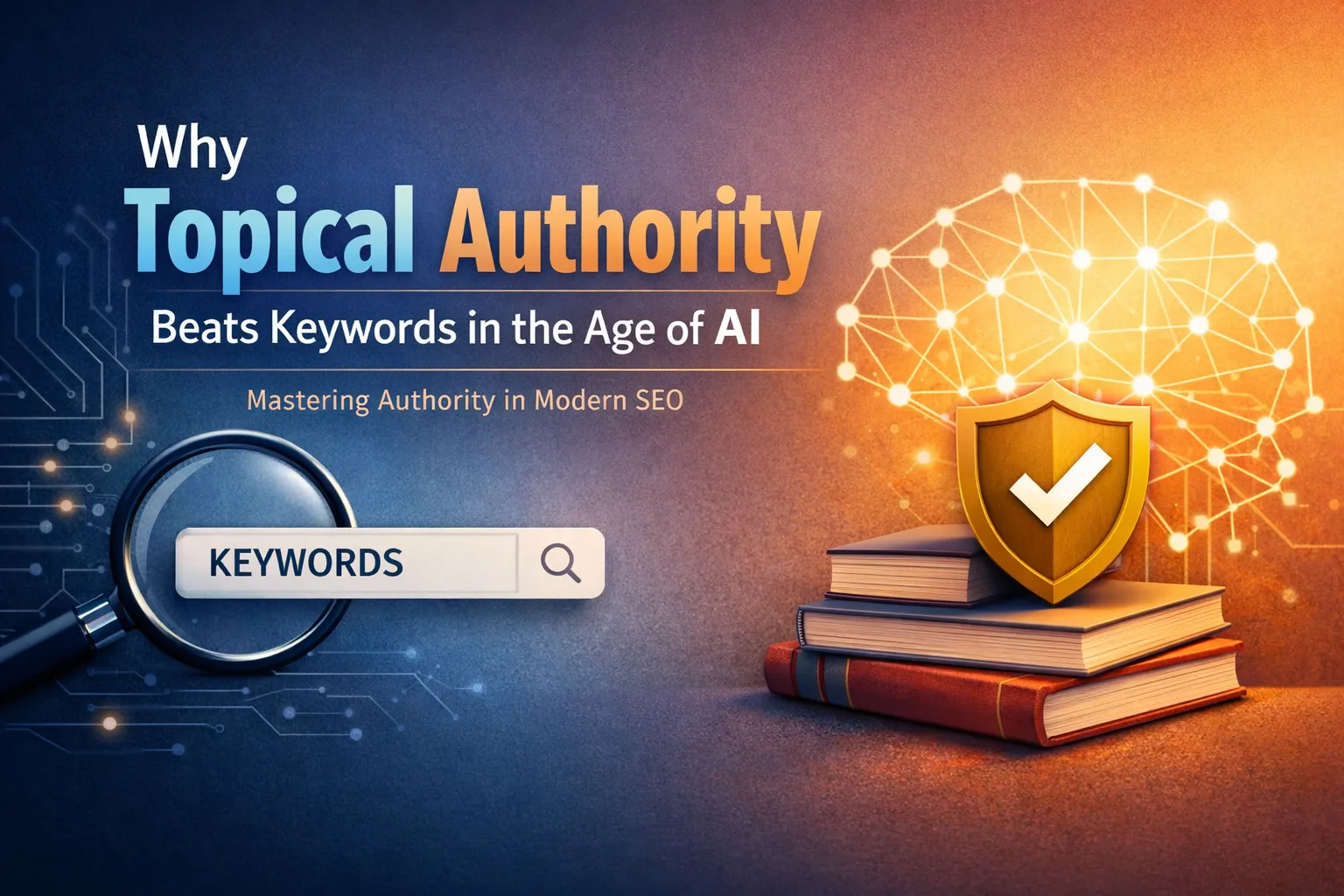
For most of SEO’s history, keywords were the primary unit of optimization. Pages were planned, written, and evaluated around individual terms. Ranking meant matching phrases. Growth meant finding more keywords.
AI has disrupted that model at scale. Today, anyone can generate keyword-targeted content quickly. Entire keyword lists can be covered in days. As a result, keyword optimization has lost its scarcity and much of its strategic value.
What replaced it is not a new tactic, but a deeper principle that search engines have been moving toward for years. Topical authority now matters more than keywords, and AI has accelerated that shift.
Why Keywords Worked for So Long
Keywords worked because they were a proxy. They represented what users typed and what content attempted to answer.
When content production was slow, covering a keyword often meant meaningful effort. Pages were researched, written, and reviewed. Ranking for a term usually implied some level of expertise.
Search engines could rely on keywords as a reasonable signal because few sites could afford to cover everything.
That assumption no longer holds.
AI Removed the Cost of Keyword Coverage
AI has made keyword coverage trivial. Hundreds of pages can be generated with minimal effort. Variations, long tails, and related phrases are easy to include.
This abundance breaks the old signal. A site can cover thousands of keywords without understanding any of them deeply.
As a result, search engines must look beyond surface-level matching.
Topical authority fills that gap.
What Topical Authority Actually Means
Topical authority is not about publishing more pages. It is about demonstrating consistent, deep understanding of a subject across a body of content.
An authoritative site does not just answer one question well. It answers many related questions coherently, without contradiction, repetition, or dilution.
This coherence signals expertise more reliably than keyword usage ever could.
AI makes coherence harder to achieve accidentally and easier to measure deliberately.
Why Search Engines Prefer Authority Over Coverage
Search engines aim to reduce uncertainty for users. When multiple pages compete, engines favor sources that appear to understand the topic broadly, not just the query narrowly.
Authority reduces risk. It increases the likelihood that content is accurate, updated, and contextually appropriate.
This preference aligns with long-standing principles in information retrieval, where relevance is evaluated across document collections rather than isolated matches.
Keywords help identify relevance. Authority confirms it.
Why Keyword-First SEO Breaks Down With AI
In an AI-driven workflow, keyword-first SEO leads to fragmentation. Each page targets a slightly different phrase. Overlap increases. Internal competition emerges.
Instead of strengthening a topic, the site scatters its signals.
This often results in dozens of pages ranking weakly instead of a smaller number ranking strongly.
AI accelerates this failure mode because it removes friction without adding judgment.
Authority Is a Property of the Whole Site
A single page cannot be authoritative on its own for competitive topics.
Authority emerges from how pages relate to each other. Do they build logically. Do they cover gaps. Do they reinforce the same conceptual model.
When pages disagree or repeat each other, authority erodes.
AI makes it easy to create pages. Systems are required to make them agree.
Why AI Rewards Structured Topic Clusters
AI performs best when given clear structure. Topic clusters provide that structure.
When content is organized around a central theme with defined subtopics, AI outputs become more consistent and useful.
This is why tools like AI Writer are most effective when used within a topical framework rather than as standalone generators.
Structure transforms AI from a content engine into a knowledge amplifier.
Keywords Still Matter, But Differently
This shift does not mean keywords are irrelevant. They still describe demand.
The difference is where they belong in the process.
Keywords now inform topic selection and prioritization, not page-by-page justification.
They help identify what to cover, not how to prove relevance.
Why Authority Compounds Over Time
Keyword-focused SEO resets with each page. Authority-focused SEO compounds.
As more high-quality, aligned content is published, new pages benefit from existing trust.
This reduces the effort required to rank for additional queries within the same topic.
AI accelerates this compounding effect when used intentionally.
Authority Protects Against Volatility
Sites built around keywords are sensitive to algorithm changes. Small shifts in weighting can collapse rankings.
Authoritative sites tend to be more stable. Their value is distributed across many signals.
This stability matters more in an AI-saturated environment where content volume continues to rise.
Authority acts as insulation.
Why Humans Must Define the Topic Boundaries
AI cannot decide what a topic is or where it should stop.
Without human-defined boundaries, AI expands endlessly, covering adjacent but irrelevant areas.
Authority requires restraint as much as coverage.
Knowing what not to publish is a strategic advantage.
From Keywords to Knowledge Systems
The most successful SEO teams no longer think in terms of pages. They think in terms of knowledge systems.
Each article strengthens a shared understanding. Each update reinforces clarity.
AI supports this shift by handling execution while humans design structure.
This is the future of scalable SEO.
Why This Shift Is Permanent
As AI content becomes ubiquitous, superficial signals lose value.
Search engines will continue prioritizing signals that are hard to fake at scale.
Topical authority is one of those signals.
It reflects sustained effort, coherent thinking, and editorial discipline.
Keywords Were the Entry Point. Authority Is the Destination.
Keywords helped SEO grow up.
Topical authority will determine who leads it forward.
In the age of AI, producing content is easy. Demonstrating understanding is not.
The sites that win will be the ones that treat AI as a tool for building knowledge, not just pages.