Blogs / Why AI Improves Analysis More Than Decision-Making
Why AI Improves Analysis More Than Decision-Making
Klyra AI / February 14, 2026
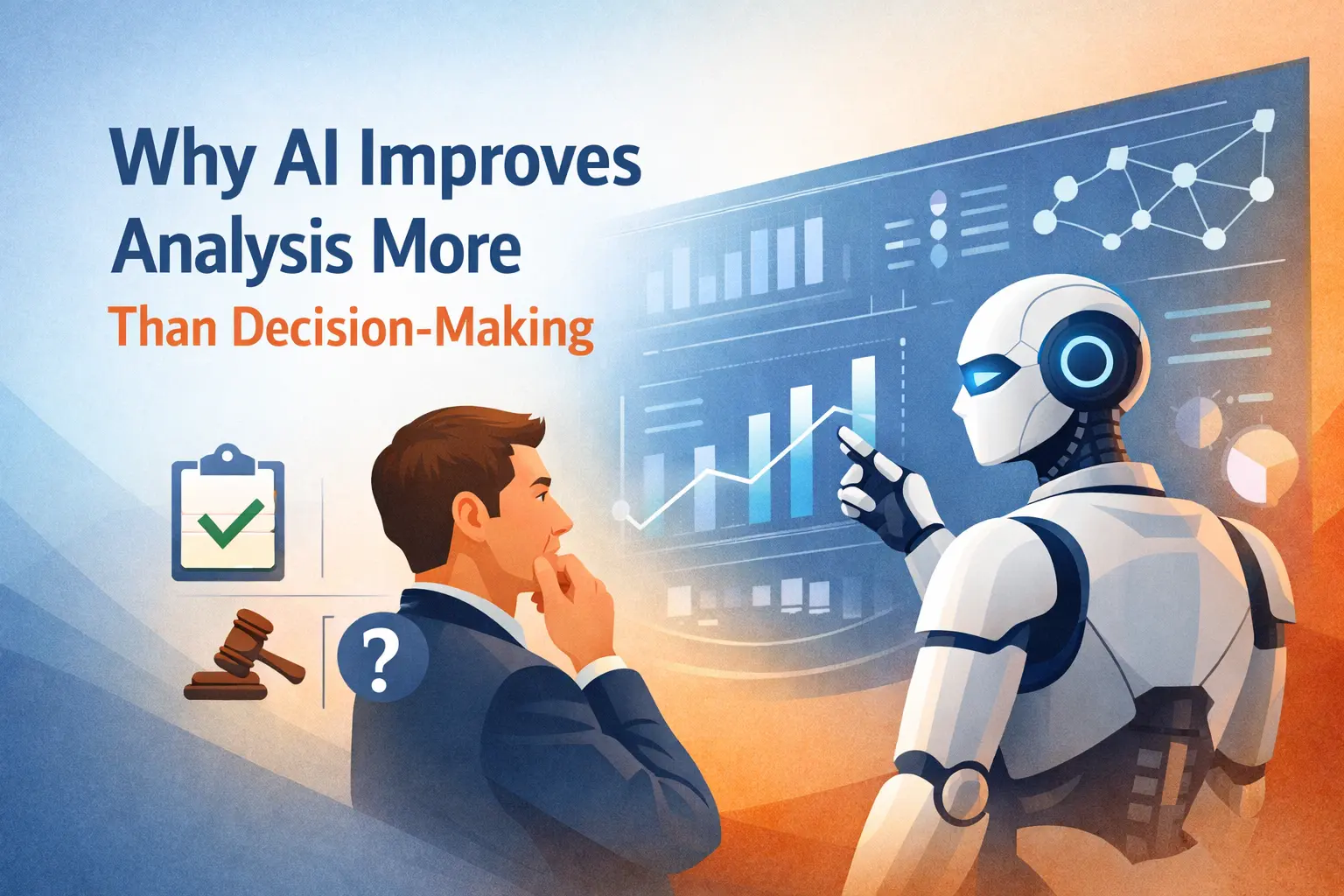
AI is exceptionally good at analysis.
It can process large volumes of information, detect patterns across datasets, summarize complex materials, and surface relevant insights in seconds. In analytical tasks, it consistently reduces friction and expands perspective.
Decision-making is different.
While AI can inform decisions, it does not own consequences, context, or values. The same characteristics that make AI powerful in analysis limit its reliability in judgment.
Understanding this distinction is critical for designing responsible AI workflows.
Why AI Excels at Analytical Tasks
Analysis is structured by nature.
It involves identifying patterns, comparing alternatives, extracting themes, and organizing information. These tasks rely heavily on computational capabilities that AI systems perform efficiently.
When professionals use AI to review documents, summarize reports, or explore options, productivity increases immediately.
These gains reflect AI’s strength in handling volume and structure.
Decision-Making Requires More Than Information
Decisions involve trade-offs.
They require evaluating risks, prioritizing competing goals, and considering consequences that may not be explicitly represented in data. They are shaped by values, accountability, and situational nuance.
AI does not possess these contextual anchors. It predicts plausible outcomes based on patterns, but it does not understand stakes.
This is why analysis and decision-making should not be treated as interchangeable.
The Illusion of Confident Recommendations
AI-generated recommendations often sound definitive.
Language models present conclusions fluently and with structured reasoning. This fluency can create a false sense of certainty.
In reality, AI is synthesizing probabilities rather than exercising judgment. It does not evaluate long-term implications or organizational dynamics.
Overreliance emerges when fluency is mistaken for authority.
Analysis as an Upstream Multiplier
When integrated correctly, AI enhances upstream processes.
Research workflows, exploratory analysis, and scenario comparisons become more comprehensive and faster to execute. This expansion of insight improves the quality of inputs available to human decision-makers.
As discussed in , structured AI research systems amplify understanding without replacing judgment.
The same principle applies to broader analytical contexts.
Why Delegating Decisions Introduces Risk
Delegating final decisions to AI shifts responsibility without removing accountability.
If an AI system recommends a strategic move that fails, humans remain accountable. Yet the reasoning process may not be fully transparent or aligned with organizational priorities.
This gap between recommendation and responsibility creates structural risk.
Decision authority should remain human-centered.
Context and Values Cannot Be Automated
Every meaningful decision reflects context.
Organizational culture, stakeholder expectations, regulatory constraints, and long-term strategy all influence outcomes. AI cannot fully model these factors unless explicitly encoded, and even then, interpretation remains probabilistic.
Human decision-makers integrate context naturally because they operate within it.
AI as a Decision Support Layer
The most effective approach is to position AI as a support layer.
It provides structured comparisons, risk assessments, and synthesized perspectives. Humans evaluate these outputs against broader objectives.
This division of labor maximizes strengths on both sides.
For example, tools like AI Textract assist in extracting structured insights from documents, enabling decision-makers to review relevant information efficiently while retaining final authority.
What Research Suggests About AI and Judgment
Research from institutions such as the Organisation for Economic Co-operation and Development emphasizes that AI systems deliver the strongest benefits when augmenting human expertise rather than replacing it.
Decision support models consistently outperform autonomous decision systems in complex, high-stakes environments.
This reinforces the importance of maintaining human oversight.
Preventing Overconfidence in AI Outputs
Teams should treat AI-generated recommendations as hypotheses.
Outputs should be validated, stress-tested, and contextualized before implementation. Structured review stages prevent premature commitment to automated suggestions.
Overconfidence emerges when review processes are informal or inconsistent.
Designing Workflows That Reflect the Distinction
Workflow design should explicitly separate analysis from decision authority.
AI handles data processing and comparative reasoning. Humans synthesize context and make commitments.
When these roles are blurred, responsibility becomes unclear and performance degrades over time.
Final Thought
AI strengthens analysis because analysis is structured.
Decision-making is not.
The most resilient AI strategies acknowledge this difference. They use AI to expand insight while preserving human ownership of consequences.
In knowledge work, judgment remains the final layer of accountability.
And that layer should not be automated.