Blogs / How Content Teams Can Replace 5 Tools With One AI Workflow
How Content Teams Can Replace 5 Tools With One AI Workflow
Klyra AI / February 9, 2026
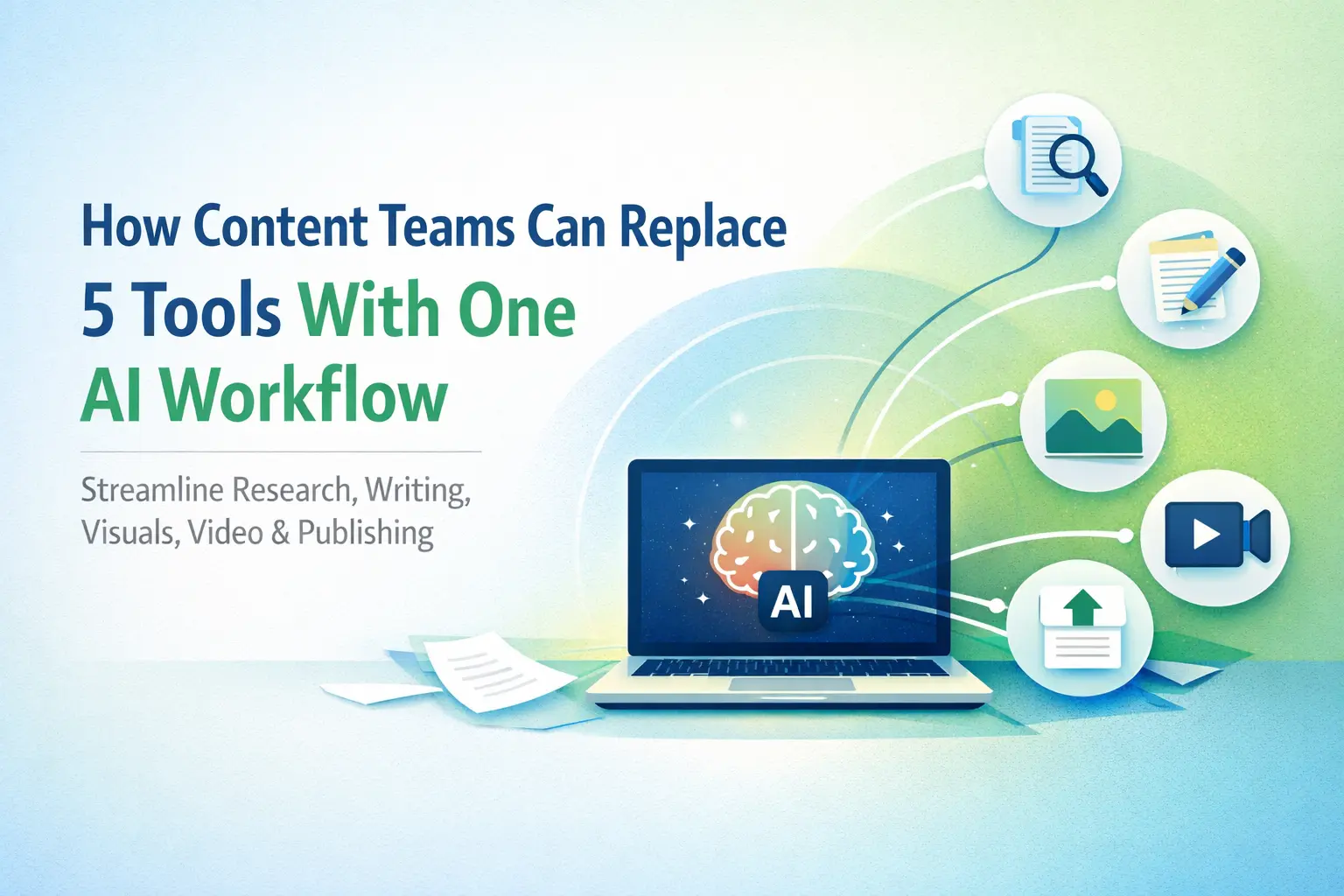
How Content Teams Can Replace 5 Tools With One AI Workflow
Most content teams don’t suffer from a lack of tools. They suffer from having too many.
Writers jump between documents and chat tools. Designers work in separate image editors. Video teams use standalone generators. Publishing happens in another system entirely.
Individually, each tool does its job. Together, they create friction, duplicated effort, and inconsistent output. This is where a unified AI workflow can replace five or more disconnected tools with a single system.
The Typical Content Workflow Today (and Where It Breaks)
Most content workflows follow the same general steps, regardless of industry or team size.
Ideas are researched in one place, drafts are written in another, visuals and videos are created separately, and publishing happens at the very end.
Each handoff introduces delays, context loss, and manual work. Over time, this fragmentation slows teams down more than any single task.
What a Unified AI Content Workflow Looks Like
A unified AI workflow brings research, creation, refinement, and publishing into one connected environment.
Instead of moving content between tools, teams build on the same context across every stage. Ideas flow naturally into drafts, visuals, videos, and published assets without repeated setup.
This approach shifts content production from a series of isolated tasks into a continuous system.
Step-by-Step: Replacing Multiple Tools With One AI Workflow
Step 1: Research and Ideation in One Workspace
Content creation begins with research. Teams gather insights from documents, articles, spreadsheets, and existing content.
Using a single workspace for research and ideation allows teams to ask questions, summarize sources, and extract key points without switching tools.
Centralized research with tools like AI Chat keeps context intact from the very first step.
Step 2: Writing and Editing Long-Form Content
Once ideas are defined, teams move into drafting and editing. Traditional workflows often involve copying notes into separate editors or documents.
An integrated writing environment allows teams to draft, refine, expand, and rewrite content without losing the original context.
Using tools such as AI Writer helps teams maintain momentum while keeping content aligned with the original intent.
Step 3: Creating Visuals and Videos From the Same Source
Modern content rarely lives in text alone. Blog posts are turned into images, short videos, and visual assets for different channels.
When visuals and videos are generated from the same source material, teams avoid rework and inconsistencies.
Integrated creation using the AI Image Suite and AI Video Generator makes multi-format production faster and more consistent.
Step 4: Maintaining Brand Consistency Automatically
As output increases, maintaining a consistent brand voice becomes more difficult. Different team members and tools often produce slightly different tones.
A centralized system that stores brand guidelines ensures every output follows the same style, messaging, and audience expectations.
Tools like Brand Voice help teams scale content without constant manual review.
Step 5: Publishing Without Manual Handoffs
In many teams, publishing is the final bottleneck. Content must be exported, formatted, uploaded, and scheduled manually.
Direct publishing and automation remove these steps entirely, allowing teams to move from draft to live content faster.
With integrations such as WordPress Integration, publishing becomes part of the same workflow rather than a separate task.
What Content Teams Gain by Simplifying Their Stack
Replacing multiple tools with one AI workflow delivers clear benefits.
Teams produce content faster, maintain higher consistency, reduce operational overhead, and collaborate more effectively.
Instead of managing tools, teams focus on ideas, quality, and impact.
When a Unified AI Workflow Makes the Most Sense
Unified workflows are most valuable for teams producing content at scale across multiple formats.
Marketing teams, educators, agencies, and businesses with ongoing publishing needs benefit the most from connected systems.
For small, one-off projects, standalone tools may be sufficient. As soon as volume and collaboration increase, unified workflows become essential.
Final Thoughts
Replacing five tools with one AI workflow is not about cutting corners. It is about removing friction.
As content demands grow, systems that preserve context, consistency, and speed outperform collections of disconnected tools.
For content teams looking to scale sustainably, unified AI workflows offer a simpler and more effective way forward.