Blogs / Designing AI-Assisted Research Workflows That Scale
Designing AI-Assisted Research Workflows That Scale
Klyra AI / February 13, 2026
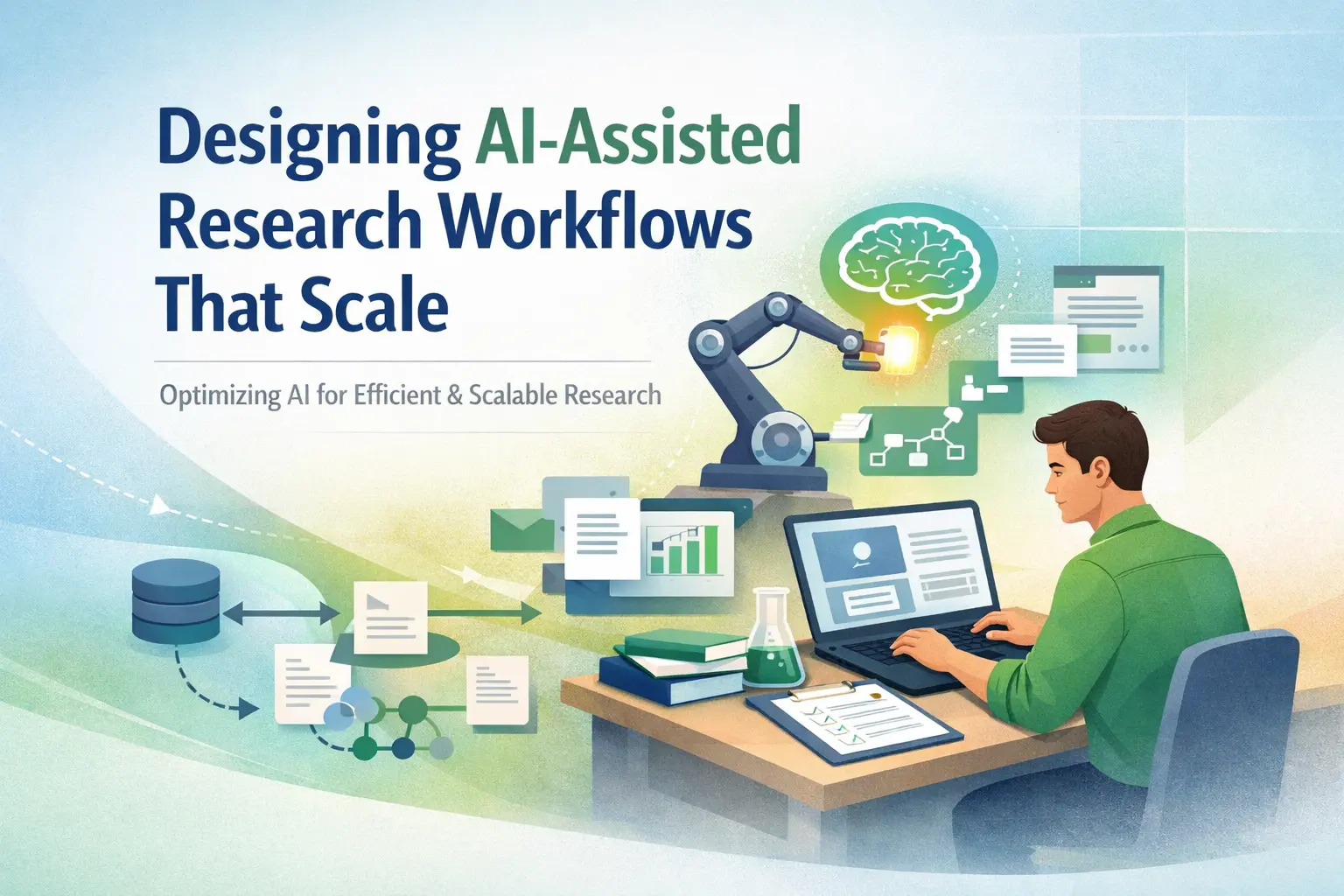
AI has transformed research from a time-intensive activity into an on-demand capability.
Summaries appear instantly. Documents are analyzed in seconds. Perspectives are synthesized without manual comparison. For individual professionals, this feels like leverage. For organizations, it feels like scale.
But scale without structure creates noise.
AI-assisted research workflows only become sustainable when they are designed intentionally. Without design, speed turns into overload and insight turns into confusion.
Why AI Research Feels Effortless at First
The first experience with AI research tools is often dramatic.
Long reports are condensed instantly. Key themes are extracted. Questions are answered with apparent clarity. What once required hours of reading becomes a structured response in minutes.
These gains are real. They reduce friction and accelerate information gathering.
The challenge emerges when AI output becomes the primary source of interpretation rather than a supplement to human reasoning.
The Difference Between Gathering and Understanding
AI excels at gathering and organizing information.
Understanding requires context.
Research workflows must account for this distinction. AI can surface relevant data, summarize perspectives, and identify patterns. It cannot evaluate implications, trade-offs, or strategic priorities without guidance.
When AI is treated as an assistant rather than an authority, workflows remain stable.
Why Unstructured AI Research Creates Bottlenecks
Without structure, AI-assisted research produces excess output.
Multiple summaries of the same topic. Repeated analyses. Slightly varied interpretations. Teams spend time reconciling outputs rather than making decisions.
Instead of reducing cognitive load, AI shifts it downstream.
Structured workflows prevent this by defining clear stages and responsibilities.
Designing Clear Phases in AI Research Workflows
Scalable AI research systems separate phases deliberately.
Exploration comes first. AI is used to survey broad perspectives, identify themes, and outline questions.
Refinement follows. Humans narrow scope, challenge assumptions, and select relevant insights.
Validation completes the process. Sources are verified, conclusions are stress-tested, and outputs are aligned with organizational context.
This separation preserves speed while maintaining rigor.
Human-in-the-Loop as a Stability Mechanism
Human oversight is not a limitation. It is a stabilizer.
Research discussed in AI as a Research Assistant, Not a Decision Maker reinforces that AI performs best when supporting, not replacing, judgment.
Embedding review checkpoints into research workflows ensures that outputs are contextualized rather than accepted at face value.
Scaling Document Intelligence Without Losing Context
Organizations often use AI to analyze large volumes of documents.
Contracts, reports, transcripts, and knowledge bases can be processed rapidly. The challenge is preserving nuance.
Tools such as AI Textract support structured extraction of information while allowing teams to retain contextual awareness. When integrated into defined workflows, document intelligence scales without sacrificing reliability.
Why Workflow Design Matters More Than Tool Selection
AI tools evolve quickly. Workflow design persists.
Choosing the right tool is important, but without a defined process, even advanced tools produce inconsistent results.
Workflows determine how inputs are structured, how outputs are reviewed, and how decisions are informed. Tools simply accelerate execution within those boundaries.
Measurement as a Feedback Layer
Scalable research workflows require feedback.
Teams should evaluate whether AI-assisted research reduces decision time, improves analysis quality, and strengthens strategic clarity.
If outputs increase but decisions slow, the workflow requires adjustment.
Measurement closes the loop between capability and effectiveness.
What Research Suggests About AI and Knowledge Work
Studies from institutions such as the Organisation for Economic Co-operation and Development emphasize that AI delivers the greatest productivity gains when augmenting skilled workers rather than replacing them.
Structured collaboration between humans and AI improves performance more reliably than automation alone.
Research workflows should reflect this principle.
Preventing Overreliance in Research Systems
As AI becomes embedded in research workflows, overreliance becomes a risk.
Professionals may begin to trust outputs reflexively. Critical thinking may decline. Verification steps may be skipped.
Clear workflow design prevents this drift by enforcing review and validation as non-negotiable stages.
From Acceleration to Amplification
Well-designed AI-assisted research workflows do more than accelerate tasks.
They amplify capability.
Professionals can explore broader perspectives, test more hypotheses, and synthesize information more efficiently. This expands strategic bandwidth without reducing responsibility.
Final Thought
AI makes research faster. Workflow design makes it reliable.
Without structure, speed produces confusion. With structure, speed produces insight.
Scalable AI research is not about replacing expertise. It is about strengthening it through disciplined collaboration between humans and intelligent systems.