Blogs / AI Note-Taking vs AI Synthesis: A Practical Difference
AI Note-Taking vs AI Synthesis: A Practical Difference
Klyra AI / January 27, 2026
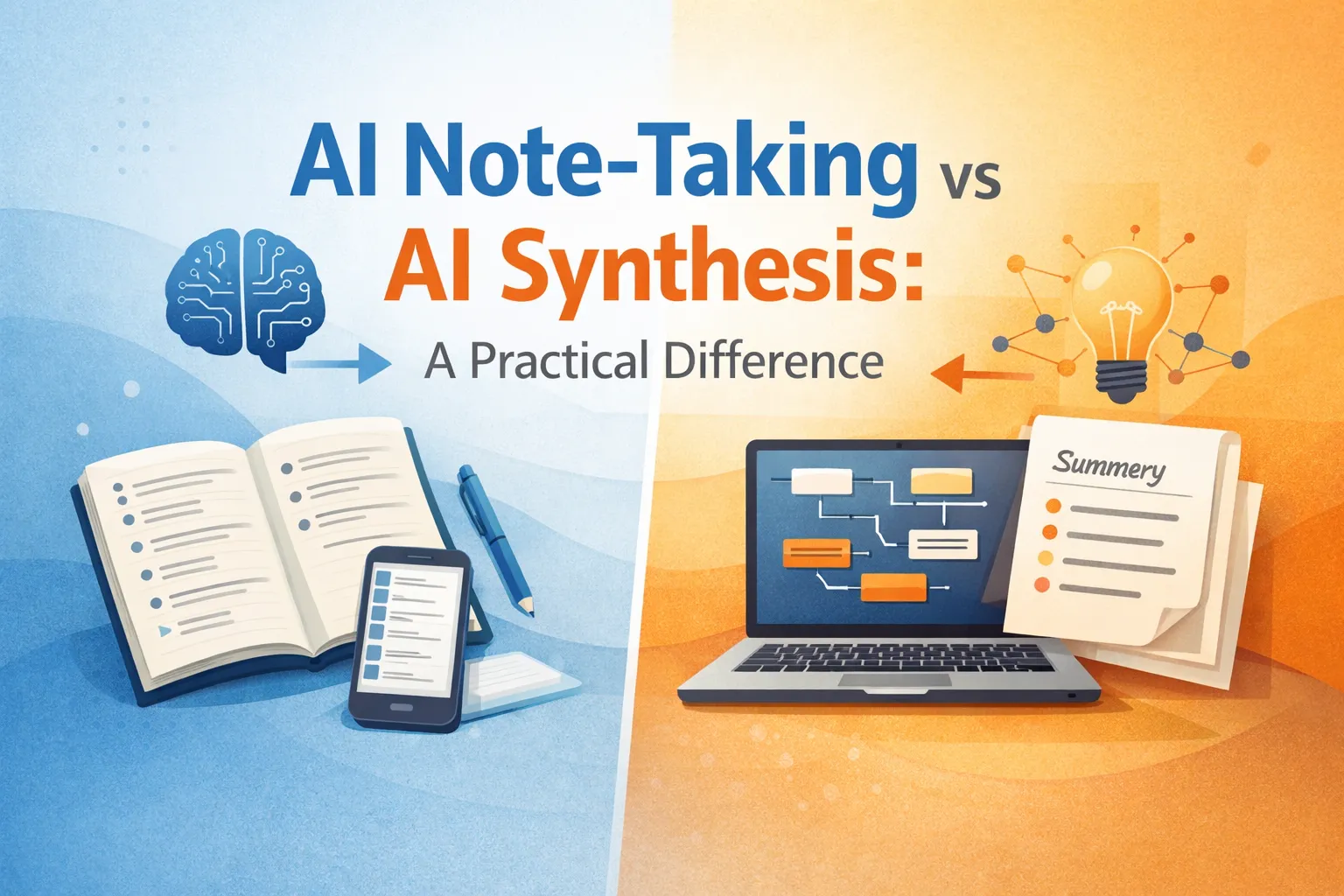
AI has become deeply embedded in how professionals capture information. Meetings are transcribed automatically. Articles are summarized instantly. Notes appear without manual effort.
At the same time, expectations around AI have expanded. Many users assume that if AI can take notes, it can also synthesize knowledge. This assumption leads to confusion, misuse, and disappointing outcomes.
AI note-taking and AI synthesis solve different problems. Treating them as interchangeable undermines both accuracy and insight.
Why the Distinction Matters More Than Ever
Before AI, note-taking and synthesis were separated by time and effort. Notes were captured first. Understanding emerged later through review and reflection.
AI collapses this gap by producing outputs instantly. This speed creates the illusion that synthesis has occurred when only capture has taken place.
Professionals who fail to distinguish between these layers often mistake information volume for insight.
Clarity begins by understanding what each function actually does.
What AI Note-Taking Actually Does
AI note-taking focuses on recording information accurately and efficiently.
It captures spoken or written content, organizes it into readable formats, and preserves what was said or written.
Transcripts, summaries, bullet-style notes, and highlights all fall into this category.
The goal is fidelity, not interpretation.
Why Note-Taking Scales So Well With AI
Note-taking is repetitive and pattern-driven.
AI excels at recognizing structure, identifying speakers, and extracting key points without fatigue.
This makes AI an excellent assistant for meetings, lectures, interviews, and document review.
Accuracy improves because nothing is missed due to human distraction.
What AI Synthesis Actually Requires
Synthesis goes beyond capture. It involves connecting ideas, resolving contradictions, and forming higher-level understanding.
It answers questions like what does this mean, how does it relate, and what should be done next.
This process depends heavily on context, goals, and judgment.
AI can assist, but it cannot fully replace human synthesis.
Why AI Often Appears to Synthesize When It Does Not
AI is skilled at producing fluent summaries that resemble insight.
These outputs feel authoritative because they are well-structured and confident.
However, they are often aggregations of surface-level patterns rather than genuine integration of ideas.
This distinction is subtle but critical.
When AI Note-Taking Is the Right Tool
AI note-taking is ideal when completeness matters more than interpretation.
Capturing meetings, preserving interviews, logging research material, and recording discussions are all strong use cases.
The value lies in creating a reliable record that humans can revisit.
In these scenarios, automation reduces cognitive load without introducing risk.
When AI-Assisted Synthesis Becomes Useful
AI-assisted synthesis works best as a preparatory step.
It helps surface themes, highlight overlaps, and suggest relationships across large information sets.
This accelerates human thinking rather than replacing it.
Insight still emerges through human evaluation.
The Role of Context in Synthesis
Synthesis depends on context that AI does not possess by default.
Organizational goals, historical decisions, stakeholder priorities, and implicit constraints shape meaning.
Without this context, synthesis becomes generic.
Humans provide the missing frame.
Why Professionals Confuse Notes With Insight
Speed creates false confidence.
When summaries appear instantly, they feel complete.
But understanding requires friction. It emerges through questioning and comparison.
AI removes friction from capture, not from thinking.
Designing Workflows That Respect the Difference
High-performing teams design workflows that separate capture from interpretation.
AI handles recording, structuring, and initial grouping.
Humans review, challenge, and synthesize.
This division prevents premature conclusions.
Where AI Chat Supports Synthesis Safely
AI becomes more useful for synthesis when it operates within grounded context.
Tools like AI Chat allow professionals to ask follow-up questions directly against uploaded notes, transcripts, or documents.
This keeps synthesis anchored to source material.
The risk of hallucination decreases as grounding increases.
Why Synthesis Is a Knowledge Science Problem
Synthesis has long been studied as a cognitive process.
It involves integrating information into coherent mental models rather than listing facts.
The formal concept of knowledge synthesis highlights this distinction between accumulation and understanding.
AI accelerates accumulation. Humans complete synthesis.
Practical Mistakes to Avoid
Treating AI summaries as final conclusions.
Skipping source review because outputs look polished.
Expecting AI to resolve ambiguity without guidance.
These mistakes erode trust and decision quality.
Why This Distinction Improves Decision Making
When teams respect the difference between notes and synthesis, decisions improve.
Information is available without overwhelming judgment.
Insights are deliberate rather than accidental.
Confidence is earned, not assumed.
Notes Capture. Synthesis Decides.
AI has transformed how information is captured.
It has not replaced the need for thinking.
Professionals who understand this distinction use AI effectively without surrendering judgment.
In knowledge work, clarity comes from synthesis, not summaries.