Blogs / AI for Knowledge Work: What Actually Gets Better and What Does Not
AI for Knowledge Work: What Actually Gets Better and What Does Not
Klyra AI / January 22, 2026
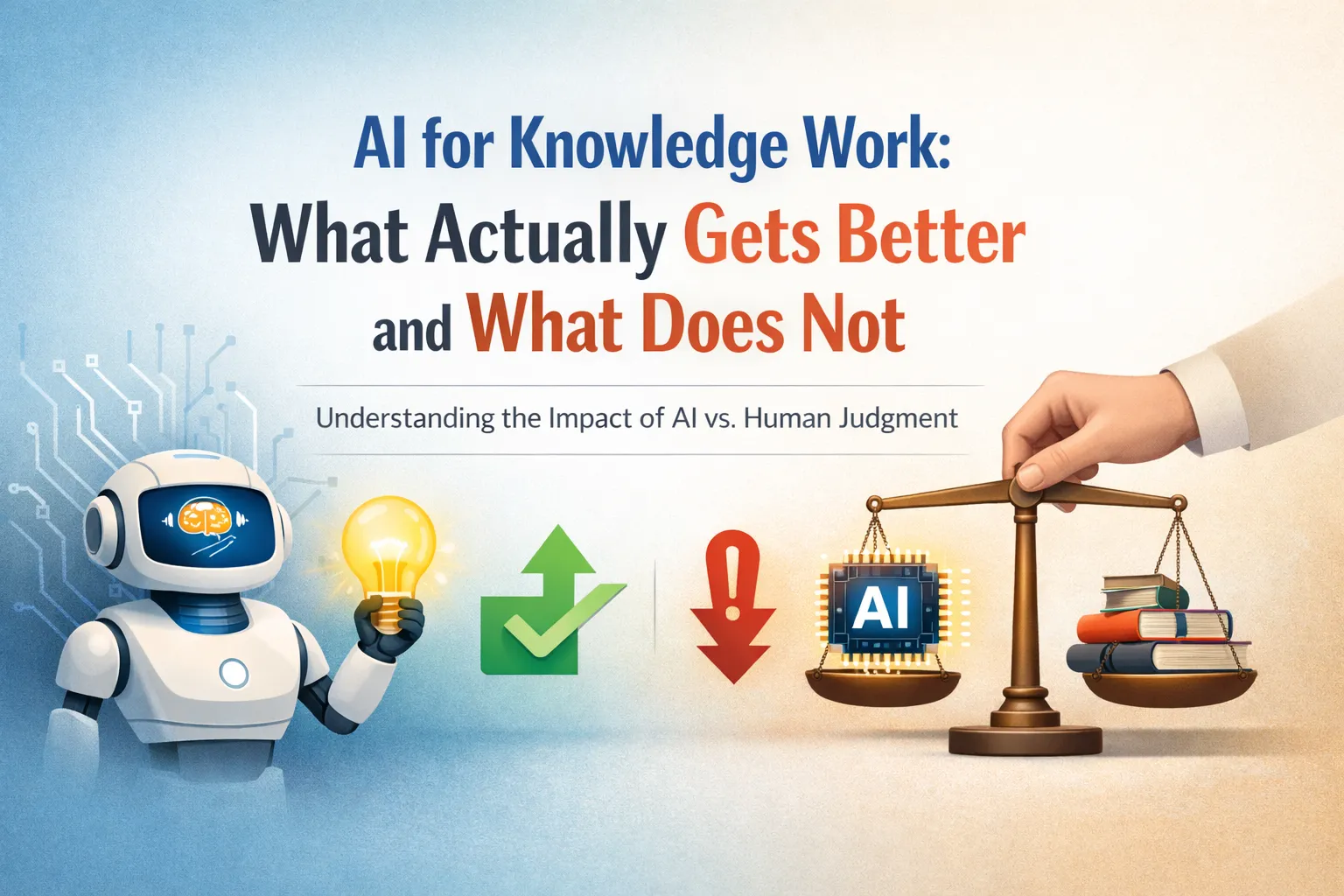
AI has been widely marketed as a breakthrough for knowledge work. Research, analysis, writing, and decision support all appear faster, cheaper, and more scalable. For many professionals, the gains feel real.
Yet alongside these gains is growing frustration. Some tasks improve dramatically. Others feel unchanged. A few even get worse. This uneven experience creates confusion about what AI is actually good at.
The truth is that AI does not improve knowledge work uniformly. It enhances specific layers of work while leaving others fundamentally untouched. Understanding this boundary is critical for setting realistic expectations and designing effective workflows.
What Knowledge Work Really Consists Of
Knowledge work is often treated as a single category, but it is made up of distinct activities. Gathering information, synthesizing ideas, applying judgment, and making decisions each rely on different cognitive skills.
AI interacts with these layers differently. It excels where patterns are repeatable and context can be inferred. It struggles where meaning depends on lived experience, accountability, or ethical consideration.
When professionals feel disappointed by AI, it is usually because they expected improvement in areas AI was never designed to handle.
Clarity begins by separating tasks rather than evaluating AI as a whole.
What Actually Gets Better With AI
AI delivers its strongest gains in information-heavy tasks. Large volumes of text can be scanned quickly. Patterns across documents emerge faster. Repetitive analysis becomes less taxing.
This reduces cognitive load. Professionals spend less time searching and more time thinking.
AI also improves consistency in execution. Given the same inputs, it produces stable outputs. This reliability is valuable in drafting, summarization, and structured analysis.
These gains are real and measurable.
Why Research and Analysis Improve First
Research and analysis benefit early because they involve compression rather than conclusion. AI shortens the distance between question and understanding.
Instead of replacing human reasoning, it prepares raw material for it. This distinction explains why professionals often trust AI in early stages but hesitate later.
When used correctly, AI reduces friction without reducing rigor.
Speed improves because effort is redirected, not removed.
What Does Not Improve With AI
Judgment does not improve simply because information arrives faster. Deciding what matters, what is risky, or what aligns with long-term goals remains human work.
AI cannot weigh consequences in the real world. It does not carry responsibility for outcomes.
This is why strategic decisions, ethical tradeoffs, and leadership choices feel unchanged even in AI-rich environments.
AI informs these decisions. It does not make them better on its own.
Why Decision Making Often Feels Worse
In some cases, AI makes decision making harder. More information appears faster than teams can process it.
Without clear criteria, abundance becomes noise. Conflicting signals increase doubt rather than clarity.
This is not a failure of AI. It is a failure to adapt decision frameworks to a new input volume.
More data requires stronger judgment, not weaker.
AI Improves Execution, Not Accountability
One of the most important boundaries is accountability. AI can execute tasks, but it cannot own outcomes.
In knowledge work, accountability drives care. Professionals check assumptions because their reputation or responsibility is at stake.
AI lacks this incentive structure.
This makes human oversight non-negotiable in high-stakes work.
Where Professionals See the Most Sustainable Gains
The strongest gains appear when AI is positioned as an assistant rather than a replacement.
Professionals who delegate preparation to AI and reserve judgment for themselves report higher satisfaction and better outcomes.
This division of labor mirrors effective human teams.
AI supports. Humans decide.
Document-Heavy Workflows Benefit Disproportionately
Knowledge work that involves contracts, reports, forms, and records sees outsized improvements.
Extracting structure from unstructured data is time-consuming for humans but well suited to AI.
Tools like AI Textract illustrate this boundary clearly. When AI handles extraction and formatting, professionals focus on interpretation and action.
Efficiency improves without compromising responsibility.
Why Creativity Feels Inconsistent
Creative knowledge work sits in an ambiguous space. AI can generate ideas, but it cannot evaluate originality or relevance with human sensitivity.
Outputs may look creative but feel misaligned.
This inconsistency frustrates professionals who expect inspiration rather than variation.
Creativity improves when AI is used to explore options, not select them.
Knowledge Work Requires Context AI Does Not Possess
Much of professional work depends on tacit context. Organizational history, stakeholder relationships, and unspoken constraints shape decisions.
AI operates without this lived context.
As a result, it can suggest technically correct actions that are practically wrong.
Humans bridge this gap.
Why Expectations Determine Satisfaction
Professionals disappointed by AI often expected it to think for them.
Those satisfied with AI expected it to help them think better.
This difference in expectation explains wildly different adoption outcomes across similar roles.
AI rewards realistic framing.
The Limits Are Structural, Not Temporary
Some limitations will improve as models evolve. Others are structural.
Judgment, accountability, and meaning are not bottlenecks to be optimized away. They are core features of human work.
Expecting AI to replace them misunderstands both AI and knowledge work.
Progress comes from alignment, not substitution.
A Useful Mental Model
Think of AI as expanding the surface area of thought rather than replacing it.
More possibilities appear faster. More connections become visible.
Choosing among them remains a human act.
This model prevents overreliance and underutilization at the same time.
Knowledge Work Still Belongs to Humans
AI changes how knowledge work is performed, but not why it matters.
It reduces friction, not responsibility. It accelerates preparation, not judgment.
Understanding this boundary allows professionals to adopt AI confidently without disillusionment.
The future of knowledge work is not automated thinking. It is better supported thinking.