AI Avatar Videos vs AI Motion Graphics: What's the Difference?
AI has changed how teams create video.
Instead of relying entirely on cameras, presenters, studios, and lengthy editing workflows, businesses can now generate video content using AI avatars, motion graphics, and other AI-powered production tools.
But these approaches solve different problems.
AI avatar videos use digital presenters to communicate information through a human-like on-screen presence. AI motion graphics use animated text, shapes, illustrations, graphics, and visual elements to communicate an idea without requiring a presenter.
So which approach is better?
The answer depends on what you are trying to communicate, how often you need to create content, and how important human presence is to the experience.
This guide compares AI avatar videos and AI motion graphics, including their differences, advantages, limitations, costs, use cases, scalability, and how to choose the right approach for your team.
AI Avatar Videos vs AI Motion Graphics: Quick Comparison
| Factor | AI Avatar Videos | AI Motion Graphics |
|---|---|---|
| Main format | Digital presenter speaking to the audience | Animated visual elements communicating information |
| Human presence | High | Low or none |
| Best for | Training, presentations, explainers, onboarding | Concepts, processes, data, visual storytelling |
| Voice | Usually integrated with generated speech | Can use voiceover separately |
| Visual style | Presenter-led | Graphic-led |
| Personalization | Can adapt presenter, language, script, and voice | Can adapt visuals, text, colors, and animation |
| Production speed | Fast | Fast |
| Scalability | Strong | Strong |
| Emotional presence | Stronger | More dependent on design and narration |
| Complex visual explanation | Moderate | Strong |
| Multilingual content | Strong | Strong when paired with multilingual voiceover |
| Best audience experience | Direct communication | Visual explanation |
The simplest way to think about the difference is:
AI avatars put a digital person at the center of the video.
AI motion graphics put the information and visual design at the center.
What Are AI Avatar Videos?
AI avatar videos use artificial intelligence to create a digital presenter who appears to speak directly to the audience.
Instead of recording a real person on camera, a team can provide a script and generate a video featuring an AI avatar.
Depending on the tool, teams may be able to customize:
- The avatar
- The script
- The language
- The voice
- The presentation
- The branding
This makes AI avatars particularly useful when a video needs a clear presenter but filming a person for every video would be inefficient.
For example, a company might use an AI avatar to create:
- Employee training videos
- Product tutorials
- Onboarding content
- Educational presentations
- Customer explainers
- Internal communications
- Multilingual marketing videos
Klyra's AI Avatar Generator is designed around this type of workflow, allowing teams to create video presentations using AI-generated digital presenters.
What Are AI Motion Graphics?
AI motion graphics use animated visual elements rather than a digital presenter as the primary focus.
A motion-graphics video may combine:
- Text
- Shapes
- Icons
- Illustrations
- Charts
- Diagrams
- Animated transitions
- Visual effects
- Voiceover
- Music
The goal is usually to communicate information visually.
For example, a motion-graphics video can show how a process works by animating each stage rather than having a presenter explain it on screen.
This makes motion graphics particularly useful for:
- Product explanations
- Data visualization
- Process demonstrations
- Educational concepts
- Software tutorials
- Marketing campaigns
- Animated explainers
AI Avatar Videos vs AI Motion Graphics
The biggest difference is how information is communicated.
With an AI avatar video, the viewer is generally following a presenter.
With motion graphics, the viewer is generally following the visual information.
Consider an employee onboarding video.
An AI avatar could say:
"Welcome to the company. In this lesson, we'll explain our three-step onboarding process."
The presenter creates a sense of direct communication.
A motion-graphics video could instead show three animated stages:
Account Setup → Training → First Week
The information itself becomes the visual focus.
Neither approach is automatically better.
They simply communicate information differently.
1. Human Presence
AI avatars have a stronger sense of human presence because the viewer sees a digital presenter speaking directly to them.
This can make certain types of communication feel more personal.
Motion graphics do not require a presenter.
Instead, the design, animation, narration, and information hierarchy carry the communication.
AI avatars are stronger when:
- The audience needs a presenter
- Direct communication matters
- Training requires a speaker
- The content benefits from a recognizable digital person
Motion graphics are stronger when:
- The concept itself should be the visual focus
- Data needs to be presented
- A process needs to be demonstrated
- The audience needs diagrams or visual explanations
2. Visual Explanation
Motion graphics can be particularly effective when the subject is inherently visual.
Imagine explaining a software workflow.
An AI avatar can describe the workflow.
A motion-graphics video can show the workflow happening.
The screen might animate:
User Input → AI Processing → Result → Output
This can make abstract or technical concepts easier to understand.
AI avatars can still be combined with graphics, screen recordings, or other visual elements, but the presenter remains the primary communication element.
3. Voice and Narration
AI avatar videos typically combine the presenter with generated speech.
The avatar appears to speak the script while the generated voice delivers the narration.
Motion graphics can also use voiceover, but the voice is separate from the visual presentation.
This can provide more flexibility when the visual content needs to change independently of the speaker.
For example:
Motion Graphics + AI Voiceover
can create a narrated explainer without requiring an on-screen presenter.
This means the two approaches are not mutually exclusive.
An effective video can combine:
AI Avatar + Motion Graphics + AI Voiceover
depending on the objective.
4. Personalization
AI avatars can be useful for personalized video communication because the script can be adapted while keeping the overall presenter experience consistent.
For example, different versions of a training video could use:
- Different languages
- Different scripts
- Different audiences
- Different product information
Motion graphics can also be personalized by changing the visual content.
The difference is that AI avatars provide personalization through a digital presenter, while motion graphics provide it primarily through visual content and design.
5. Multilingual Video
Both approaches can scale across languages.
AI avatar workflows can combine multilingual scripts with generated voices and digital presenters.
Motion graphics can use multilingual text and voiceover without changing the fundamental visual structure.
The production requirements therefore depend on the project.
If the video relies heavily on a presenter speaking directly to the viewer, AI avatars can simplify localization.
If the video is primarily visual, motion graphics may be easier to localize.
6. Production Speed
Both AI avatars and AI motion graphics can significantly reduce production time compared with traditional video production.
Traditional production can involve:
Script → Scheduling → Filming → Editing → Review → Revision
AI workflows can reduce much of this process.
An AI avatar workflow may look like:
Script → Avatar → Voice → Video → Review
A motion-graphics workflow may look like:
Concept → Visuals → Animation → Voiceover → Review
The exact production time depends on the complexity of the video, but both approaches can make iteration much faster.
7. Cost
Cost depends heavily on the tools, production quality, volume, and complexity of the project.
Traditional Video
Traditional video may require:
- Cameras
- Lighting
- Studio space
- Presenters
- Crew
- Editing
- Post-production
Even small script changes can sometimes require additional recording.
AI Avatar Videos
AI avatars can reduce the need for:
- Physical filming
- Camera equipment
- Studio space
- On-camera talent
This can make recurring video production more efficient.
AI Motion Graphics
Motion graphics can also reduce traditional production requirements, but complex animation can still require significant design and editing work.
For simple recurring explainers, AI-assisted motion graphics can be efficient.
For highly sophisticated animation, production complexity can increase.
So the real question is not:
"Which is always cheaper?"
It is:
"Which approach produces the required result with the least unnecessary production effort?"
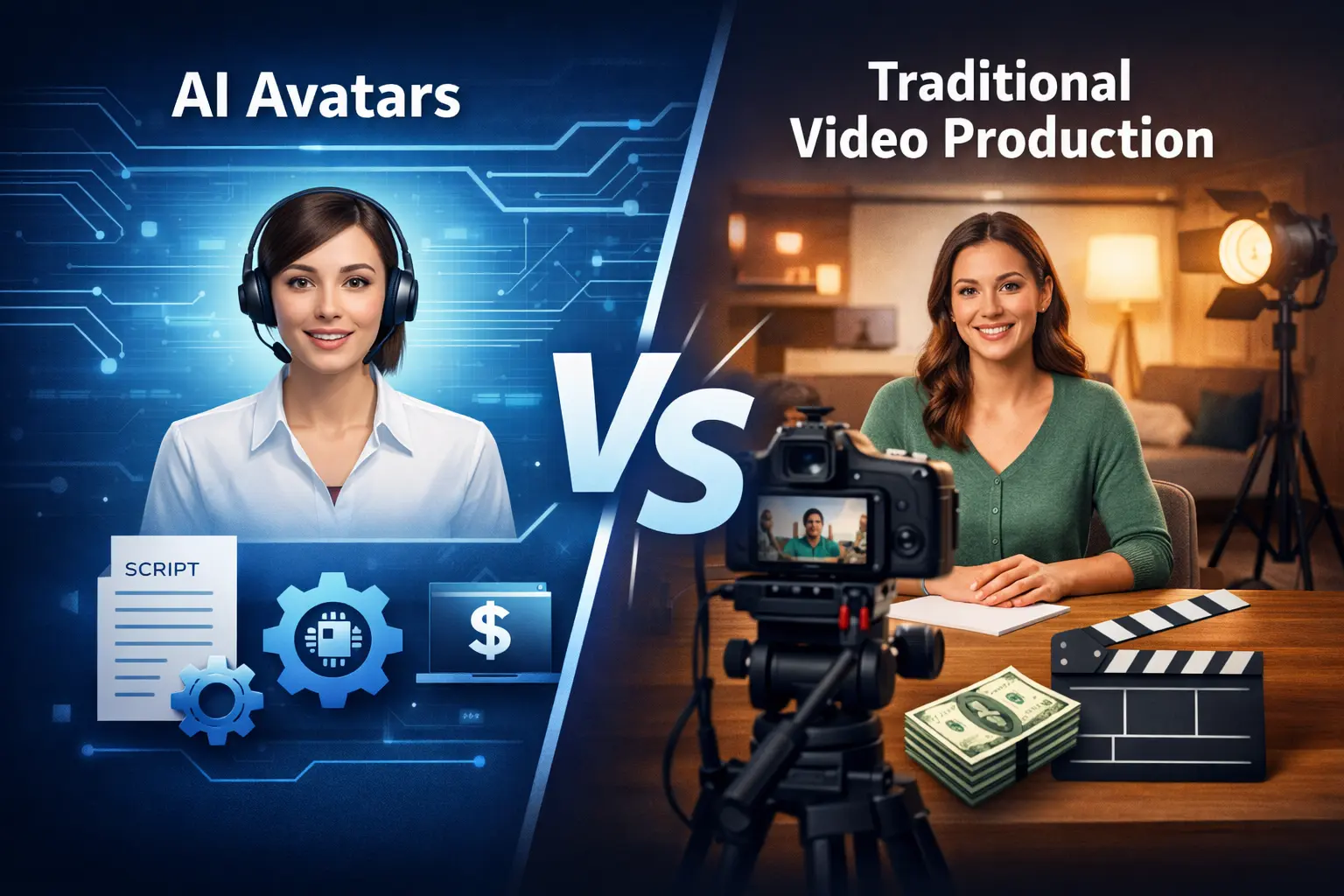
AI Avatar Videos vs Traditional Video Production
Although AI avatar videos and AI motion graphics are the primary comparison here, traditional production is still relevant.
Traditional video uses real people, cameras, locations, lighting, sound equipment, and post-production.
Its greatest advantage is authentic human presence.
A real presenter can provide:
- Natural expressions
- Human emotion
- Physical interaction
- Real-world environments
- Unscripted reactions
- Brand personality
This can be particularly important for:
- Brand campaigns
- Commercials
- Event coverage
- Influencer collaborations
- Emotion-driven storytelling
- High-end productions
AI avatars are generally better suited to repeatable, structured communication where speed and scalability matter.
For many teams, the strongest strategy is not choosing one technology for everything.
It is using each approach where it makes the most sense.
When Should You Use AI Avatar Videos?
AI avatars are particularly useful when the audience benefits from having a presenter.
Employee Training
A digital presenter can guide employees through structured lessons.
Product Tutorials
An avatar can introduce features and walk viewers through a product.
Onboarding
Organizations can create repeatable onboarding videos without scheduling a presenter for every update.
Educational Content
AI avatars can present lessons, explanations, and instructional material.
Multilingual Communication
Teams can adapt scripts and voiceovers for different audiences.
Internal Communications
Companies can create recurring announcements and presentations without filming every message.
When Should You Use AI Motion Graphics?
Motion graphics are particularly useful when visual explanation is more important than presenter presence.
Explainer Videos
Complex concepts can be broken into visual stages.
Product Workflows
Animated screens and diagrams can demonstrate how a product works.
Data and Statistics
Charts and animated numbers can communicate information quickly.
Process Visualization
Steps can be animated to show how something happens.
Educational Concepts
Abstract concepts can become easier to understand when represented visually.
Marketing Content
Motion graphics can create short, visually engaging promotional content without requiring a presenter.
When Should You Combine AI Avatars and Motion Graphics?
You do not always have to choose between them.
Combining the two can produce a stronger video.
For example:
AI Avatar → Introduces the topic
Motion Graphics → Explains the concept
AI Avatar → Summarizes the key point
This structure can combine human-like communication with visual explanation.
It can be particularly effective for:
- Training
- Product education
- Software demonstrations
- Corporate presentations
- Educational content
The same principle applies to voice.
You can combine:
AI Avatar + Motion Graphics + AI Voiceover
to create a complete AI-assisted video workflow.
Are AI Avatars the Best Option for Video Creation?
Not necessarily.
AI avatars are one of several approaches to video creation.
They are particularly strong when you need:
- A presenter
- Repeatable content
- Fast revisions
- Multilingual communication
- Training
- Instructional content
- Structured presentations
But they may not be the best option for every project.
A cinematic brand campaign may benefit more from traditional filming.
A technical process may be easier to understand through motion graphics.
A short social video may work better with a combination of generated video, text, images, and voice.
The best approach is therefore determined by the communication objective, not simply by which technology is newest.
Personalized Video Automation vs AI Avatars
Personalized video automation and AI avatars can overlap, but they describe different concepts.
An AI avatar is primarily a digital presenter.
Personalized video automation refers to creating multiple video variations based on different audience data, scripts, products, or scenarios.
For example, a company might create different videos for:
- Different customers
- Different products
- Different industries
- Different regions
- Different onboarding paths
An AI avatar can be part of that workflow.
So rather than treating personalized video automation and AI avatars as competing technologies, it is often more useful to think of them as complementary.
AI avatar = presenter technology
Personalized video automation = scalable content workflow
How to Choose Between AI Avatars and AI Motion Graphics
Ask these questions before choosing your production approach.
Do you need a presenter?
If yes, an AI avatar may be the stronger choice.
Does the audience need to see a process?
If yes, motion graphics may communicate the idea more effectively.
Is the content repeated frequently?
If yes, an AI-powered workflow can reduce the effort required for future versions.
Do you need multiple languages?
Both approaches can support multilingual production, depending on the tools and workflow.
Is emotional authenticity critical?
For high-emotion storytelling, traditional video may still be preferable.
Is speed more important than cinematic production?
AI avatars and motion graphics can both provide faster production workflows.
Are you explaining something complex?
Motion graphics can be particularly effective when diagrams, workflows, or visual sequences are central to the explanation.
A Practical Decision Framework
A simple way to choose is:
| Your requirement | Recommended approach |
|---|---|
| Need a digital presenter | AI Avatar |
| Need visual explanation | AI Motion Graphics |
| Need both presenter and visual explanation | AI Avatar + Motion Graphics |
| Need highly authentic human performance | Traditional Video |
| Need recurring training content | AI Avatar |
| Need process or data visualization | AI Motion Graphics |
| Need multilingual presenter-led content | AI Avatar |
| Need cinematic brand storytelling | Traditional Video |
| Need scalable content variations | AI-powered workflow |
| Need maximum flexibility | Hybrid approach |
How Klyra AI Supports AI Video Creation
Klyra brings AI video capabilities into a broader AI workspace rather than treating video generation as an isolated task.
For presenter-led content, the AI Avatar Generator can be used to create digital-presenter videos from scripts.
For other video workflows, Klyra's AI Video Generator can support AI-assisted video creation.
Voice can also become part of the same workflow through AI Voiceover.
This makes it possible to think about production as a connected workflow:
Script → Avatar / Video → Voice → Edit → Publish
Rather than managing each capability through disconnected tools, teams can move between different AI capabilities within a broader workspace.
AI Avatar Generator
Use an AI-generated presenter when your audience benefits from direct, presenter-led communication.
This can be useful for:
- Training
- Tutorials
- Presentations
- Onboarding
- Educational content
AI Video Generator
Use AI-assisted video generation when the project requires generated visual content beyond a presenter.
AI Voiceover
Add generated narration when the video requires voice but does not necessarily require an on-screen presenter.
Together, these capabilities make it possible to choose the right production format for each piece of content rather than forcing every project into the same workflow.
Explore Klyra AI Video ToolsThe Future of AI Video Is Not One Format
AI video creation is unlikely to settle on a single winning format.
Different communication problems require different visual approaches.
An AI avatar is useful when the audience needs a presenter.
Motion graphics are useful when the audience needs visual explanation.
Traditional video remains valuable when human authenticity and cinematic production are central to the message.
And increasingly, these formats can work together.
A single video might combine:
AI Avatar + Motion Graphics + AI Voiceover + Generated Video
The important question is therefore not:
"Which technology will replace everything else?"
It is:
"Which production approach communicates this idea most effectively?"
Frequently Asked Questions
What is the difference between AI avatar videos and AI motion graphics videos?
AI avatar videos use a digital presenter as the primary communication element, while AI motion graphics use animated text, shapes, illustrations, diagrams, and other visual elements to communicate information.
Are AI avatar videos better than motion graphics?
Not necessarily. AI avatars are often better for presenter-led communication, training, onboarding, and instructional content. Motion graphics can be stronger for processes, data, technical concepts, and visual explanations.
What are AI avatar videos used for?
AI avatar videos can be used for employee training, onboarding, product tutorials, educational content, internal communications, customer explainers, and multilingual presentations.
What are AI motion graphics used for?
AI motion graphics can be used for explainer videos, process demonstrations, product workflows, educational content, data visualization, and marketing videos.
Can AI avatars and motion graphics be used together?
Yes. An AI avatar can introduce or explain a topic while motion graphics visually demonstrate the information. Combining the two can create a more engaging instructional or explanatory video.
Are AI avatars good for video creation?
AI avatars can be very effective for video creation when a project needs a digital presenter, fast iteration, repeatable production, or multilingual communication. They are not necessarily the best choice for every type of video.
Are AI avatar videos cheaper than traditional video production?
They can reduce costs associated with filming, presenters, equipment, studio space, and repeated recording. However, the total cost depends on the AI tools, production volume, video complexity, and quality requirements.
Can AI avatar videos be multilingual?
AI avatar workflows can support multilingual video when the underlying avatar and voice systems support the required languages. The exact capabilities depend on the tool.
What is personalized video automation?
Personalized video automation is a workflow for creating multiple versions of video content based on different audiences, products, regions, scripts, or other variables. AI avatars can be one component of such a workflow.
Should businesses use AI avatars or traditional video?
It depends on the objective. AI avatars can be effective for scalable training, tutorials, onboarding, and structured communication. Traditional video can remain preferable for high-impact campaigns, authentic storytelling, events, and productions where real human presence is central.
Conclusion
AI avatar videos and AI motion graphics solve different communication problems.
AI avatars put a digital presenter at the center of the experience. Motion graphics put the information and visual design at the center.
If your audience needs a presenter, AI avatars can provide a fast and scalable alternative to filming a person for every video.
If your audience needs to understand a process, concept, workflow, or set of data, motion graphics may communicate the idea more effectively.
Traditional video remains valuable when authenticity, emotion, and cinematic production matter most.
And you do not always have to choose one.
A modern video workflow can combine AI avatars, motion graphics, AI voiceover, and generated video depending on the objective.
The best approach is therefore not the one with the most advanced technology.
It is the one that communicates the message clearly, efficiently, and at the right scale.