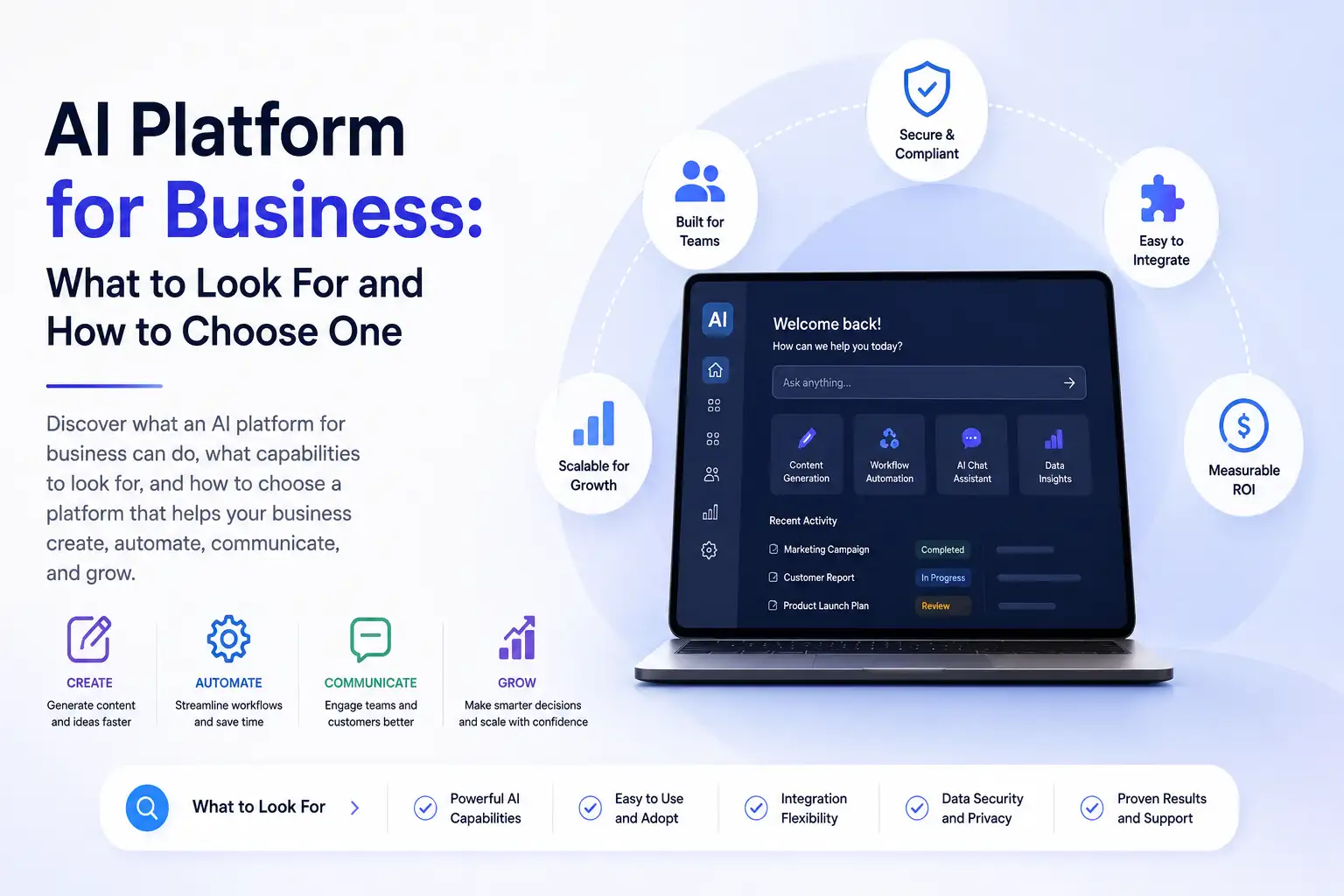
AI Platform for Business: What to Look For and How to Choose One
Businesses are using artificial intelligence across more areas of work than ever before. Teams use AI to create content, analyze information, generate images and videos, communicate with customers, automate repetitive work, and improve productivity.
The challenge is that adopting AI can quickly create another problem: too many tools.
One platform may be used for writing, another for images, another for video, another for customer support, and another for automation. Each tool may have its own interface, subscription, workflow, and learning curve.
An AI platform for business brings multiple AI capabilities into a more unified environment. Instead of managing AI as a collection of disconnected services, businesses can use one platform to support different types of AI-powered work.
But not every AI platform is built the same way.
The important question is not simply whether a platform uses AI. It is whether the platform can help your business use AI effectively, simply, and at scale.
What Is an AI Platform for Business?
An AI platform for business is a software platform that brings AI capabilities, applications, and workflows together to help businesses perform work such as content creation, automation, communication, customer engagement, and productivity from a more unified environment.
Unlike a single-purpose AI tool, an AI platform can support multiple business use cases from one place.
Depending on the platform, this can include:
- AI writing and content creation
- AI image generation
- AI video generation
- AI voice capabilities
- AI chat and assistants
- Business automation
- Customer engagement
- AI-powered productivity
- Team workflows
The exact capabilities vary between platforms. What matters is how effectively those capabilities work together around real business needs.
If you want a broader explanation of the category itself, see our guide to what an AI platform is. For a deeper explanation of how Klyra approaches this category, see what an AI Operating System is.
Why Businesses Are Moving Beyond Individual AI Tools
Individual AI tools can be useful. A business may find a specialized application that does one particular job extremely well.
The problem starts when every new AI requirement results in another separate tool.
Over time, businesses can end up managing an increasingly fragmented AI stack.
Too many AI tools
A marketing team might use one service for writing, another for SEO, another for images, another for video, and another for social media.
A customer support team might use a separate chatbot platform.
A sales team might use another AI service for research or communication.
Each tool can solve a legitimate problem. Together, however, they can create a complicated environment for employees to manage.
Multiple subscriptions
More tools can also mean more subscriptions to track, more billing relationships, and more decisions about which service should be used for which task.
The issue is not that specialized tools are always bad. It is that businesses should not have to assemble a complicated collection of services simply to use AI across their daily work.
Disconnected workflows
When AI work happens across different platforms, users often have to move information from one application to another.
That can introduce unnecessary steps.
A business may create content in one application, generate an image somewhere else, produce a video in another service, and then move everything into another platform for publishing or communication.
The more fragmented the process becomes, the harder it is to maintain a simple workflow.
Growing AI complexity
The AI ecosystem is also changing quickly.
New models, applications, and capabilities continue to appear. Businesses that build their entire AI strategy around individual tools may find themselves constantly evaluating what to add, replace, or learn next.
The goal of an AI platform is to make this complexity easier to manage.
The goal is not to give businesses more AI to manage.
It is to make AI easier to use.
What Can an AI Platform Do for a Business?
A useful way to evaluate an AI platform is to look at what it helps a business accomplish.
Rather than starting with technical specifications, start with outcomes.
Klyra organizes its value around four core outcomes:
Create. Automate. Communicate. Grow.
Create
Businesses need to produce more content and creative work across more channels.
An AI platform can support tasks such as:
- Writing articles and business content
- Creating SEO content
- Building presentations
- Generating images
- Creating product visuals
- Producing videos
- Creating voice content
Klyra brings these capabilities together through AI Apps covering content, creative, video, and voice workflows.
For example, businesses can use AI Writer, AI Blogger, AI SEO, AI Presentation, AI Image Studio, AI Photoshoot, AI Video Generator, AI Avatar, and AI Voiceover as part of the broader Klyra ecosystem.
The important idea is that these are not meant to feel like unrelated products. They are applications within one AI Operating System.
Automate
AI can also reduce repetitive work.
Businesses can use AI to support recurring processes, content workflows, customer interactions, and other activities that would otherwise require significant manual effort.
The value of automation is not automation for its own sake.
It is the time saved when people spend less effort repeating predictable tasks and more time on work that requires judgment, creativity, and business expertise.
Klyra's product principles specifically prioritize automation and reducing unnecessary manual work.
Communicate
Communication is another important area for business AI.
Depending on the platform, this can include:
- AI chat
- Customer chatbots
- Voice chatbots
- Social media communication
- Customer support workflows
- Human-assisted customer interactions
Klyra's AI Apps include AI Chatbots, AI Voice Chatbots, AI Social Media, Human Agent capabilities, and related customer engagement functionality.
This allows businesses to use AI not only to create internal work, but also to support interactions with customers.
Grow
The ultimate purpose of business AI is not simply to generate more AI output.
It is to help the business operate more effectively.
That can mean:
- Producing more marketing content
- Creating customer-facing assets faster
- Supporting customer engagement
- Improving productivity
- Automating repetitive processes
- Giving teams access to more AI capabilities
- Scaling AI use as the business grows
This is why Klyra's positioning focuses on helping businesses, creators, and teams create, automate, communicate, and grow from one platform.
What Should You Look for in an AI Platform for Business?
Choosing an AI platform is about more than counting features.
A platform can have dozens of AI capabilities and still create a poor experience if those capabilities are difficult to discover, disconnected from one another, or unnecessarily complicated.
Here are the most important factors to evaluate.
1. A genuinely unified platform
First, determine whether the platform is actually unified.
Putting several AI products behind one login does not automatically create a unified platform.
Look at how the applications work together.
Ask:
- Is there one central workspace?
- Can users access different AI capabilities from the same environment?
- Does navigation feel consistent?
- Are workflows connected?
- Does the platform feel like one product?
A strong AI platform should reduce fragmentation rather than simply hide it behind a single login.
2. Multiple AI capabilities
Businesses rarely have only one AI requirement.
A useful platform should support the types of work your business actually performs.
Depending on your needs, this could include:
- Text
- Images
- Video
- Voice
- Chat
- Automation
- Customer engagement
- Productivity
The goal is not to collect the largest possible number of features.
The goal is to have the right capabilities available in one environment.
3. Useful AI applications
Access to AI models alone is not enough for most businesses.
Businesses need applications that turn AI capabilities into useful outcomes.
For example, a business may not simply want access to an image model. It may want to create professional product photography.
It may not simply want access to a language model. It may want to create an article, presentation, or business document.
This is why Klyra combines leading AI models with business-ready AI applications.
The application layer is where AI becomes practical for everyday work.
4. Access to leading AI models
The AI model landscape changes quickly.
A business should therefore consider whether its platform can evolve as new AI capabilities become available.
A flexible platform can provide access to different leading models while allowing users to focus on the outcome they want rather than forcing them to understand every underlying technical choice.
Klyra's approach is to integrate leading AI providers rather than compete with them. Its product philosophy treats AI models as infrastructure while keeping the user experience focused on outcomes.
5. Automation capabilities
Consider how much repetitive work the platform can help reduce.
Look beyond the word "automation" and ask what it actually helps you accomplish.
Can it reduce repetitive steps?
Can it support recurring workflows?
Can it make business processes easier?
Can it automatically handle parts of a workflow that do not require constant human intervention?
The best automation is often the automation users barely notice because it simply makes the process easier.
6. Customer engagement capabilities
If customer communication matters to your business, evaluate the platform's customer engagement capabilities.
Depending on your needs, look for:
- AI chatbots
- Voice chatbots
- Customer conversations
- Knowledge bases
- Human handoff
- Analytics
- Communication integrations
Klyra's product architecture includes AI chatbots, voice chatbots, human agents, knowledge bases, analytics, WhatsApp integration, and Telegram integration.
7. Team and business scalability
An AI platform should work for the size of your business today while giving you room to grow.
Consider:
- Number of users
- Team collaboration
- AI usage
- Customer-facing AI requirements
- Business capacity
- Workflow complexity
Klyra's pricing philosophy is designed around business scale rather than hiding AI capabilities behind different feature tiers. Paid customers receive the complete AI Operating System, while plans scale through factors such as AI Capacity and Team Members.
8. Simplicity
This is easy to overlook.
A platform can be powerful and still be difficult to use.
Businesses should look for AI software that reduces unnecessary decisions rather than adding more of them.
Users should not need to understand model architecture, tokens, APIs, or internal AI infrastructure simply to accomplish a business task.
Klyra's product principles explicitly prioritize simplicity, reduced cognitive load, and hiding technical complexity from users.
9. Clear capacity and pricing
Before choosing an AI platform, understand how usage is measured and how costs increase.
Ask:
- What is included?
- How does usage scale?
- How does team size affect pricing?
- What happens as AI usage increases?
- Are important capabilities restricted by plan?
- Is pricing easy to understand?
Klyra uses AI Capacity as its customer-facing concept for AI usage. The underlying system may use different technical credit measurements, but the customer experience is designed around AI Capacity rather than exposing raw technical credit systems.
10. Future flexibility
Finally, consider where the platform is going.
AI will continue to change.
New models, applications, workflows, and capabilities will emerge.
A good AI platform should be able to evolve without requiring your business to rebuild its entire AI workflow every time the technology changes.
The more future-ready the platform, the more useful it can become as your business's use of AI expands.
AI Platform for Business vs. Individual AI Tools
Individual AI tools can be valuable, particularly when a business needs a highly specialized capability.
But there is a fundamental difference between managing individual tools and using a unified AI platform.
| Individual AI tools | AI platform for business |
|---|---|
| Separate products | Unified platform |
| Multiple interfaces | Central environment |
| Multiple subscriptions | Consolidated experience |
| Disconnected workflows | More connected workflows |
| Users manage the tool ecosystem | Platform organizes the experience |
| Focused on individual tasks | Designed for broader AI-powered work |
The goal is not necessarily to eliminate every specialized application.
Instead, the goal is to reduce unnecessary fragmentation.
A business should be able to use AI across different types of work without constantly switching between unrelated platforms.
AI Platform vs. AI Operating System
The terms "AI platform" and "AI Operating System" are closely related, but they can describe different ideas.
An AI platform is a broad category that can include AI models, infrastructure, applications, services, or combinations of these.
An AI Operating System takes a more unified approach to how people actually use AI across their work.
The distinction is less about a technical specification and more about the experience and purpose.
Klyra AI positions itself as an AI Operating System that brings leading AI models and business-ready AI applications together in one unified workspace.
For a deeper explanation, read What Is an AI Operating System?.
AI Platform vs. AI Workspace
An AI platform and an AI workspace are also related concepts.
An AI platform describes the broader collection of AI capabilities and applications available to users.
An AI workspace describes the environment where users access, organize, and work with those capabilities.
In a unified system, the relationship can look like this:
AI Operating System → AI Workspace → AI Apps → AI-powered work
Klyra's AI Workspace is designed to bring AI-powered work into one environment rather than making every application feel like a separate product.
You can learn more in What Is an AI Workspace?.
How Businesses Can Use an AI Platform
The best AI platform depends on what your business actually needs to accomplish.
Here are some common use cases.
Marketing teams
Marketing teams can use AI platforms for:
- Content creation
- SEO content
- Social media
- Images
- Video
- Presentations
- Creative production
Instead of managing a separate platform for every content format, a unified AI environment can bring more of the workflow together.
Content teams
Content teams can use AI for:
- Articles
- Blog posts
- Presentations
- Visual content
- Video
- Voice content
- Content workflows
Klyra's Content, Creative, Video, and Voice AI Apps are designed to support these different types of work from the same broader platform.
Customer support teams
Customer-facing teams can use AI for:
- Website chatbots
- Voice interactions
- Knowledge-based responses
- Customer communication
- Human-assisted conversations
The goal is to help teams handle customer interactions more efficiently while maintaining the ability to involve people where appropriate.
Ecommerce businesses
Ecommerce businesses can use AI for:
- Product imagery
- Product content
- Marketing assets
- Videos
- Social media
- Customer communication
Visual and content workflows can be particularly useful for businesses that regularly need new creative assets.
Agencies
Agencies often manage multiple types of content and communication for different clients.
A unified AI platform can provide access to:
- Writing
- SEO
- Images
- Video
- Presentations
- Voice
- Customer engagement
The advantage is not simply having more applications. It is having a consistent environment for performing different types of work.
Startups and small businesses
Smaller businesses often need to accomplish many different tasks without building large teams around every function.
An AI platform can give these businesses access to multiple AI capabilities from one environment.
That can make it easier to experiment with AI, build repeatable workflows, and expand usage as the business grows.
How to Choose the Right AI Platform for Your Business
Before choosing an AI platform, start with your business rather than the software.
Use this process.
1. Identify your business use cases
Start by listing what you actually want AI to help with.
For example:
- Content
- Marketing
- Customer support
- Product imagery
- Video
- Sales communication
- Automation
Do not start with a list of AI features.
Start with business outcomes.
2. Map your current AI tools
Write down the AI services your team currently uses.
Identify what each service is used for and who uses it.
This gives you a clear picture of your current AI stack.
3. Identify overlapping capabilities
Look for areas where multiple services perform similar jobs.
You may discover that different teams are paying for separate solutions that overlap.
This does not automatically mean you should replace them, but it gives you a useful starting point for evaluating consolidation.
4. Evaluate the workflow
Look beyond individual features.
Ask:
Does this platform make the overall process easier?
A platform with fewer steps can be more valuable than a platform with more features.
5. Evaluate AI applications
Consider whether the platform provides applications that match your actual business needs.
A business should not have to build everything from scratch simply because an AI model is available.
6. Evaluate model flexibility
Consider whether the platform can adapt as AI models evolve.
The goal is to benefit from improvements in AI without constantly rebuilding your workflow around a different provider.
7. Evaluate team scalability
Think about where your business will be six months or a year from now.
Will more people need access?
Will AI usage increase?
Will customer-facing AI become more important?
Choose a platform that can accommodate that growth.
8. Understand capacity and pricing
Understand how the platform measures usage and how pricing changes as your needs increase.
Look for pricing that scales with business requirements rather than forcing you to purchase capabilities you may not need.
9. Test simplicity
Before committing, ask whether your team can understand the platform quickly.
Can a new user accomplish a task without extensive technical knowledge?
Can users focus on what they want to achieve rather than how the underlying AI works?
10. Evaluate the long-term fit
Finally, consider whether the platform fits the direction of your business.
The best AI platform is not necessarily the one with the longest feature list.
It is the one that can become a useful part of how your business works with AI over time.
How Klyra AI Approaches AI for Business
Klyra AI takes the unified-platform approach one step further by positioning itself as the AI Operating System.
The platform brings together leading AI models and business-ready AI applications in one intelligent workspace. Its purpose is to simplify how businesses, creators, professionals, and teams use AI by reducing the need to manage multiple disconnected AI subscriptions.
One platform
Instead of treating every AI capability as a separate product, Klyra brings them together within one operating system.
The goal is a consistent experience where users can move between different types of AI-powered work without constantly switching platforms.
Business-ready AI applications
Klyra is not simply a place to access AI models.
It includes AI Apps designed around practical outcomes, including content creation, visual production, video, voice, customer engagement, and productivity.
This allows businesses to focus on what they want to accomplish rather than starting with the technical details of the underlying AI.
Leading AI models
AI models are an important part of the Klyra experience, but they are not the product's primary identity.
Klyra integrates leading AI providers across areas such as text, images, video, avatars, voice, and speech.
This approach allows the platform to evolve as the broader AI ecosystem changes.
One intelligent workspace
The Klyra AI Workspace is designed to be the central environment where AI-powered work happens.
Instead of managing separate interfaces for every capability, users can access AI Apps and workflows from one platform.
This reflects Klyra's broader product philosophy: everything should feel connected.
Create, automate, communicate, and grow
Ultimately, Klyra's approach is centered around business outcomes.
Businesses can use the platform to:
Create content, images, presentations, videos, and other assets.
Automate repetitive work and workflows.
Communicate with customers through AI-powered conversations and engagement.
Grow by applying AI across more areas of the business.
That progression is central to how Klyra communicates its value.
AI Apps Businesses Can Use With Klyra
Klyra's AI Apps cover multiple areas of business work.
Create
Businesses can use applications such as:
These applications support different forms of content and creative production within the broader Klyra environment.
Communicate
For customer-facing communication, Klyra includes:
These capabilities can help businesses extend AI into customer engagement and communication workflows.
Explore the full AI Apps collection
Klyra's complete collection is available through the AI Apps section.
The goal is not to make users manage a collection of disconnected tools. Each AI App is part of the broader AI Operating System.
How Klyra's AI Capacity Works
AI usage naturally grows as businesses use more AI.
Klyra approaches this through AI Capacity.
Paid customers receive the complete AI Operating System, including access to AI Apps and supported AI models. Plans are designed to scale primarily through factors such as AI Capacity and Team Members rather than hiding core AI capabilities behind separate feature unlocks.
This means businesses can start with what they need and increase capacity as their use of AI grows.
The underlying technical systems may measure different types of usage, but the customer experience is designed around the simpler concept of AI Capacity rather than requiring users to manage raw credit terminology.
For current plan details, see Klyra pricing.
Frequently Asked Questions
What is an AI platform for business?
An AI platform for business brings multiple AI capabilities and applications together to help businesses perform work such as content creation, automation, communication, customer engagement, and productivity from a more unified environment.
What can an AI platform do for a business?
An AI platform can support many areas of business work, including writing, SEO, images, video, presentations, voice, automation, customer engagement, and productivity. The exact capabilities depend on the platform.
What is the difference between an AI platform and an AI tool?
An AI tool typically focuses on a specific task or capability. An AI platform brings multiple AI capabilities or applications together so users can perform different types of AI-powered work from one environment.
Is an AI platform useful for small businesses?
Yes. Small businesses can use AI platforms to access multiple AI capabilities without having to manage a large collection of separate services. The most useful platform is one that matches the business's actual needs and can scale as those needs grow.
Can an AI platform replace multiple AI tools?
It can reduce the need for multiple overlapping AI tools, but it does not necessarily replace every specialized application. The right approach is to identify where consolidation makes the workflow simpler and where specialized tools still provide unique value.
What should businesses look for in an AI platform?
Businesses should consider the platform's AI capabilities, applications, workflow integration, automation, customer engagement, model flexibility, simplicity, team scalability, capacity, pricing, and ability to evolve with the AI ecosystem.
How much does an AI platform for business cost?
Pricing varies considerably between platforms. Costs may depend on factors such as users, AI usage, capacity, applications, and business requirements. Businesses should evaluate both the advertised price and how pricing changes as usage grows.
What is the difference between an AI platform and an AI Operating System?
An AI platform is a broad category that can include AI models, infrastructure, applications, and services. An AI Operating System focuses more specifically on creating a unified environment where people can use AI across different types of work.
Bring More of Your Business's AI Work Into One Place
AI can help businesses create more, automate repetitive work, communicate more effectively, and grow.
But adding more AI tools is not always the answer.
The real opportunity is to make AI simpler to use.
Klyra AI brings leading AI models and business-ready AI applications together in one intelligent workspace, giving businesses and teams one place to create, automate, communicate, and grow.
Build your AI Workspace with Klyra AI.