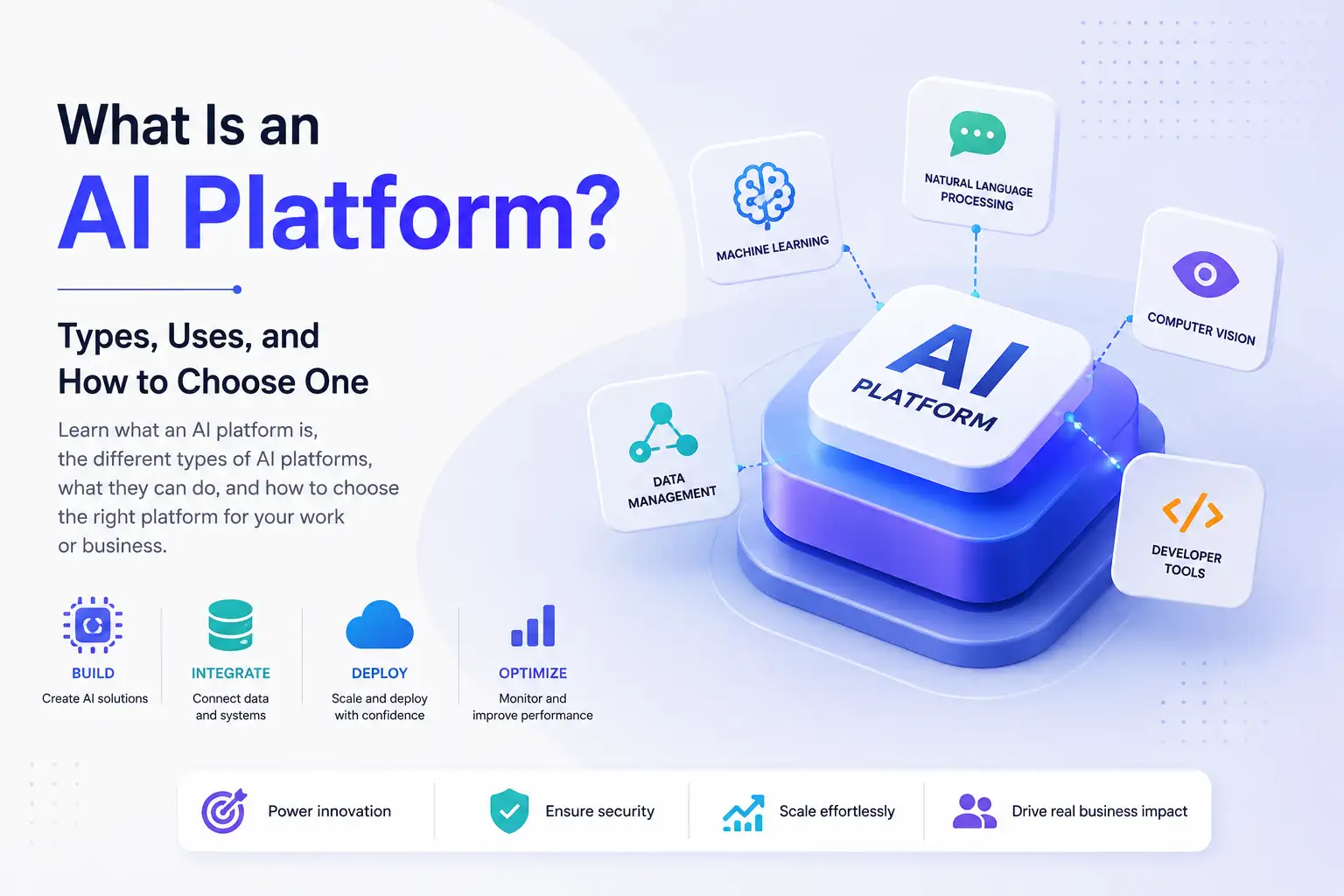
What Is an AI Platform? Types, Uses, and How to Choose One
Artificial intelligence is becoming part of everyday work. People use AI to write, research, create images and videos, analyze information, automate repetitive tasks, communicate with customers, and more.
But as AI becomes more widespread, one term appears everywhere: AI platform.
What does it actually mean?
An AI platform is a broad term for a system that brings together AI capabilities, models, applications, infrastructure, or workflows so people or organizations can use, build, manage, or scale artificial intelligence.
The important part is that not every AI platform is designed for the same purpose. Some are built for developers. Others focus on infrastructure or AI models. Some bring AI applications together for everyday users and businesses.
Understanding these differences makes it easier to choose the right platform for your needs.
In this guide, we'll explain what an AI platform is, the different types of AI platforms, what you can do with one, how AI platforms differ from individual AI tools, and what to look for when choosing one.
What Is an AI Platform?
An AI platform is a software environment that brings together one or more artificial intelligence capabilities, models, applications, infrastructure, or workflows in a connected system.
The exact meaning varies depending on the platform.
For a developer, an AI platform might provide access to models, APIs, development tools, deployment infrastructure, and monitoring.
For a business, an AI platform might provide applications and workflows for content creation, customer engagement, productivity, automation, and other everyday work.
For a technical team, it may provide the infrastructure needed to build and operate AI systems at scale.
This is why "AI platform" is best understood as an umbrella term rather than a single type of product.
The common idea is that an AI platform brings AI capabilities together in an environment where they can be used, managed, connected, or scaled.
How Does an AI Platform Work?
The simplest way to understand an AI platform is to look at the layers involved:
AI models → AI capabilities → AI applications → AI workflows → outcomes
Each layer serves a different purpose.
AI models
AI models provide the underlying intelligence used to generate, analyze, understand, or transform information.
Different models can specialize in different types of work, including text, images, video, speech, reasoning, or other tasks.
An AI platform may provide access to one model or multiple models.
AI capabilities
Models become useful to people through capabilities such as:
- Text generation
- Research and analysis
- Image generation and editing
- Video generation
- Speech-to-text
- Text-to-speech
- Voice interaction
- Automation
- Customer communication
The capability is what the user actually wants to accomplish. The underlying model is part of how the system makes that possible.
AI applications
Applications package AI capabilities into experiences designed around specific outcomes.
For example, an application might help someone create a presentation, generate a video, write content, produce product imagery, or build a customer chatbot.
AI workflows
The biggest opportunity comes when multiple capabilities can work together.
A business might use AI to research a topic, create content, generate supporting visuals, publish the result, and communicate with customers without moving between a collection of disconnected systems.
Outcomes
Ultimately, an AI platform should make it easier to accomplish something useful.
The technology matters, but the outcome matters more.
This is why a good AI platform should reduce unnecessary complexity rather than make users manage more technical choices.
What Are the Different Types of AI Platforms?
The term "AI platform" covers several different categories. Understanding them helps you determine what a platform is actually designed to do.
AI Development Platforms
AI development platforms are primarily designed for developers and technical teams building AI-powered applications.
They can provide capabilities such as:
- Model access
- APIs
- Development environments
- Testing
- Deployment
- Monitoring
- Application integration
These platforms are useful when the goal is to build AI software rather than simply use AI applications for everyday work.
For example, a development team might use an AI platform to integrate AI capabilities into an existing product or create an entirely new AI application.
The user of the platform is usually working on the technology itself.
AI Infrastructure Platforms
AI infrastructure platforms focus on the computing and technical environment required to run AI systems.
They can support areas such as:
- Computing resources
- Data processing
- Model deployment
- Scaling
- Infrastructure management
- Model serving
These platforms operate closer to the technical foundation of AI.
They are particularly relevant to organizations that need to build, deploy, or operate AI systems at scale.
AI Model Platforms
Some AI platforms focus primarily on accessing or working with AI models.
These platforms can provide ways to:
- Access different models
- Integrate models into applications
- Manage model usage
- Select models for different tasks
- Build workflows around AI capabilities
The distinction is useful:
An AI model provides intelligence. An AI platform provides an environment around that intelligence.
The platform may make it easier to access and use models without requiring users to build everything from scratch.
AI Application Platforms
AI application platforms bring multiple AI-powered applications or capabilities together for users.
Instead of focusing primarily on building AI infrastructure, these platforms focus on helping people accomplish tasks.
Depending on the platform, applications might cover:
- Content creation
- Writing
- Research
- Image generation
- Video creation
- Presentations
- Voice
- Customer engagement
- Productivity
This type of platform is closer to the experience most business users have in mind when they search for an AI platform.
AI Work Platforms
AI work platforms focus on using AI to accomplish real work.
Rather than asking users to think about models, APIs, infrastructure, or technical configuration, the platform organizes AI capabilities around workflows and outcomes.
This can include:
- AI-powered content creation
- Automation
- Communication
- Productivity
- Business workflows
- Multiple AI applications
- A unified workspace
This category is particularly relevant as businesses move from experimenting with individual AI tools toward using AI across everyday operations.
What Can You Do With an AI Platform?
The capabilities of an AI platform depend on the type of platform, but user-focused AI platforms can support a wide range of work.
A useful way to think about these possibilities is through four outcomes: create, automate, communicate, and grow.
Create
AI platforms can help users create different types of content and assets.
Depending on the platform, this can include:
- Writing and editing content
- Research and summarization
- Presentations
- Images
- Product photography
- Videos
- Voice content
- Music
For example, Klyra AI includes AI applications for blogging, SEO, presentations, image creation, photoshoots, fashion content, video, avatars, voice, and music.
The value comes from bringing these capabilities into a connected environment rather than requiring a separate service for every task.
Automate
AI can also reduce repetitive work.
Examples include:
- Content workflows
- Customer support processes
- Business tasks
- Repetitive communication
- AI-powered workflows
Automation becomes more valuable when it is connected to the other work a person or business is already doing.
Communicate
AI platforms can support communication with both internal teams and customers.
Depending on the platform, this can include:
- AI chat
- Customer chatbots
- Voice chatbots
- Human-agent workflows
- Knowledge bases
- Customer analytics
- Social communication
Klyra's documented AI applications include external chatbots, voice chatbots, human-agent capabilities, chatbot analytics, knowledge bases, WhatsApp integration, and Telegram integration.
Grow
The broader purpose of using AI is not simply to generate more content or use more technology.
Businesses can use AI to support:
- Marketing
- Content operations
- Customer engagement
- Sales activities
- Productivity
- Business workflows
The goal is to save time, reduce fragmented work, and help people focus on higher-value activities.
AI Platform vs AI Tool
An AI tool typically focuses on a particular task or use case.
An AI platform can provide a broader environment containing multiple AI capabilities, applications, services, or workflows.
| AI Tool | AI Platform |
|---|---|
| Usually solves a specific problem | Can support multiple AI needs |
| Often has a narrower scope | Usually has a broader scope |
| May operate independently | Can connect multiple capabilities |
| Often provides one main experience | May include multiple applications |
| Useful for a focused task | Useful for broader AI adoption |
That does not mean an AI platform is always better.
If you only need one specific capability, a dedicated AI tool may be all you need.
But if you regularly use AI for several types of work, managing separate applications can become inefficient.
You may end up paying for multiple subscriptions, switching between interfaces, repeating context, and maintaining disconnected workflows.
That's where an AI platform can become more useful.
AI Platform vs AI Workspace
The terms AI platform and AI workspace are related, but they are not interchangeable.
An AI platform is a broad category. It can refer to infrastructure, development environments, model platforms, application platforms, or user-focused AI systems.
An AI workspace is more specifically the environment where users organize and perform AI-powered work.
Think of it this way:
AI platform = the broader system
AI workspace = the place where AI-powered work happens
An AI workspace can bring conversations, AI applications, files, projects, and workflows into one environment.
If you want to explore the concept in more detail, read our guide to AI workspace.
AI Platform vs AI Operating System
An AI Operating System is a more specific concept within the broader AI platform landscape.
The term AI platform can describe many different kinds of technology. An AI Operating System focuses more specifically on creating a unified environment where AI-powered work can happen.
| AI Platform | AI Operating System |
|---|---|
| Broad category | More specific concept |
| Can focus on infrastructure, models, development, or applications | Focuses on unified AI-powered work |
| Can be highly technical | Designed around user outcomes |
| Meaning varies between platforms | Centers on a connected work environment |
| May provide individual AI services | Connects capabilities, applications, and workflows |
Klyra AI uses the AI Operating System category because its goal is not simply to provide another AI capability.
Klyra brings AI models and business-ready AI applications together in one unified platform and workspace so businesses, creators, professionals, and teams can create, automate, communicate, and grow.
For a deeper explanation of the category, read our guide to AI Operating Systems.
What Should You Look for in an AI Platform?
Choosing an AI platform should start with what you need to accomplish, not how many features a platform advertises.
Here are the factors worth considering.
1. The AI capabilities you actually need
Start with your workflows.
Do you need AI for writing? Research? Images? Video? Voice? Customer engagement? Automation?
A platform should support the capabilities that matter to your work.
More features do not automatically mean more value.
2. Ease of use
AI can become complicated quickly.
A good platform should make useful capabilities accessible without requiring users to understand every technical detail behind them.
Look for a clear interface, simple workflows, sensible defaults, and the ability to access advanced controls when they are actually needed.
3. Model flexibility
AI models continue to evolve.
A platform that can work with multiple leading models can give users more flexibility as different models improve for different types of work.
The important consideration is not how many model names appear on a page.
It is whether the platform helps users get a good result without unnecessary complexity.
4. Connected workflows
Consider whether your AI activities can work together.
For example, can you move from research to writing, from writing to presentation creation, or from customer information to an automated response without rebuilding the workflow in another application?
Connected workflows can reduce context switching and duplicated work.
5. Business use cases
An AI platform should solve real problems.
For a business, that might mean:
- Creating marketing content
- Producing visual assets
- Automating repetitive tasks
- Supporting customer communication
- Improving productivity
- Building repeatable workflows
The best platform is the one that helps you accomplish meaningful work more effectively.
6. Scalability
Your AI needs may change as your usage grows.
A platform should make it possible to increase usage without forcing you to rebuild your entire workflow around new systems.
For teams, also consider collaboration, access management, customer engagement requirements, and other business needs.
7. Pricing and capacity
AI platforms use different pricing approaches.
Some may charge per user. Others may use usage-based pricing, feature-based plans, or capacity-based models.
Don't compare only the headline subscription price.
Consider what you receive, how much you can use, whether all necessary capabilities are available, and how the cost changes as your usage grows.
AI Platforms for Business
Businesses often have a wider range of AI needs than individual users.
A marketing team may need content creation and visual generation. A customer support team may need chatbots and knowledge bases. A sales team may need research and communication support. Operations teams may need automation and productivity workflows.
This is why an AI platform can be useful for businesses.
Instead of adopting a separate AI application for every department or workflow, a business can look for a platform that brings relevant capabilities together.
The goal is not simply to have more AI.
The goal is to make AI easier to use across the business.
Klyra AI is designed for businesses, creators, professionals, and teams, with documented use cases spanning content, creative work, video, voice, customer engagement, productivity, and more.
For businesses specifically evaluating this category, an important question is:
Does the platform help unify the way your business uses AI?
AI Platform vs Multiple AI Tools
Using multiple specialized AI tools can work well when each tool serves a clear purpose.
But as AI becomes part of more workflows, the number of subscriptions and interfaces can grow quickly.
You may end up managing:
- Multiple subscriptions
- Multiple interfaces
- Separate workflows
- Repeated context
- Different billing systems
- Disconnected AI applications
A unified AI platform takes a different approach.
Instead of treating every AI capability as a separate product, it can bring multiple capabilities into one environment.
That can make it easier to move between different types of work without constantly switching platforms.
This is one of the central ideas behind Klyra AI.
Its product philosophy is to provide one platform containing multiple business-ready AI applications powered by leading AI models, rather than making customers feel as though they are subscribing to a collection of disconnected tools.
Ready to bring more of your AI work together?
Build Your AI WorkspaceIs an AI Platform Right for You?
An AI platform may be worth considering if:
- You regularly use multiple AI capabilities
- AI is becoming part of your everyday work
- You manage several AI subscriptions
- Your team uses different AI services
- You need repeatable AI workflows
- You want to expand how your business uses AI
A standalone AI tool may be enough if:
- You have one narrow AI use case
- You rarely use AI
- You don't need connected workflows
- One dedicated application already solves your problem
The right choice depends on the complexity of your work, not on how many AI features a platform offers.
Klyra AI as an AI Operating System
Klyra AI takes the broader AI platform concept and organizes it around AI-powered work.
Klyra AI is positioned as the AI Operating System that brings together leading AI models and business-ready AI applications in one unified workspace.
The goal is simple: instead of managing multiple disconnected AI subscriptions, users can access different AI capabilities from one platform.
One intelligent platform
Klyra is designed around the idea of one platform rather than a collection of separate AI products.
Its documented product philosophy is that customers should feel like they are using one operating system that enables AI-powered work, rather than buying individual AI tools.
AI Workspace
The AI Workspace provides the central environment for using Klyra's AI capabilities.
It is designed around the principle of making AI-powered work easier to organize and access.
AI Apps
Klyra brings together business-ready AI applications across multiple areas.
These include:
- AI Chat
- AI Blogger
- AI SEO
- AI Presentation
- AI Image Studio
- AI Photoshoot
- AI Fashion Studio
- AI Video Generator
- AI Avatar
- AI Influencer
- AI Music Studio
- AI Voiceover
- Speech to Text
- Voice Cloning
- AI Chatbots
- Voice Chatbots
- Human Agent
- AI Social Media
The exact application set can evolve as Klyra expands, but the underlying principle remains the same: AI capabilities should feel connected within one operating system.
Leading AI models
Klyra integrates leading AI providers rather than positioning itself around a single AI model.
The documented platform architecture includes models and providers across text, images, video, avatars, voice cloning, text-to-speech, and speech-to-text.
The purpose is not to make users manage model complexity.
Klyra's product principles emphasize showing outcomes first and keeping technical complexity in the background.
AI Capacity
Klyra also uses AI Capacity as the user-facing way to think about usage.
Instead of exposing internal systems through terms such as words, media credits, characters, or minutes, the product direction is to present usage through AI Writing Capacity, AI Media Capacity, AI Voice Capacity, and related capacity concepts.
The broader philosophy is straightforward:
Customers should increase capacity as their AI usage grows, rather than paying simply to unlock capabilities.
Klyra's documented pricing philosophy states that paid customers receive the complete AI Operating System, access to AI Apps, and access to supported AI models, with plans differentiated primarily through capacity and business scale.
Build your AI Workspace
If you want to bring more of your AI-powered work into one environment, Klyra AI is built around that goal.
Build Your AI WorkspaceExplore AI Apps
Frequently Asked Questions About AI Platforms
What is an AI platform?
An AI platform is a software environment that brings together AI capabilities, models, applications, infrastructure, or workflows so people or organizations can use, build, manage, or scale artificial intelligence.
The exact meaning depends on the type of platform.
What does an AI platform do?
An AI platform can provide access to AI models, applications, workflows, development environments, infrastructure, or other AI capabilities.
User-focused platforms can help with activities such as content creation, automation, communication, research, productivity, and customer engagement.
What are the different types of AI platforms?
Common categories include AI development platforms, AI infrastructure platforms, AI model platforms, AI application platforms, and AI work platforms.
These categories serve different users and purposes.
What is the difference between an AI platform and an AI tool?
An AI tool usually focuses on a particular task or use case.
An AI platform has a broader scope and may bring multiple AI capabilities, applications, services, or workflows together.
What is the difference between an AI platform and an AI workspace?
An AI platform is a broad category that can cover many types of technology.
An AI workspace is the environment where users organize and perform AI-powered work.
What is the difference between an AI platform and an AI Operating System?
AI platform is a broad category.
An AI Operating System is a more specific concept focused on creating a unified environment where AI-powered work happens.
Klyra AI uses the AI Operating System category for this reason.
Are AI platforms only for developers?
No.
Some AI platforms are designed primarily for developers and technical teams, while others are built for professionals, creators, businesses, and teams that want to use AI in everyday work.
The important question is what the platform is designed to help you accomplish.
Can businesses use AI platforms for everyday work?
Yes.
Businesses can use AI platforms for content creation, research, presentations, visual content, automation, customer engagement, productivity, communication, and other workflows.
The right platform depends on the business's specific needs.
How do I choose an AI platform?
Start with your goals.
Consider the AI capabilities you need, ease of use, model flexibility, connected workflows, business use cases, scalability, and pricing or capacity.
Choose the platform that helps you accomplish meaningful work with the least unnecessary complexity.
Conclusion
An AI platform is not one specific type of technology.
It is a broad category that can include development environments, infrastructure, model platforms, AI applications, and user-focused work platforms.
The right choice depends on what you want to accomplish.
If you need a technical environment for building AI, a development or infrastructure platform may be appropriate. If you want to use AI across multiple types of everyday work, a user-focused AI platform may be more useful.
The bigger shift is happening as AI moves from isolated experiments to everyday workflows.
Instead of using a separate AI service for every task, people and businesses can increasingly bring AI capabilities together into connected environments.
That is the direction Klyra AI is built around.
One platform. Every AI capability. Infinite possibilities.
Klyra AI brings leading AI models and business-ready AI applications together in one intelligent workspace, helping businesses, creators, professionals, and teams create, automate, communicate, and grow.
Build Your AI Workspace