Blogs / How Teams Use AI to Turn Raw Information Into Decisions
How Teams Use AI to Turn Raw Information Into Decisions
Klyra AI / February 1, 2026
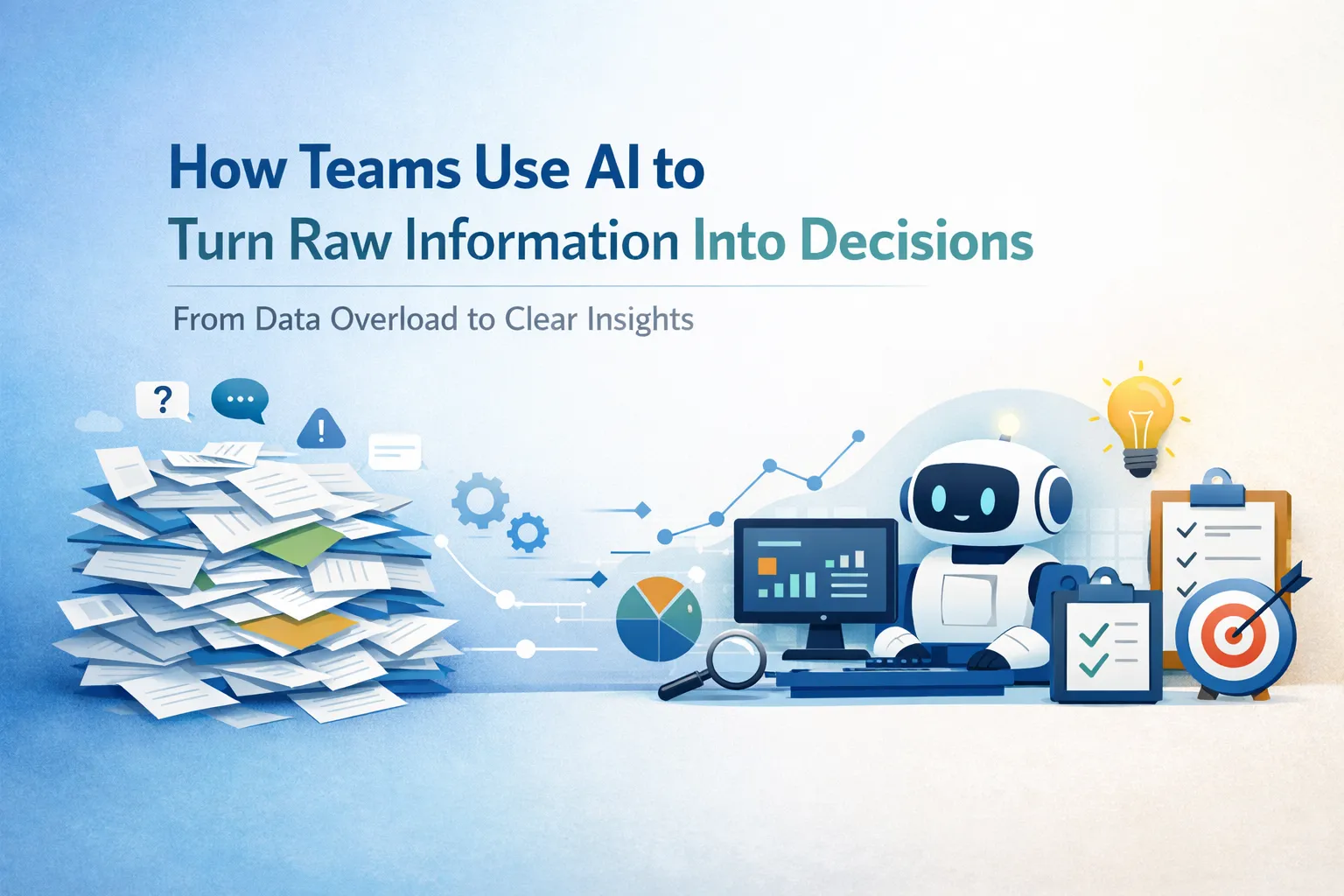
Modern teams do not suffer from a lack of information. They suffer from an inability to turn overwhelming amounts of information into clear, confident decisions.
Reports pile up. Documents grow longer. Dashboards multiply. Yet decision quality often stagnates. The bottleneck is not access to data, but synthesis. This is where AI is quietly reshaping how knowledge work actually happens.
The most effective teams are not using AI to replace decision-makers. They are using it to restructure the path between raw information and human judgment.
The Real Problem: Information Does Not Equal Insight
Organizations generate more data than ever before, but decision timelines have not meaningfully improved. Meetings still revolve around summarizing documents instead of acting on them.
This happens because raw information requires interpretation. Numbers, transcripts, reports, and research only become useful when patterns are identified and trade-offs are understood.
Traditional tools focus on storage and retrieval. They assume humans will do the synthesis manually. At scale, this assumption breaks down.
AI enters at this exact pressure point.
Where AI Fits in the Decision-Making Workflow
AI creates the most value in the middle layer of decision workflows. Not at the point of data collection, and not at the moment of final judgment.
Instead, AI excels at compressing large volumes of unstructured information into structured representations. Summaries, comparisons, extracted themes, and highlighted anomalies.
This reduces cognitive load before humans engage. Decision-makers start from a position of clarity rather than confusion.
Used correctly, AI shortens the distance between understanding and action.
Common Use Cases Inside Teams
In research-heavy roles, teams use AI to analyze reports, studies, and internal documents simultaneously. Instead of reading everything, they review synthesized findings and drill down only when needed.
In planning and strategy contexts, AI helps compare scenarios, surface assumptions, and summarize stakeholder inputs without flattening nuance.
For operations and audits, AI extracts patterns from logs, transcripts, and records that would otherwise be missed due to volume.
Across these use cases, AI does not decide. It prepares the ground for better decisions.
The Difference Between Assistance and Authority
A critical boundary separates helpful AI use from risky dependence. AI can identify signals, but it cannot validate their implications.
Treating AI outputs as conclusions introduces false confidence. Models generate plausible summaries even when data is incomplete, outdated, or contradictory.
Effective teams treat AI as an assistant, not an authority. Outputs are starting points for discussion, not endpoints.
This distinction protects judgment while preserving efficiency.
Why Context Matters More Than Accuracy Alone
High factual accuracy is important, but it is not sufficient for decision support. Context determines relevance.
AI systems perform best when grounded in the right sources and framed by clear questions. Without context, even accurate summaries can mislead by emphasizing the wrong factors.
This is why context-aware tools that allow teams to work directly with their own documents, data, and sources are more valuable than generic query-based systems.
Synthesis without context is noise reduction, not insight.
How Teams Maintain Human Control
Successful teams introduce checkpoints where humans validate assumptions, review interpretations, and challenge conclusions.
They also maintain transparency about sources. Knowing where information comes from matters as much as what is said.
AI systems that support document-based reasoning and citation make this process easier by preserving traceability instead of obscuring it.
This balance keeps humans accountable while allowing AI to handle scale.
AI as a Research and Synthesis Layer
Tools like Klyra AI Chat are designed around this middle layer. By allowing teams to interact directly with documents, files, and sources, they support structured exploration rather than detached answers.
This approach aligns AI capabilities with real knowledge work. The goal is not faster responses, but better-informed decisions.
When AI is embedded into existing workflows instead of replacing them, adoption becomes practical rather than disruptive.
The Risk of Over-Automating Judgment
As AI becomes more fluent, the temptation to delegate judgment grows. This is where misuse often begins.
Decisions involve values, trade-offs, and accountability. These cannot be automated without eroding responsibility.
Research from McKinsey highlights that organizations see the greatest gains from AI when it augments human decision-making rather than replacing it.
What Actually Improves Decision Quality
Better decisions do not come from more data. They come from clearer thinking.
AI contributes by organizing information, highlighting patterns, and reducing noise. Humans contribute by applying judgment, experience, and responsibility.
When these roles are respected, teams move faster without sacrificing quality.
The future of decision-making is not automated. It is assisted.
From Information Overload to Informed Action
Teams that use AI effectively do not ask it to decide for them. They ask it to help them understand.
This shift changes how knowledge work feels. Less reactive. More deliberate. More confident.
AI turns raw information into usable structure. Humans turn that structure into decisions.
That division of labor is where real productivity gains emerge.