Blogs / How Internal Linking Builds Authority in AI Content Systems
How Internal Linking Builds Authority in AI Content Systems
Klyra AI / February 11, 2026
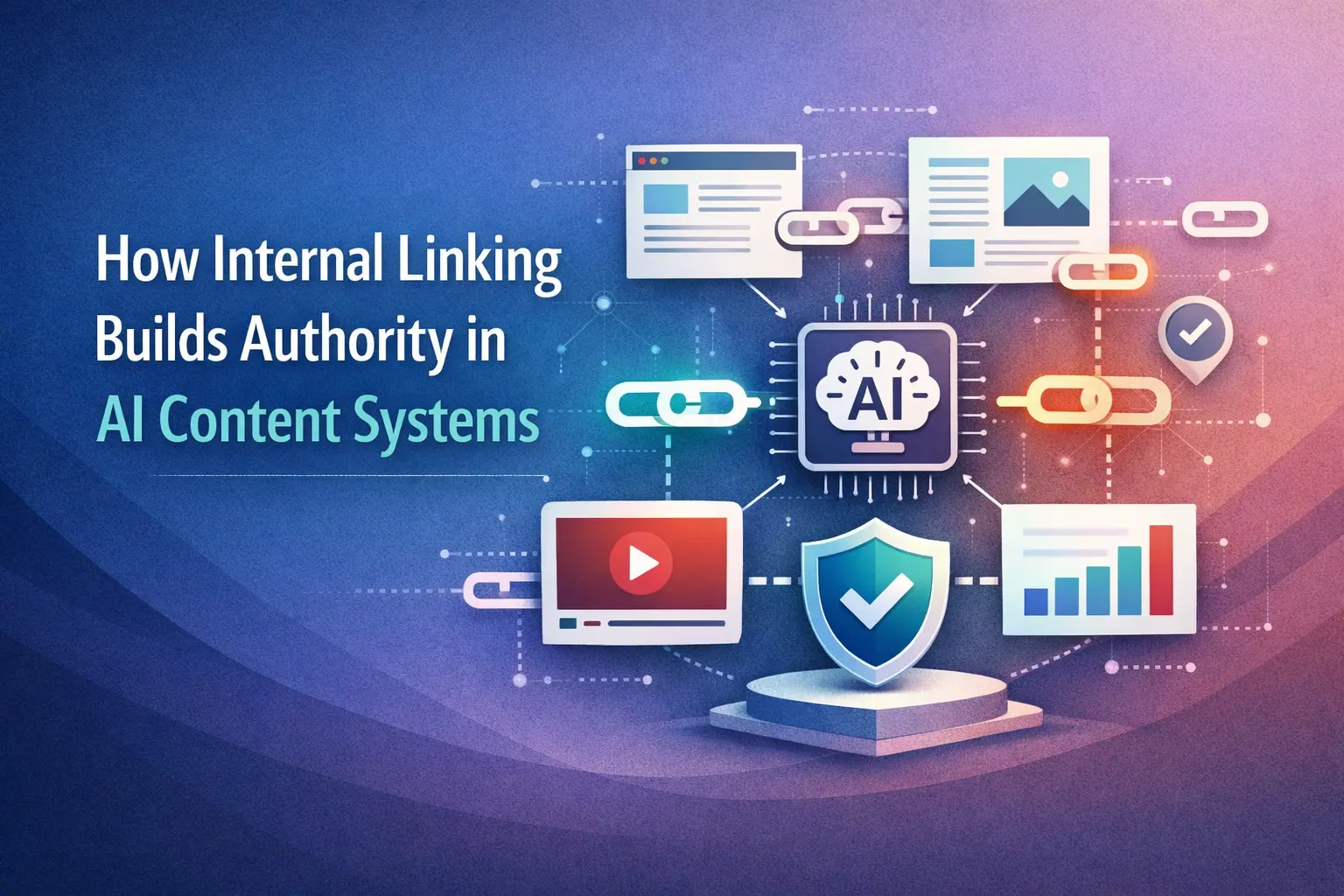
Internal linking is often treated as a finishing step.
A few contextual links are added before publishing. Anchor text is adjusted. The page goes live.
In an AI-driven content system, this approach is no longer sufficient.
When content volume increases rapidly, internal linking becomes structural rather than tactical. It determines how authority flows, how topics are interpreted, and how search engines understand the site’s expertise.
Internal linking is not an SEO trick. It is an authority system.
Why AI Publishing Changes the Role of Internal Links
AI reduces the cost of creating new pages.
As page count increases, so does the complexity of relationships between those pages. Without deliberate linking architecture, content becomes fragmented. Articles exist but do not reinforce each other.
Search engines evaluate not only what pages say, but how they connect. In AI-assisted environments, those connections must be intentional.
Authority Is Interpreted Through Structure
Search engines infer expertise by observing patterns.
When multiple related articles link coherently to each other, reinforce shared terminology, and support central concepts, the system signals topical authority.
When links are sparse, random, or inconsistent, authority appears diluted.
Structure communicates confidence.
Why Volume Without Structure Weakens SEO
Publishing dozens of AI-generated articles without a linking system often leads to cannibalization.
Pages compete for similar queries. Internal links point inconsistently. Some strong pages receive little reinforcement while weaker pages receive disproportionate attention.
This weakens ranking stability and creates noise in performance data.
As discussed in When to Update AI Content Instead of Publishing New Pages, overproduction without consolidation fragments authority rather than compounding it.
Internal Linking as a Hierarchy Signal
Effective internal linking establishes hierarchy.
Some pages receive more links because they represent foundational concepts. Others serve as supporting depth.
This hierarchy helps search engines identify which pages should carry broader visibility and which provide nuance.
Without hierarchy, all pages appear equally important. In practice, none become authoritative.
The Difference Between Random Links and Systematic Links
Random internal links are added opportunistically. Systematic links are designed intentionally.
A systematic approach defines which pages function as anchors, how clusters are structured, and how new content integrates into the existing ecosystem.
This transforms internal linking from maintenance work into strategic design.
How Anchor Text Influences Interpretation
Anchor text provides context.
Descriptive anchors clarify how pages relate conceptually. Generic anchors weaken semantic clarity.
In AI-driven systems, anchor discipline becomes more important because volume increases the risk of ambiguity. Consistent phrasing reinforces shared meaning across pages.
Internal Linking Supports Content Refresh
Refresh strategies benefit directly from structured internal links.
When updating a page, reviewing inbound and outbound links reveals its role within the cluster. Weak or outdated connections become visible.
This alignment reinforces the refresh principles discussed earlier in Month 4.
Why Internal Linking Strengthens Measurement Accuracy
Cluster-level measurement becomes more reliable when internal linking is coherent.
Performance shifts are easier to interpret when relationships between pages are clear. Weak nodes can be identified and strengthened rather than replaced.
Tools like the SEO Performance Analyzer help surface these structural relationships by mapping performance trends against topical organization.
Measurement and structure reinforce each other.
What Research Suggests About Structured Content
Search engine documentation consistently emphasizes clear site structure and logical navigation.
Well-organized content helps algorithms understand relationships between pages, improving crawl efficiency and authority interpretation.
Internal linking is the practical implementation of that principle.
Internal Linking as an Authority Flywheel
When structured properly, internal links create a reinforcing cycle.
Strong pages elevate adjacent pages. Adjacent pages support central themes. Authority compounds at the cluster level.
This flywheel effect becomes especially powerful in AI-assisted publishing environments, where speed must be balanced with cohesion.
Why Internal Linking Is a Long-Term Advantage
Competitors can replicate topics quickly using AI.
They cannot replicate structured ecosystems as easily.
Internal linking requires strategic thinking, consistent maintenance, and editorial oversight. It becomes a durable advantage rather than a temporary tactic.
Final Thought
AI makes content creation abundant. Internal linking makes it intelligible.
Without structure, volume produces noise. With structure, volume produces authority.
In an AI-driven SEO world, internal linking is not optional optimization. It is infrastructure.