Blogs / How Editorial Systems Prevent AI Content Decay
How Editorial Systems Prevent AI Content Decay
Klyra AI / February 5, 2026
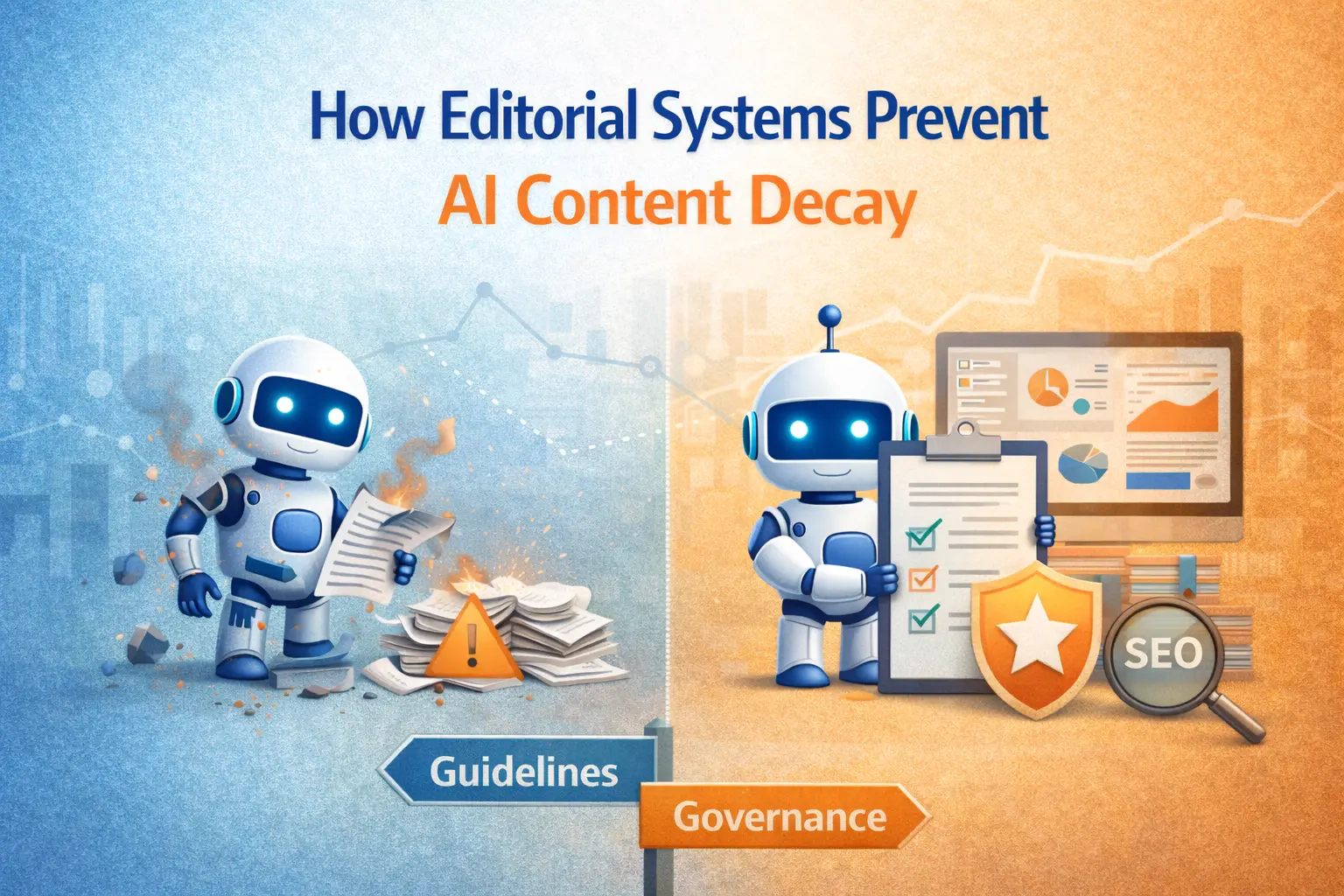
AI makes it easy to publish content. It also makes it easy to quietly lose quality over time.
Many teams adopt AI to increase output and initially see positive results. Pages go live faster. Coverage expands. Publishing velocity improves. Then, months later, rankings flatten. Engagement drops. Updates fail to revive performance.
This pattern is not caused by AI itself. It is caused by content decay accelerated by the absence of an editorial system.
Editorial systems are the difference between scalable AI content that compounds and AI content that slowly erodes trust.
What AI Content Decay Actually Looks Like
Content decay is rarely dramatic. It is incremental.
Articles become outdated. Terminology drifts. Tone changes subtly across posts. Facts remain mostly correct but lose relevance. Pages still exist, but they stop performing.
AI accelerates this process because it increases volume without enforcing coherence. When dozens or hundreds of pages are generated without a governing structure, inconsistencies accumulate faster than teams can correct them.
Over time, the site no longer feels intentional. It feels assembled.
Why Publishing More Content Does Not Stop Decay
A common reaction to declining performance is to publish more.
More content feels like progress, but it often worsens the problem. New pages introduce new assumptions, new phrasing, and new interpretations of the same topics. Instead of reinforcing authority, they fragment it.
This dynamic is explained in detail in the article The Future of SEO When AI Generates Most Content, which outlines how AI saturation shifts SEO away from volume and toward coherence.
Without an editorial system, additional content increases surface area for decay rather than reversing it.
Editorial Systems Are Not Style Guides
Many teams confuse editorial systems with documentation.
Style guides define tone. Templates define structure. Neither prevents decay on its own.
An editorial system defines how decisions are made. It clarifies what qualifies as publishable, what requires revision, and what must be updated over time.
It answers questions like why this content exists, how it supports related pages, and when it should change.
Without these answers, AI content remains static while user intent evolves.
How AI Accelerates Weak Editorial Foundations
AI does not introduce new problems. It magnifies existing ones.
If topic ownership is unclear, AI produces overlapping pages. If intent is poorly defined, AI generates generic explanations. If review processes are inconsistent, errors propagate.
This is why many AI content initiatives appear successful early and struggle later. Initial gains come from speed. Long-term performance depends on structure.
The article How to Build an AI Content System That Scales Without Breaking Trust explores this pattern at a system level. Editorial systems are the mechanism that protects trust as scale increases.
The Relationship Between Editorial Systems and Topical Authority
Search engines do not evaluate pages in isolation. They evaluate ecosystems.
Editorial systems help ensure that content across a topic cluster uses consistent language, reinforces shared assumptions, and builds logically from one article to the next.
This coherence is what search engines interpret as topical authority. It is also what users experience as expertise.
When editorial systems are absent, even high-quality individual pages struggle to signal authority collectively.
Why Decay Is More Dangerous Than Poor Content
Poor content is obvious. It can be fixed or removed.
Content decay is subtle. Pages continue to exist and even attract impressions, but they underperform. Teams assume the issue is competition or algorithm changes when the real issue is internal erosion.
Decay is especially dangerous in AI-assisted workflows because it compounds quietly. The longer it goes unaddressed, the harder it becomes to reverse.
Editorial Checkpoints Instead of Manual Control
Preventing decay does not require rewriting everything manually.
Effective systems use editorial checkpoints rather than heavy-handed control. These checkpoints focus on intent alignment, factual accuracy, and cluster consistency.
AI handles drafting and synthesis. Humans handle evaluation and direction.
This balance preserves speed while protecting quality.
How Measurement Exposes Content Decay Early
Decay often appears in performance metrics before it becomes obvious in rankings.
Rising impressions with falling engagement, stagnating rankings despite updates, and declining internal link performance are early indicators.
Tools like the SEO Performance Analyzer help surface these signals by shifting focus from output metrics to outcome metrics. Measurement is an essential component of any editorial system.
Why Editorial Systems Become More Important Over Time
The larger a content library becomes, the harder it is to maintain coherence.
AI accelerates library growth, but it does not manage legacy content. Editorial systems ensure that older articles evolve alongside new ones rather than becoming liabilities.
This is especially important as search intent shifts and industries mature.
Editorial Systems as a Competitive Advantage
As AI adoption increases, content quality converges.
What differentiates sites is not who uses AI, but who governs it effectively. Editorial systems are difficult to replicate quickly because they require discipline, ownership, and long-term thinking.
This makes them a durable competitive advantage in an AI-saturated landscape.
Final Thought
AI makes content creation scalable. Editorial systems make it sustainable.
Without systems, AI content decays faster than teams realize. With systems, AI becomes a force multiplier that strengthens authority over time.
The future of content is not automated publishing. It is governed scale.