Blogs / AI for Internal Knowledge Bases: Benefits and Hidden Risks
AI for Internal Knowledge Bases: Benefits and Hidden Risks
Klyra AI / February 1, 2026
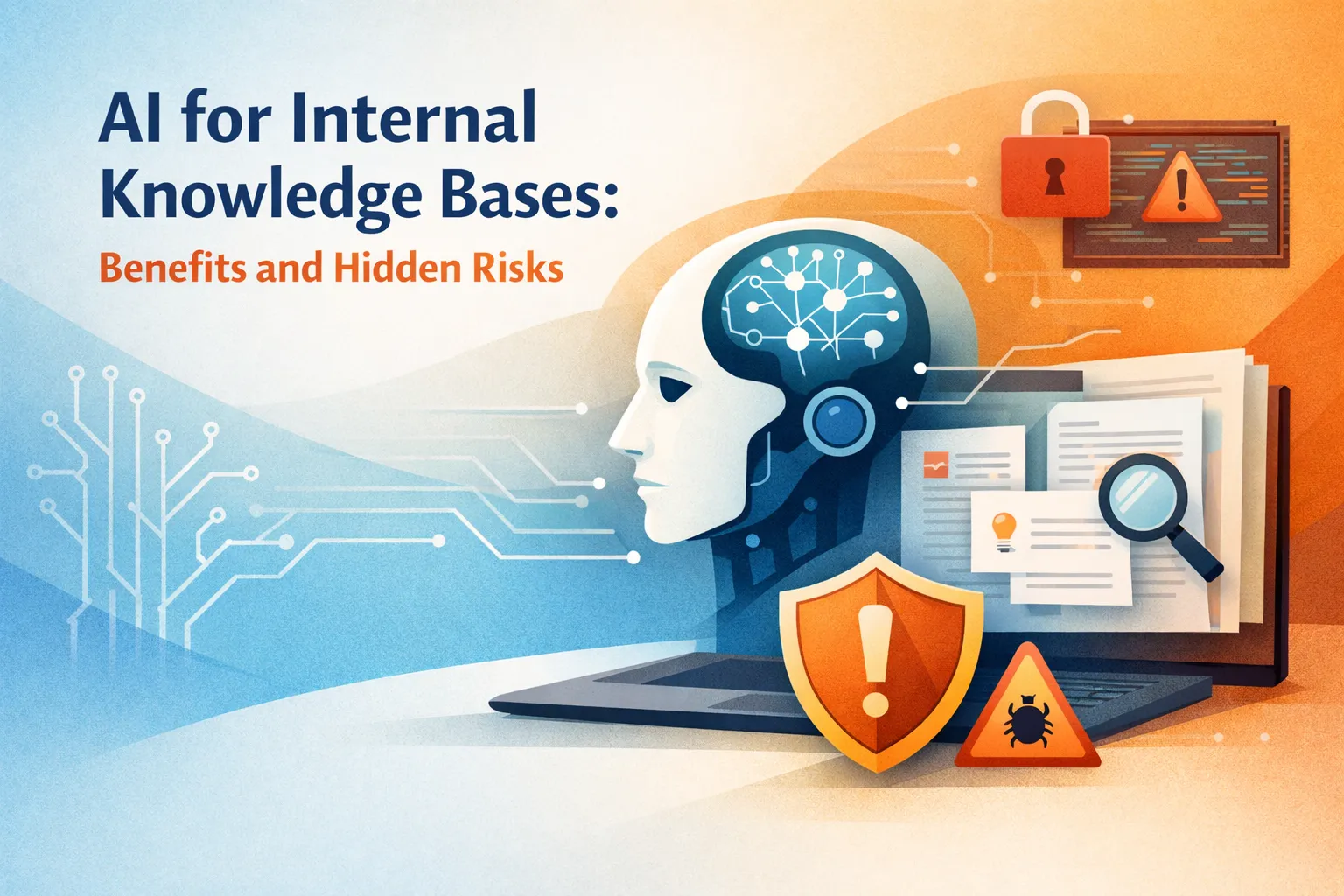
Internal knowledge has always been one of the hardest assets for organizations to manage. Documents sprawl across tools, institutional memory lives in people’s heads, and answers are often locked behind the right question being asked to the right person.
AI-powered internal knowledge bases promise to fix this. Ask a question in plain language and receive an instant answer pulled from company documents, policies, and historical data.
When implemented well, this capability can dramatically improve productivity. When implemented poorly, it can quietly introduce new risks that are harder to detect than traditional documentation failures.
Why Teams Are Adopting AI Knowledge Bases
The appeal of AI-driven knowledge systems is straightforward. They reduce friction between questions and answers.
Employees no longer need to know where information lives or how it is structured. They only need to know what they want to ask.
This improves onboarding, reduces repetitive internal support questions, and speeds up day-to-day decision-making. For distributed teams, it also lowers reliance on informal knowledge channels.
From a productivity standpoint, the upside is real.
The Visible Benefits Come First
Most organizations initially experience positive outcomes. Information becomes easier to access. Fewer messages are sent asking for clarifications. Teams feel more autonomous.
AI systems can summarize long documents, surface relevant sections, and respond conversationally instead of forcing keyword searches.
These early wins often drive rapid expansion of use without equal attention to governance.
That is where problems begin to form.
The Hidden Risk of Confident Inaccuracy
Unlike traditional documentation systems, AI knowledge bases do not simply retrieve information. They interpret and generate responses.
This means errors are not always obvious. Responses sound fluent and authoritative even when they are incomplete, outdated, or subtly wrong.
In an internal context, these errors can be more dangerous than public ones. Incorrect policy guidance, misinterpreted procedures, or outdated compliance information can lead to real operational consequences.
Because answers feel trustworthy, they are less likely to be questioned.
Loss of Source Awareness
Another common issue is the loss of provenance. Users receive answers without clearly understanding where those answers came from.
When source visibility is reduced, accountability weakens. It becomes harder to verify whether information is current, authoritative, or contextually appropriate.
Over time, teams may stop consulting original documents altogether, relying solely on generated summaries.
This creates a fragile knowledge layer that drifts from reality.
Why Internal Errors Cost More Than External Ones
Public-facing AI errors affect reputation. Internal AI errors affect operations.
A misleading internal answer can influence decisions, approvals, and actions long before it is noticed. By the time discrepancies surface, the damage may already be done.
This is why internal AI systems require stricter controls than external-facing chatbots or marketing tools.
The tolerance for error is significantly lower.
The Governance Gap
Most failures of AI knowledge bases are not technical. They are governance failures.
Organizations often connect large document repositories without defining ownership, update responsibility, or response boundaries.
Without rules about what the AI is allowed to answer, what sources it can use, and how frequently content is reviewed, quality degrades silently.
AI amplifies whatever structure already exists. If that structure is weak, the output will be too.
Where AI Knowledge Bases Work Well
AI-driven knowledge systems are most effective when used for reference, orientation, and discovery.
They excel at helping users locate relevant documents, understand general concepts, and navigate complex information landscapes.
When paired with clear disclaimers and source citations, they can significantly reduce time spent searching.
The key is positioning them as guides, not authorities.
Designing for Responsible Use
Responsible implementations preserve transparency. Users should be able to see which documents were referenced and when they were last updated.
They also enforce boundaries. Sensitive, ambiguous, or high-risk questions should be redirected rather than answered definitively.
Systems that allow teams to constrain responses strictly to approved sources reduce hallucination risk and improve trust.
These design choices matter more than model sophistication.
Internal Chatbots and Controlled Knowledge Access
Tools like Klyra AI External Chatbots illustrate how controlled training, source restriction, and response governance can be applied to knowledge-driven systems.
While often used externally, the same principles apply internally. Accuracy improves when AI is grounded in explicitly defined data rather than open-ended inference.
This approach prioritizes reliability over breadth.
What Research Shows About AI Knowledge Risks
Research from established standards bodies highlights that AI systems used for knowledge work require clear human oversight and accountability to prevent silent error propagation.
Without defined responsibility, organizations risk mistaking fluent, well-structured AI responses for correctness, even when underlying information is incomplete or outdated.
Balancing Access With Accuracy
The promise of AI knowledge bases is real. Faster access, reduced friction, and better use of institutional knowledge.
The risk is equally real. Confident errors, lost context, and weakened accountability.
Organizations that succeed treat AI as an interface to knowledge, not a replacement for it.
They invest as much in governance as they do in technology.
The Real Question Teams Must Answer
The question is not whether AI can power internal knowledge bases. It already can.
The question is whether organizations are prepared to manage the responsibility that comes with delegating access, interpretation, and explanation to a machine.
When that responsibility is taken seriously, AI becomes a powerful ally. When it is not, the risks remain invisible until they matter most.
That is the trade-off every team must evaluate before scaling internal AI knowledge systems.