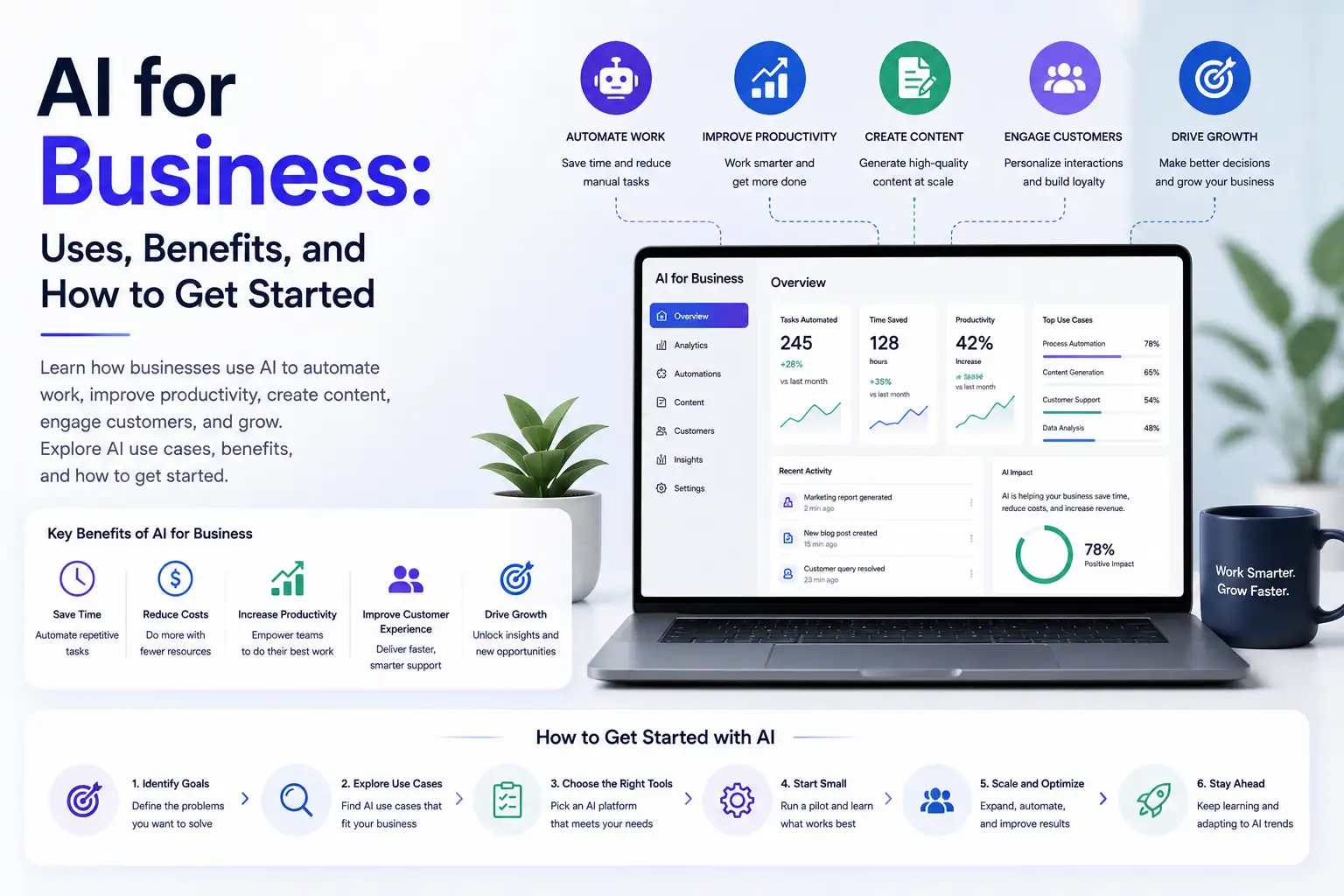
Artificial intelligence is becoming part of everyday business work. Companies are using AI to create content, automate repetitive tasks, communicate with customers, support marketing, improve productivity, and handle workflows that once required significant manual effort.
But using AI in business is not simply about adding an AI application to your technology stack.
The bigger opportunity is to identify where AI can help your business create, automate, communicate, and grow more effectively.
What Is AI for Business?
AI for business is the use of artificial intelligence to help a business perform, automate, or improve everyday work and business processes.
Instead of treating AI as a standalone technology, businesses can apply it to practical activities such as content creation, marketing, customer engagement, sales support, productivity, and workflow automation.
The goal is not to use AI simply because it is available. The goal is to use it where it can produce a meaningful business outcome, such as saving time, increasing output, simplifying repetitive work, or helping teams serve customers more effectively.
This distinction matters because successful AI adoption starts with the business problem, not the technology.
For example:
- A marketing team may use AI to create and repurpose content faster.
- A business may use AI to answer common customer questions.
- A team may use AI to automate repetitive workflows.
- An ecommerce business may use AI to create product imagery and descriptions.
- A growing company may use AI to help employees produce presentations, documents, research, and other work more efficiently.
AI can therefore become part of the way a business operates rather than simply another application employees occasionally open.
How Businesses Use AI
AI can support many different areas of a business. The most valuable use cases are usually connected to work that is repetitive, time-consuming, content-heavy, or difficult to scale manually.
Here are some of the most common ways businesses use AI.
AI for Content Creation
Businesses create content constantly.
That can include:
- Blog posts
- Product descriptions
- Social media content
- Presentations
- Marketing copy
- Images
- Videos
- Voice content
- Website content
AI can assist with different stages of this process, from generating an initial draft to transforming existing content into another format.
For example, a marketing team could turn a campaign idea into a written draft, presentation, social content, and visual assets without starting each piece from scratch.
The benefit is not simply generating more content. It is reducing the amount of repetitive work required to produce useful content.
Klyra AI supports business content workflows through applications such as AI Blogger Agent, SEO tools, AI Presentation Maker, AI Image Pro, AI Photoshoot, AI Video, AI Avatar, and AI Music Pro.
AI for Marketing
Marketing teams often need to produce a large amount of content across multiple channels.
AI can help with activities such as:
- Content ideation
- Copywriting
- Social media content
- Creative production
- Content repurposing
- Campaign support
- Marketing communications
For example, a business could develop a campaign concept and then use AI to help turn that concept into social posts, visuals, presentation material, and other marketing assets.
This can make it easier for small marketing teams to maintain a consistent flow of content without increasing every part of the process manually.
Klyra's product capabilities include AI Social Media alongside content, image, video, and voice applications, supporting a broader marketing workflow from one platform.
AI for Customer Service
Customer service is another area where AI can support repetitive work.
Businesses may use AI to:
- Answer common questions
- Provide information from a knowledge base
- Assist customers through website chat
- Handle initial conversations
- Route conversations when human support is needed
- Support customer-service teams
AI does not necessarily have to replace human customer support.
A more practical approach is to let AI handle appropriate routine interactions while giving human agents the ability to take over when a conversation requires judgment, context, or personal attention.
Klyra's documented customer-engagement capabilities include external chatbots, external voice chatbots, human-agent support, analytics, knowledge bases, and integrations such as WhatsApp and Telegram.
AI for Sales and Communication
Sales teams spend considerable time communicating, preparing information, creating materials, and following up with prospects and customers.
AI can assist with activities such as:
- Drafting communications
- Preparing sales materials
- Creating presentations
- Summarizing information
- Supporting customer conversations
- Producing content for different stages of the sales process
The objective is not to automate every sales interaction.
Instead, AI can reduce the amount of time spent on routine preparation so sales professionals can focus more of their time on customers, relationships, and decisions.
AI for Business Operations
Many businesses contain repetitive processes that consume time without directly creating new value.
Examples include:
- Moving information between systems
- Preparing recurring documents
- Processing content
- Repeating administrative tasks
- Coordinating routine workflows
- Managing large amounts of information
AI can help automate or simplify appropriate parts of these workflows.
This is where AI moves beyond content generation and becomes part of how work gets done.
Klyra's product philosophy explicitly prioritizes automation and reducing manual work, with the broader goal of making AI-powered work simpler and more connected.
AI for Productivity
Knowledge workers spend much of their day creating, organizing, researching, communicating, and processing information.
AI can support these activities by helping with:
- Writing
- Summarization
- Research
- Presentations
- Information extraction
- Content transformation
- Repetitive knowledge work
The value comes from shortening the distance between an idea and a finished result.
For example, instead of starting a presentation from a blank document, a user can begin with an idea and use AI to help structure the content and produce a first version.
The same principle can apply to documents, marketing content, customer communications, and other business work.
Benefits of AI for Business
The benefits of AI depend on how it is implemented. Simply adding AI to a business does not automatically create better results.
The strongest benefits usually come from applying AI to specific problems and workflows.
Save Time on Repetitive Work
One of the clearest opportunities is reducing manual work.
If an employee spends hours repeatedly creating similar content, answering the same questions, organizing information, or completing routine tasks, AI may be able to handle part of that work.
That gives employees more time for work that requires judgment, creativity, relationships, and decision-making.
Klyra's decision principles specifically identify time savings and reducing manual work as important product goals.
Increase Productivity
AI can help people move through certain tasks faster.
Instead of replacing the person doing the work, AI can become an assistant that helps them:
- Start faster
- Produce first drafts
- Process information
- Transform content
- Complete repetitive tasks
- Explore ideas
The result can be more productive work without requiring every employee to become an AI specialist.
Create More Content
Businesses increasingly need content across websites, social media, marketing campaigns, sales materials, and customer communications.
AI can help teams increase their capacity to create and adapt content.
The important point is that more content is not automatically better.
Businesses still need quality, relevance, accuracy, brand consistency, and human judgment.
AI is most useful when it helps teams increase useful output without sacrificing those standards.
Automate Workflows
Individual AI tasks are useful, but connected workflows can create greater value.
For example:
Idea → Content → Visual → Social Post → Customer Engagement
Instead of treating every stage as a completely separate task, businesses can look for opportunities to connect them.
This is one reason unified AI environments can become valuable as businesses adopt more AI.
Klyra's product philosophy is built around connecting AI applications inside one operating system rather than making customers feel as though they are purchasing unrelated products.
Improve Customer Engagement
AI can help businesses respond faster and provide support across more channels.
Customer-facing AI can assist with common questions, information retrieval, and initial conversations while allowing human agents to handle situations that require personal attention.
The right balance depends on the business and the customer experience it wants to provide.
Support Business Growth
AI can help businesses increase their capacity without making every additional task dependent on additional manual effort.
For a growing business, this can be especially useful.
A small team may need to produce more content, communicate with more customers, support more workflows, and maintain more business activity as it grows.
AI can help provide additional capacity across those activities.
Klyra's target customers include small businesses, marketing agencies, ecommerce stores, startups, content teams, sales professionals, growing companies, and departments such as marketing and customer support.
Examples of AI in Business
The best way to understand AI for business is to look at practical workflows.
| Business activity | Common challenge | How AI can help |
|---|---|---|
| Content creation | Creating content takes time | Draft, transform, and improve content |
| Marketing | Teams need content across channels | Support content and creative production |
| Customer service | Repetitive questions consume time | Handle appropriate routine conversations |
| Presentations | Creating presentations manually takes time | Generate and structure presentation content |
| Product content | Visual production can be resource-intensive | Assist with product imagery and creative assets |
| Social media | Frequent publishing requires ongoing effort | Create and manage social content |
| Video | Video production can require multiple steps | Assist with video creation workflows |
| Operations | Repetitive processes consume employee time | Automate appropriate workflow steps |
| Productivity | Knowledge work involves repetitive tasks | Assist with writing, research, summaries, and information processing |
The specific value of AI will vary by business. A marketing agency may prioritize content and creative production, while an ecommerce company may prioritize product content and customer engagement.
The right question is therefore not:
"What can AI do?"
It is:
"Where can AI create the most useful outcome for this business?"
Common AI Use Cases by Business Function
AI adoption becomes easier to understand when you look at it through the functions of a business.
Marketing and Content
AI can support:
- Content creation
- Social media
- Marketing communications
- Visual production
- Presentations
- Content repurposing
Customer Support
AI can support:
- Frequently asked questions
- Knowledge-base interactions
- Initial customer conversations
- Customer information
- Conversation routing
- Human-agent handoff
Sales and Communication
AI can support:
- Sales materials
- Presentations
- Written communication
- Research
- Customer interactions
- Follow-up preparation
Operations and Automation
AI can support:
- Repetitive processes
- Workflow automation
- Information processing
- Routine business tasks
- Coordination between steps in a workflow
Productivity and Knowledge Work
AI can support:
- Writing
- Research
- Summarization
- Information extraction
- Presentations
- Content transformation
Ecommerce and Product Content
Ecommerce businesses often need large amounts of product content.
AI can assist with:
- Product descriptions
- Product imagery
- Marketing content
- Social content
- Creative variations
This can be particularly useful when businesses have many products or need to produce content regularly.
Creative Production
AI can support businesses that regularly create:
- Images
- Videos
- Presentations
- Voice content
- Music
- Avatars
Klyra's documented application set spans content, creative, video, voice, customer engagement, and productivity capabilities within its broader AI Operating System.
AI Tools vs. AI Platforms for Business
As businesses adopt AI, they often encounter a growing number of individual applications.
One application may help with writing.
Another may help with images.
Another may help with video.
Another may help with customer support.
Another may help automate workflows.
This can be useful, but it can also create a fragmented workflow.
What Is an AI Tool?
An AI tool generally focuses on a particular task or category of work.
For example, a business might use one application for writing and another for generating images.
Individual tools can be valuable when they solve a specific problem particularly well.
What Is an AI Platform?
An AI platform brings multiple AI capabilities, applications, workflows, or services together within a broader environment.
Instead of treating every capability as a completely separate experience, a platform can provide a more unified way to access and manage AI-powered work.
If you want to understand the broader category, see our guide to What Is an AI Platform?.
For businesses specifically evaluating these solutions, see AI Platform for Business.
What Is an AI Operating System?
An AI Operating System takes the idea of a unified AI environment further.
Klyra AI defines itself as The AI Operating System, bringing leading AI models and business-ready AI applications together in one unified workspace. Its goal is to give businesses, creators, professionals, and teams one place to create, automate, communicate, and grow.
This distinction matters because the goal is not simply to collect AI applications.
The goal is to make AI-powered work feel connected.
How to Choose AI for Your Business
Choosing AI should begin with your business, not with a list of AI models or the latest technology announcement.
A practical evaluation starts with five questions.
Start With a Business Problem
First, identify a problem worth solving.
Ask:
- What takes too much time?
- What work is repetitive?
- Where are employees spending time on low-value tasks?
- Where does content production slow the business down?
- Where do customers experience delays?
- Which processes become difficult as the business grows?
A clear problem gives you a better starting point than simply asking which AI technology is most popular.
Identify the Workflow
Once you know the problem, look at the complete workflow.
For example:
Create → Review → Publish → Promote
AI might help with several steps rather than just one.
Understanding the workflow also makes it easier to identify where automation could create the greatest benefit.
Evaluate the AI Capabilities You Need
Different businesses have different requirements.
You may need AI for:
- Writing
- Images
- Video
- Voice
- Customer engagement
- Productivity
- Automation
- Research
- Content management
The objective is to choose capabilities that support your business goals rather than collecting capabilities simply because they exist.
Consider Workflow Integration
As the number of AI applications increases, switching between disconnected systems can create its own problems.
Teams may have to manage:
- Multiple subscriptions
- Multiple interfaces
- Separate workflows
- Repeated setup
- Different systems for different parts of the same project
A unified AI platform can be worth considering when a business needs multiple AI capabilities as part of connected workflows.
Klyra's core value proposition is built around bringing leading AI models and business-ready AI applications together in one platform instead of requiring users to manage multiple AI subscriptions independently.
Prioritize Simplicity and Usability
AI should make work easier, not introduce another layer of complexity.
When evaluating an AI solution, consider:
- How easy is it for employees to learn?
- How many separate systems will they need?
- Can different workflows be connected?
- Can the business scale usage as it grows?
- Does the system hide unnecessary technical complexity?
Klyra's product principles specifically emphasize simplicity, reduced cognitive load, fewer unnecessary choices, and business-first experiences.
How to Get Started With AI in Your Business
You do not need to transform every business process at once.
A better approach is to start with one meaningful opportunity.
Step 1: Identify One Opportunity
Choose one task that is:
- Repetitive
- Time-consuming
- Frequent
- Easy to measure
For example, content creation or answering common customer questions.
Step 2: Define the Desired Outcome
Be specific about what success looks like.
Instead of:
"We want to use AI."
Define an outcome such as:
"We want to reduce the manual effort required to produce weekly marketing content."
Step 3: Choose the Right AI Approach
Determine whether the problem requires:
- An individual AI application
- Several connected applications
- Workflow automation
- An AI platform
- A broader AI Operating System
The answer depends on the complexity of the workflow.
Step 4: Test the Workflow
Start with a manageable use case.
Evaluate:
- Quality
- Time saved
- Employee experience
- Customer experience
- Reliability
- Amount of manual work remaining
Step 5: Measure the Result
AI adoption should produce an observable improvement.
Depending on the use case, you might measure:
- Time saved
- Content produced
- Response time
- Workflow completion
- Customer engagement
- Manual steps removed
Step 6: Expand What Works
Once a workflow demonstrates value, look for adjacent opportunities.
For example:
Content creation
could expand into:
Content → Images → Social → Video → Customer engagement
This is where AI can move from an isolated experiment to part of a broader business workflow.
Common Mistakes Businesses Make With AI
AI adoption can create problems when businesses focus more on technology than outcomes.
1. Using AI Without a Clear Business Objective
Adding AI simply because competitors are using it does not guarantee value.
Start with the problem.
2. Choosing Tools Before Defining the Workflow
A tool may look impressive but still be a poor fit for the actual business process.
Understand the workflow first.
3. Managing Too Many Disconnected AI Applications
Using multiple applications can create fragmentation when every part of a workflow requires a different system.
A growing AI stack can eventually create its own administrative and workflow overhead.
4. Focusing on AI Models Instead of Outcomes
Businesses generally care about what the technology helps them accomplish.
The model is part of the infrastructure.
The outcome is what matters.
Klyra's product principles explicitly state that customers buy outcomes, not AI models or APIs.
5. Automating a Poor Process
Automation does not automatically improve a workflow.
If a process is unclear or inefficient, automating it may simply make the same problem happen faster.
Improve the process first, then automate where appropriate.
6. Expecting AI to Replace Human Judgment Everywhere
AI can be highly useful for repetitive and information-heavy work, but businesses still need people for judgment, context, creativity, relationships, and accountability.
The right balance depends on the task.
AI for Business FAQs
What is AI for business?
AI for business is the use of artificial intelligence to help a business perform, automate, or improve everyday work and processes. Common applications include content creation, marketing, customer service, productivity, communication, and workflow automation.
How is artificial intelligence used in business?
Businesses use artificial intelligence for activities such as creating content, assisting customer service, automating repetitive work, supporting marketing, producing images and video, processing information, and improving productivity.
What are the benefits of AI for business?
Potential benefits include saving time, reducing repetitive work, increasing productivity, creating more content, automating workflows, improving customer engagement, and helping businesses increase their capacity.
What are common AI use cases in business?
Common use cases include marketing, content creation, customer support, sales communication, business operations, productivity, ecommerce content, creative production, and workflow automation.
How can small businesses use AI?
Small businesses can use AI to support tasks that consume significant time or resources, such as marketing content, customer support, product content, presentations, research, communication, and repetitive workflows. Starting with one measurable business problem is usually more practical than trying to adopt AI everywhere at once.
What business tasks can AI automate?
AI can support automation of appropriate repetitive workflows, including information processing, routine customer interactions, content workflows, administrative processes, and other tasks where predictable steps can be handled with limited manual intervention.
What is the difference between AI tools and AI platforms?
An AI tool generally focuses on a particular task or capability. An AI platform brings multiple AI capabilities, applications, or workflows together in a broader environment.
How should a business get started with AI?
Start by identifying one repetitive or time-consuming business problem. Define the desired outcome, choose an appropriate AI approach, test it, measure the result, and then expand to other workflows that could benefit from AI.
The Future of AI for Business
AI adoption is moving beyond isolated experiments.
As businesses use AI for more activities, the bigger challenge becomes connecting those capabilities into useful workflows.
A business may need AI for content, communication, customer engagement, creative production, productivity, and automation at the same time.
Managing each capability separately can create unnecessary complexity.
This is why the future of AI for business is not simply about having access to more AI applications.
It is about making those capabilities simpler, more connected, and more useful to the people doing the work.
Klyra AI is built around this idea. It brings leading AI models and business-ready AI applications together in one intelligent workspace, with the goal of helping businesses, creators, professionals, and teams create, automate, communicate, and grow from a single platform.
The most effective AI strategy for a business therefore starts with a simple question:
Where can AI help us do meaningful work better, faster, or with less unnecessary effort?
Start there.
Then build from what works.
Explore Klyra AI
If you're looking for a way to bring AI-powered work together instead of managing a growing collection of disconnected AI subscriptions, explore Klyra AI, The AI Operating System.
Create. Automate. Communicate. Grow.