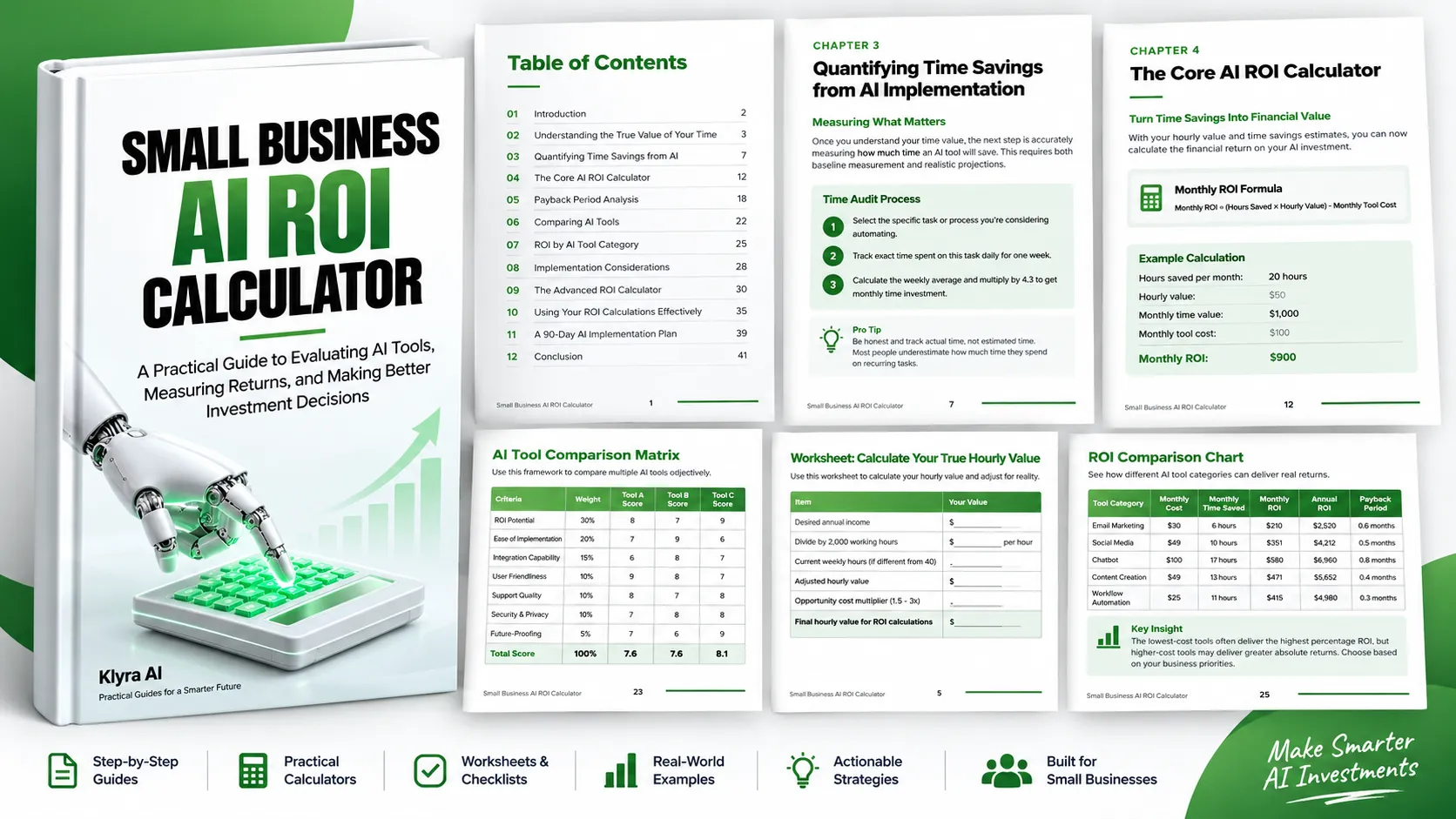
Why AI ROI Matters for Small Businesses
AI tools can create meaningful improvements for small businesses, but choosing a tool simply because it is popular or impressive does not guarantee a worthwhile investment. A better approach is to evaluate the business problem first, understand the value of the time involved, estimate realistic savings, and compare those benefits with the full cost of implementation.
This guide provides a practical framework for doing exactly that. It moves from basic time-value calculations to more comprehensive ROI analysis, while also addressing factors such as implementation effort, employee adoption, system integration, revenue impact, error reduction, and scalability.
The objective is to make AI investment decisions more systematic. Instead of asking whether an AI tool looks useful, you can ask whether it solves a specific problem, how much value it could create, how quickly the investment could pay back, and whether it is the right solution for your business.
Start by Calculating the Value of Your Time
The foundation of an AI ROI calculation is understanding what the time being replaced or improved is actually worth.
Calculate Your Hourly Value
The basic formula provided in the guide is:
Hourly Value = Desired Annual Income ÷ 2,000 Working Hours
For example, a desired annual income of $100,000 produces a baseline hourly value of $50 using 2,000 working hours.
This calculation provides a starting point, but it should be adjusted for the realities of your role and workload.
Adjust the Calculation for Reality
- Business owners: If you work more than 40 hours per week, your actual hourly value may be lower than the basic calculation suggests. If you are the primary revenue generator, however, the opportunity value of your time may be significantly higher.
- Employees: Consider the fully-loaded cost of an employee, including salary, benefits, taxes, and overhead.
- Specialized roles: Consider what revenue-generating activities an employee could perform instead of the task being automated.
The guide also introduces opportunity cost. When valuable time is spent on lower-value administrative work, the cost can include both the direct value of the time and the revenue opportunity lost by not working on higher-value activities.
For high-value activities such as strategic planning, client relationships, and product innovation, the guide suggests multiplying the hourly value by 1.5 to 3 times to account for opportunity cost.
Match Time Value to the Activity
- Strategic activities: 2-3x, because they directly affect long-term growth and innovation.
- Revenue-generating activities: 1.5-2x, because they directly produce income.
- Operational activities: 1x, because they are necessary but do not directly generate revenue.
- Administrative activities: 0.8-1x, because they are necessary but can often be outsourced or automated.
A key point is that many tasks that are relatively easy to automate are also low in strategic value while consuming significant amounts of time. This creates an opportunity for AI automation to generate meaningful returns.
Measure the Time AI Could Actually Save
Once the value of time has been established, the next step is to determine how much time an AI tool could realistically save.
Establish a Baseline
Before implementing an AI solution, measure the existing process rather than relying on an estimate.
- Select the specific task or process being considered for automation.
- Track the exact time spent on the task each day for one week.
- Calculate the weekly average and multiply it by 4.3 to estimate the monthly time investment.
This baseline creates a measurable starting point against which the AI implementation can later be evaluated.
Use Realistic Efficiency Estimates
AI tools generally reduce the amount of time required rather than eliminating the task completely. The guide provides the following typical time-reduction ranges:
- Basic automation: 70-90%, such as email responders and scheduling tools.
- AI writing and content: 50-70%, such as blog posts, social media content, and product descriptions.
- Customer service AI: 60-80%, such as chatbots and FAQ handling.
- Data analysis: 40-60%, such as report generation and insight extraction.
- Complex workflows: 30-50%, particularly where multiple stages require human judgment.
For example, if a business spends 20 hours each month responding to customer emails and an AI tool produces a 70% efficiency improvement, the estimated time saved is 14 hours per month. Six hours would still be required for the remaining work.
Initial setup and ongoing management should also be included. The guide estimates that many tools require 2-8 hours of initial setup and 10-20% of the saved time for ongoing management and refinement.
Calculate the Core AI ROI
With the hourly value and potential time savings established, the next step is to convert those savings into financial value.
Monthly ROI
The basic monthly formula is:
Monthly ROI = (Hours Saved × Hourly Value) - Monthly Tool Cost
For example, if an AI tool saves 20 hours per month and the time is valued at $50 per hour, the monthly time value created is $1,000. If the tool costs $100 per month, the resulting monthly ROI is $900.
First-Year ROI
A more complete calculation includes the initial setup investment:
First-Year ROI = (Annual Hours Saved × Hourly Value) - (Tool Annual Cost + Setup Hours × Hourly Value)
The guide's example produces $12,000 in annual time value from 240 hours saved, against $1,200 in annual tool costs and $200 in setup time, resulting in $10,600 of first-year ROI.
ROI percentage can then be calculated as:
ROI Percentage = (Net Gain ÷ Investment Cost) × 100
Understand the Payback Period
ROI tells you how much value an investment can generate, while the payback period tells you how quickly the investment can recover its cost.
Payback Period (months) = (Setup Cost + Tool Monthly Cost) ÷ Monthly Value Created
The guide provides the following benchmarks:
- Less than 1 month: Excellent, with immediate implementation recommended.
- 1-2 months: Very Good, making the tool a high-priority implementation.
- 2-3 months: Good, with implementation recommended when resources are available.
- 3-6 months: Fair, particularly when the tool has high strategic importance.
- More than 6 months: Poor, unless the tool addresses a strategic necessity.
The guide also notes that low-cost tools costing under $50 per month that save two or more hours each week can often produce rapid payback.
Compare AI Tools Beyond Their ROI Percentage
A high ROI percentage is useful, but it should not be the only factor in an AI purchasing decision.
Define Your Selection Criteria
Before comparing specific tools, rate the importance of factors such as:
- Cost effectiveness
- Ease of implementation
- Integration with existing systems
- Learning curve
- Customer support quality
- Data security and privacy
- Scalability
Evaluate Each Tool
For every AI solution under consideration, examine four areas:
- Problem definition: Identify the specific problem being solved, how critical it is, and how frequently it occurs.
- Implementation requirements: Determine required integrations, available data, implementation ownership, and training needs.
- Risk assessment: Consider what happens if the tool underperforms, the vendor stops operating, or data security and privacy become concerns.
- Alternative solutions: Compare other AI tools, non-AI solutions, and the possibility of outsourcing the task.
Use a Weighted Comparison
When multiple tools address the same problem, a standardized scorecard can make the comparison more objective. The guide assigns weights to criteria including ROI, implementation ease, integration capability, user friendliness, support quality, security and privacy, and future-proofing.
Each tool is scored from 1 to 10 against each criterion. The score is multiplied by the criterion's weight, and the weighted results are added together to produce an overall score.
Look at ROI by AI Tool Category
The guide illustrates how different categories of AI solutions can produce different combinations of cost, time savings, ROI, and payback.
- Email marketing automation: The example uses a $30 monthly tool cost, six hours of monthly time savings, $210 monthly ROI, and a 0.6-month payback period.
- Social media management: The example uses a $49 monthly cost, ten hours saved per month, $351 monthly ROI, and a 0.5-month payback period.
- Customer service chatbots: The example uses a $100 monthly cost, 17 hours saved per month, $580 monthly ROI, and a 0.8-month payback period.
- AI content creation: The example uses a $49 monthly cost, 13 hours saved per month, $471 monthly ROI, and a 0.4-month payback period.
- Workflow automation: The example uses a $25 monthly cost, 11 hours saved per month, $415 monthly ROI, and a 0.3-month payback period.
The comparison highlights an important distinction: lower-cost tools can produce higher percentage ROI, while higher-cost tools can potentially create greater absolute returns. The appropriate choice depends on the business's priorities and available resources.
Implementation Can Change the Actual ROI
The purchase price of an AI tool is only part of the investment. Implementation decisions can significantly influence the value ultimately achieved.
DIY vs. Assisted Implementation
- DIY implementation: Best suited to simple tools with good documentation. It generally has lower upfront costs and better knowledge retention but can take longer and carry greater implementation risk.
- Consultant or expert help: More appropriate for complex integrations or critical systems. It costs more upfront but can reduce implementation time and risk.
The guide suggests handling setup yourself when a tool is simple and supported by clear tutorials. Expert help becomes more appropriate when setup affects multiple business systems or involves sensitive customer data.
Phased vs. Complete Implementation
Phased implementation typically requires less initial investment, reaches first value faster, makes team adaptation easier, and carries lower risk. Complete implementation may require more capital and commitment but can potentially produce higher long-term ROI.
A practical decision rule from the guide is to start with one simple AI tool. Early wins can create momentum for more advanced implementations.
Training and Adoption
Technology alone does not guarantee successful adoption. The guide recommends planning for documentation, training sessions, and the development of AI champions within the team.
- Documentation: Allocate 2-4 hours per tool to reduce ongoing support requirements.
- Team training: Allocate 1-2 hours per tool to support adoption.
- AI champions: Identify early adopters who can help other team members learn and adapt.
The guide also recommends budgeting 10-15% of implementation time for training because tools that are not fully adopted can continue generating subscription costs while producing limited returns.
Integration with Existing Systems
Integration can have a substantial effect on the value of an AI solution. The guide categorizes integration from standalone tools through basic data sharing, workflow automation, and full ecosystem integration.
Tools that connect with existing systems can eliminate manual data transfer and create additional efficiency gains. The guide therefore recommends prioritizing integration capability even when an integrated tool costs somewhat more.
Expand the Calculation Beyond Time Savings
Direct time savings provide a useful starting point, but a comprehensive ROI calculation can include other forms of business value.
Revenue Impact
AI can potentially influence revenue through improved conversion rates, customer retention, and AI-powered recommendations.
For example, a business generating $30,000 in monthly revenue and expecting a 5% improvement could estimate an additional $1,500 per month, or $18,000 annually.
Error Reduction
To calculate the value of reducing errors:
- Identify the number of errors occurring each month.
- Estimate the average cost of each error, including correction time and financial impact.
- Calculate the current monthly error cost.
- Estimate the expected reduction in errors from AI.
- Calculate the resulting monthly savings.
The guide's example starts with 15 monthly errors costing $100 each and an expected 80% reduction, producing estimated monthly savings of $1,200.
Scalability Value
AI can also affect the amount of additional staffing required as a business grows.
- Estimate workload growth over the next 12 months.
- Calculate the additional staff required without AI.
- Calculate the additional staff required with AI.
- Multiply the difference by the average employee cost.
In the guide's example, a 30% workload increase would require one full-time equivalent without AI but only 0.2 FTE with AI. Using an annual employee cost of $60,000, the calculated scalability value is $48,000 annually.
Competitive Advantage
Competitive advantage can be harder to express as a precise dollar amount. Potential factors include faster response times, better customer insights, improved offerings, and a more consistent customer experience.
The guide presents competitive advantage as a broader value factor that can potentially be significant in addition to direct time savings.
Use the Comprehensive ROI Formula
For strategic AI decisions, combine the major value factors into one calculation.
Total Annual Value = Time Savings Value + Revenue Impact + Error Reduction Value + Scalability Value
Total Annual Cost = Tool Cost + Implementation Cost + Maintenance Time Cost
Comprehensive ROI = (Total Value - Total Cost) ÷ Total Cost × 100%
The guide provides an example with $6,000 in annual time savings value, $18,000 in annual revenue impact, $14,400 in annual error reduction value, and $48,000 in annual scalability value. Against a first-year cost of $4,200, the example produces a comprehensive first-year ROI of 1,957%.
Turn ROI Calculations Into Better Decisions
The purpose of calculating ROI is not simply to produce a percentage. The calculation should help determine what to implement, when to implement it, and whether an existing implementation is performing as expected.
Use ROI for Budget Allocation
- Calculate the comprehensive ROI for each potential AI investment.
- Rank the opportunities from highest to lowest ROI.
- Implement the highest-ROI opportunities first while staying within budget constraints.
The guide's budget example shows how multiple tools can be prioritized based on their ROI and monthly cost rather than choosing a tool solely because it has the highest percentage return.
Review Actual Performance
After implementation, compare actual results with the original projections.
- Measure actual time savings and other relevant value metrics.
- Compare actual performance with projected ROI.
- Identify opportunities for optimization or determine whether replacement is necessary.
The guide recommends a simple evaluation framework: if actual ROI reaches at least 80% of projected ROI, continue using and optimizing the tool. If actual ROI is between 50% and 80%, identify improvement opportunities. If actual ROI falls below 50%, consider replacement or significant reconfiguration.
Build a Culture of Measurement
AI ROI should become an ongoing business practice rather than a one-time calculation.
- Document baseline metrics before every AI implementation.
- Set specific targets for improvement.
- Schedule review points at 30, 60, and 90 days after implementation.
- Celebrate and communicate successful results.
- Learn openly from implementations that do not meet projections.
Consistent measurement creates a feedback loop. Each implementation provides data that can improve future AI investment decisions.
Use ROI to Communicate With Stakeholders
ROI calculations can also help explain an AI investment to different stakeholders.
- Team members: Focus on eliminating tedious tasks and creating more interesting work.
- Partners and investors: Emphasize financial returns and competitive advantages.
- Customers: Highlight improvements in service and consistency.
A useful presentation structure includes the current challenge, proposed AI solution, expected benefits, required investment, expected ROI, and implementation timeline.
A Practical AI ROI Action Plan
The guide concludes with a 90-day progression for moving from analysis to implementation and measurement.
Today
- Calculate the hourly value for yourself and key team members.
- Identify 3-5 time-consuming tasks that may be suitable for AI.
This Week
- Conduct a time audit for the top two automation candidates.
- Research available AI tools for those specific tasks.
- Apply the basic ROI calculator to estimate potential returns.
Within 30 Days
- Select and implement the first AI tool based on the ROI calculation.
- Document baseline metrics before implementation.
- Create a simple training plan for affected team members.
Within 60 Days
- Measure actual results from the first implementation.
- Apply the comprehensive ROI calculation to evaluate performance.
- Identify the next AI implementation opportunity based on ROI potential.
Within 90 Days
- Implement the second AI tool.
- Optimize the first implementation using actual performance data.
- Create an ongoing measurement system for AI tools.
The Core Principle
The guide's central approach is straightforward: identify a clear business problem, measure what the problem currently costs, calculate the potential value of an AI solution, implement it carefully, and measure the actual results.
AI adoption does not require choosing the most technically advanced solution. The more important task is finding simple, high-impact opportunities and applying implementation discipline. A systematic ROI process helps businesses distinguish those opportunities from AI investments that do not create enough value.
The recommended starting point is therefore simple: choose one tool, calculate its ROI, implement it well, measure the results, and use those results to guide the next investment.