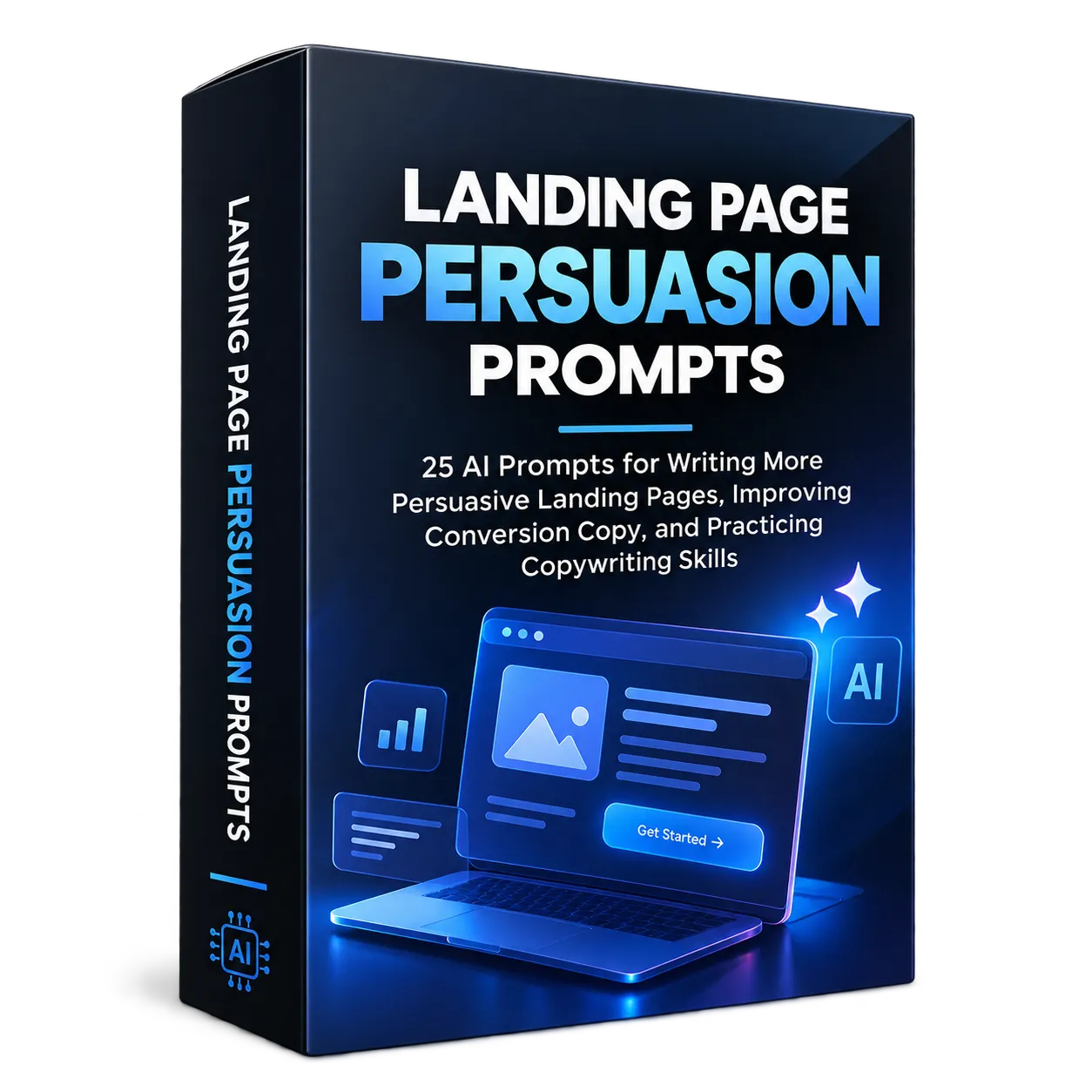
Use AI as a Landing Page Copywriting Practice Partner
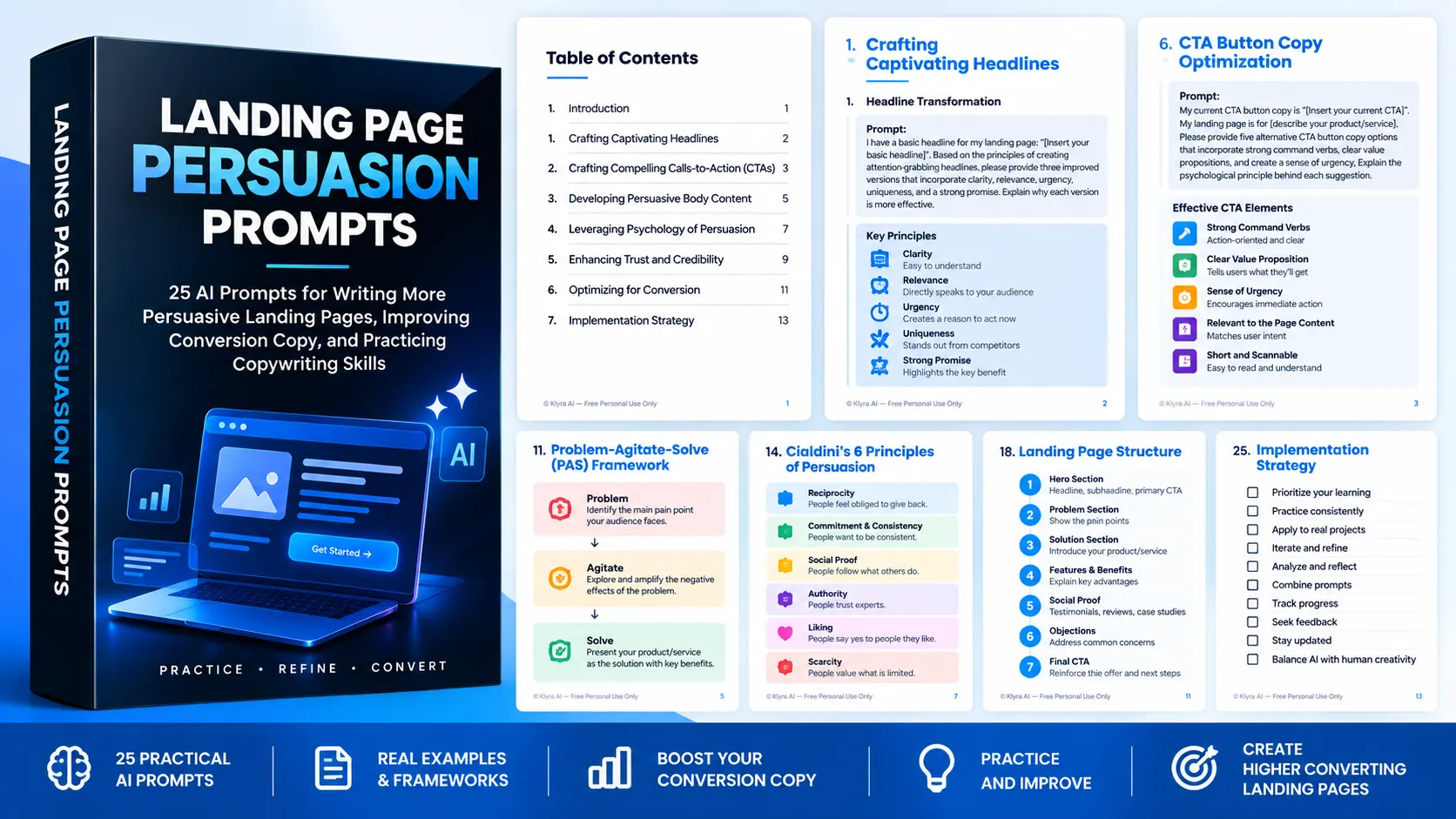
Landing page copy has to capture attention, communicate value, address concerns, build trust, and guide visitors toward action. Landing Page Persuasion Prompts provides a structured way to use an AI assistant while practicing these skills.
The prompt pack contains 25 prompts covering the major components of persuasive landing page copy. Each prompt gives you a defined task and asks the AI to provide an output, analysis, explanation, or set of alternatives. This makes the resource useful not only for producing copy, but also for understanding why particular approaches may be effective.
The prompts can be applied to real landing pages, products, services, audiences, and copywriting challenges. The resource encourages users to treat AI output as a starting point and then refine it using their own knowledge of their brand, product, and audience.
Start With Captivating Headlines
The first group of prompts focuses on headlines, one of the most visible elements of a landing page.
Transform Basic Headlines
The headline transformation prompt takes an existing headline and asks the AI to create improved alternatives based on clarity, relevance, urgency, uniqueness, and a strong promise. It also asks the AI to explain why each version may be more effective.
Test Different Headline Approaches
The headline A/B testing prompt generates headline pairs for a specific audience and asks the AI to approach them through different psychological triggers, such as curiosity, scarcity, and social proof. This provides a structured starting point for exploring different messaging directions.
Analyze Competitor Headlines
The industry-specific headline prompt allows you to provide competitor headlines for analysis. The AI is asked to identify what makes each headline effective or ineffective and then suggest ways to create a differentiated approach.
Apply Headline Formulas
The resource also includes prompts for applying specific headline formulas, including approaches based on achieving a desired outcome within a timeframe, solving a problem in a defined number of ways, and revealing a potential secret related to a desired outcome.
Consider Mobile Constraints
A dedicated prompt addresses mobile headlines by asking for options under 40 characters. The goal is to explore how a headline can retain impact while working within limited screen space.
Create More Compelling Calls-to-Action
After capturing attention, landing pages need clear ways for visitors to take the next step. The CTA prompts explore both the wording and context of calls-to-action.
Improve CTA Button Copy
The CTA button optimization prompt takes an existing CTA and generates alternatives using command verbs, value propositions, and urgency. Each option is accompanied by an explanation of the psychological principle behind it.
Match CTAs to Page Sections
The contextual CTA prompt considers the sections of a landing page and suggests primary and secondary CTAs for each one. This helps create a more logical conversion path rather than treating every CTA as an isolated element.
Personalize and Test CTAs
Other prompts explore personalized CTAs for different user personas, A/B test design, and exit-intent CTAs. The A/B testing prompt also considers CTA copy, button design, placement, psychological principles, and the metrics that can be used to evaluate the test.
Develop Persuasive Body Content
Strong landing page copy needs more than a headline and button. The resource includes prompts for developing body content that connects problems, features, benefits, objections, social proof, and stories.
Apply the Problem-Agitate-Solve Framework
The PAS prompt structures copy around a clear customer problem, deeper exploration of its negative effects, a solution, and the benefits of that solution. It also asks the resulting narrative to maintain a consistent tone and naturally lead toward a CTA.
Connect Features With Benefits
The feature-benefit prompt takes individual product or service features and asks the AI to identify the benefit each one provides. It also requests a one-sentence feature-benefit statement and a mini-story or use case showing the benefit in action.
Address Customer Objections
The objection-handling prompt focuses on three customer objections. For each one, the AI is asked to acknowledge the concern, develop a counter-argument, and suggest supporting evidence such as a testimonial or statistic.
Use Social Proof and Storytelling
The social proof prompt explores customer testimonials, usage statistics, awards or recognition, media mentions, and trust badges or certifications. The storytelling prompt develops a framework around a relatable protagonist, their challenge, discovery of the product, transformation, and positive outcome.
Use Psychology of Persuasion Responsibly
The resource dedicates a section to psychological techniques that can influence how visitors evaluate a landing page.
Explore Cognitive Biases
The cognitive bias prompt covers the anchoring effect, scarcity bias, loss aversion, bandwagon effect, and confirmation bias. Importantly, it asks for ethical cautions alongside the suggested applications so these techniques are considered without turning persuasion into manipulation.
Identify Emotional Triggers
The emotional trigger prompt asks the AI to identify five emotional triggers relevant to a particular offering. For each trigger, it explores why the emotion is relevant, provides a short copy example, and suggests where the appeal could appear on the page. It also asks how emotional appeals can be balanced with logical arguments.
Apply Persuasion Principles
Another prompt explores Robert Cialdini's six principles of persuasion: Reciprocity, Commitment/Consistency, Social Proof, Authority, Liking, and Scarcity. The exercise asks how each principle could be applied, what copy could demonstrate it, and what potential impact it could have on user behavior.
Make Decisions Easier and Build Trust
Visitors may hesitate when a landing page gives them too many decisions or fails to establish credibility. The resource therefore includes prompts for simplifying decisions and strengthening trust.
Use Decision-Making Shortcuts
The decision-making shortcuts prompt asks for five relevant approaches, such as default options or limited choices. Each approach is evaluated according to how it simplifies the decision, how it could be implemented, and what drawbacks or ethical considerations should be considered.
Strengthen Trust
The trust-building prompt explores elements such as security badges, money-back guarantees, and transparency about business practices. It asks how each element builds trust, how it could be presented in copy, and where it could be placed on the landing page.
Optimize the Landing Page for Conversion
The final group of prompts moves from individual copy elements toward the broader landing page experience.
Structure the Page Around Conversion
The landing page structure prompt asks for a recommended order of sections, suggested content for each section, CTA placement, and integration of social proof and trust elements. It also asks for the psychological reasoning behind the structure and how it guides visitors toward conversion.
Use Micro-Conversions
The micro-conversion prompt explores smaller actions that can gradually engage visitors, such as newsletter sign-ups or content downloads. Each action is connected to its value for the visitor and its relationship to the primary conversion goal.
Optimize for Mobile
The mobile conversion prompt addresses page structure, mobile-friendly copy, touch-oriented CTAs, and mobile-specific functionality. It asks for specific implementation examples and consideration of their effect on the mobile experience and conversion rates.
Consider Page Load Time
The load time prompt focuses on written content, visual usage, and above-the-fold prioritization. It asks for practical ways to optimize the landing page experience without losing the information visitors need.
Design CRO Tests
The final prompt creates a conversion rate optimization test plan covering elements such as headlines, CTAs, and page layout. It asks for variations, metrics, testing methods, and guidance for interpreting results.
A Practical Strategy for Using the Prompts
The resource concludes with an implementation strategy for getting more value from the prompt pack. It recommends starting with the prompts that address the most immediate needs or biggest challenges, then practicing consistently through regular sessions.
It also recommends applying the prompts to real projects whenever possible. Working with actual landing pages makes the exercises more relevant and gives the resulting copy an immediate practical context.
- Prioritize your learning: Begin with the prompts that address your most immediate needs or biggest challenges.
- Practice consistently: Work through prompts on a regular daily or weekly basis.
- Apply them to real projects: Use actual landing pages and copywriting work as the basis for exercises.
- Iterate: Treat AI responses as starting points and refine them using your understanding of the brand, product, and audience.
- Analyze and reflect: Review the AI's response and consider what you learned from the exercise.
- Combine prompts: As you become more comfortable, combine prompts or develop your own for more complex challenges.
- Track progress: Keep a record of your work and periodically review how your skills and understanding are developing.
- Seek feedback: Share AI-assisted work with colleagues or mentors to gain additional perspectives.
- Stay updated: Continue learning about developments in AI and copywriting and adapt your approach as new practices emerge.
- Balance AI with human creativity: Use AI to enhance your copywriting rather than replace your own insights, creativity, and understanding of your audience.
Use the Prompts to Build Better Copywriting Skills
Landing Page Persuasion Prompts is designed as a practical companion for developing landing page copywriting skills with AI assistance. Its 25 prompts provide structured exercises across headlines, CTAs, body copy, persuasion psychology, trust, conversion strategy, mobile optimization, and CRO testing.
The resource emphasizes practice and refinement rather than simply generating finished copy. By applying the prompts to real work, reviewing the results, seeking feedback, and maintaining a balance between AI assistance and human creativity, you can use the exercises to develop a deeper understanding of persuasive writing and consumer psychology.
Download the complete prompt pack to work through the full set of exercises and use them as a repeatable resource for your landing page copywriting practice.