Turn AI From an Idea Into a Practical Business Tool
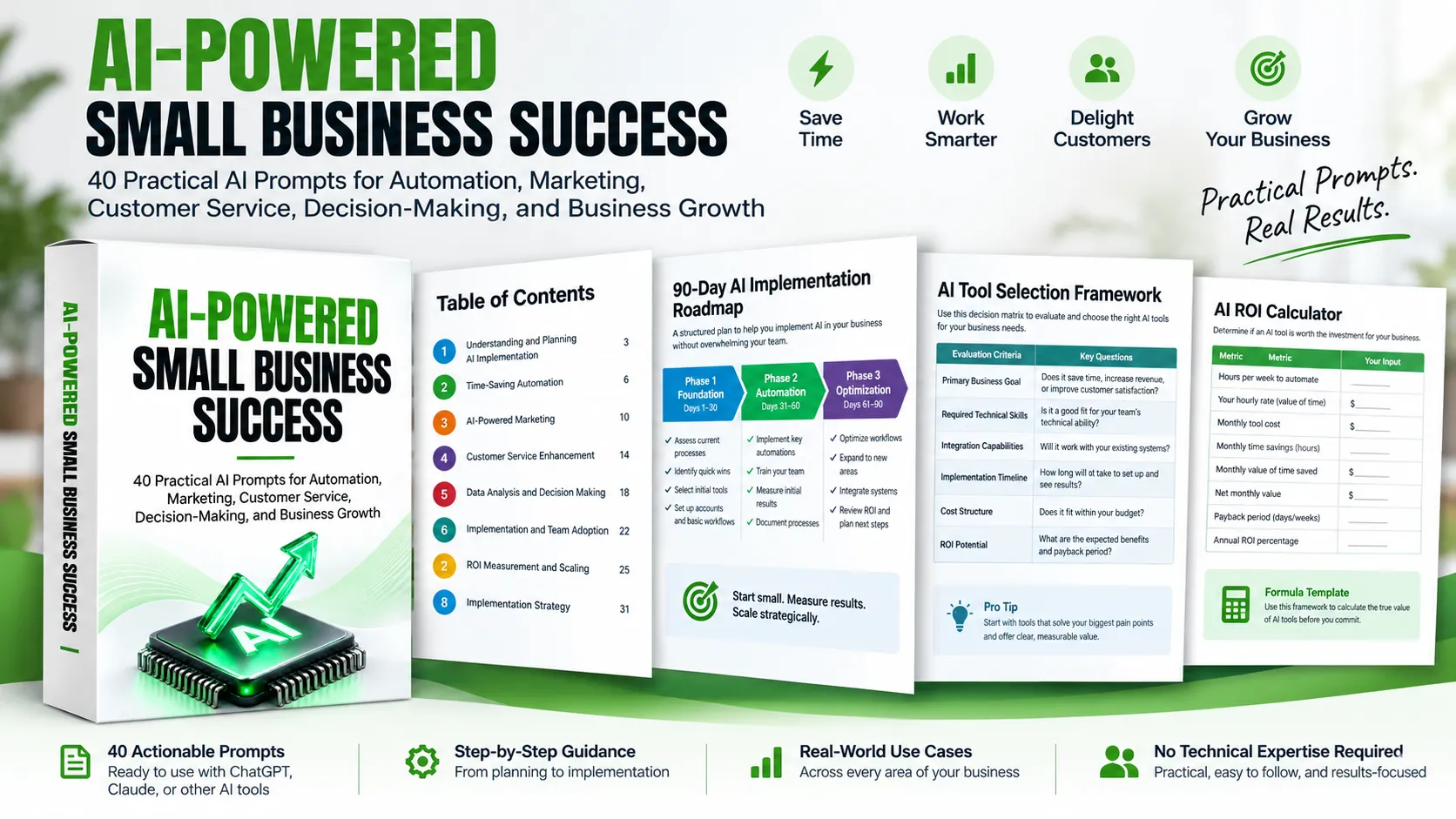
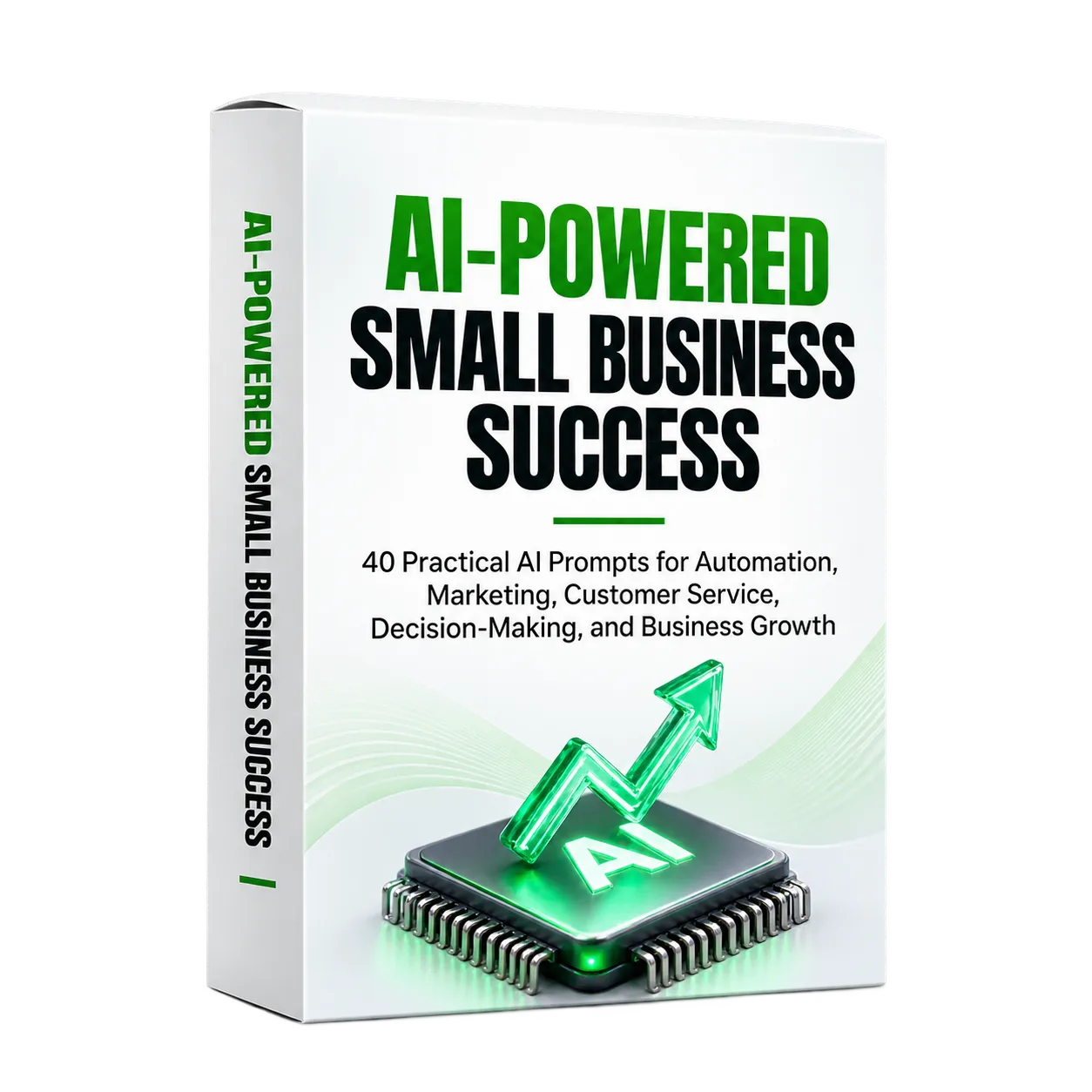
AI can be useful across many parts of a small business, but identifying where to begin can be difficult. AI-Powered Small Business Success approaches this problem through practical prompts that help business owners work through specific use cases with AI assistants.
The resource is built around a simple idea: start with a business problem, provide the relevant context, and use a structured prompt to develop an appropriate approach. Rather than requiring a business owner to understand every aspect of AI before getting started, the prompts provide a practical way to explore implementation opportunities.
The collection covers operational automation, marketing, customer service, data analysis, team adoption, ROI, scaling, and more advanced applications. The prompts are designed to be adapted using information about the business, such as its industry, existing processes, technology, budget, customers, team, and goals.
Start With Understanding and Planning
Effective AI implementation begins with understanding where AI can create value. The first group of prompts helps a small business examine its existing operations before choosing a tool or automation.
Audit Business Processes
The Business Process Audit Prompt helps identify repetitive tasks, work that consumes time without requiring deep thinking, and processes where relatively small improvements could have a meaningful business impact. This provides a starting point for identifying automation opportunities.
Build a 90-Day Implementation Roadmap
The AI Implementation Roadmap Creator organizes implementation into three phases: foundation, automation, and optimization. The goal is gradual implementation, with actions and milestones structured to avoid overwhelming the team.
Evaluate AI Tools Before Choosing Them
The AI Tool Selection Framework provides a decision matrix for comparing tools according to factors such as the primary business goal, required technical skills, integration capabilities, implementation timeline, cost structure, and potential ROI.
Understand the Economics of AI
The AI ROI Calculator Prompt helps evaluate whether an AI investment is worthwhile by considering time savings, the value of time saved, tool costs, payback period, and annual ROI.
The resource also includes an AI Terminology Simplifier covering concepts such as machine learning, AI, automation, natural language processing, API integration, workflow automation, predictive analytics, generative AI, and prompt engineering.
Use AI to Save Time Through Automation
A major section of the resource focuses on practical ways to reduce repetitive work. The prompts address workflows that frequently require recurring manual effort.
- Email automation: Design welcome, prospect follow-up, abandoned-cart or incomplete-inquiry, re-engagement, thank-you, and review-request sequences.
- Meeting scheduling: Create systems that synchronize calendars, allow clients to book appointments, send reminders, manage cancellations and rescheduling, and collect information before meetings.
- Document processing: Explore automation for invoices, contracts, document storage and retrieval, form completion, data extraction, and approval workflows.
- Social media scheduling: Develop systems for batching, scheduling, content repurposing, recurring content themes, common engagement responses, and performance reporting.
- System-to-system workflows: Identify opportunities to connect software systems, reduce duplicate data entry, and minimize manual data transfers and errors.
Apply AI Across Marketing
The marketing prompts focus on creating more structured and targeted marketing processes while reducing the time required to manage them.
Build a Sustainable Content System
The Content Calendar Generator helps create a content plan aligned with business goals and audience interests. It covers multiple content formats, specific content ideas, AI tool recommendations, and a sustainable publishing schedule.
Develop Customer Personas
The Customer Persona Development prompt helps organize information about customer demographics, psychographics, pain points, goals, preferred communication channels, buying behaviors, and triggers. The intended purpose is to improve marketing precision and message relevance.
Develop an AI-Assisted Social Strategy
The AI-Powered Social Media Strategy prompt addresses platform-specific strategies, suitable content types, AI tools for content creation and scheduling, engagement automation, performance metrics, and a manageable weekly workflow.
Improve Email and Advertising
The AI Email Campaign Optimizer covers subject lines, email structure, personalization, A/B testing, and segmentation. The Precision Ad Targeting Framework covers audience segmentation, lookalike audiences, behavioral targeting, creative optimization, budget allocation, and performance tracking.
Improve Customer Service With AI
The customer service section focuses on using AI for routine interactions while maintaining appropriate opportunities for human involvement.
The Chatbot Development Guide helps businesses plan a customer service chatbot around common questions, conversation flows, brand-aligned personality and tone, system integrations, and quality testing.
The 24/7 Support System Designer goes further by helping determine which inquiries should be handled by AI and which should be handled by people. It also addresses AI-to-human transfers, after-hours workflows, training data, and integration with customer systems.
Other prompts address proactive customer outreach, customer feedback analysis, and training AI customer service systems to represent a company's brand voice. The customer feedback framework covers collecting feedback from reviews, surveys, and support interactions, identifying sentiment and themes, prioritizing issues, creating reports, and tracking improvements.
Use Data to Improve Business Decisions
The resource also moves beyond automation into AI-assisted analysis and decision-making.
Business Intelligence
The Business Intelligence Dashboard Designer helps identify important KPIs, select appropriate visualizations, establish alert thresholds, analyze trends, and determine implementation requirements based on technical ability.
Predictive Analytics
The Predictive Analytics Implementation prompt provides a process for identifying valuable prediction opportunities, determining data requirements, selecting appropriate tools, planning implementation, and validating prediction accuracy. Suggested areas include sales, inventory needs, and customer behavior.
Customer Segmentation and Inventory
The Customer Segmentation Analyzer focuses on segmentation criteria, data requirements, implementation tools, actions for individual segments, and ongoing refinement. The Inventory Optimization System addresses demand forecasting, reorder points and quantities, stockout warnings, excess inventory identification, and integration with existing systems.
Balance AI Insights With Human Judgment
The Decision-Making Framework with AI Inputs emphasizes defining the decision, identifying relevant data and AI analysis, balancing AI recommendations with human judgment, planning implementation, and creating a feedback loop based on outcomes.
Make AI Adoption Work for the Team
Introducing AI is not only a technology exercise. The resource includes prompts for helping people adopt new AI-supported workflows.
The Team AI Training Program covers progressive learning from basic to advanced usage, role-specific training, practical exercises, resistance points, and adoption metrics. The Change Management Plan focuses on communicating the value of AI, addressing concerns about job replacement, developing AI champions, managing resistance, and celebrating early wins.
The resource also provides an AI Process Documentation Template covering process goals, workflow steps, AI configuration, system integrations, troubleshooting, performance metrics, and success criteria.
Troubleshoot Implementation Problems
The AI Implementation Problem-Solver addresses technical integration issues, data quality problems, team resistance, budget and ROI concerns, and workflow disruption during transitions.
Consider Ethics and Privacy
The AI Ethics and Privacy Framework addresses data collection and usage policies, transparency about AI use, bias prevention, data security, and compliance with relevant regulations.
Measure Results and Prepare to Scale
The resource recommends measuring AI implementation rather than treating adoption as an end in itself. The AI ROI Tracking System focuses on time saved, revenue increases attributable to AI, cost reductions, customer satisfaction improvements, and employee productivity gains.
The AI Scaling Readiness Assessment helps evaluate whether a business is ready to expand its AI implementation based on the success of current initiatives, team proficiency, data quality, integration readiness, budget availability, and clear objectives for the next phase.
For businesses that have already implemented basic AI tools, the Advanced AI Implementation Roadmap introduces areas such as predictive analytics, advanced customer behavior analysis, AI-powered inventory or resource management, enhanced personalization, and integrated business intelligence systems.
Connect AI Systems and Plan for the Future
As businesses use more AI tools, integration becomes an important consideration. The AI Integration Optimization Plan helps identify integration gaps, prioritize opportunities by business impact, connect AI systems, optimize data flows, and measure integration effectiveness.
The resource also includes an AI Competitive Analysis Framework for examining competitor AI implementations, evaluating their strategies, identifying opportunities for differentiation, prioritizing initiatives, and tracking relevant industry trends.
For ongoing planning, the AI Trend Monitoring System helps businesses identify reliable sources, separate practical developments from hype, evaluate relevance to the business, plan implementation timelines, and balance innovation with practical needs.
Additional advanced prompts address voice AI implementation, AI-powered video creation, personalized customer experiences, and evaluating potential business pivots or new product directions.
A Practical Implementation Path
The final section brings the prompts together into a practical sequence. It recommends beginning with an assessment and a quick win, measuring the result, documenting the new process, sharing early wins with the team, and then expanding strategically.
- Assess the business: Use the process audit to identify time-consuming tasks and opportunities.
- Create a roadmap: Establish a structured implementation plan rather than adopting tools without direction.
- Start with one simple automation: The resource specifically points to email automation or meeting scheduling as potential starting points.
- Measure results: Use the ROI tracking system to understand the impact of the implementation.
- Document the process: Create a reference that supports consistency and team adoption.
- Expand strategically: Choose the next AI application based on the business's needs and roadmap.
- Build integrated systems: Look for opportunities to connect tools and reduce manual transfers.
- Train and empower the team: Develop AI skills and identify potential AI champions.
- Continuously optimize: Reassess readiness, monitor relevant developments, and continue measuring ROI.
The resource's central implementation guidance is to start small, focus on business problems rather than technology, document processes, test before committing, expect adjustments, balance automation with human interaction, and revisit AI opportunities as the business evolves.
Used this way, the 40 prompts become more than a collection of AI instructions. They provide a structured starting point for identifying opportunities, testing practical applications, involving the team, measuring outcomes, and gradually expanding AI across a small business.
Download the complete resource to access all 40 prompts and use them directly with your preferred AI assistant.