A Practical Framework for AI-Powered Content Marketing
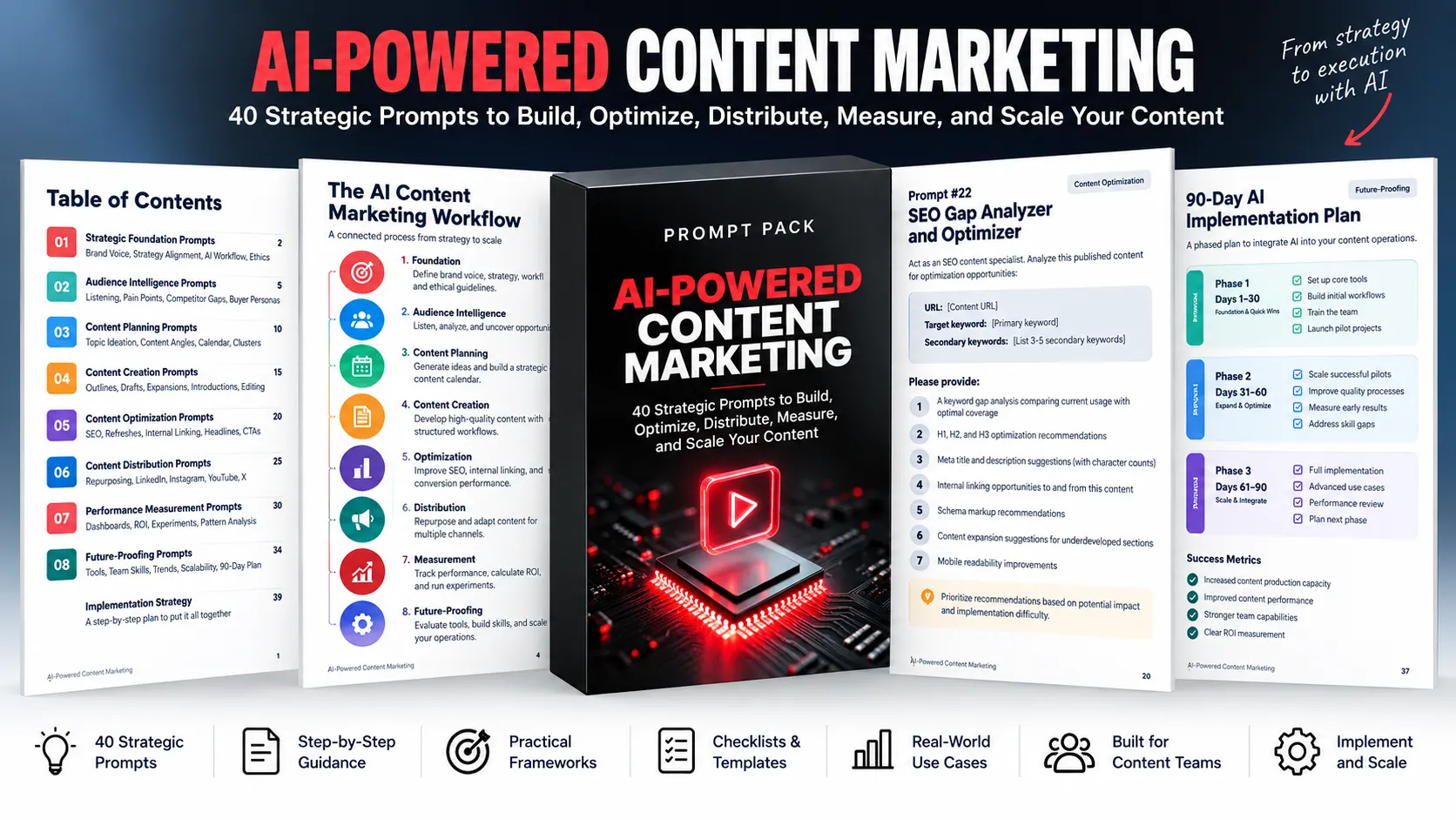
AI can be applied to far more than writing a first draft. Effective AI-powered content marketing requires a connected approach that begins with strategy and audience understanding, moves through planning and production, and continues into optimization, distribution, measurement, and ongoing improvement.
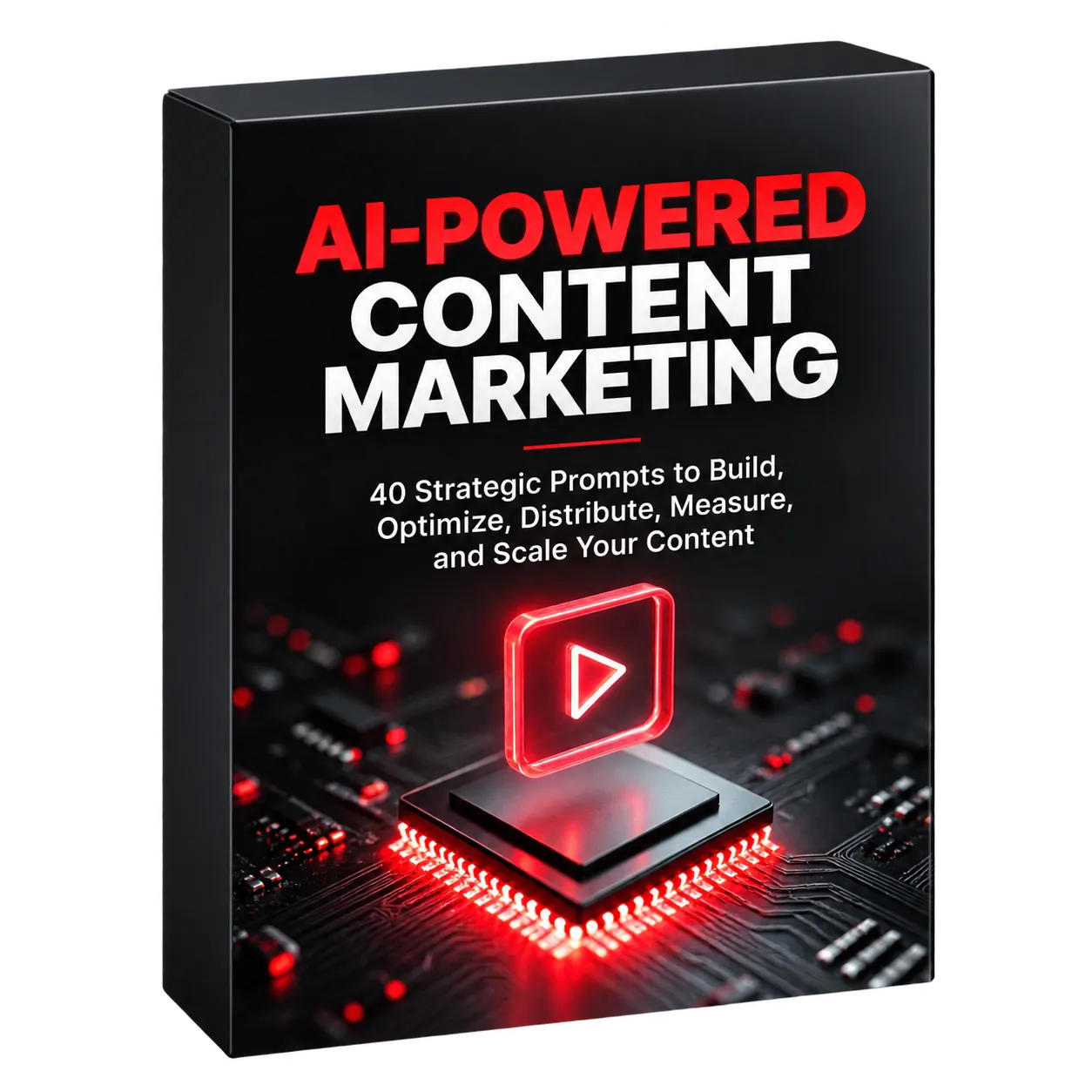
This resource brings those activities together through 40 structured prompts. Rather than treating AI as a single content-generation tool, the collection provides prompts for different stages of the content marketing operation, allowing teams to apply AI where it can support research, planning, creation, optimization, distribution, analysis, and scalability.
Start With Strategic Foundations
The first stage focuses on creating the foundation that should guide AI-assisted content work. The Brand Voice DNA Generator helps turn examples of existing content into a reference for tone, sentence structure, vocabulary, prohibited language, and stylistic preferences.
The Content Strategy Alignment Mapper connects content planning with business goals, audience segments, key performance indicators, and current content challenges. It also considers which content activities are better suited to AI assistance or human creation and how approval workflows can differ according to content risk.
The AI Content Workflow Designer then addresses the operational side of implementation. Its prompt is designed to identify where AI can provide value, define AI and human responsibilities, establish quality checkpoints, consider potential bottlenecks, and maintain brand standards.
The foundation stage also includes an ethical guidelines prompt covering responsible AI use, transparency, fact-checking, bias mitigation, and potential responses to AI content failures.
Build Audience Intelligence
Content becomes more useful when it reflects the questions, challenges, and interests of its intended audience. The audience intelligence prompts are designed to make research an ongoing activity rather than a one-time exercise.
Listen to the Audience
The AI Listening Stack Constructor helps structure an audience research system around sources such as social platforms, review sites, and forums. It asks for specific signals to monitor, collection frequencies, AI tools for processing information, an analysis framework, and privacy considerations.
Identify Pain Points and Market Gaps
The Audience Pain Point Extractor is designed to surface meaningful patterns from audience data. The Competitor Content Gap Analyzer examines opportunities created by gaps in competing content, while the Dynamic Buyer Persona Generator helps translate audience information into more useful audience profiles.
Connect Research With Search Intent
The Search Intent Decoder connects audience and market insights with SEO strategy. This creates a bridge between understanding what people need and developing content that addresses the underlying intent behind their searches.
Create a Systematic Content Engine
Once the strategic and audience foundations are established, the resource moves into content planning and production.
Generate and Organize Content Ideas
The Infinite Topic Generator supports systematic topic development. The Content Angle Diversifier helps explore different ways to approach a subject, while the Strategic Content Calendar Builder turns content opportunities into a structured publishing plan aligned with business objectives.
The Content Cluster Architect extends planning into broader content structures by considering relationships between cluster content, questions to address, internal linking, and SEO metadata. The Content Ideation Template Customizer provides reusable structures for problem-solution articles, comparison content, how-to guides, thought leadership, and case studies.
Develop Content in Controlled Stages
The content creation prompts emphasize structured development rather than relying on a single request for a finished article. The Goldilocks Prompt helps establish an appropriate level of detail, while the Chained Outline-to-Draft Developer separates outlining from drafting.
The Section-by-Section Content Expander provides another controlled approach by developing a comprehensive piece one section at a time. The Voice-Calibrated Introduction Generator focuses specifically on creating introductions that reflect a defined brand voice while addressing audience challenges and incorporating a primary keyword.
Protect Content Quality
The Four-Pass Content Editor provides a structured editing approach, while other content development prompts address strengthening arguments, adding relevant data points, improving practical applications, and creating smoother transitions.
The overall workflow therefore treats AI-assisted creation as a process that includes planning, drafting, review, and refinement rather than simply generating text and publishing it.
Optimize Content for Search and Conversion
Content performance depends not only on what is written but also on how the content is structured, connected, presented, and optimized.
Improve Existing Content
The SEO Gap Analyzer and Optimizer evaluates published content for keyword gaps, heading improvements, metadata, internal linking, schema opportunities, content expansion, and mobile readability. The prompt also asks users to prioritize recommendations according to potential impact and implementation difficulty.
The Content Refresh Strategist provides a structured way to identify opportunities to update existing content rather than treating published content as permanently finished.
Strengthen Internal Connections
The Internal Linking Architect focuses on relationships between content pieces. This supports a more connected content structure by considering relevant links between related resources and identifying opportunities to strengthen the broader content system.
Improve Clicks and Actions
The Headline Performance Optimizer generates alternative headlines using different psychological triggers while considering the primary keyword and search and social performance. The Call-to-Action Optimizer evaluates CTAs in relation to the target audience, conversion objective, and funnel stage.
The Content Conversion Path Designer extends this work by considering how individual content assets can contribute to a broader path toward a desired conversion.
Turn One Content Asset Into Multiple Formats
Creating a strong piece of content does not have to mean creating every subsequent format from scratch. The Content Atomization Planner is designed to transform flagship content into multiple distribution assets.
The prompt includes social posts, email newsletter angles, infographic or data visualization concepts, video outlines, community discussion questions, presentation content, and podcast ideas. It also asks for recommendations around format, length, style, and distribution timing.
Channel-specific prompts then adapt content for professional and social platforms. The collection includes adapters for LinkedIn and Instagram, a YouTube script generator, and a Twitter/X thread creator. The purpose is not simply to duplicate the original content, but to reshape it for the requirements of each channel.
Measure What Content Is Doing
The resource treats measurement as part of the content operation rather than an activity that happens only after publishing.
Build a Performance Dashboard
The Content Performance Dashboard Designer organizes measurement around business objectives. It considers primary metrics for different content types, leading indicators, lagging indicators, AI-specific performance metrics, visualization recommendations, reporting frequency, and action triggers for optimization.
Connect Content to ROI
The Content ROI Calculator provides a framework for examining production costs, distribution channels, conversion goals, customer value, and attribution. It also considers tracking accuracy, performance evaluation, executive reporting, and leading indicators that may predict eventual ROI.
Use Experiments and Performance Patterns
The Content Experiment Designer and Performance Pattern Analyzer introduce an iterative approach to optimization. Experiments can be structured around hypotheses, variables, controls, sample sizes, success metrics, evaluation criteria, duration, and implementation steps. Performance analysis then looks for recurring characteristics among stronger-performing content.
Build for Long-Term Content Operations
The final group of prompts moves beyond individual pieces of content and addresses the capabilities required to operate an AI-assisted content system over time.
Evaluate Technology and Skills
The AI Content Technology Evaluator helps assess tools according to workflow challenges, content volume, quality standards, budget, integrations, implementation requirements, quality control, ROI, risks, and future-proofing.
The Content Team Skills Gap Analyzer addresses the human side of AI adoption. It considers the skills required for AI-augmented content production, individual skill gaps, training, role evolution, performance measurement, and future capabilities.
Respond to Trends
The Trend-Response Content Planner provides a framework for responding to emerging developments. It covers trend monitoring, response protocols, rapid content formats, distribution, success metrics, resource allocation, and risk assessment.
Scale Content Production
The Content Scalability Architect addresses how an organization can increase production capacity while maintaining quality. Its framework considers content architecture, workflows, resource optimization, technology requirements, scalable quality control, performance tracking, and implementation phases.
A 90-Day Approach to Implementation
The resource concludes with a structured implementation strategy for putting the prompt collection into practice.
- Weeks 1-2: Build the foundation. Establish brand voice, content strategy, AI workflow design, and ethical guidelines.
- Weeks 3-4: Develop audience intelligence. Create systems for audience listening, pain-point analysis, competitor gaps, buyer personas, and search intent.
- Weeks 5-8: Establish the content engine. Build topic ideation, content planning, drafting, expansion, and editing workflows.
- Weeks 9-10: Optimize distribution. Atomize flagship content and adapt it for different channels.
- Weeks 11-12: Measure and iterate. Introduce performance dashboards, ROI measurement, and performance analysis.
- Ongoing: Future-proof operations. Continue evaluating technology, team capabilities, trends, scalability, and the broader AI content operation.
The complete resource provides the individual prompts behind each stage, making it possible to move from strategic planning to practical execution without treating content generation as an isolated AI task.
What the Complete Resource Provides
With 40 prompts spanning strategy, audience intelligence, content creation, optimization, distribution, measurement, and future-proofing, the resource is designed as a working reference for building an AI-assisted content marketing operation. The full collection provides the detailed prompt templates and inputs needed to apply each framework to a specific business, audience, workflow, or content program.