What Is the Goldilocks Prompt Formula?
AI-assisted content creation often produces disappointing results for a simple reason: the instructions do not give the AI enough useful direction. A request such as "write about pricing" leaves the tool to determine the audience, purpose, tone, structure, depth, and boundaries on its own.
The opposite approach can create another problem. When a prompt contains too many unstructured instructions, the AI may become confused and address some requirements while overlooking others.
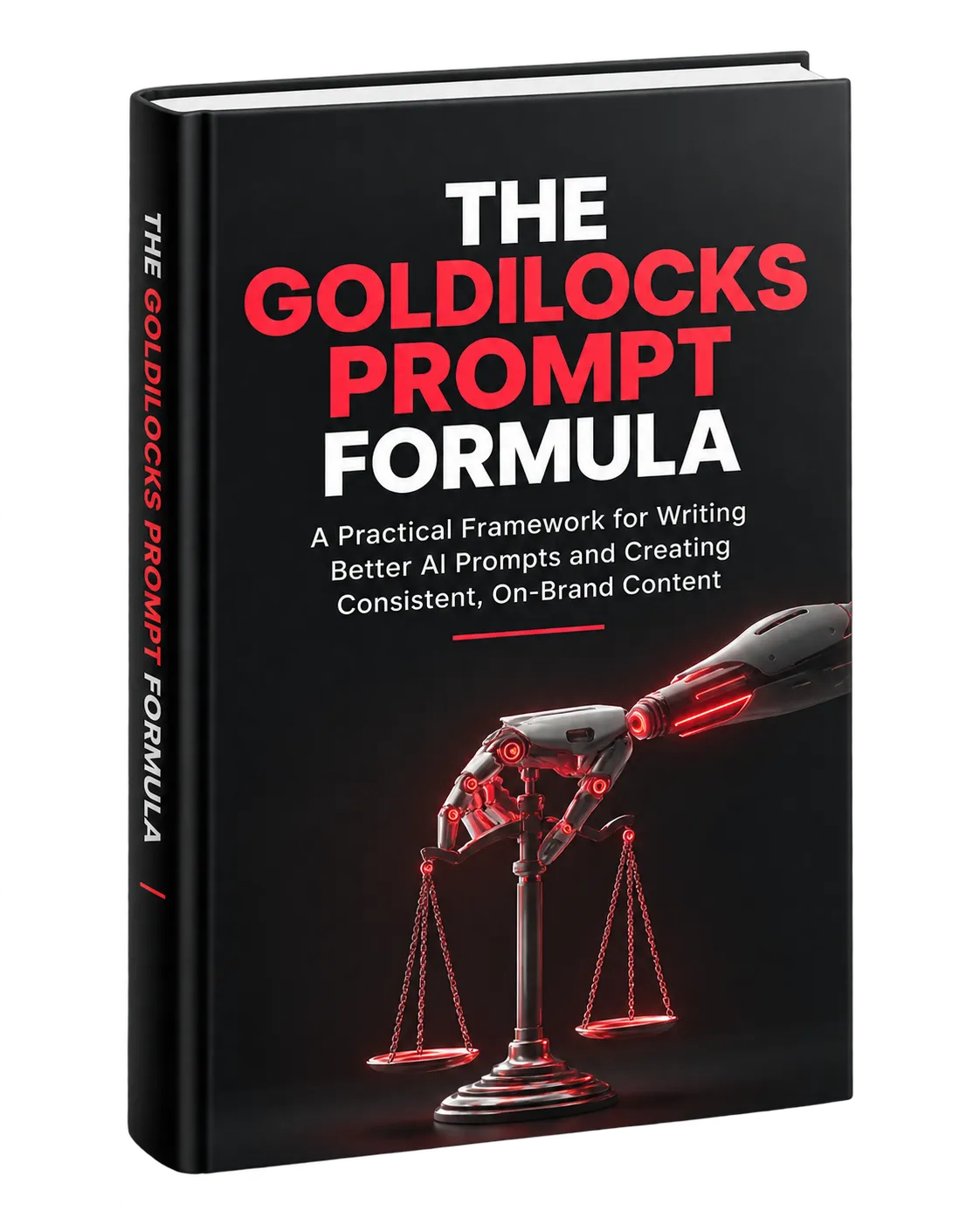
The Goldilocks Prompt Formula is designed to sit between these extremes. It provides a systematic structure for creating prompts that are specific enough to guide the output while remaining practical and adaptable.
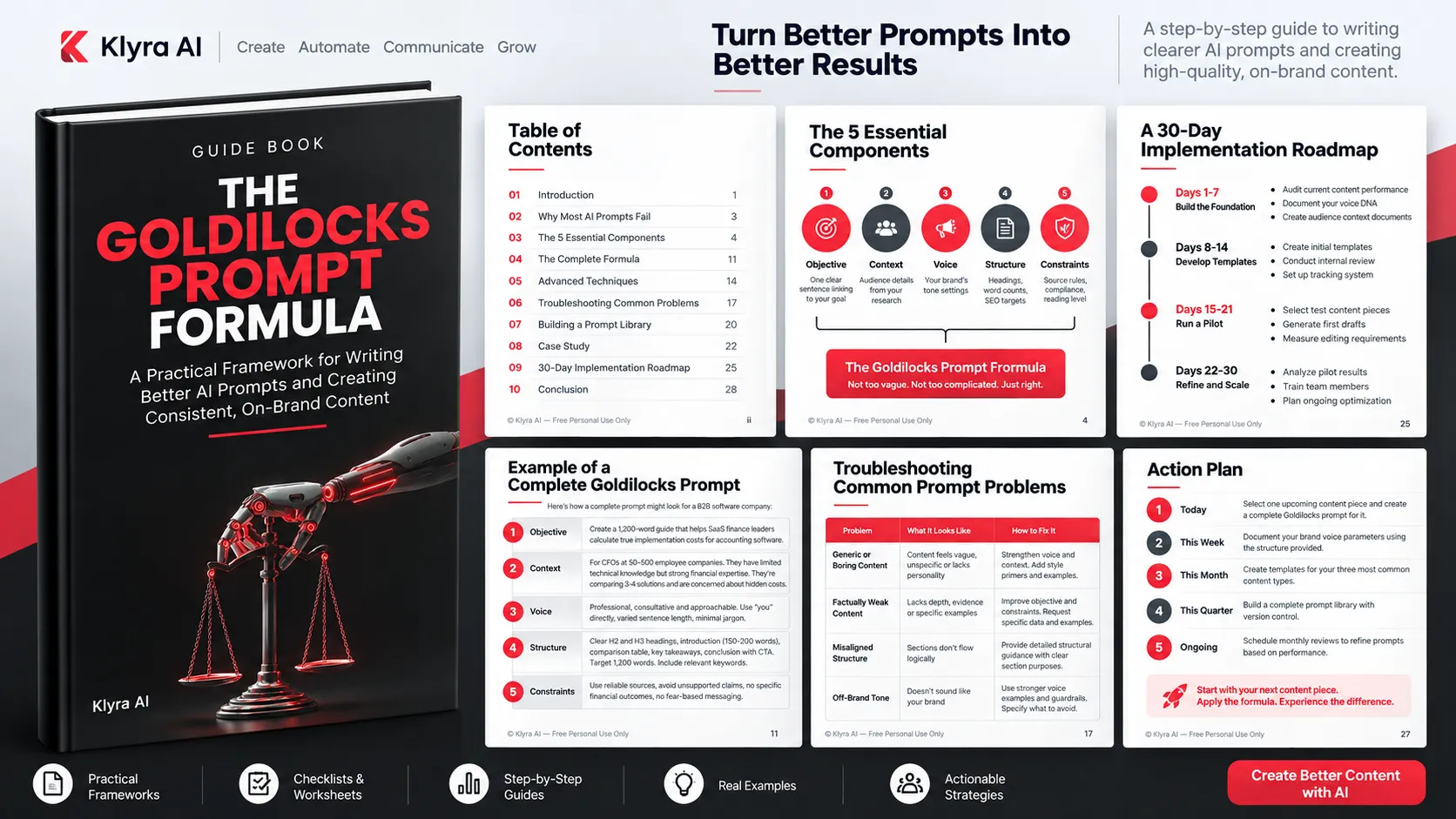
The formula is built around five essential components:
- Objective: The specific purpose of the content and the goal it should support.
- Context: Information about the intended audience and their situation.
- Voice: Instructions that define the desired brand tone and writing style.
- Structure: Guidance about organization, headings, length, content elements, and SEO requirements.
- Constraints: Boundaries covering sources, compliance, reading level, claims, and topics or approaches to avoid.
Why Most AI Prompts Fail
The Vague Request Trap
A vague request asks AI to make too many decisions without sufficient guidance. For example, asking AI to "write about pricing" does not explain what the content should accomplish, who should read it, or what perspective it should take.
Without those details, the resulting content can be generic and require substantial revision.
The Kitchen Sink Approach
The opposite problem occurs when a prompt is overloaded with instructions that are not organized into a clear framework. Too many unstructured requirements can result in an output that addresses some points while missing others.
The Missing Context Problem
AI also needs useful information about the audience and situation. Without audience details and business context, content may be technically correct but strategically disconnected from the people it is intended to serve.
The Tone Drift Issue
When voice guidance is missing or too general, AI-generated content can sound generic or inconsistent with an established brand voice. Clear voice parameters help provide a more consistent direction.
The Five Essential Components
1. Objective: Set Clear Direction
The objective explains what the content is supposed to accomplish. It should be expressed as one clear sentence that connects the content to a meaningful goal.
A strong objective is more than a topic. It can specify the content type, approximate length, desired reader action, and unique angle or perspective.
For example, instead of simply asking AI to write about pricing, the guide provides a stronger objective for a pricing comparison guide aimed at B2B SaaS prospects. The objective defines the approximate length, audience goal, and intended positioning.
When refining an objective, consider four questions:
- What specific content type do you need?
- What approximate length works for the purpose?
- What action should readers take after consuming the content?
- What unique angle differentiates the content from similar material?
2. Context: Help AI Understand the Audience
Context gives AI information about who will read the content and the circumstances in which they will encounter it.
The guide recommends documenting several important elements:
- The target persona's role and industry.
- Their knowledge level about the subject.
- The current pain points they are experiencing.
- Their stage in the buying journey.
- The competitive alternatives they are considering.
For example, "for business users" provides very little direction. A more useful context description can identify a specific role, company size, knowledge level, buying stage, and concerns about the decision.
To develop context for your next piece of content, identify the primary audience, list characteristics about their role, determine their knowledge level, identify their buying journey stage, and document their main concerns or objections.
3. Voice: Maintain Brand Consistency
Voice instructions help AI produce content that follows a defined style instead of defaulting to a generic writing approach.
The guide identifies several voice parameters to consider:
- Overall tone descriptors.
- Sentence length and variation.
- Vocabulary and industry terminology.
- Humor and personality.
- Formality level.
- How the reader should be addressed.
A useful voice instruction can be considerably more specific than simply saying "professional tone." The guide's example describes a consultative but approachable voice, direct use of "you," varied sentence length, controlled jargon, and specific boundaries around humor and confidence.
To calibrate your voice, select a piece of existing content that represents your brand well. Identify the characteristics that make it sound like your brand, examine sentence and word-choice patterns, and turn those observations into a concise voice description.
4. Structure: Define the Organizational Framework
Structure tells AI how the content should be organized. It can include section headings, subheading hierarchy, approximate word counts, required content elements, keyword placement, and calls to action.
Instead of asking AI to "make it well-structured," provide a clear blueprint. Specify the introduction, main sections, approximate length, required lists or examples, conclusion, keywords, and call-to-action requirements.
A structure blueprint can be developed by:
- Sketching the ideal section structure.
- Assigning approximate word counts.
- Identifying where lists, examples, or quotes should appear.
- Identifying primary and secondary keywords.
- Drafting the desired call to action.
This gives the AI a defined organizational framework while allowing the content itself to be generated within those boundaries.
5. Constraints: Set Clear Boundaries
Constraints establish what the AI should and should not do. They can reduce the risk of content requiring significant revision because of compliance, editorial, sourcing, or brand requirements.
The guide recommends considering:
- Source requirements and citation style.
- Industry compliance limitations.
- Reading level targets.
- Topics or approaches to avoid.
- Fact-checking requirements.
Instead of saying "keep it compliant," define the actual boundaries. The guide provides examples such as avoiding unsupported performance claims, attributing statistics to sources, avoiding specific financial outcomes, avoiding medical advice or health claims, and avoiding fear-based messaging around security threats.
Constraint development should begin with the requirements of the industry and content type. Identify regulatory issues, topics to avoid, the appropriate reading level, citation requirements, and brand safety considerations.
Combine the Five Components
The real value of the formula comes from combining all five components into one prompt.
A complete Goldilocks prompt follows this basic structure:
- Objective: Define the content goal and its connection to business objectives.
- Context: Describe the audience and their situation.
- Voice: Define the desired tone, style, and language.
- Structure: Specify organization, content elements, length, and SEO requirements.
- Constraints: Define boundaries, compliance requirements, limitations, and sourcing rules.
The guide's complete formula begins with a statement that content should be created according to these five specifications and asks the AI to maintain the guidelines throughout the draft.
This creates a repeatable prompt structure that can be adapted for different content needs instead of starting from scratch every time.
Advanced Techniques for Better Prompts
Style Primers
A style primer gives AI a short example of the desired writing style. Instead of describing every characteristic abstractly, you provide a sample that demonstrates how the brand communicates.
This can help clarify tone, sentence patterns, vocabulary, pacing, and personality.
Role-Based Instructions
Role-based instructions ask AI to approach content from a specific professional perspective. The guide uses the example of asking AI to approach content as an experienced CFO who understands software implementation and its financial implications.
The purpose is to provide additional perspective for the particular content being created.
Audience Empathy Prompting
Prompts can explicitly instruct AI to acknowledge the emotions and concerns of the intended audience. The guide's example focuses on the frustration and anxiety finance leaders may experience when dealing with unexpected costs and their need for predictability and control.
Competitive Positioning Guidance
When content needs to position a solution against alternatives, the prompt can provide clear positioning instructions without requiring direct criticism of competitors.
The guide's example focuses on emphasizing transparency, an all-inclusive pricing model, and a detailed implementation roadmap while acknowledging that implementations still require internal resources.
Tiered Content Structuring
Content can also be designed for different reading patterns. The guide identifies three groups:
- Skimmers: Readers who need bold subheadings and bulleted summaries.
- Browsers: Readers who select particular sections and benefit from clear introductions and conclusions.
- Deep readers: Readers who want detailed examples and supporting evidence.
Troubleshooting Common Prompt Problems
Even a structured prompt may require refinement. The guide provides a troubleshooting approach based on the type of output problem.
Generic or Boring Content
If content feels generic, the guide recommends strengthening the voice and context components. More specific tone instructions, audience details, style primers, storytelling guidance, and example requirements can provide additional direction.
Factually Weak or Superficial Content
If the content lacks depth, strengthen the objective and constraints around evidence and detail. The guide recommends explicitly requesting specific evidence, examples, or data points and establishing minimum depth requirements for important topics.
Misaligned Structure or Flow
If sections do not connect logically, provide more detailed structural guidance. The guide recommends defining the purpose of each section and using transitions so that each section leads naturally into the next.
The example progression establishes the problem, explains why traditional approaches fail, introduces a new methodology, and then provides implementation guidance.
Off-Brand Tone or Voice
If content does not sound like the brand, the voice component may need stronger examples and guardrails. The guide recommends specifying both what AI should do and what it should avoid.
This can include positive examples of the desired tone and negative examples that demonstrate unacceptable phrasing, such as hyperbole, unexplained jargon, absolute claims, or condescending language.
Build and Maintain a Prompt Library
Effective prompts can become organizational knowledge rather than disposable instructions. The guide recommends building a systematic prompt library that captures successful approaches and supports consistent results.
Document Performance Outcomes
For each prompt, track relevant content performance metrics, revision time, team feedback, and audience response. This information can help identify which prompt structures consistently produce useful results.
Create Templates by Content Type
Develop standardized templates for recurring formats such as blog posts, social media content, email sequences, product pages, and case studies.
Each template should incorporate the five Goldilocks components while accounting for the requirements of its specific content format.
Implement Version Control
Assign version numbers to prompts, document changes, record why changes were made, and track performance differences between versions.
This creates a record of how prompts evolve and helps prevent the organization from reverting to less effective approaches.
Review Prompts Regularly
The guide recommends quarterly prompt reviews to update prompts based on performance data, incorporate new brand voice elements, adjust to changing strategic priorities, and refine prompts in response to AI platform updates.
Create a Prompt Style Guide
A prompt style guide can document required prompt elements, company-specific terminology, prohibited approaches or topics, and approval workflows for different content types.
The goal is to make prompt practices more consistent across teams and new employees.
Case Study: The Formula in Action
The guide presents a case study involving a B2B software company that struggled with inconsistent blog content, extensive editing, and content that frequently failed to meet strategic objectives.
The company's original process involved providing writers with basic topics and hoping for the desired result. After implementing the Goldilocks Prompt Formula, the company created a standardized blog content template using Objective, Context, Voice, Structure, and Constraints.
According to the case study, the reported results included:
- Editing time reduced by 68%.
- Blog publishing frequency increased from twice monthly to weekly.
- Organic traffic increased by 42% within three months.
- Content-attributed leads increased by 35%.
The team also reported that the structured approach eliminated the "blank page problem" while helping content remain aligned with strategic objectives and a consistent brand voice.
These figures are presented as results from the guide's case study rather than general performance expectations.
A 30-Day Implementation Roadmap
The guide provides a phased implementation plan for putting the formula into practice.
Days 1-7: Build the Foundation
- Audit current content performance and identify successful content and recurring revision issues.
- Document your voice DNA using successful content and specific examples.
- Create audience context documents covering personas, knowledge levels, pain points, buying stages, and typical questions.
Days 8-14: Develop Templates
- Create initial templates for common content types using all five components.
- Conduct an internal review and gather stakeholder and subject matter expert feedback.
- Set up a tracking system for prompt storage, version control, and performance metrics.
Days 15-21: Run a Pilot
- Select two or three upcoming content pieces that vary in type and complexity.
- Generate first drafts using the Goldilocks Formula and document the prompts and raw outputs.
- Measure the editing requirements and compare them with historical revision patterns.
Days 22-30: Refine and Scale
- Analyze pilot results and identify the prompt elements that worked best.
- Document the prompt creation workflow and template adaptation guidelines.
- Train team members through workshops and practical scenarios.
- Plan ongoing optimization through regular reviews and feedback loops.
The Action Plan
The guide concludes its implementation roadmap with a simple progression:
- Today: Select one upcoming content piece and create a complete Goldilocks prompt.
- This Week: Document your brand voice parameters using the framework.
- This Month: Create templates for your three most common content types.
- This Quarter: Build a complete prompt library with version control.
- Ongoing: Review and refine prompts based on performance.
From Prompting to a Repeatable Content System
The Goldilocks Prompt Formula presents prompting as both a structured discipline and an exercise in human judgment.
The five components provide the repeatable structure: objective, context, voice, structure, and constraints. Human expertise supplies the specific guidance needed to make those components relevant to a particular brand, audience, and business objective.
The guide emphasizes continuous improvement rather than trying to create a perfect prompt immediately. Document successful approaches, learn from weaker outputs, and update the prompt library based on performance.
Over time, this approach can turn individual prompts into reusable templates, documented processes, and institutional knowledge for content creation.
The complete resource provides the full framework, exercises, prompt examples, troubleshooting guidance, case study, implementation roadmap, and action plan needed to put the Goldilocks approach into practice.