AI Adoption Is a People Challenge
Organizations can invest in capable AI technology, secure leadership approval, complete training, and still struggle to achieve meaningful adoption. The problem may not be the technology or the implementation itself. It may be how people respond to the change.
AI can create deeper concerns than a conventional software rollout. Employees may wonder whether AI will affect their jobs, reduce the value of their expertise, change their responsibilities, or make them less important to the organization. Others may struggle with the complexity of AI systems or feel uncomfortable acknowledging that they use AI in their work.
For agencies and change management professionals, this creates an important responsibility: helping organizations bridge the gap between technological capability and human adoption.
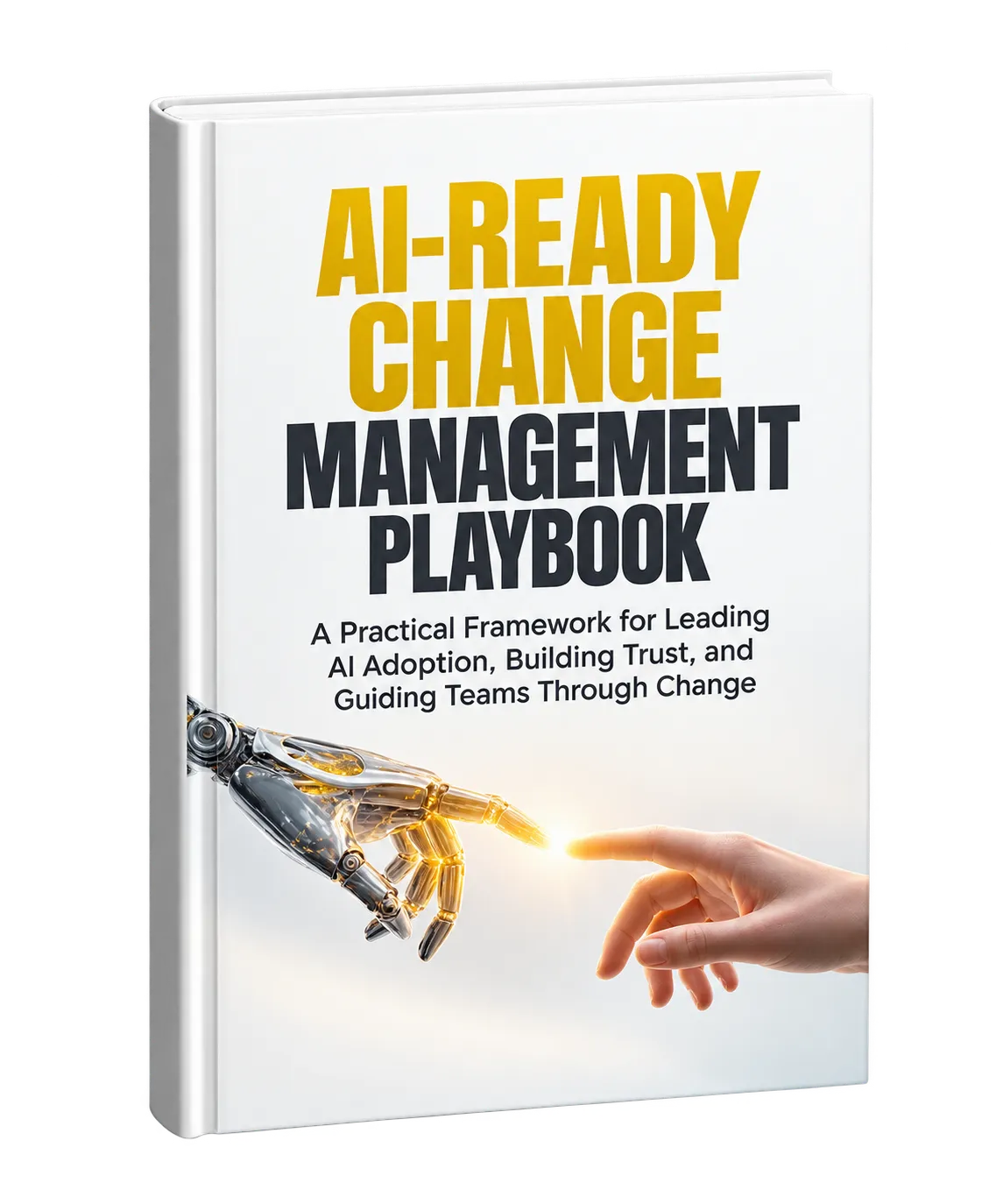
The AI-Ready Change Management Playbook approaches AI transformation from that human perspective. Instead of treating resistance as something to defeat, it treats resistance as information about what employees value, fear, and need in order to move forward.
Understand Why Teams Resist AI
Before an organization can successfully adopt AI, change leaders need to understand the reasons behind resistance.
The Psychology Behind AI Resistance
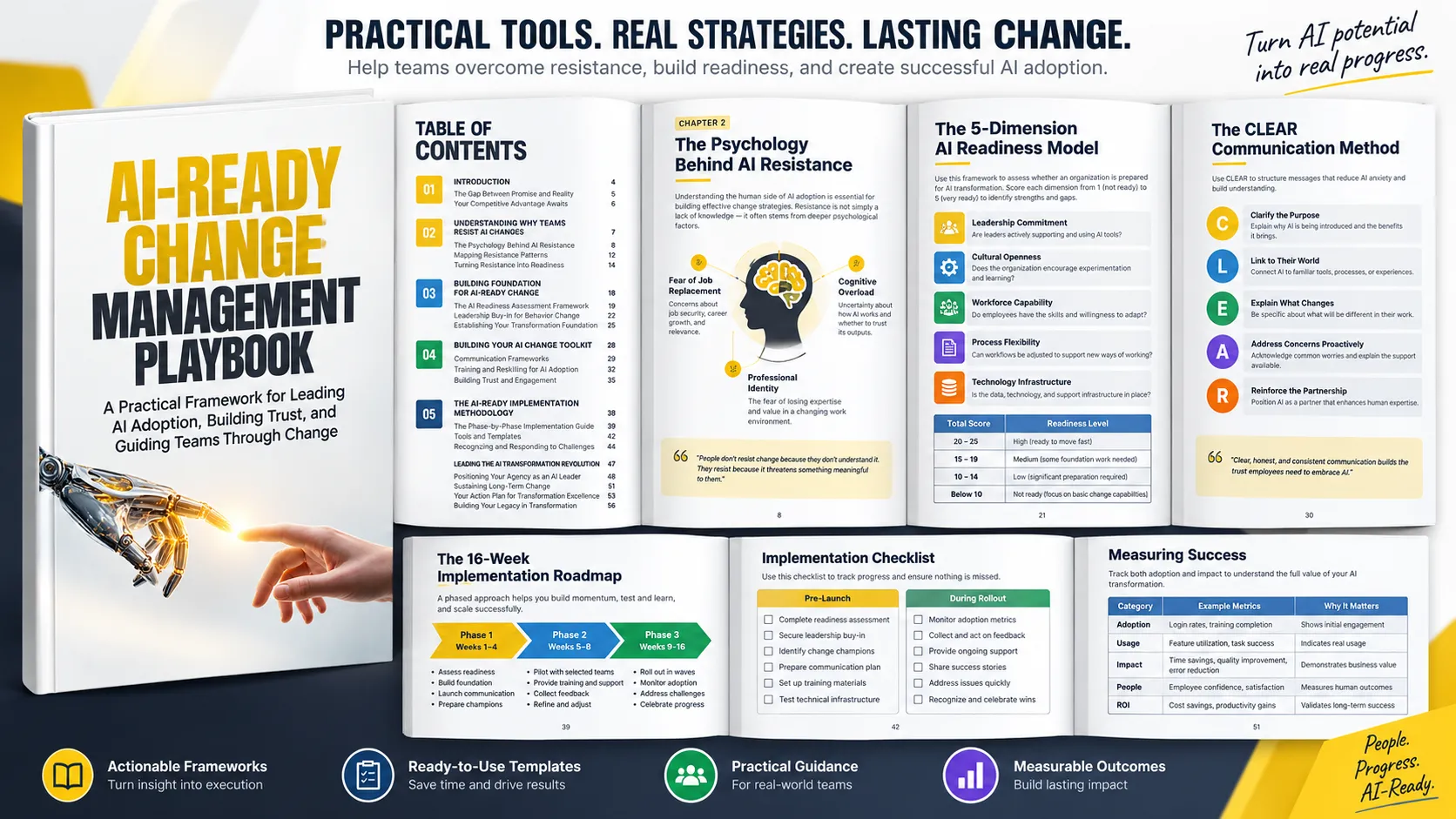
The playbook identifies three major psychological factors behind resistance to AI: fear of job replacement, cognitive overload, and threats to professional identity.
Fear of replacement extends beyond immediate concerns about losing a job. Employees may worry about becoming less valuable, losing opportunities for advancement, or being viewed as non-essential.
Cognitive overload can occur when people do not understand how an AI system reaches its outputs. Unlike familiar software where users can often see how a process works, AI can introduce a level of uncertainty that makes employees question whether they can trust the results.
Professional identity creates another layer of resistance. People often take pride in skills that have historically defined their roles. When AI begins performing tasks that were once considered uniquely human, employees may question the value of their expertise.
The response should not be to dismiss these concerns. The playbook recommends addressing them directly and helping employees redefine their roles around how human expertise and AI capabilities can work together.
Recognize Different Resistance Patterns
Resistance is not uniform. Different roles and departments can have different concerns.
- Early adopters are generally eager to experiment with new technology, although they can still encounter resistance from colleagues or managers.
- Middle managers may worry about losing authority or being caught between executive expectations and employee concerns.
- Sales teams may worry that AI could make customer relationships feel impersonal.
- Finance teams may be concerned about errors in AI-generated information and related business risks.
- Operations teams may be concerned about disrupting processes that already work well.
The playbook also presents resistance as a spectrum. Champions actively promote adoption, while blockers actively work against it. Between those extremes are supporters, skeptics, and passive resisters.
This matters because people can move along the spectrum. A skeptic can become a supporter after seeing evidence and experiencing benefits. Conversely, forcing change too quickly can push supporters toward resistance.
Identify Warning Signs Early
Deep-rooted resistance can reveal itself through declining training attendance, continued use of old processes, negative conversations about AI, delays in implementation, repeated job security concerns, or a pattern of focusing exclusively on problems.
Recognizing these signals early allows change leaders to investigate the underlying issue instead of treating every adoption problem as a technical problem.
Build AI Readiness Before Implementation
AI readiness is different from basic digital readiness. Digital readiness is largely about using established software and predictable workflows. AI readiness requires people and organizations to become comfortable working with systems that evolve and change over time.
The 5-Dimension Readiness Model
The playbook introduces a five-dimension assessment for understanding whether an organization is prepared for AI transformation.
- Leadership commitment: Assess whether leaders actively support the initiative, provide resources, discuss AI, and use the tools themselves.
- Cultural openness: Determine whether the organization encourages experimentation, learning, and adaptation or tends to resist change and mistakes.
- Workforce capability: Evaluate current digital skills, willingness to learn, and ability to adapt when processes change.
- Process flexibility: Assess how easily the organization can modify workflows and adopt new ways of working.
- Technology infrastructure: Examine data quality, compatibility with AI tools, and the availability of technical and support resources.
Each dimension is scored from 1 to 5. A total score of 20 to 25 indicates high readiness. Scores from 15 to 19 indicate medium readiness, while 10 to 14 indicates low readiness requiring significant preparation. Scores below 10 indicate that the organization should first strengthen its basic organizational change capabilities.
The purpose of the assessment is not simply to produce a score. It helps identify where change management attention should be concentrated. A leadership gap may require stronger executive engagement, while a workforce capability gap may make training the immediate priority.
Secure Leadership Buy-In for Behavior Change
Buying AI software is not the same as preparing an organization to use it. Leaders need to understand that successful AI transformation involves behavioral change as well as technology implementation.
Create Leadership Alignment
The playbook recommends a Leadership Alignment Workshop that brings key leaders together around a shared vision for AI adoption.
Start by identifying leaders' concerns, including employee resistance, cost, and disruption to existing work. Then examine the cost of doing nothing, including the potential consequences of competitors adopting AI faster.
Finally, define success in both technological and behavioral terms. Leaders should understand not only what technology will be introduced, but also how employees will work differently, what skills they will develop, and how communication will change.
Develop Change Champions
Leadership cannot drive transformation alone. Change champions provide a bridge between leadership and frontline employees.
Look for people who are naturally curious about technology, enjoy helping others learn, and have influence within their teams. Give them early access to AI tools, prepare them with talking points, and enable them to share their experiences with colleagues.
Champions can help make transformation feel less top-down and provide peer-level support during adoption.
Create the Foundation for AI-Ready Change
A successful AI transformation requires infrastructure for communication, feedback, measurement, support, and continuous adjustment.
The playbook describes this as a Change Command Center, which serves as the central hub for managing the transformation. It can be virtual, but it should be organized and accessible to everyone involved.
A strong transformation foundation includes:
- Communication channels for different audiences and preferences
- Feedback mechanisms for questions, concerns, and problems
- Technical and behavioral adoption tracking
- A resource library containing training materials and frequently asked questions
- A support escalation process
- Recognition and success celebration programs
- Regular review and adjustment processes
The objective is to prevent small problems from becoming major obstacles and to give leaders the information they need to adjust the transformation as it develops.
Use Communication to Reduce AI Anxiety
Effective communication should be transparent without overwhelming employees with technical information. People generally need to understand what AI means for their work, not every technical detail behind the technology.
The CLEAR Communication Method
The playbook introduces the CLEAR method for structuring AI communication.
- Clarify the Purpose: Explain why AI is being introduced and connect it to specific outcomes such as saving time, reducing errors, or improving customer service.
- Link to Their World: Connect the new technology to familiar tools, processes, or experiences.
- Explain What Changes: Clearly describe which tasks AI will handle and which responsibilities remain with employees.
- Address Concerns Proactively: Discuss common worries before they become roadblocks and explain what support will be available.
- Reinforce the Partnership: Position AI as support for human expertise rather than a replacement for human judgment, creativity, and relationships.
When difficult conversations arise, listen before trying to solve the problem. Acknowledge concerns, use specific examples, and finish with clear next steps such as additional training, peer mentoring, or a supported trial period.
The playbook also recommends avoiding technical jargon, unrealistic promises, dismissive responses, and communication that focuses exclusively on business benefits.
Train People Through Progressive Exposure
AI training needs to develop both competence and confidence. Practical training based on real workplace scenarios is emphasized over lengthy theoretical sessions.
The Progressive Exposure Training Model
The model moves employees through four stages.
- Awareness: Demonstrate the AI tool briefly and allow people to observe its capabilities without pressure.
- Guided Practice: Provide structured exercises and step-by-step instructions using realistic work scenarios.
- Supported Independence: Allow employees to use AI on their own tasks while support remains available.
- Full Integration: AI becomes part of normal workflows, with users able to handle simple issues and recognize when additional support is needed.
Safe practice environments are important. Training should allow people to experiment without affecting real customers or confidential work. The playbook also recommends peer mentoring, particularly for employees who may find formal training intimidating.
Different training approaches can complement one another, including hands-on workshops, online modules, peer mentoring, and job shadowing.
Build Trust Through Early Wins and Human Oversight
Technology working correctly does not automatically create trust. People need to believe that the AI will help them and that the organization will support them through the transition.
The playbook recommends starting with small applications that can demonstrate visible benefits without major disruption. Early wins create confidence and provide real examples that colleagues can share with one another.
Trust also requires transparency. Organizations should explain AI limitations, how errors are handled, and what backup processes exist. Employees should understand where human oversight remains in place and how AI recommendations are reviewed.
Feedback must also lead to action. When organizations make visible improvements based on employee input, they demonstrate that concerns are taken seriously.
Recognition can reinforce adoption when used carefully. Milestone celebrations, peer recognition, and friendly opportunities to share creative uses of AI can encourage experimentation without creating unnecessary pressure.
Follow a Structured 16-Week Implementation Methodology
The AI-Ready Implementation Methodology provides a three-phase approach covering 16 weeks. Each phase builds on the previous one and creates opportunities to validate the approach before expanding it.
Phase 1: Foundation Setting, Weeks 1 to 4
Begin with the AI Readiness Assessment and share the results with leadership. Establish communication channels for updates, questions, and feedback. Build the change champion network and provide champions with early information and training.
During week three, launch the initial communication campaign using the CLEAR method. Week four focuses on final preparation, including system testing, champion training, and visible leadership support.
Phase 2: Pilot Launch, Weeks 5 to 8
Test the approach with a carefully selected pilot group. Include both enthusiastic early adopters and cautious employees who may represent potential resistance. This combination creates more useful feedback than testing exclusively with people who already support AI.
Use progressive exposure training and closely monitor both technical proficiency and emotional responses. Collect feedback through surveys, interviews, and direct observation.
At the end of the pilot, analyze what worked, identify areas for improvement, update training and communication, and share the results openly with employees and leaders.
Phase 3: Full Deployment, Weeks 9 to 16
Roll out AI through waves rather than introducing it to everyone simultaneously. Start with departments that demonstrated higher readiness so early successes can create momentum for subsequent groups.
Provide intensive support during the first two weeks of each wave. Continue communication, celebrate progress, address challenges transparently, and create peer-learning opportunities through buddy systems or informal mentoring.
Measure Adoption and Usage Quality
Measuring whether people have started using AI is important, but usage quality provides deeper insight into whether transformation is becoming sustainable.
Adoption metrics can include login rates, training completion, and initial usage attempts. Usage metrics examine how effectively people use AI through feature utilization, task completion success, and productivity improvements.
The playbook recommends monitoring both leading and lagging indicators.
- Leading indicators: Training completion, champion engagement, and early usage patterns.
- Lagging indicators: Overall adoption, productivity improvements, and user satisfaction.
Leaders may also care about time savings, quality improvements, error reduction, employee confidence, employee satisfaction, return on investment, and cost savings.
Respond Quickly When Implementation Goes Off Track
AI transformation requires flexibility. Successful implementations may need adjustments as new information emerges.
Warning signs should be investigated rather than ignored. A sudden decline in daily usage may indicate technical problems or declining confidence. Complaints about accuracy or reliability require prompt attention because unresolved issues can damage trust.
Requests to delay or stop the rollout should also be treated as signals to understand the underlying concern. The response may involve additional communication, training, support, or modifications to the system.
When changes to the implementation become necessary, communicate why the adjustment is being made and how it is intended to improve outcomes. The objective is to remain responsive without losing sight of the overall transformation goals.
Turn AI Change Management Into a Long-Term Capability
AI transformation does not end when the technology goes live. Organizations need systems that allow them to continue adapting as technology, workflows, and user needs change.
Establish regular conversations about what is working and what needs adjustment. Capture both quantitative data and qualitative feedback. Help managers recognize resistance patterns and respond to concerns quickly.
Documentation should also evolve. Instead of treating project deliverables as static documents, create living resources that can be updated as AI tools and organizational needs change.
The long-term goal is organizational independence. Train internal leaders and change champions to manage future adoption challenges themselves. Give managers scripts and frameworks for difficult conversations, use role-playing to build confidence, and provide simple assessment tools such as pulse surveys, usage dashboards, and team reflection sessions.
Build a Stronger Transformation Practice
The playbook extends beyond individual implementations and addresses how agencies and consultants can position themselves as AI transformation leaders.
Develop expertise in change psychology, adult learning, communication psychology, and behavioral change. Gain hands-on experience with AI tools so your guidance reflects what users actually experience.
Document lessons from client work and create case studies showing both the challenges and outcomes. The resource emphasizes that clients value evidence of practical results, including measurable adoption and improvements in employee confidence.
Partnerships can also strengthen a transformation practice. Technology vendors, HR firms, training companies, and complementary service providers can provide knowledge, referrals, and broader capabilities.
Specialization is another path described in the playbook. Developing deep expertise in a particular industry or type of transformation can make positioning clearer and reduce competition.
A Practical Path Forward
The playbook's action plan begins with an honest assessment of current change management capabilities. Identify existing strengths, determine the biggest gaps, and use those findings to guide training or hiring decisions.
Choose one suitable client project as a transformation learning laboratory. Use it to test and refine the methodology.
Then build the practice around evidence and continuous learning:
- Assess current change management capabilities.
- Choose a suitable client project for practical experimentation.
- Develop thought leadership around AI adoption and transformation.
- Connect with professionals in the transformation space.
- Research target-market AI adoption needs.
- Develop a formal change management framework or tool.
- Create detailed case studies from completed work.
- Develop team skills through training, certification, workshops, or mentoring.
- Build partnerships with complementary providers.
- Consider specialization by industry or transformation type.
- Create a continuous learning system that keeps the team current.
From AI Implementation to Transformation Partnership
The central message of the playbook is that AI transformation requires more than deploying technology. Organizations need people who understand the human side of change and can help teams move from uncertainty to confidence, from resistance to readiness, and from initial adoption to continuous improvement.
For agencies and consultants, this creates an opportunity to become more than implementation providers. By developing repeatable frameworks, practical tools, real-world experience, and a disciplined methodology, they can become trusted transformation partners for organizations navigating an increasingly changing workplace.
The strongest transformation capability is not simply knowing how to introduce another AI system. It is knowing how to help people adapt, learn, and continue improving as the technology evolves.