Build an SEO Content Toolkit Around the Entire Content Process
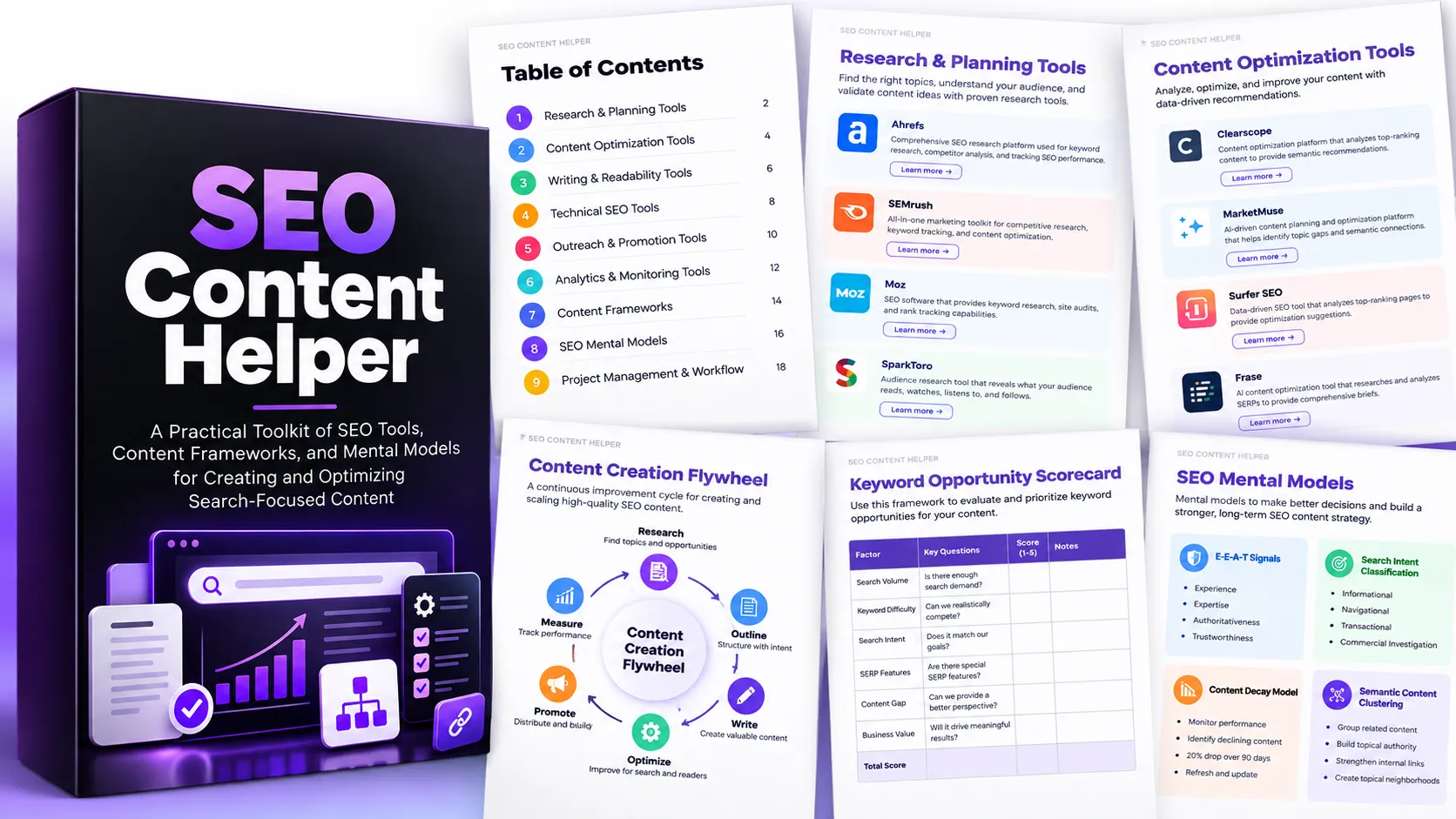
SEO content creation is not a single activity. The SEO Content Helper organizes resources around multiple stages of the process, including research, optimization, writing, technical SEO, promotion, measurement, content frameworks, mental models, and workflow management.
The objective is not to use every available tool. Instead, the repository provides options that can be explored according to the challenges you are trying to solve.
Research and Plan Before You Create
Research and planning tools help establish what to create before writing begins. The resource includes platforms for keyword research, competitor analysis, search demand validation, audience research, question discovery, content research, and content-gap identification.
Tools covered in this category include Ahrefs, SEMrush, Moz, SparkToro, Answer the Public, AlsoAsked, BuzzSumo, and Serpstat.
Research Keywords and Competition
Ahrefs, SEMrush, and Moz provide capabilities related to keyword research and competitive analysis. The resource highlights uses such as assessing keyword difficulty, validating topics against search demand, examining SERP features, and supporting content planning.
Understand Audience Questions and Interests
Research can extend beyond keyword metrics. SparkToro is included for understanding what audiences read, watch, listen to, and follow. Answer the Public and AlsoAsked focus on questions people ask and can help develop broader topic structures.
BuzzSumo provides another perspective by identifying highly shared content, while Serpstat can support content-gap and missing-subtopic analysis.
Optimize Content for Better Topic Coverage
Once a topic has been selected, optimization tools can help evaluate how comprehensively the content addresses it.
The repository includes Clearscope, MarketMuse, Surfer SEO, and Frase for activities such as analyzing ranking content, finding topic gaps, identifying semantic connections, developing content briefs, and receiving optimization recommendations.
It also includes Jasper AI and Copy.ai for draft, outline, and copy creation, together with Yoast SEO and Rank Math for on-page analysis within WordPress environments.
Improve Writing and Readability
Search-focused content still needs to work for human readers. The writing and readability section therefore covers tools for improving clarity, grammar, readability, and visual presentation.
- Hemingway Editor: Identifies complex sentences, passive voice, and readability issues.
- Grammarly: Reviews grammar, clarity, and writing style.
- WebFX Readability Test Tool: Calculates readability measurements including Flesch-Kincaid and Gunning Fog Index.
- Canva: Supports the creation of images, infographics, and other visual assets.
- Loom: Makes it possible to add screen recordings and explanations to long-form material.
The repository presents these resources as different ways to improve how content is consumed, not merely how it is optimized for search.
Support Content With Technical SEO
Content performance can also depend on the technical environment surrounding the page. The Technical SEO Tools section includes resources for crawling websites, analyzing architecture, monitoring page experience, and validating structured data.
Audit Site Structure and Internal Links
Screaming Frog SEO Spider can analyze elements such as headings, internal links, and metadata across a website. Sitebulb provides technical auditing with visual representations of site architecture and link flow, which can help reveal internal-linking and topical-clustering opportunities.
Monitor Page Experience and Structured Data
PageSpeed Insights is included for analyzing Core Web Vitals and receiving optimization recommendations. Google's Rich Results Test and Schema Validator can be used to validate structured data, while Schema App provides structured-data management capabilities.
Promote Content After Publication
SEO content work does not necessarily end when a page is published. The resource includes outreach and promotion tools for supporting link-building and content-promotion campaigns.
Pitchbox focuses on outreach campaign management, BuzzStream on relationship-based outreach, and Hunter.io on identifying contact information for outreach.
Together, this category represents the promotion stage of the content lifecycle.
Measure What Happens After Content Goes Live
Analytics and monitoring tools provide feedback that can guide future improvements.
- Google Search Console: Provides search-performance information including impressions, clicks, and click-through rate, and can help identify underperforming content.
- Google Analytics: Tracks website traffic and user behavior, including engagement and conversion actions.
- Hotjar: Uses heatmaps, recordings, and feedback collection to show how visitors interact with content.
These tools help connect publishing with measurement rather than treating content creation as a finished task.
Use Frameworks to Make Content Creation Repeatable
One of the most useful sections of the SEO Content Helper goes beyond software and introduces frameworks for planning, structuring, maintaining, and repurposing content.
Content Brief Template
A structured brief establishes parameters such as target keywords, search intent, competitive angle, and content structure before writing begins. Its purpose is to align strategy and execution.
Keyword Opportunity Scorecard
This framework evaluates potential keyword targets using factors including volume, difficulty, intent, SERP features, and content-gap opportunities. It is designed to help prioritize where content resources should be invested.
Three-Part Introduction Formula
The formula structures an introduction around three elements: identify the problem, make a clear promise, and preview the content structure.
Data-Story-Insight-Action Framework
The DSIA framework moves through four stages: present statistics, contextualize them with examples, extract patterns, and provide implementable actions. The resource positions it particularly for comparison content and “best” list articles.
Content Creation Flywheel
The Content Creation Flywheel connects research, outlining, writing, optimization, and promotion into a continuous improvement cycle. Rather than viewing these activities as isolated tasks, the framework turns them into a repeatable system.
Problem-Agitate-Solve and Before-After-Bridge
The Problem-Agitate-Solve framework begins with a reader's pain point, intensifies its impact, and then introduces a solution. Before-After-Bridge contrasts the reader's current situation with a desired outcome before providing a bridge between the two.
Hero's Journey and Inverted Pyramid
The Hero's Journey positions the reader as the protagonist and the content as a guide through a challenge. The Inverted Pyramid takes a different approach by placing the most important information first and following it with supporting detail.
Maintain, Repurpose, and Organize Content
The collection also includes frameworks designed for content operations after initial publication.
The 12-Month Content Audit Calendar introduces regular performance reviews to maintain freshness and identify content decay. The Repurposing Matrix provides a method for transforming long-form content into formats suitable for different channels. The Content Sprint Model organizes content production into daily tasks across a week and establishes clearer handoffs between team members.
Apply SEO Mental Models to Content Decisions
The resource introduces four mental models that can guide how SEO content is evaluated and organized.
E-E-A-T Signals
Experience, Expertise, Authoritativeness, and Trustworthiness are presented as signals of content quality. The resource identifies citations, expert authorship, and comprehensive coverage as ways these signals can be strengthened.
Search Intent Classification
Keywords can be classified as informational, navigational, transactional, or commercial investigation. Understanding that intent helps determine an appropriate content format and approach.
Content Decay Model
The Content Decay Model provides a way to identify content whose performance is declining and may need refreshing. The resource specifies a 20% decline over 90 days as a threshold for triggering an update.
Semantic Content Clustering
Semantic content clustering organizes interconnected pages into topic-based groups. The resource describes these groups as topical neighborhoods designed to strengthen authority within particular subject areas.
Create a Manageable SEO Content Workflow
SEO content also requires organization. The repository includes Trello, ClickUp, Asana, Notion, Airtable, and Motion for managing different aspects of content production and project workflows.
These options range from Kanban-style workflows and editorial calendars to databases, task management, documentation, timelines, and automated scheduling.
Use the Repository According to Your Current Needs
The SEO Content Helper is best approached as a reference repository rather than a checklist requiring every tool.
Start with the part of your SEO content process that needs improvement. That could be keyword research, content planning, optimization, readability, technical auditing, promotion, analytics, content maintenance, or workflow management.
From there, explore the relevant tools, frameworks, and mental models and gradually expand your toolkit. The underlying process remains continuous: create, optimize, promote, measure, refine, and repeat.
Download the complete SEO Content Helper to explore the full repository and use it as a reference when building or refining your SEO content workflow.