Build an AI-Powered Content Marketing Growthstack
AI-assisted content marketing involves more than generating drafts. Content Marketing Growthstack presents a collection of interconnected frameworks, workflows, mental models, and tools designed to support the broader content lifecycle, from audience intelligence and ideation through creation, optimization, distribution, and measurement.
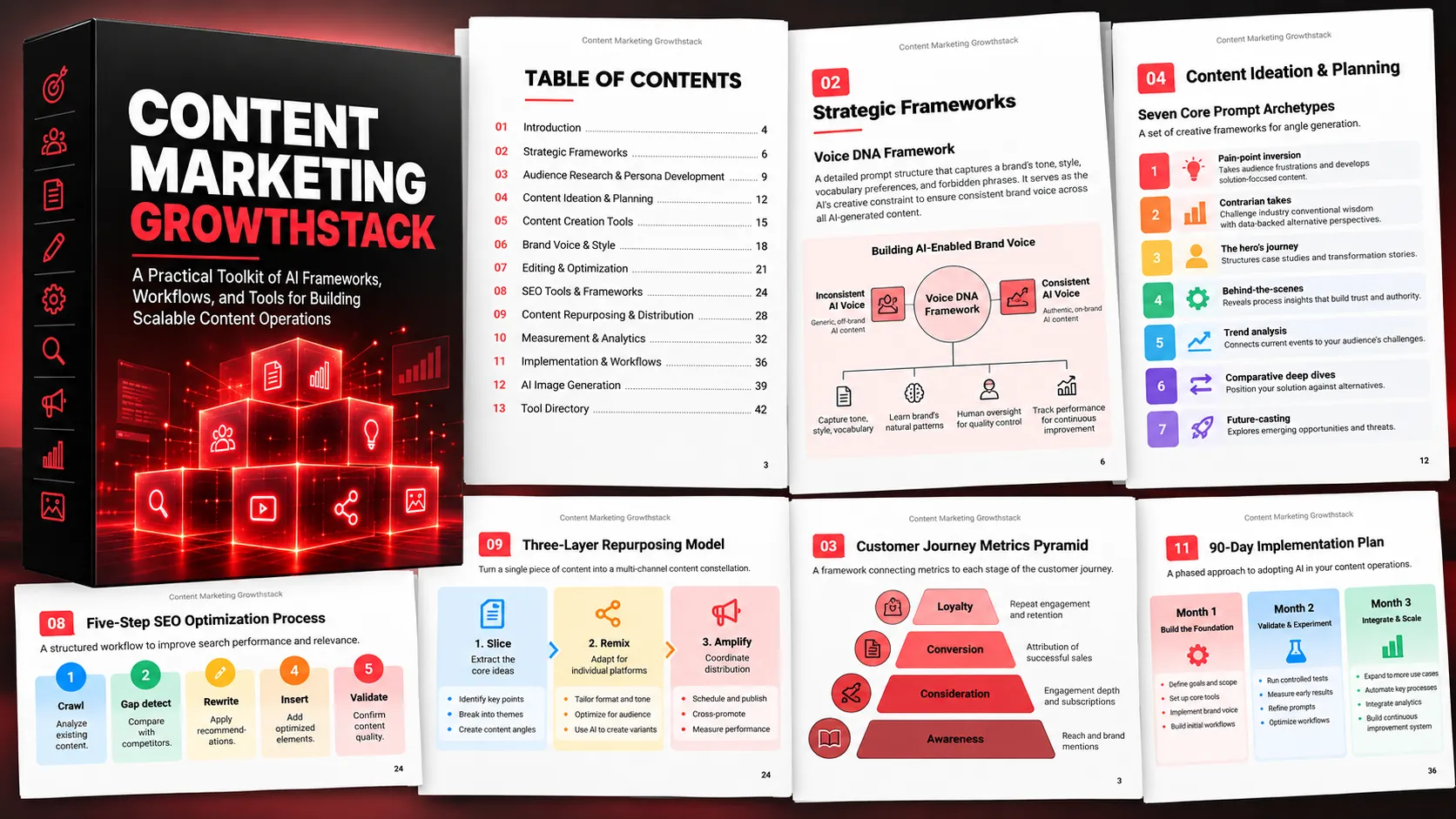
The resource organizes the growthstack into major operational areas: strategic frameworks, audience research and persona development, content ideation and planning, content creation, brand voice and style, editing and optimization, SEO, repurposing and distribution, measurement and analytics, implementation workflows, and AI image generation.
Establish the Strategic Foundation
Several frameworks provide the foundation for deciding how AI should participate in content operations.
Voice DNA Framework
The Voice DNA Framework captures a brand's tone, style, vocabulary preferences, and forbidden phrases. These elements become creative constraints for AI, helping maintain a more consistent brand voice across generated content.
The framework is designed to move teams away from inconsistent AI output by capturing tone, style, and vocabulary, learning natural brand patterns, maintaining human oversight for quality control, and tracking performance for continuous improvement.
Capability Matrix
The Capability Matrix matches AI tools to stages of the content lifecycle. Its purpose is to help determine where AI can improve efficiency, such as research and drafting, and where human involvement provides greater value.
Measure What Matters
The Three-Tier Measurement Framework organizes performance measurement into three groups:
- North-star metrics connect activity with revenue.
- Health metrics monitor operational efficiency.
- AI-specific indicators evaluate automated system effectiveness.
The Funnel-Aligned Metrics Map adds a customer journey perspective by connecting measurement to awareness, consideration, conversion, and loyalty. The customer journey pyramid illustrated in the resource moves from reach and brand mentions at awareness, through engagement and subscriptions at consideration, attribution at conversion, and repeat engagement at loyalty.
Turn Audience Signals Into Content Intelligence
Effective AI-assisted content starts with understanding the audience. The resource introduces an AI Listening Stack consisting of data sources, processing tools, and output formats. Audience conversations can be collected from sources such as Reddit and review sites, processed with AI, and converted into actionable insights for content strategy.
Develop Dynamic Personas
The Data-Driven Persona Building Workflow converts raw audience feedback into actionable buyer profiles. Instead of focusing primarily on demographics, the approach emphasizes need states and continuously updates personas as new information becomes available.
Vector embeddings are presented as a mechanism for comparing text and helping evolving personas respond to new audience data and significant pattern changes.
Create a Repeatable Ideation System
Content ideation becomes more systematic when audience signals are combined with repeatable creative frameworks.
Seven Core Prompt Archetypes
The resource provides seven archetypes for generating strategically different content angles:
- Pain-point inversion turns discovered audience frustrations into solution-focused content.
- Contrarian takes challenge conventional industry wisdom with data-backed alternatives.
- The hero's journey structures case studies and transformation stories.
- Behind-the-scenes reveals process insights that can build trust and authority.
- Trend analysis connects current events with audience challenges.
- Comparative deep dives position a solution against alternatives.
- Future-casting explores emerging opportunities and threats.
Find and Prioritize Content Opportunities
The Content Gap Analysis Framework combines competitor content scraping, theme clustering, and opportunity scoring to identify subjects audiences need that competitors have not adequately addressed.
Ideas can then be evaluated using the Five-Factor Content Triage System. It applies five filters:
- Business relevance
- Search opportunity
- Novelty
- Production effort
- Persona alignment
This creates a more structured editorial decision process while preserving strategic judgment.
Move Ideas Through an Ideation Pipeline
The four-step Ideation Pipeline converts audience insights into publication-ready concepts:
- Signal feeding: gather audience insights.
- Raw generation: create initial content ideas.
- Clustering and tagging: organize and categorize ideas.
- Scoring and scheduling: prioritize concepts and schedule content.
Separating idea generation from prioritization helps prevent the evaluation process from interfering with initial creative exploration.
Protect Brand Voice as Content Production Scales
AI-generated content requires explicit voice controls if output is expected to remain consistent.
Alongside the Voice DNA Framework, the resource introduces Tone Dials for controlling attributes such as formality, energy, humor, and authority. Style Primers provide sample paragraphs that demonstrate desired writing patterns, allowing AI to pattern-match against established examples.
Use a Structured Editing Process
The Four-Pass Editing Workflow separates refinement into four focused reviews:
- Structure: evaluate flow and headings.
- Clarity: improve readability.
- Voice: check brand consistency.
- Proof: review grammar, facts, and rules.
This prevents editing from becoming a scattered process in which multiple objectives are addressed simultaneously.
Role-Based Editing Prompts extend the workflow by asking AI to evaluate content from specific perspectives, such as a senior editor, SEO specialist, or compliance officer. This can surface issues that broad editing instructions may overlook.
Make SEO a Continuous Refinement Process
The Five-Step SEO Optimization Process treats search optimization as an ongoing workflow rather than a final task performed after content creation.
- Crawl: analyze existing content.
- Gap detect: compare the content against competitors.
- Rewrite: apply relevant recommendations.
- Insert: add optimized elements.
- Validate: confirm content quality.
The resource also introduces CTR Scoring Models for evaluating headline variants based on factors such as psychological triggers, word choice, and competitor analysis before selecting candidates for further testing.
Turn Flagship Content Into a Content Constellation
Content distribution is addressed through the Three-Layer Repurposing Model. Instead of treating every channel as a separate content-production requirement, the model starts with a flagship asset and systematically adapts it.
- Slice: extract the core ideas.
- Remix: adapt those ideas for individual platforms.
- Amplify: coordinate their distribution.
The 48-Hour Repurposing Sprint turns this model into a tactical process. Day one focuses on finalizing flagship content and using AI to slice it into reusable ideas. Day two completes platform-specific remixing and schedules distribution.
Measure Repurposing Effectiveness
The Content Constellation Score measures the percentage of flagship insights successfully redeployed across channels while incorporating the average performance lift compared with single-channel publishing.
CCS = (Successful Adaptations ÷ Total Adaptation Attempts) × Average Performance Lift
Channel-Specific Adaptation Playbooks then define how content should change according to audience expectations and consumption patterns, including format length, tone, AI prompt angle, and success metrics.
Build a Measurement and Learning System
The AI Analytics Stack uses three layers:
- Data capture through platform connections.
- AI processing for pattern recognition.
- Visualization through automated reporting.
The objective is to convert raw performance information into actionable intelligence without overwhelming decision-makers.
Test, Learn, and Amplify
The Test-Learn-Amplify Sprint establishes a monthly optimization cycle. Teams test controlled variations, learn by analyzing performance differences, and amplify the approaches that work by integrating them into future operations.
The AI Analytics Maturity Model describes progression from manual analysis to automated insights, predictive analytics, and continuous learning systems. This provides a way to evaluate current capabilities and plan further development.
Implement the Growthstack Gradually
The resource does not recommend introducing every tool and framework simultaneously. Its 90-Day Implementation Plan divides adoption into three stages:
- Month one: build the foundation.
- Month two: validate through experiments.
- Month three: move toward full integration.
This approach allows each capability to become established before additional complexity is introduced.
Build Better Prompt Operations
Prompt Chaining connects related prompts through shared context, allowing sequential refinement while preserving strategic and voice parameters.
A Prompt Library Repository captures successful prompt frameworks using documentation, version control, and tagging. This preserves knowledge about which prompts work, why they work, and the conditions under which they perform effectively.
The Goldilocks Prompt Formula provides a five-part structure for context-rich AI instructions:
- Objective
- Context
- Voice
- Structure
- Constraints
Select Tools According to the Workflow
The growthstack includes complementary tools across the content lifecycle rather than prescribing a single platform for every task.
The repository covers tools for audience listening and research, content planning, AI-assisted writing, brand voice, editing, SEO analysis, social distribution, audio and video adaptation, workflow automation, and AI image generation.
The underlying principle is to begin with the workflow rather than the size of the tool stack. Identify which part of the content operation would benefit most from AI assistance, select the relevant frameworks and tools, validate the approach, and expand as the operation becomes more capable.
From Individual AI Tools to an Integrated Content Operation
The central idea behind Content Marketing Growthstack is integration. Audience intelligence feeds ideation. Strategic frameworks guide creation. Voice systems establish consistency. Structured editing and SEO improve quality. Repurposing extends valuable ideas across channels. Analytics feed learning back into the operation.
The complete resource provides the broader repository of frameworks, systems, complementary tools, and implementation approaches for building this AI-assisted content marketing workflow.