How Persuasive Landing Page Copy Works
A landing page has a specific job: engage visitors and motivate them to take a desired action. Effective landing page copy supports that goal through four connected elements: the headline, body content, call-to-action, and psychological principles that influence how people respond to the message.
These elements should not operate independently. The headline establishes the promise, the body develops and supports it, and the CTA gives the visitor a clear next step. Persuasion principles can strengthen each stage when they are applied honestly and with a focus on genuine value.
Start With a Headline That Earns Attention
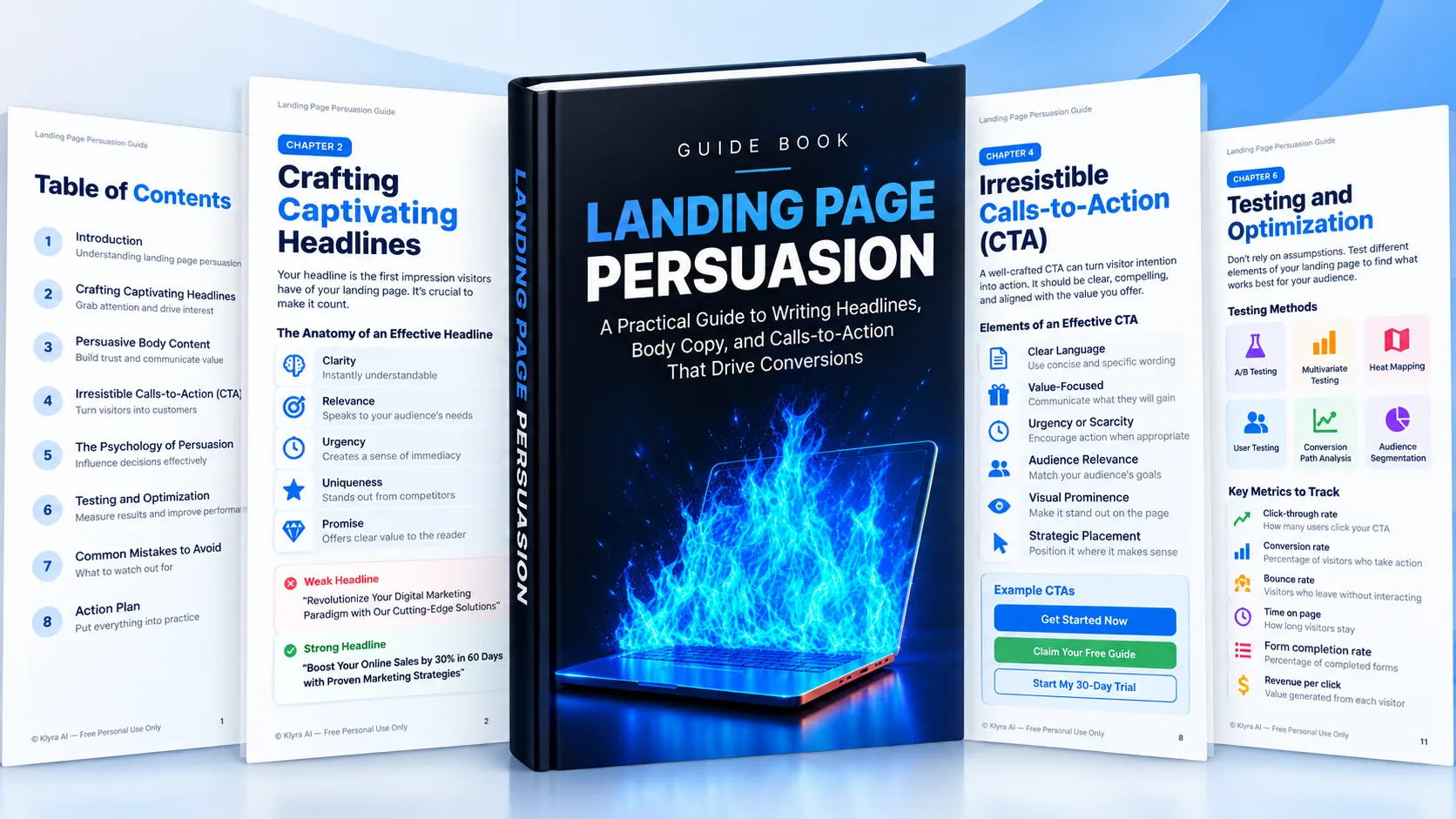
The headline is the visitor's first impression of a landing page. The guide identifies five qualities that can make a headline more effective:
- Clarity: Make the message instantly understandable.
- Relevance: Connect directly with the needs of the target audience.
- Urgency: Give readers a reason to pay attention now when urgency is appropriate.
- Uniqueness: Differentiate the message from competing alternatives.
- Promise: Communicate clear value to the reader.
Psychological triggers such as curiosity, loss aversion, social proof, and reciprocity can also strengthen a headline. These techniques should support the message rather than replace clarity.
A Practical Headline Creation Process
Headline development works best as an iterative process rather than an attempt to find the perfect wording immediately.
- Identify the core message.
- Understand the target audience.
- Brainstorm multiple headline ideas.
- Consider relevant emotional triggers and persuasive language.
- Add urgency or scarcity only when appropriate.
- Check the headline for clarity and specificity.
- Test whether it feels distinctive.
- Refine the strongest options.
- A/B test different versions.
The guide also recommends avoiding headlines that sacrifice clarity for cleverness, rely on clickbait, remain too generic, ignore SEO considerations, or become unnecessarily long.
Build Persuasive Body Content Around the Headline
The body of a landing page is where the initial promise is developed. It should build trust, establish a connection with the visitor, and logically move the reader toward the CTA.
Maintain Narrative Consistency
The opening copy should reflect the promise made by the headline. From there, the page should maintain a consistent tone, progress through ideas logically, reinforce the central message at important points, and lead naturally toward the desired action.
Address Objections Before They Become Barriers
Visitors may have concerns that prevent them from taking action. The guide recommends identifying common objections through market research and customer feedback, then addressing those concerns clearly.
Evidence, guarantees, and FAQ sections can help resolve specific questions when appropriate. The objective is to reduce uncertainty by giving visitors useful information rather than ignoring potential concerns.
Use Social Proof to Build Trust
Evidence of other people's experiences can strengthen a landing page. Depending on what is genuinely available, this can include:
- Customer testimonials with specific results or benefits
- Case studies showing successful outcomes
- Trust badges or certifications
- Usage statistics or customer numbers
- Awards or industry recognition
Specificity and authenticity matter. Social proof should communicate meaningful information rather than relying on vague praise.
Create Connection Through Storytelling
Storytelling can make the problem and desired outcome easier for visitors to relate to. A useful structure begins with a relatable person, introduces the challenge they face, presents the product or service as a solution, and shows the resulting transformation or outcome.
Persuasive language can reinforce this narrative. The guide recommends active voice, sensory language, benefit-focused messaging, inclusive language, and carefully chosen words that encourage action.
Structure Copy for Readability and Action
Persuasion depends not only on what a page says but also on how easily visitors can understand it. The guide presents a practical sequence for organizing landing page content:
- Opening hook
- Problem statement
- Solution introduction
- Benefits breakdown
- Features explanation
- Social proof
- Objection handling
- Message reinforcement
- Transition to the CTA
Content should also be easy to scan. Short paragraphs, descriptive subheadings, lists, white space, selective emphasis, sufficient contrast, and readable typography can help visitors process the page more efficiently.
Turn Visitor Intention Into Action With the CTA
The call-to-action is the point where visitor intention can become an actual action. Effective CTAs use clear, concise language and make the value of taking the next step understandable.
The guide recommends considering strong command verbs, the value the visitor will receive, appropriate urgency or scarcity, audience relevance, visual prominence, and placement.
Use Psychological Principles Carefully
Several persuasion principles can support a CTA, including loss aversion, social proof, reciprocity, commitment and consistency, scarcity, authority, and rapport.
More advanced approaches include two-step CTAs, dynamic CTAs, paired CTAs, micro-commitments, exit-intent CTAs, and clickable actions within video content. Whatever approach is used, it should remain aligned with the page and the visitor's expected next step.
Avoid Common CTA Problems
- Vague or weak wording
- Too many competing options
- CTAs that do not align with the surrounding content
- Ignoring the mobile experience
- Overlooking what happens after the click
- Failing to test alternatives
- Using manipulative tactics
Test Instead of Assuming
Effective landing page copy is an ongoing process of learning, testing, and refinement. Rather than assuming that a headline, message, or CTA will perform well, the guide recommends measuring how visitors actually respond.
Testing approaches include A/B testing, multivariate testing, heat mapping, user testing, conversion path analysis, and audience segmentation.
Metrics to Monitor
- Click-through rate
- Conversion rate
- Bounce rate
- Time on page
- Form completion rate
- Revenue per click
- Cost per acquisition
These measurements can help identify where landing page copy is working and where further refinement may be needed.
Understand the Psychology Behind Persuasion
Landing page copy can be strengthened by understanding tendencies that influence decision-making. The guide discusses cognitive biases including anchoring, the availability heuristic, confirmation bias, the bandwagon effect, and framing.
It also explores emotional motivations such as fear of missing out, hope for a better future, belonging, status or recognition, and security.
Practical application can include presenting important benefits prominently, using memorable examples, storytelling, addressing pain points directly, framing information carefully, making specific and believable claims, and testing different approaches.
Keep Persuasion Ethical
Persuasion should not come at the expense of trust. The guide emphasizes honesty, respect for the audience, avoiding high-pressure tactics, and focusing on genuine value.
This principle applies across the entire landing page. Headlines should not become clickbait, evidence should be authentic, urgency should be appropriate, and CTAs should help visitors make an informed decision rather than pressure them into one.
Put the Principles Into Practice
The guide concludes with an action plan for applying these ideas to an existing landing page:
- Audit the current headline, body content, and CTAs.
- Rewrite the main headline using the principles and formulas in the guide.
- Restructure body content to improve flow and readability.
- Create new CTAs using relevant persuasion principles.
- Implement A/B testing.
- Track key metrics and analyze the results after 30 days.
- Continue learning about copywriting trends and practices.
- Practice persuasive writing regularly.
- Seek feedback from colleagues and members of the target audience.
- Refine the landing page using data and feedback.
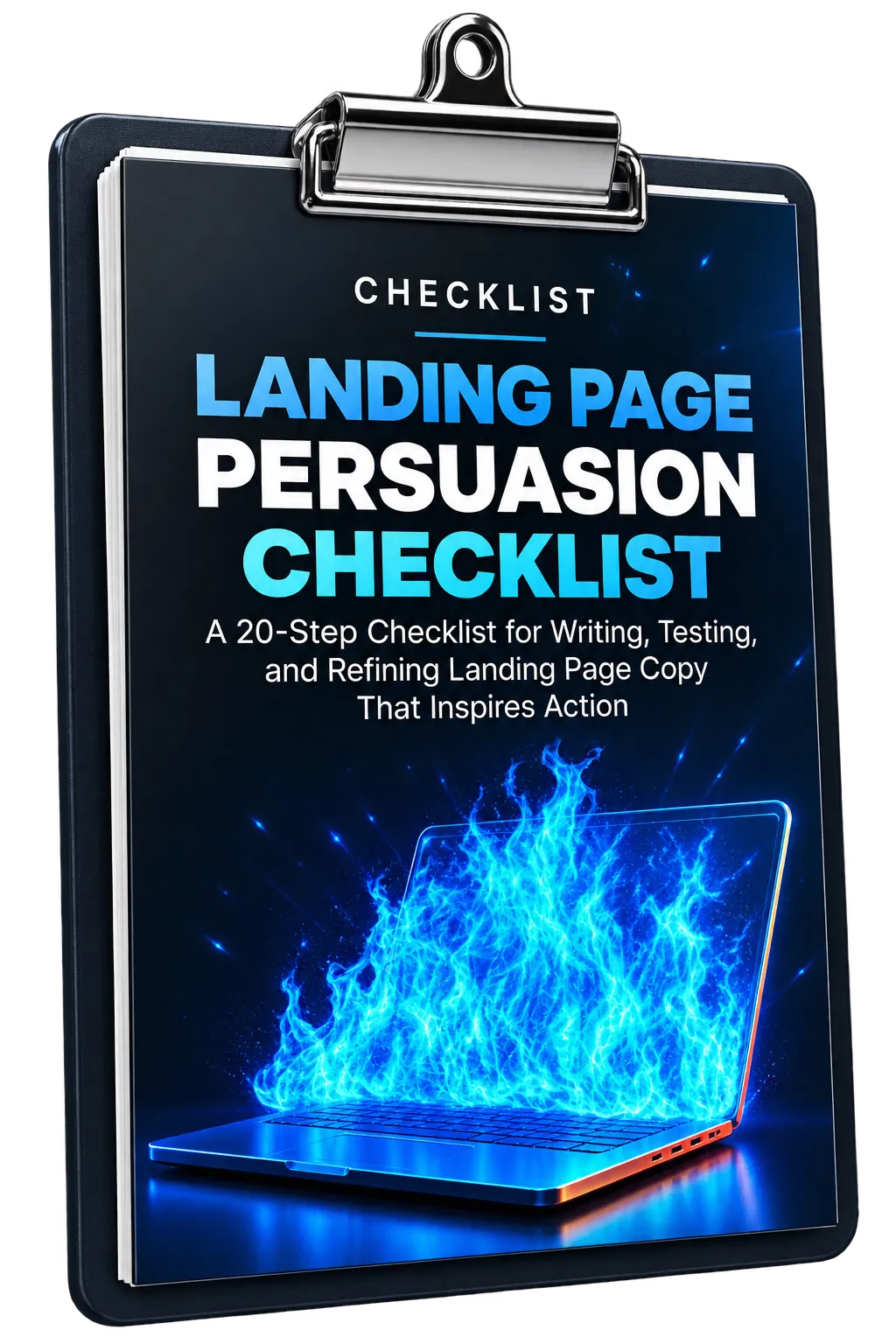
The complete Landing Page Persuasion guide expands on these principles with headline formulas, practical examples, exercises, CTA optimization methods, psychological triggers, and a structured action plan you can use to improve your own landing pages.