SEO Works Better When You Stop Chasing Shortcuts
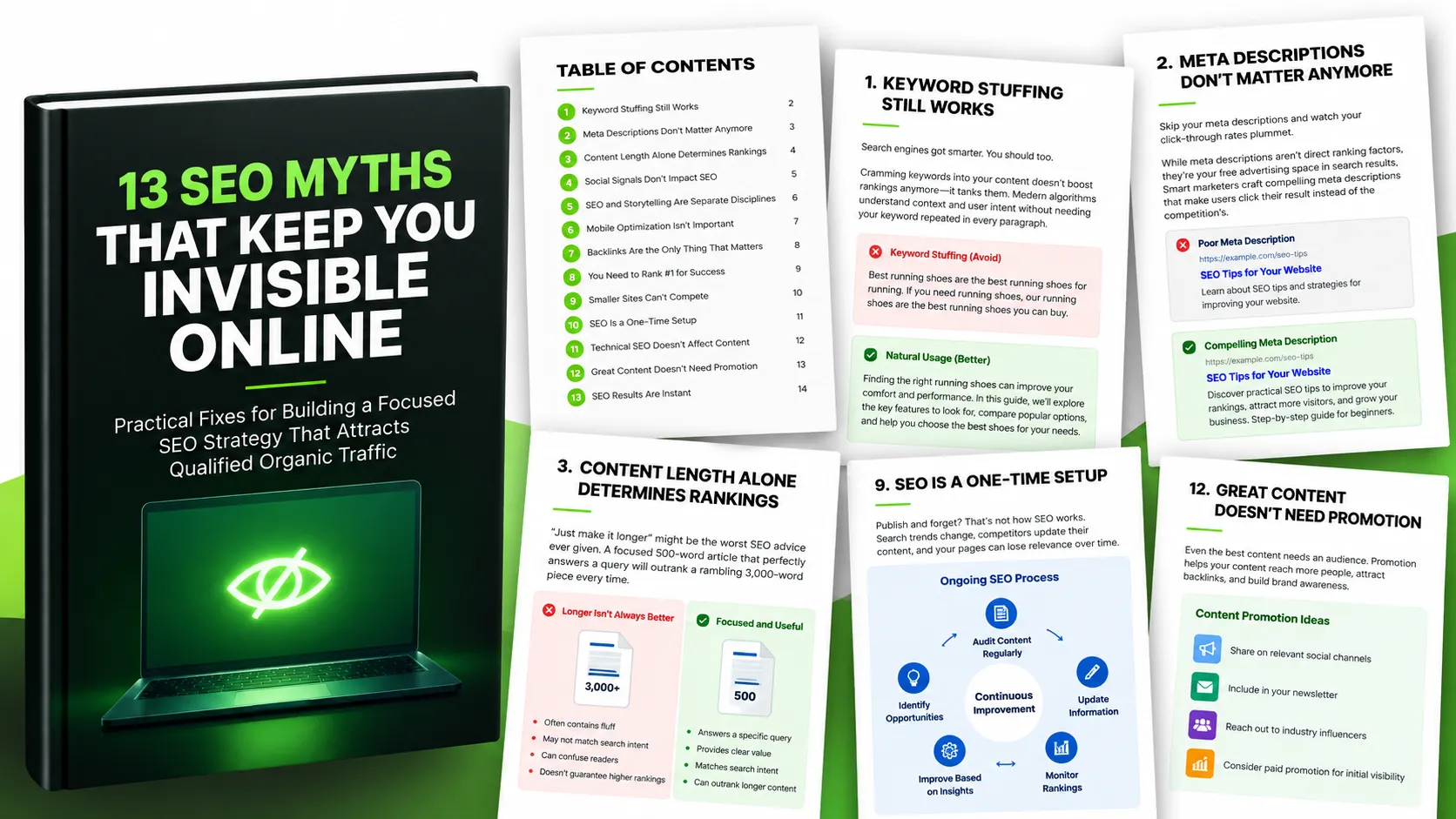
Many SEO problems begin with assumptions that sound reasonable but lead content strategies in the wrong direction. The central message of this resource is that sustainable SEO comes from consistently applying useful principles rather than relying on shortcuts or outdated tactics.
That means creating content around what people actually want to find, making it useful and accessible, giving it the technical foundation it needs, promoting it, and continuing to improve it after publication.
1. Use Keywords Naturally Instead of Stuffing Them
Repeating a keyword throughout every paragraph is not the goal. The resource recommends using a primary keyword naturally in important locations such as the title, headers, first paragraph, and occasionally throughout the content.
From there, expand the content with related terms and questions your audience actually asks. The objective is content that reads naturally while still maintaining a clear topical focus.
Keep Each Piece Focused
The same principle applies to the number of keywords you target. Trying to rank one page for dozens of loosely related terms can produce unfocused content.
Instead, build each piece around one primary keyword and a small group of closely related terms that share the same search intent. When keywords represent different intents, create separate content for those purposes.
2. Match Content Depth to Search Intent
Longer content is not automatically better content. Adding words simply to reach a particular length can create unnecessary material without improving the answer provided to the reader.
A better approach is to ask:
- Have I answered the reader's important questions?
- Have I covered the topic thoroughly?
- Have I provided useful insights?
- Does the content match the searcher's intent?
Write until the subject has been covered properly, then stop. The resource prioritizes quality and relevance over arbitrary word-count targets.
3. Treat Search Snippets as Part of the Content Experience
Meta descriptions may not be direct ranking factors, but the resource emphasizes their role in encouraging people to choose a result in search.
A useful meta description should address search intent, communicate a clear benefit, and give the searcher a reason to click. Rather than leaving descriptions blank or treating them as an afterthought, create a unique, benefit-focused description for each page.
4. Bring SEO and Storytelling Together
SEO and engaging writing do not need to compete with each other. The resource recommends using SEO research to discover the questions and needs of an audience, then answering them through content that holds the reader's attention.
Start with keyword research to understand what people are looking for. Then build narratives around those needs while incorporating relevant keywords naturally.
The result should feel useful to the reader rather than visibly optimized for an algorithm.
5. Build Content for Mobile Users
Mobile optimization should be considered from the beginning rather than added after a desktop experience has already been created.
The resource recommends several practical considerations:
- Use responsive design.
- Keep paragraphs short and readable.
- Make tap targets appropriately sized.
- Test loading speed on real mobile devices.
A strong piece of content still needs an accessible experience around it.
6. Build Content Before Chasing Backlinks
Quality backlinks remain important, but the resource warns against pursuing links while neglecting the content itself.
The recommended sequence starts with creating genuinely useful content that solves real audience problems and demonstrates expertise. Strong content can then be promoted strategically to help it earn the links it deserves.
This creates a more balanced approach in which backlinks support valuable content rather than compensate for weak content.
7. Measure SEO by Business Value, Not Just Position
Ranking number one should not become the only measure of SEO success. A lower position for a keyword with stronger conversion potential can be more valuable than the top position for a broad term that produces little business value.
The resource recommends developing a diverse keyword strategy across the customer journey, including long-tail keywords with clear purchase intent.
The larger objective is qualified organic traffic that contributes to business results, not rankings pursued primarily as vanity metrics.
8. Smaller Sites Can Compete Through Focus
Large brands may have advantages around broad, high-volume keywords, but their content can also be generalized. More focused topics can create opportunities for smaller publishers.
The resource recommends using specific expertise, targeting long-tail keywords that larger competitors may overlook, and developing comprehensive content around focused subjects.
The goal is not to compete everywhere. It is to identify queries where your knowledge and content can provide a particularly useful answer.
9. Treat SEO as Continuous Improvement
SEO is not finished when a page is published or initially optimized. Competitor content evolves, user behavior changes, new opportunities appear, and existing content can gradually lose relevance.
The resource recommends an ongoing process that includes:
- Conduct routine content audits.
- Identify underperforming pages.
- Refresh important content with updated information.
- Monitor rankings for potential problems.
- Continue improving content instead of allowing it to become stale.
This turns SEO from a one-time project into an ongoing content practice.
10. Connect Technical SEO With Content Strategy
Useful content still needs to be accessible and understandable to search engines. For that reason, the resource argues against separating technical SEO from content strategy.
Technical considerations should be incorporated from the beginning. This includes creating clear site architecture and topical clusters, implementing appropriate schema markup, maintaining fast loading times, and ensuring mobile optimization.
The objective is to combine content that serves readers with a technical foundation that supports its performance in search.
11. Use Social Distribution and Promotion to Create Visibility
Social likes and shares may not function as direct ranking factors, but the resource describes an indirect connection between social visibility and SEO. Greater visibility can contribute to backlinks, brand awareness, and engagement around content.
Rather than treating social media and SEO as completely separate activities, create content worth sharing and distribute it through relevant channels.
Great Content Still Needs Promotion
Publishing strong content does not guarantee immediate visibility. The resource recommends creating a repeatable promotion process for new content.
Possible approaches identified in the resource include:
- Sharing content through relevant social channels.
- Including it in a newsletter.
- Reaching out to industry influencers.
- Considering paid promotion to help establish initial visibility.
Content quality and distribution therefore work together rather than functioning as separate strategies.
Turn the 13 Myths Into an SEO Audit
The resource concludes with a simple way to put these lessons into practice: audit your existing content strategy against the 13 myths and identify which assumptions may be influencing your current approach.
Do not try to correct everything at once. Choose one issue to address first, then move to another. Over time, this creates a strategy centered on focused keywords, search intent, valuable content, sound technical foundations, ongoing improvement, and deliberate promotion.
The complete resource explores all 13 SEO myths individually and provides the practical correction recommended for each one. Download the full resource to work through every misconception and compare it with your current SEO approach.