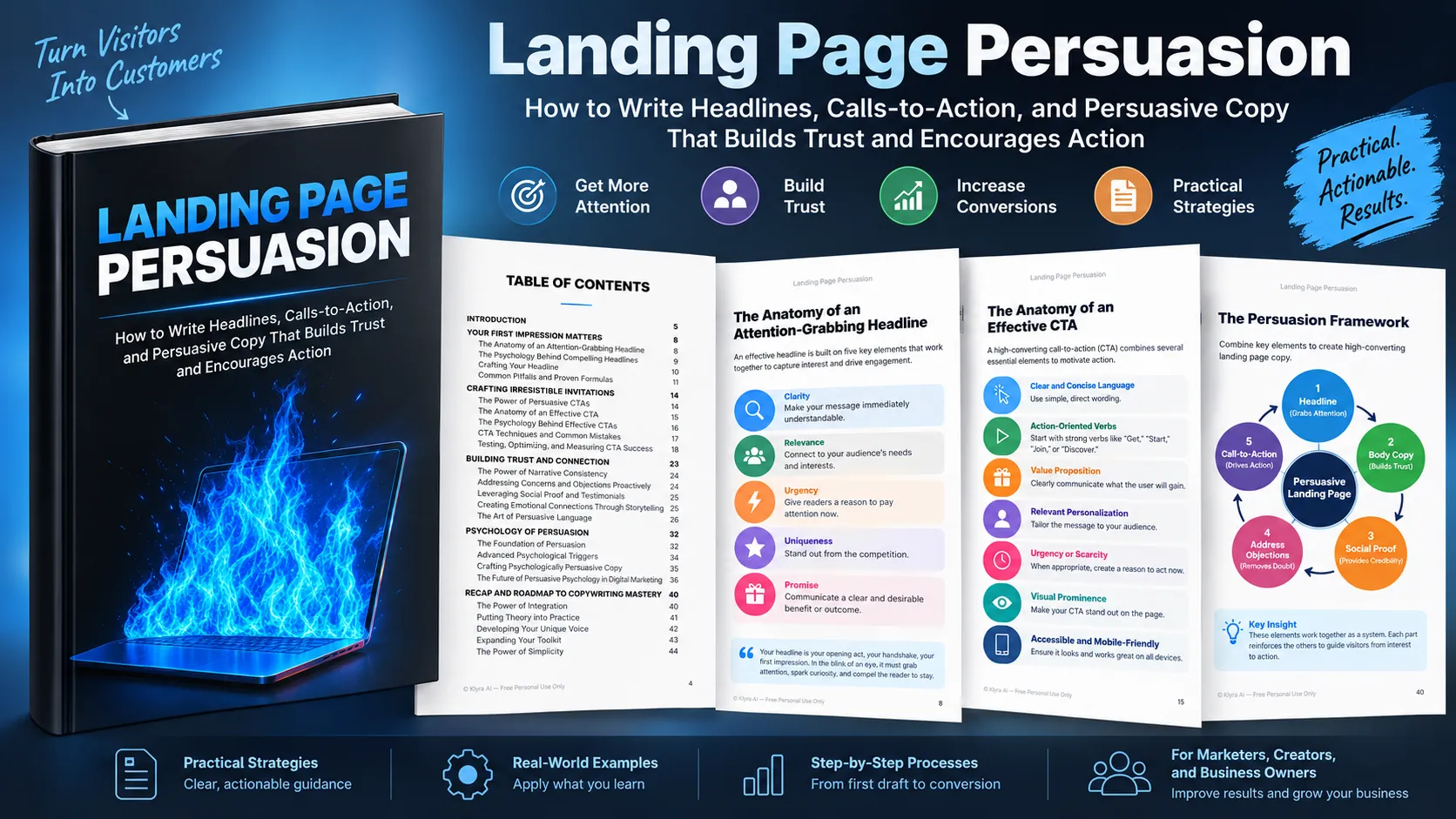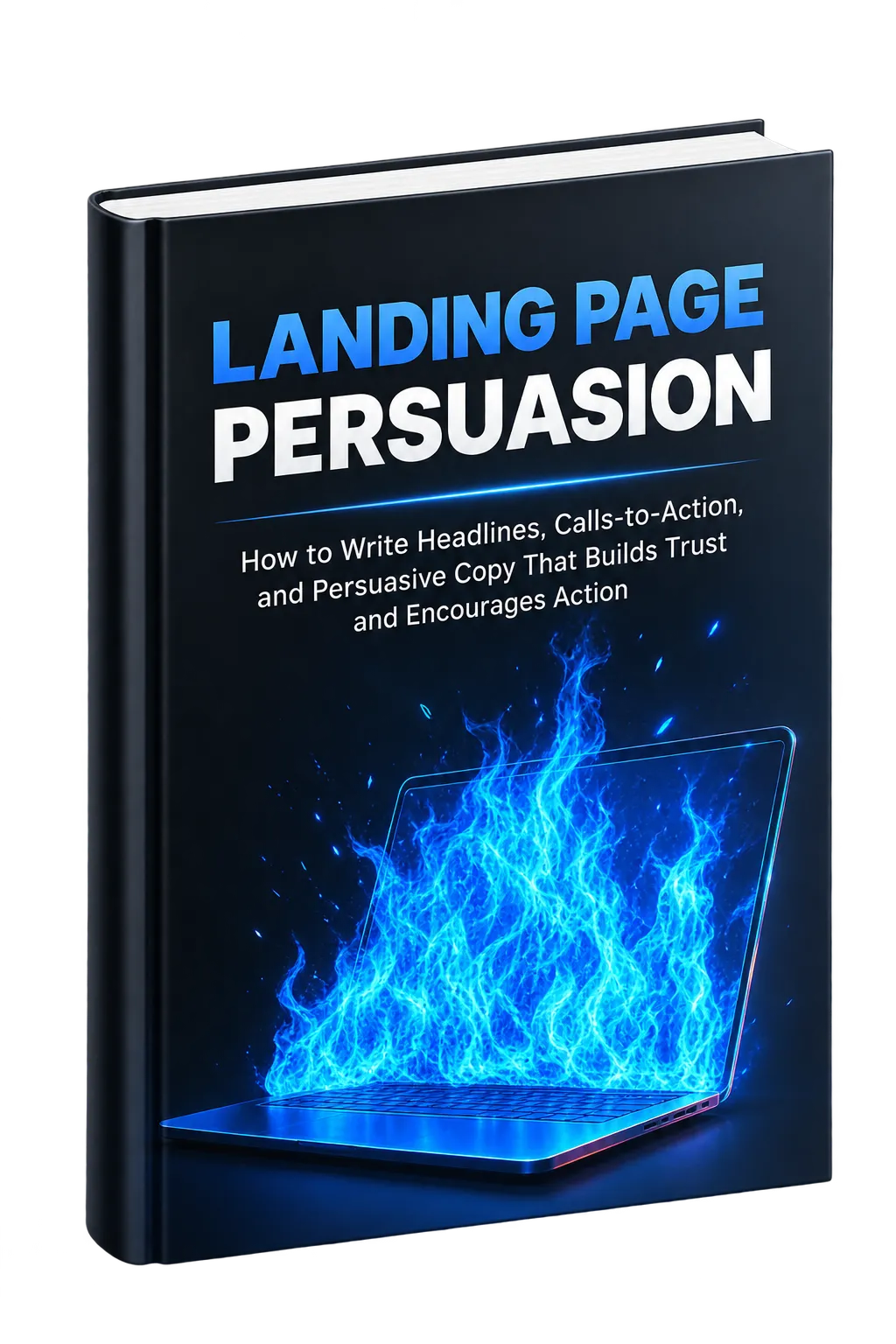
Landing Page Persuasion Starts With the Audience
Persuasive landing page copy is not simply about finding clever words. It begins with understanding what matters to the people reading the page.
Your audience arrives with needs, desires, questions, concerns, and motivations. Effective copy connects those realities with the value of what you offer. Instead of relying on tricks, the goal is to communicate clearly, build a connection, and make the next step understandable and compelling.
A strong landing page therefore works as a connected experience. The headline earns attention and establishes expectations. The body develops the argument, communicates value, and builds trust. The call-to-action gives the visitor a clear next step. Psychological principles can strengthen each part when they are applied thoughtfully and ethically.
Create a Strong First Impression With the Headline
The headline takes center stage when someone arrives on a landing page. It needs to attract attention quickly while giving the visitor a reason to continue.
The guide identifies five qualities that contribute to an effective headline:
- Clarity: Make the message immediately understandable.
- Relevance: Connect the headline directly to the needs of the intended audience.
- Urgency: When appropriate, give the reader a reason to pay attention now.
- Uniqueness: Give the message enough distinction to stand out.
- Promise: Communicate meaningful value or a desirable outcome.
Clarity should not be sacrificed simply to sound creative. A headline that is clever but difficult to understand can weaken the first impression. The resource recommends focusing on the audience's important desires or problems and showing them a clear reason to continue reading.
A Practical Headline-Writing Process
Headline development is presented as an iterative process rather than an attempt to find the perfect sentence immediately.
- Identify the core message.
- Understand the audience.
- Brainstorm multiple ideas.
- Introduce stronger language where appropriate.
- Consider urgency or scarcity when genuine.
- Check the headline for clarity and specificity.
- Evaluate whether it is distinctive.
- Refine and polish the wording.
- A/B test alternatives when possible.
Common mistakes include being too clever at the expense of clarity, relying on clickbait, writing generic headlines, overusing superlatives, and ignoring how the headline works in search.
Turn Attention Into Action With Better CTAs
A call-to-action is the point at which passive reading can become active engagement. It should make the next step clear and communicate why taking that step is worthwhile.
An effective CTA begins with straightforward, concise language. Strong command verbs such as "Get," "Start," "Join," or "Discover" can establish momentum, but the verb alone is not enough. The surrounding message should communicate what the visitor gains by acting.
Build the CTA Around Value
The value proposition should be visible in the invitation to act. The visitor should understand whether the next step gives them a solution, useful content, access to an offer, or another desirable outcome.
The resource identifies several elements that can strengthen a CTA:
- Clear and concise language
- Strong action-oriented verbs
- A recognizable value proposition
- Relevant personalization
- Urgency or scarcity when appropriate
- Visual prominence
- Accessible sizing and placement, including on mobile devices
The CTA should also fit the rest of the landing page. If the page establishes one promise and the CTA suddenly introduces a different message, the experience loses consistency.
Reduce Friction With Smaller Commitments
Not every visitor is ready to make a large commitment immediately. The guide discusses techniques such as two-step CTAs and micro-commitments, where a smaller initial action can create momentum toward a larger conversion goal.
It also discusses approaches such as dynamic CTAs, paired primary and secondary CTAs, exit-intent CTAs, and CTAs incorporated into video. These techniques should support the visitor's journey rather than create unnecessary complexity.
Avoid Common CTA Mistakes
CTA performance can suffer when the language is vague, the page offers too many competing options, the CTA does not match the surrounding content, the mobile experience is neglected, or the post-click experience is overlooked.
The resource also warns against manipulative tactics. A persuasive CTA should communicate genuine value rather than pressure people into an action that is not appropriate for them.
Build Trust Through the Body Copy
Once the headline establishes expectations, the body content needs to deliver on them. This is where the landing page can explain the offer, address concerns, develop trust, and guide the visitor toward a decision.
Maintain Narrative Consistency
The headline, body, and CTA should feel like parts of the same argument. If a headline makes a promise, the opening and subsequent content should support that promise.
Maintain a consistent tone and voice, organize ideas in a logical sequence, reinforce the central message at important points, and lead naturally toward the CTA. This consistency reassures readers that the page is delivering what it initially promised.
Address Objections Before They Become Barriers
Visitors may hesitate because they have unanswered questions about price, value, suitability, risk, or other aspects of an offer. The guide recommends identifying common objections through market research and customer feedback, then addressing those concerns clearly.
Depending on the offer, this may involve providing evidence, explaining value, presenting relevant guarantees, or answering specific questions through an FAQ. The objective is not to hide concerns but to help the reader make a better-informed decision.
Use Social Proof With Specificity
Testimonials, case studies, customer numbers, trust indicators, certifications, awards, and other forms of social proof can strengthen credibility.
The resource emphasizes specificity and authenticity. A testimonial that describes a concrete experience or outcome communicates more useful information than a vague statement of praise.
Use Storytelling to Create Connection
Storytelling can help visitors understand an offer through a relatable situation rather than through features alone.
A simple persuasive narrative can:
- Introduce a relatable person or situation.
- Present a recognizable problem or challenge.
- Introduce the product or service as a possible solution.
- Show the resulting transformation or outcome.
This structure allows readers to recognize themselves in the problem and better understand how the solution fits into a real-world situation.
Storytelling does not require every landing page to become a long narrative. Even short copy can communicate the story of a problem being solved, a transformation taking place, or a better future becoming possible.
Choose Language That Communicates Value Clearly
Persuasive language is not about making the message more complicated. The resource repeatedly returns to clarity, relevance, and value.
Useful techniques include active voice, benefit-focused wording, sensory language where relevant, inclusive language, and a conversational tone that supports rapport and trust.
Jargon and unnecessary complexity can distance the reader from the message. The goal is to make the offer easier to understand while showing why it matters.
Structure the Body Content as a Progression
The guide provides a practical sequence for organizing landing page body copy:
- Opening hook
- Problem statement
- Solution introduction
- Benefits breakdown
- Features explanation
- Social proof
- Objection handling
- Reinforcement
- Transition to the CTA
This sequence is useful because it builds the case progressively rather than presenting disconnected information. The exact page can vary, but each section should help move the visitor toward understanding the offer and deciding whether to act.
Design Copy for People Who Scan
Landing page copy also needs to work for visitors who scan rather than read every sentence. Important information should remain understandable even when someone moves quickly through the page.
The resource recommends techniques such as:
- Keeping paragraphs relatively short
- Using descriptive subheadings
- Breaking appropriate information into lists
- Using white space to reduce visual clutter
- Emphasizing important information selectively
- Maintaining sufficient contrast between text and its background
- Choosing readable typography and sizing
Visual elements can support this experience. Product images, screenshots, demonstrations, infographics, icons, and before-and-after visuals can reinforce the written narrative when they directly support the message.
Apply Persuasion Psychology Thoughtfully
Landing page persuasion involves cognitive, emotional, and social influences. Understanding these influences can help you structure information in ways that align with how people evaluate decisions.
Anchoring
People can rely heavily on the first information they encounter. On a landing page, this makes the opening message important. Presenting a compelling benefit or offer early can establish the context through which later information is interpreted.
Availability and Memorable Examples
Vivid examples and stories can make information easier to recall. Rather than relying entirely on abstract descriptions, demonstrate what a benefit looks like in a recognizable situation.
Social Proof and Authority
People often look to others when evaluating a decision. Relevant testimonials, customer information, client logos, and credible expert support can help establish confidence when those signals are genuine.
Reciprocity
Providing useful value before asking for something in return can create a more constructive relationship with the visitor. Examples in the resource include free information, trials, and bonus material.
Commitment and Consistency
Smaller commitments can sometimes lead naturally toward larger actions. Instead of demanding a major decision immediately, the visitor can be guided through lower-stakes steps that are consistent with the larger goal.
Scarcity and Urgency
Limited availability can influence perceived value and encourage action. The resource stresses that scarcity should be used carefully rather than manipulatively. False scarcity undermines the ethical foundation of persuasive copy.
The Paradox of Choice
More options do not always make a decision easier. Too many competing choices can contribute to decision paralysis. Landing pages can reduce this problem by focusing attention on the most important benefits or options and helping visitors identify what is relevant to their needs.
Keep Persuasion Ethical and Authentic
The resource draws an important distinction between persuasion and manipulation. Persuasive copy should be honest about the offer, transparent about relevant conditions, and respectful of the audience's ability to make its own decisions.
That means avoiding false scarcity and misleading claims, communicating genuine value, being clear about what a product can and cannot do, explaining relevant terms or costs, and using authentic customer experiences.
The broader objective is not merely to produce a short-term conversion. Effective copy should contribute to trust and longer-term customer relationships.
Test Instead of Assuming
Persuasion is not one-size-fits-all. A headline, CTA, page structure, or psychological approach that works with one audience may perform differently with another.
The resource therefore treats optimization as an ongoing cycle of creation, testing, measurement, and refinement.
Use A/B Testing
A/B testing allows you to compare two versions while changing an element and observing which version performs better. Headlines, CTA wording, content structure, and CTA placement are all candidates for testing.
Other approaches discussed in the resource include multivariate testing, heat mapping, user testing, conversion path analysis, and audience segmentation.
Measure Relevant Performance Indicators
Depending on the landing page and its goal, useful measurements can include:
- Click-through rate: How many visitors click the CTA.
- Conversion rate: How many complete the intended action.
- Bounce rate: A signal that can help identify potential page or message misalignment.
- Time on page: An indicator of engagement with the content.
- Form completion rate: Useful when the CTA leads to a form.
- Revenue per click: Relevant for ecommerce experiences.
- Cost per acquisition: Useful when evaluating paid acquisition campaigns.
Numbers should not be considered in isolation. The guide also recommends gathering qualitative feedback through user testing or surveys to understand how the audience perceives the copy and where the experience may be falling short.
Develop a Voice That Fits Your Brand and Audience
Persuasive principles can provide a foundation, but effective copy should still sound appropriate for the brand using it.
Your voice might be conversational or formal, humorous or professional. There is no single tone that works in every situation. The appropriate choice depends on the brand and the people it is trying to reach.
Developing that voice requires experimentation and practice. It also requires empathy. Understanding the audience's needs, desires, fears, aspirations, and objections gives you the foundation for writing copy that speaks to what actually matters to them.
Use Simplicity as a Copywriting Discipline
A landing page does not become more persuasive simply by containing more information. Packing every possible feature and benefit into the page can overwhelm the reader and weaken the central message.
The guide recommends practicing distillation. Ask whether you can communicate the core value proposition in one sentence and whether the main benefit can be explained in straightforward language.
Simplicity helps important ideas stand out. It also forces the copywriter to decide what matters most instead of asking the visitor to process everything at once.
Bring the Entire Landing Page Together
The strongest lesson running through the resource is integration. Headlines, body copy, CTAs, storytelling, proof, objections, psychology, design, and testing should not operate independently.
The headline sets an expectation. The body develops and supports it. Evidence and social proof help build confidence. Objection handling reduces uncertainty. The CTA presents the next step. Psychological principles can reinforce the experience throughout.
When reviewing an existing landing page, consider the complete journey:
- Does the headline clearly communicate something relevant?
- Does the opening continue the promise made by the headline?
- Does the body explain the problem, solution, and benefits logically?
- Does the page address meaningful concerns?
- Is supporting proof specific and authentic?
- Can a visitor scan the page and still understand its main message?
- Does the CTA communicate both the action and its value?
- Does the entire experience feel consistent?
- Are important elements being tested and refined using actual performance data and audience feedback?
Landing page copywriting is an ongoing practice rather than a one-time task. The complete Landing Page Persuasion resource explores these principles in greater depth, including headline development, CTA techniques, body-content structure, persuasion psychology, practical examples, testing approaches, and a roadmap for continuing to develop your copywriting skills.