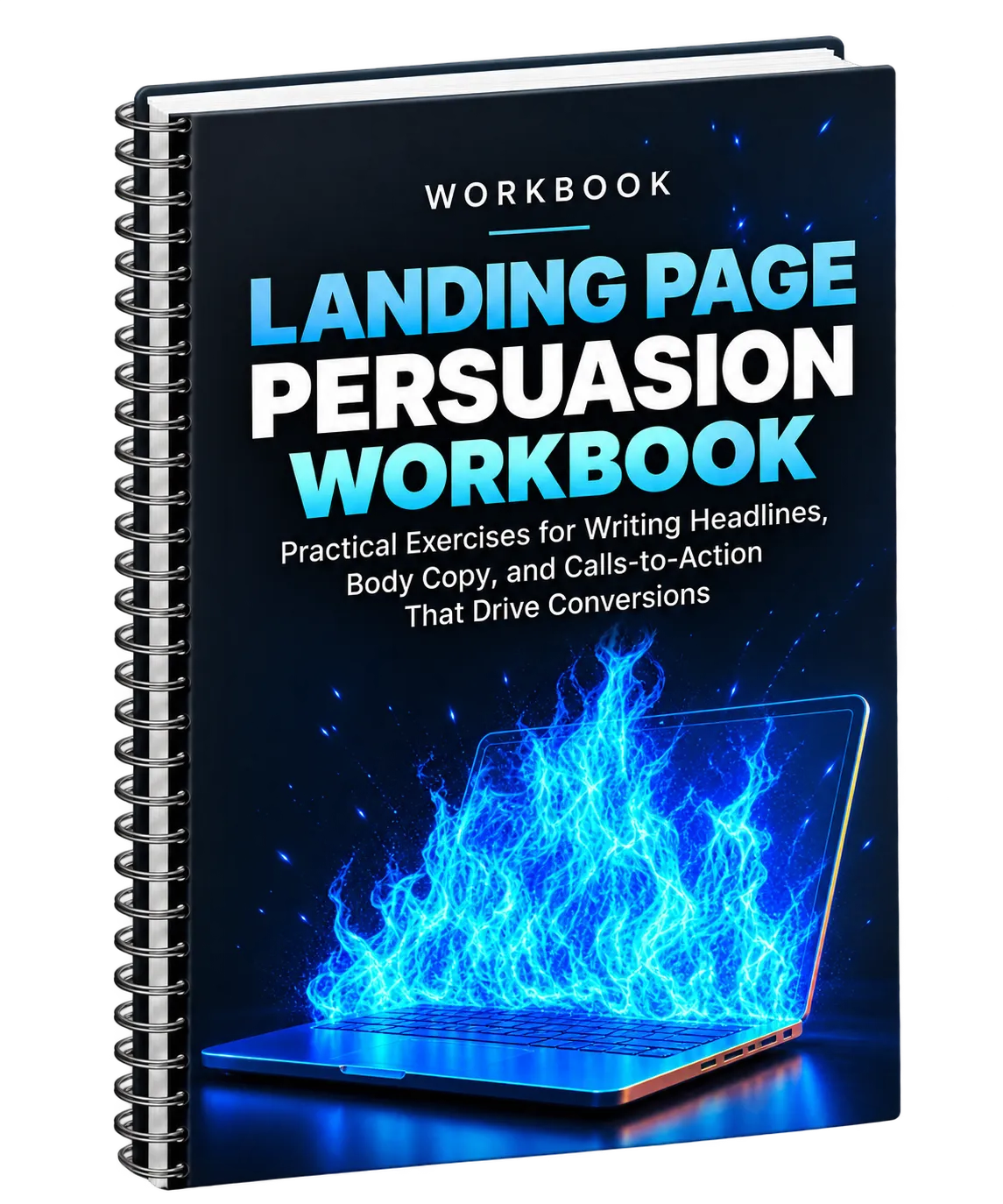
Practice Landing Page Copywriting, Not Just the Theory
Effective landing page copywriting involves more than understanding persuasive principles. You also need to practice applying them to headlines, body content, calls-to-action, audience objections, psychological triggers, and complete landing page experiences.
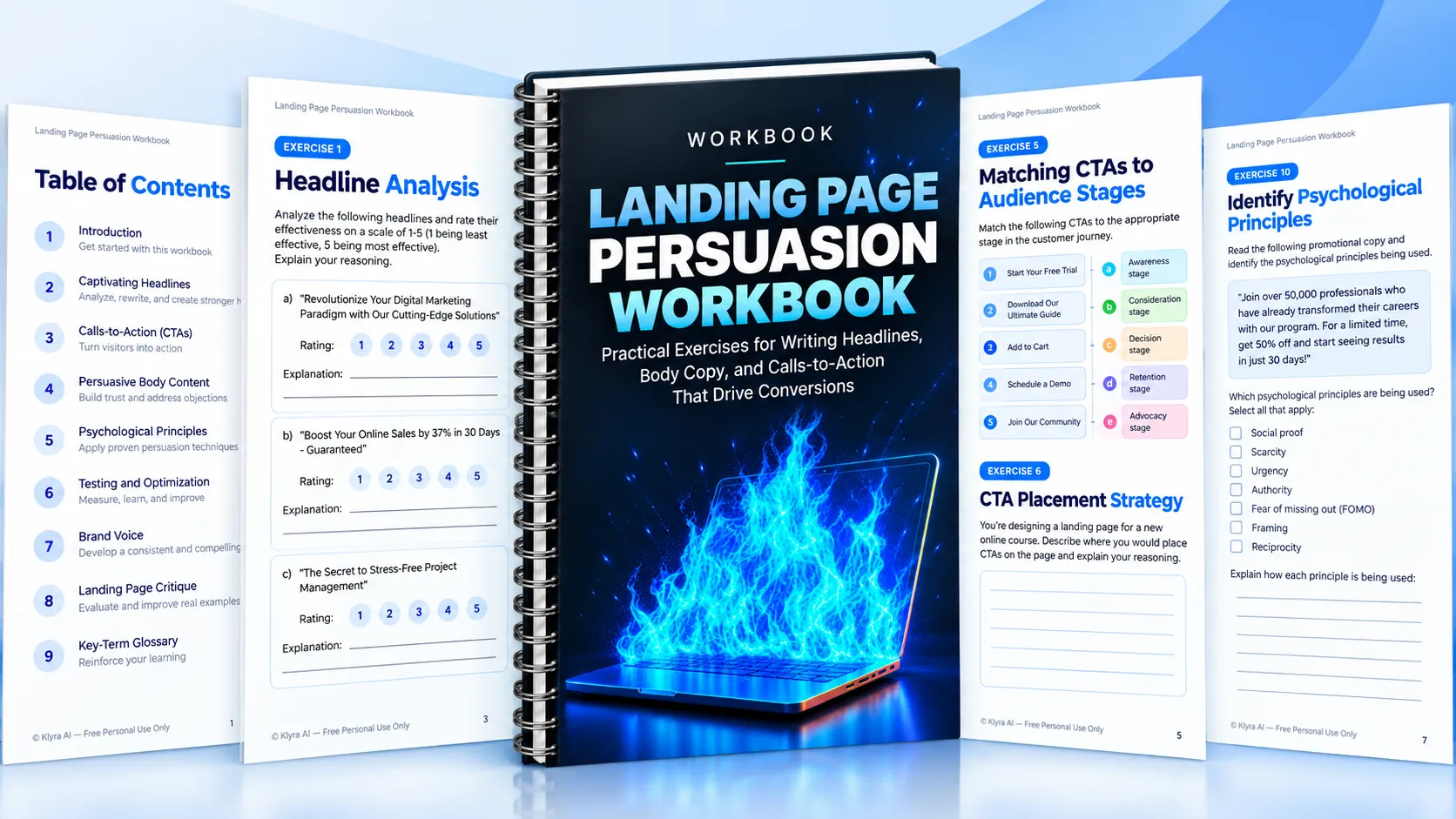
The Landing Page Persuasion Workbook is structured around practical exercises that help develop those skills. Instead of simply presenting rules to remember, it asks you to analyze existing copy, identify problems, rewrite weak messaging, create alternatives, and think through optimization decisions.
The workbook focuses on seven learning objectives: crafting compelling headlines, developing persuasive CTAs, creating body content that builds trust and addresses objections, applying psychological principles, integrating landing page elements, developing brand voice, and using testing and optimization for continued improvement.
Strengthen Your Landing Page Headlines
The headline exercises begin with analysis. You are given different headline examples and asked to rate their effectiveness and explain your reasoning. This encourages you to evaluate why a headline works or fails rather than relying only on instinct.
Transform Weak Headlines
The next exercise moves from evaluation to rewriting. Generic examples such as product, software, and educational headlines must be transformed into stronger alternatives using the principles covered by the accompanying material.
You will also practice creating headlines using three specific formulas:
- How to [Achieve Desired Outcome] in [Timeframe]
- [Number] Ways to [Solve a Problem]
- The Secret of [Desired Outcome]
The workbook applies these formulas to a fictional productivity app called FocusMax, giving you a defined scenario in which to practice translating a value proposition into different headline structures.
Turn Generic CTAs Into Action-Oriented Copy
Calls-to-action are explored through several exercises rather than a single rewriting task. The first challenges you to improve generic CTAs such as "Submit," "Click Here," and "Learn More" by making them more compelling and action-oriented.
Match the CTA to the Customer Journey
Different visitors may require different actions. The workbook asks you to consider CTAs such as starting a free trial, downloading a guide, adding a product to a cart, scheduling a demo, and joining a community, then match them with stages in the customer journey.
This exercise develops the habit of considering context instead of treating every CTA as interchangeable.
Think Strategically About CTA Placement
Another exercise presents a landing page for an online course and asks you to decide where CTAs should appear and explain your reasoning.
The visual framework included with the workbook also illustrates a progression from generic CTAs to action-oriented and compelling CTAs, connecting stronger calls-to-action with increasingly specific and immediate user actions.
Create Body Copy That Stays Consistent
A landing page should maintain a consistent narrative from its headline through its supporting content. The workbook provides an intentionally inconsistent landing page example in which a public-speaking headline is followed by body copy about writing skills.
Your task is to identify the inconsistencies and rewrite the passage. The exercise helps develop the ability to spot disconnects between a landing page's promise and the content used to support it.
Practice Addressing Customer Objections
Persuasive copy also needs to recognize the concerns that may prevent a visitor from acting. An exercise asks you to identify three objections someone might have about purchasing an expensive online course and then write a response to each one.
The objective is to practice anticipating resistance and addressing it directly within the copy rather than leaving important concerns unanswered.
Develop More Specific Social Proof
The workbook then returns to the fictional FocusMax productivity app and asks you to write a testimonial that includes specific results and benefits.
This exercise connects social proof with concrete outcomes and encourages you to think about what makes testimonial copy useful and persuasive.
Recognize Psychological Principles in Copy
Persuasion principles become easier to apply when you can first recognize them in existing messaging. The workbook presents promotional copy and asks you to identify the psychological principles being used.
The example combines customer numbers, limited-time pricing, fear of missing out, and outcome-focused language, giving you an opportunity to examine how multiple persuasive elements can appear within a short passage.
Practice Ethical Scarcity and Urgency
Another exercise asks you to write landing page copy for a limited-time fitness offer using scarcity and urgency ethically.
The accompanying visual explanation distinguishes the two concepts: scarcity emphasizes limited availability, while urgency creates a sense of immediacy that encourages action.
Learn to Reframe a Message
Framing affects how a benefit is communicated. The workbook provides the statement "Our time management course will help you waste less time" and asks you to rewrite it using more positive and persuasive framing.
The exercise develops the ability to preserve the underlying idea while changing how the outcome is presented to the audience.
Bring the Landing Page Elements Together
Individual copywriting skills ultimately need to work together on a complete landing page. The integration and optimization exercises move beyond isolated headlines or CTAs and ask you to evaluate multiple elements as a connected experience.
Critique a Fictional Landing Page
You are given a generic headline, CTA, and body copy for marketing software and asked to suggest improvements to each element.
This requires you to apply several skills at once: headline development, CTA writing, benefit communication, specificity, and message consistency.
Think About Testing and Optimization
The workbook introduces an A/B testing scenario involving two landing page versions. Version A has a 2% conversion rate and Version B has a 2.5% conversion rate after each receives 1,000 visitors.
Rather than supplying the conclusion, the exercise asks you to consider whether the result is statistically significant and determine what you would do next.
This shifts the focus from simply writing copy to thinking about how landing page changes should be evaluated after implementation.
Develop a Brand Voice for Different Audiences
Landing page copy should also reflect the brand communicating the message. The workbook asks you to describe an appropriate brand voice for three different contexts:
- A luxury watch brand
- A children's educational app
- A corporate cybersecurity service
By working across very different products and audiences, the exercise encourages you to think about how voice should adapt to context instead of applying the same writing style everywhere.
Build Your Own Copywriting Glossary
The final worksheet asks you to define five important terms yourself:
- Call-to-Action (CTA)
- A/B Testing
- Social Proof
- Scarcity Principle
- Narrative Consistency
Rather than providing the definitions for you, the workbook leaves space for your own responses. This makes the glossary another learning exercise and gives you an opportunity to reinforce the concepts covered throughout the workbook.
Turn Persuasion Principles Into Practical Skills
The workbook is designed around active practice. Across 15 exercises, you move from analyzing individual headlines and CTAs to evaluating complete landing page elements, psychological principles, testing scenarios, and brand voice.
Download the complete Landing Page Persuasion Workbook to work through the exercises, record your answers directly in the worksheets, and practice applying the concepts to realistic landing page copywriting scenarios.