Build Content for Search Engines and Human Readers
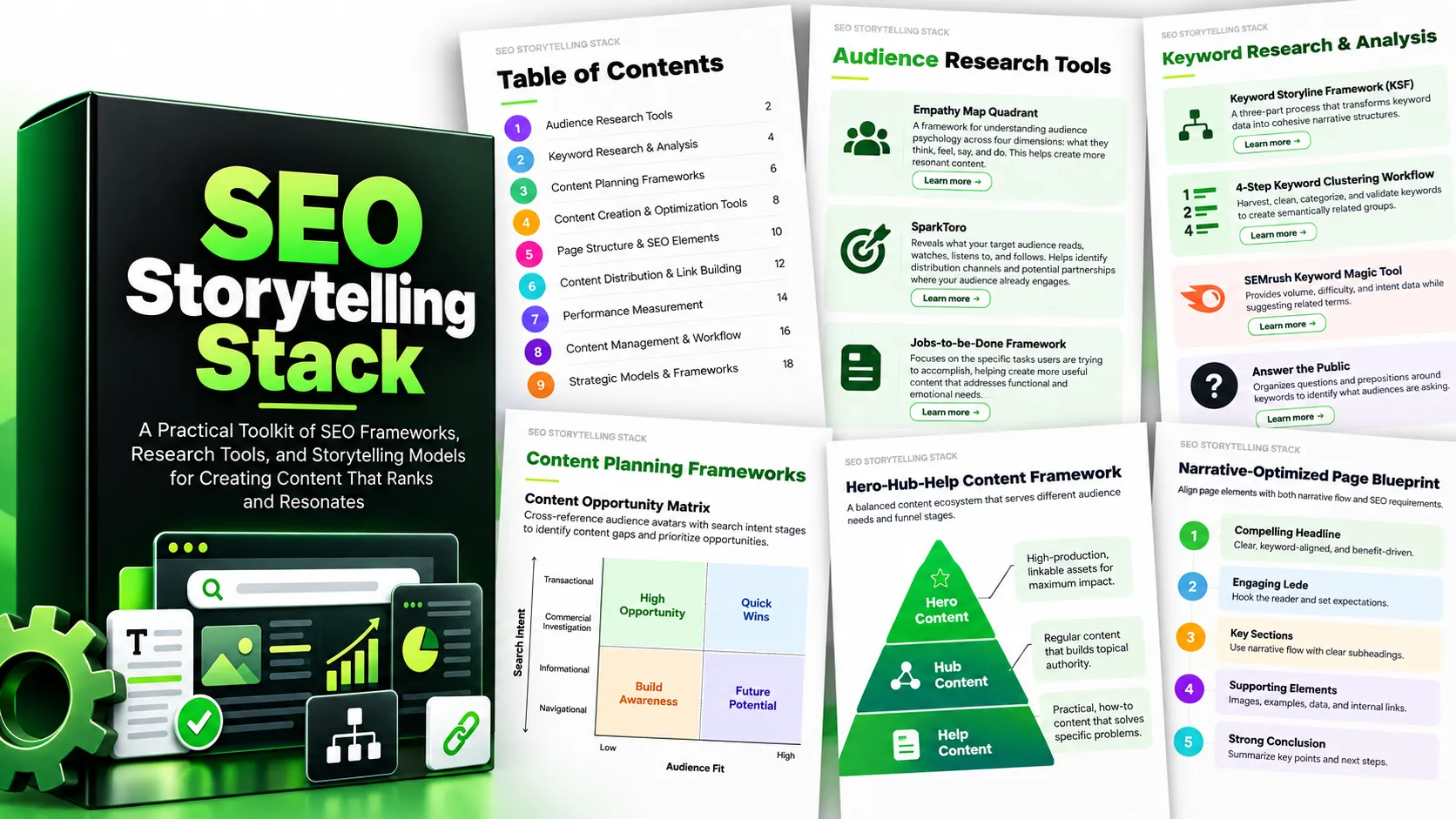
The central idea behind the SEO Storytelling Stack is that effective content should not force a choice between technical SEO and compelling storytelling. The resource brings both disciplines together through a collection of research tools, planning frameworks, optimization techniques, distribution methods, measurement systems, and strategic models.
The repository covers the content lifecycle from understanding an audience and researching keywords through planning, creation, page optimization, distribution, performance measurement, and ongoing content management.
Start With Audience Understanding
Before choosing keywords or creating content, the resource begins with understanding the people the content is intended to serve.
Empathy Map Quadrant
The Empathy Map Quadrant examines audience psychology through four dimensions: what people think, feel, say, and do. Rather than relying only on demographic information, the framework is designed to help content creators develop deeper audience insights that can support more resonant content.
Jobs-to-be-Done Framework for Content
The Jobs-to-be-Done approach shifts attention from demographic profiles toward the tasks users are trying to accomplish. This perspective helps content creators focus on functional and emotional needs when deciding what information to provide.
SparkToro complements these frameworks by showing what a target audience reads, watches, listens to, and follows, which can also help identify potential distribution channels and partnerships.
Turn Keyword Research Into Content Structure
Keyword research becomes more useful when it informs how content is organized. The resource introduces the Keyword Storyline Framework, a three-part process for transforming keyword data into cohesive narrative structures.
The objective is to organize large keyword sets into focused clusters that can satisfy search requirements while remaining coherent for readers.
Use a Four-Step Keyword Clustering Workflow
The resource describes keyword clustering as a four-stage process:
- Harvest keywords.
- Clean the keyword set.
- Categorize related terms.
- Validate the resulting groups.
This methodology combines algorithmic insights with human judgment to create semantically related keyword groups that can guide content creation.
The repository also identifies SEMrush Keyword Magic Tool, Answer the Public, AlsoAsked, and Google Trends as resources for researching keyword data, audience questions, related searches, seasonality, and emerging interest.
Find and Prioritize Content Opportunities
The Content Planning Frameworks section provides several ways to decide what content should be created and how it should be positioned.
Content Opportunity Matrix
The Content Opportunity Matrix cross-references audience avatars with search intent stages. Its purpose is to expose content gaps and help prioritize opportunities according to audience pain points and business goals.
Story Arc Matrix
The Story Arc Matrix connects informational-to-transactional intent with core brand values. This creates a way to select narrative angles that align search intent with brand positioning.
Hero-Hub-Help Content Framework
This planning model balances three types of content: high-production hero content, regular hub content, and practical help content. Together, they create a broader content ecosystem designed to serve different audience needs and funnel stages.
Content Design Matrix
The Content Design Matrix matches content formats with audience needs and journey stages so that information can be delivered in a format suited to the situation.
Pillar-and-Cluster Architecture
Pillar pages address broad topics comprehensively, while cluster content explores related subtopics in greater depth. The structure establishes relationships between pieces of content while providing users with clearer navigation through a topic.
Research, Create, and Optimize the Content
The repository includes a collection of tools for understanding successful content, identifying useful angles, developing briefs, improving topical coverage, and maintaining readability.
Ahrefs Content Explorer and BuzzSumo can be used to investigate successful content and engaging approaches. Clearscope, MarketMuse, and Frase support content research and optimization, while TF-IDF analysis can identify important terminology in ranking content without relying on keyword stuffing.
Hemingway Editor focuses on readability, while CoSchedule Headline Analyzer evaluates headline elements including structure and emotional impact.
Design Pages Around Narrative and SEO Requirements
The resource extends optimization beyond keywords by considering how individual page elements work together.
Narrative-Optimized Page Blueprint
This blueprint aligns page elements such as the headline, lede, and promise with both narrative flow and SEO requirements. The objective is for each element to serve search engines without losing its role in the reader's experience.
E-E-A-T Signals Framework
The E-E-A-T Signals Framework focuses on incorporating expertise, authoritativeness, and trustworthiness signals throughout content, particularly for subjects that can affect readers' well-being, finances, or major decisions.
Micro-Scenes Structure
For long-form content, the resource proposes breaking material into digestible sections of approximately 150 to 300 words. These micro-scenes are intended to maintain reader momentum while also creating natural opportunities for keyword placement.
Semantic Proximity Optimization
Instead of concentrating on keyword density, Semantic Proximity Optimization focuses on relationships between terms. Related concepts form clusters of meaning that can communicate topical depth while preserving more natural writing.
Test Whether Content Works at Different Reading Depths
The Skim, Scan, Settle Test evaluates content at three levels. Readers may skim the headlines, scan first sentences, or settle into an in-depth reading experience.
The purpose of the test is to ensure the content remains coherent at each of those levels.
The resource also includes a 6-Point Meta Audit Checklist for evaluating page metadata, including titles, descriptions, and header tags, along with Google's Rich Results Test for checking structured data implementation.
Turn One Core Asset Into Wider Distribution
Publishing is only one stage of the process. The Content Distribution & Link Building section provides frameworks for increasing the reach and value of completed content.
Give, Guide, Gain Outreach Philosophy
This approach to link building begins by providing value, making implementation easy, and allowing links to become a natural outcome. The emphasis is on sustainable relationships rather than transactional exchanges.
Rule of 8 Content Atomization
The Rule of 8 proposes that each core content asset should generate at least eight derivative pieces across different formats and platforms. This expands the number of audience touchpoints created from the original investment.
Distribution Flywheel
The Distribution Flywheel describes a reinforcing cycle in which initial placements create secondary sharing, engagement contributes to algorithmic visibility, and additional interactions create new distribution opportunities.
The resource also covers the Skyscraper Technique for developing improved versions of successful content, UTM parameters for measuring distribution sources, and Moz Link Explorer for examining link profiles and opportunities.
Measure, Test, and Improve Content
The resource treats measurement as part of content development rather than an activity that happens separately after publication.
HTMI Loop
The HTMI Loop follows four stages: Hypothesis, Test, Measure, and Iterate. It creates a repeatable methodology for connecting content experiments with audience motivations and using the results to guide further improvement.
ICE Framework
The ICE Framework evaluates experiments according to Impact, Confidence, and Ease. This creates a prioritization method for focusing resources on improvements that combine potential upside, likelihood of success, and achievable implementation.
Measure Performance Across Multiple Dimensions
Google Search Console provides information about impressions, clicks, positions, and click-through rates. Google Analytics 4 helps evaluate behavior and conversions after visitors arrive, while Looker Studio can combine data sources into customizable dashboards.
The resource also introduces a Content Impact Score that combines visibility metrics such as traffic and rankings, engagement indicators such as time on page and scroll depth, and conversion metrics into a broader view of content performance.
Turn Published Content Into Living Assets
Content management continues after publication. The Evergreen Flywheel provides a five-stage cycle:
- Create.
- Measure.
- Refresh.
- Repurpose.
- Amplify.
This approach treats content as a living asset that can be maintained and extended rather than something that is finished after publication.
The repository also includes the RACI Matrix for assigning responsibility across content teams, a Content Governance Framework for defining roles and standards, Zapier for workflow automation, GatherContent for content operations, Screaming Frog for technical analysis, and a Content Decay Detection Framework for identifying declining performance before larger traffic losses occur.
Find the Narrative Advantage
The strategic models section brings the resource back to its central principle through the Narrative Advantage Concept. This mental model identifies the intersection between technical SEO requirements and emotional storytelling needs.
Additional models help put that idea into practice. Search Intent Classification separates queries into informational, navigational, commercial, and transactional categories. The Brand Narrative Canvas connects narratives with brand purpose, values, and positioning.
The AIDA Framework structures content around Attention, Interest, Desire, and Action, while the StoryBrand Framework positions the customer as the hero and the brand as the guide, focusing the narrative on the customer's transformation rather than brand features.
Build Your Stack Gradually
The SEO Storytelling Stack is designed as a repository rather than a requirement to adopt every tool and framework immediately. Start with the resources that correspond to the challenges in your current content process, then expand the toolkit as each component becomes useful.
The complete resource brings these tools, frameworks, and mental models together across audience research, keywords, planning, optimization, page structure, distribution, measurement, workflow, and strategy. Download the full resource to use the complete collection as a reference while developing your SEO content process.