Turn Disconnected Content Into a Conversion Path
A business can publish consistently and still struggle to convert its audience. Blog posts generate visits. Social posts earn attention. Lead magnets collect contact information. Emails get sent. Webinars attract registrations. Yet the individual pieces may never form a coherent journey.
The underlying problem is often not a lack of content. It is a lack of strategic connection between content assets.
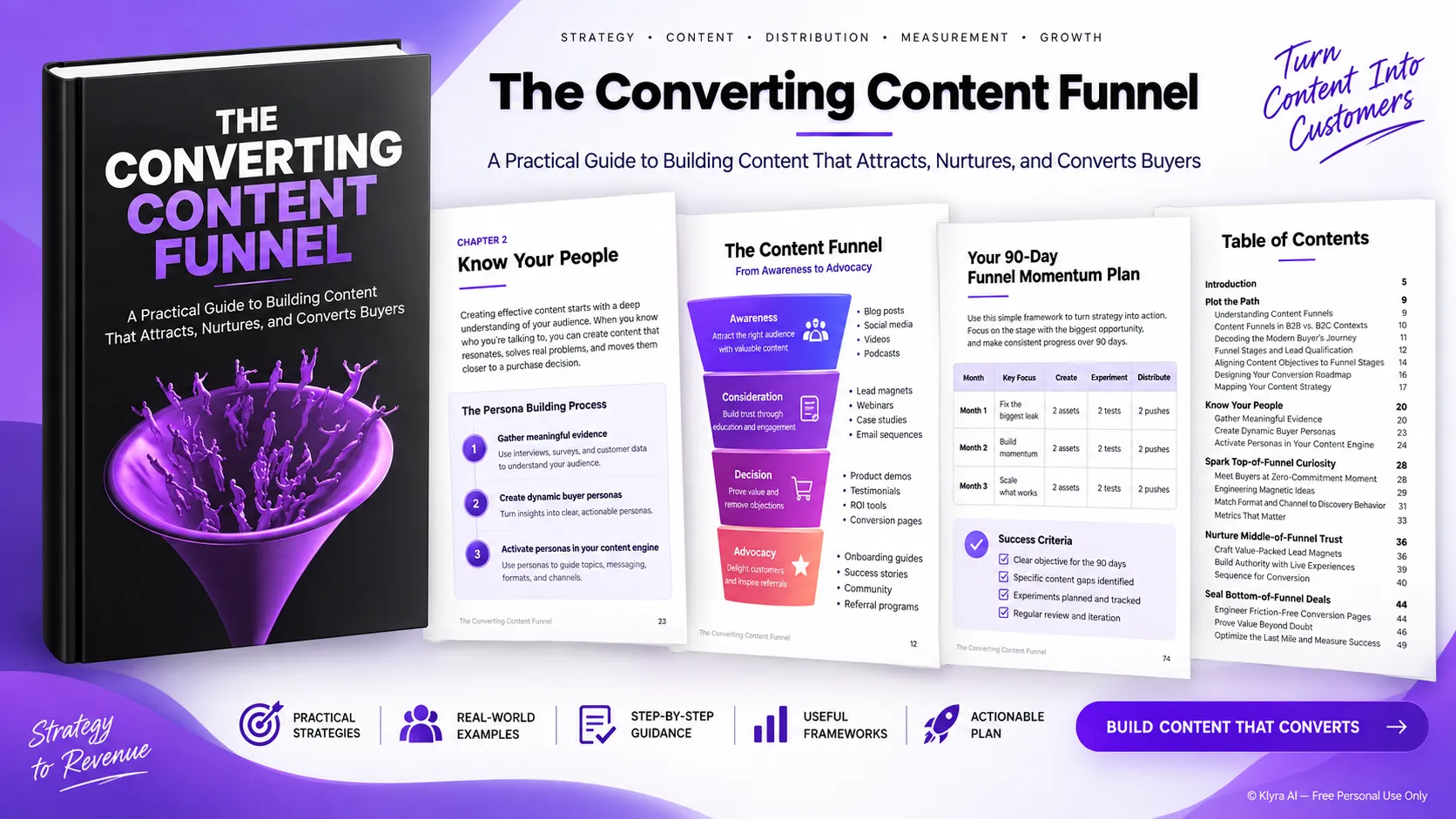
A content funnel addresses that problem by mapping specific content to different stages of the buyer's journey. Instead of asking only, "What should we publish next?", the more useful questions become:
- Who is this content for?
- What does that person need at this stage?
- What job should this asset perform?
- What should the reader logically do next?
- How will we know whether the content worked?
This changes content marketing from a collection of publishing activities into a system designed to guide prospects through increasingly informed decisions.
Understand the Content Funnel Before Building It
The basic funnel reflects changing buyer needs. Prospects at the beginning of their journey require different information from people actively comparing solutions or preparing to purchase.
Top of Funnel: Build Awareness
Top-of-funnel, or TOFU, prospects are becoming aware of a problem or need. They are not necessarily looking for a specific product. Content at this stage should educate, create relevant curiosity, and help people understand why a problem matters without immediately pushing a solution.
Useful formats can include blog posts, social content, videos, and podcasts. Success should focus on relevant attention and engagement rather than expecting every visitor to become an immediate lead.
Middle of Funnel: Build Trust
Middle-of-funnel, or MOFU, prospects understand their problem and are exploring ways to solve it. They need deeper information that helps them evaluate approaches and build confidence.
Guides, comparison content, webinars, assessments, templates, case studies, and email nurture sequences can help prospects progress through this stage.
Bottom of Funnel: Support the Decision
Bottom-of-funnel, or BOFU, prospects have moved closer to choosing a specific solution. Their questions become more concrete. They want proof that the solution works, evidence that it can work in their situation, clarity around value, and confidence that moving forward will not create unnecessary risk.
Product demonstrations, customer testimonials, case studies, ROI calculators, trials, implementation information, and focused conversion pages can address those needs.
Build Your Funnel Backward From the Outcome
A useful content funnel begins with the outcome rather than the publishing calendar. Start with the business result you want and work backward to determine what must happen at each stage.
- Set the revenue target and determine how many customers it requires.
- Define the ideal buyer.
- Establish meaningful KPIs for each funnel stage.
- Inventory existing content and assign assets to their appropriate stages.
- Identify gaps between stages.
- Prioritize production around the gaps with the greatest potential impact.
This process can reveal common structural problems. You might have strong awareness content but little material that builds trust. You might educate prospects thoroughly but provide weak decision-stage proof. Or you may have invested heavily in blog content while leaving readers with no clear route toward deeper engagement.
Rather than automatically creating more content, first determine where qualified prospects are being lost. That point should influence what you build next.
Know the People Moving Through the Funnel
A funnel cannot work effectively if its content is based on assumptions about buyers. The language, concerns, motivations, objections, and desired outcomes used in your marketing should be grounded in meaningful evidence about the people you want to reach.
Customer interviews and other forms of buyer evidence can reveal important differences between how a company describes its offering and how customers actually describe the problem it solves.
Those insights should inform dynamic buyer personas that influence the entire content engine rather than becoming documents that are created once and forgotten.
Use Buyer Language in Content
The words customers use to describe their frustrations and desired outcomes can sharpen headlines, calls to action, lead magnets, email sequences, and conversion pages.
This is especially important when applying a jobs-to-be-done perspective. Instead of focusing only on demographic characteristics or product features, examine what the buyer is trying to accomplish and what deeper outcome matters to them.
Allow for Different Buyer Paths
Different personas may need different information at the same funnel stage. A technical buyer may prioritize implementation details, while a financial decision-maker may want ROI evidence. Your funnel should be able to support these parallel information needs.
Create Top-of-Funnel Content That Earns Relevant Attention
TOFU prospects are at a low-commitment point. They recognize a challenge but may not have committed to a particular solution path.
Effective awareness content should capture attention, explain why the problem matters, connect it to meaningful goals or frustrations, and offer a low-pressure path toward deeper learning.
Build Ideas From Insights, Not Just Topics
The strongest content ideas can begin with actual buyer pains and aspirations. The resource outlines three approaches for developing hooks:
- Pain-point flip: Turn a familiar frustration into an unexpected or useful perspective.
- Unexpected data reveal: Lead with information that challenges an existing assumption.
- Narrative teardown: Examine a success or failure and extract useful lessons from it.
For longer educational content, a teach-tease-transfer structure can create a natural progression. Teach something immediately useful, indicate where deeper applications exist, and then create a logical bridge toward more detailed content.
Match Content to Discovery Behavior
People behave differently across search, social media, video, and email. Content should therefore be adapted to the context in which it is discovered.
Search-driven content can use intent and internal linking to create pathways toward deeper resources. Social content should provide standalone value rather than functioning only as a link distribution mechanism. Short-form video requires an immediate reason to pay attention. Email can continue delivering useful education without prematurely forcing a sales conversation.
Measure the Quality of Attention
Raw traffic alone does not reveal whether TOFU content is attracting people who could eventually become customers. Useful indicators include:
- Topic-to-visitor match
- Scroll depth
- Return visitor rate
- Page-to-page journeys
- Social sharing
- Click-through to middle-funnel content
The objective is not simply to attract more visitors. It is to attract relevant attention and create a natural path toward the next stage.
Use Middle-of-Funnel Content to Turn Interest Into Trust
Once prospects begin actively exploring solutions, content needs to do more than capture attention. It needs to establish confidence.
The resource focuses on three important MOFU mechanisms: valuable lead magnets, live experiences, and structured email sequences.
Create Lead Magnets With Real Utility
A useful lead magnet provides enough value to justify the prospect's attention and contact information while helping qualify whether the person is a suitable potential customer.
Possible formats include:
- Ebooks and guides
- Checklists
- Templates
- Interactive calculators
- Mini-courses
- Assessment quizzes
- Playbooks
The right format depends on the buyer, the problem, and the gap you need the asset to fill. Ideally, the resource should provide an immediate practical win while also helping the prospect understand the larger path toward solving the problem.
Build Trust Through Live Experiences
Webinars, workshops, expert panels, customer spotlights, live demonstrations, polls, and Q&A sessions can strengthen trust by allowing prospects to interact with expertise directly.
These formats can also help surface and address objections. Rather than waiting for concerns to appear during a sales conversation, content can acknowledge common concerns, educate buyers about possible approaches, and support the explanation with relevant evidence.
Sequence Nurture Content Instead of Sending Random Emails
A middle-funnel email sequence should progress logically rather than repeating the same promotional request. One five-email structure covered in the resource is:
- Welcome and quick win: Deliver the promised resource and an additional useful insight.
- Deep-dive resource: Answer common follow-up questions.
- Customer story: Demonstrate the approach through a relevant example.
- Objection-buster: Address a common source of hesitation.
- Soft conversion invite: Present a logical next action with a clear reason to take it.
Behavioral branching can make nurture content more relevant by adjusting what prospects receive according to the content they engage with.
Strengthen the Bottom of the Funnel
Decision-stage content should reduce uncertainty, demonstrate value, and make the next step clear. This is where otherwise strong funnels can lose prospects if conversion pages create friction or fail to provide sufficient proof.
Reduce Friction on Conversion Pages
A focused BOFU page should help prospects understand the outcome, evaluate credibility, resolve remaining objections, and identify one clear next action.
Important elements can include:
- A specific, outcome-focused headline
- Benefits expressed through buyer outcomes
- Concise value points
- Relevant credibility and social proof
- Only the form fields necessary for the next step
- A clear primary call to action
- Risk-reversal information where appropriate
- A concise FAQ addressing final objections
For visitors who are not ready for the primary action, smaller micro-conversions can provide a lower-commitment way to continue the conversation.
Match Proof to the Buyer's Objection
Different forms of proof answer different questions. A product demonstration can show whether something works. Testimonials demonstrate that it has worked for others. Industry-specific case studies make evidence more relevant. ROI calculators help buyers examine financial value. Trials allow prospects to test suitability in their own context.
Proof becomes stronger when it closely reflects the prospect's role, industry, concerns, and desired outcomes.
Keep Marketing and Sales Connected
The transition from marketing to sales should feel like one continuous experience. Sales teams should understand the prospect's previous engagement, while the messages used in sales conversations should remain consistent with the content that created the opportunity.
Distribute Content According to Funnel Intent
Creating an asset does not guarantee that the right people will discover it. Distribution should therefore be planned alongside creation.
Channel selection should consider where the buyer spends time, which funnel stage the content serves, the intent represented by the channel, the formats the channel supports, the KPI being pursued, and whether the business can sustain the required investment.
Build Organic Distribution Into the Funnel
Search content can be organized into connected topic clusters that help readers move naturally between related ideas. Strong assets can also be repurposed into social posts, short videos, and email content.
Email is especially valuable because subscribers have explicitly requested ongoing communication. Segmentation allows different subscribers to receive content appropriate to their current level of awareness and intent.
Use Paid Distribution With Clear Intent
Paid distribution can provide speed, scale, and precise targeting. The resource recommends a 70/20/10 allocation framework:
- 70%: Proven channels supporting consistent results
- 20%: Promising experiments showing early positive signals
- 10%: Higher-risk ideas that could open new audience segments
Paid creative should lead with the value of the content rather than defaulting to product features. The promise in the advertisement should also match what the landing page actually delivers.
Amplify Through Partnerships
Industry experts, podcasts, communities, complementary businesses, employees, and customers can extend distribution through existing trust networks. Partnerships work best when the audiences and offerings are naturally aligned.
A repeatable amplification process also prevents valuable content from receiving only sporadic promotion after publication.
Measure the Funnel as a Connected System
Measurement should help people make decisions rather than merely fill dashboards.
A useful framework connects activity from the first interaction through revenue. Depending on the stage, this can involve conversion rates, customer acquisition cost, lifetime value, engagement depth, qualification rates, sales opportunities, win rates, and acquisition payback.
Leading indicators can provide early signals of future performance, while lagging indicators confirm what has already happened. Using both creates a more complete picture of funnel health.
Find the Leaks That Matter
Every funnel loses prospects. The objective is not to eliminate every drop-off but to identify which problems deserve attention.
A structured diagnostic process can include:
- Export stage-by-stage conversion data.
- Compare performance with relevant historical or external benchmarks.
- Segment results by traffic source, persona, and content type.
- Develop hypotheses explaining meaningful drop-offs.
- Gather qualitative evidence such as heat maps, session recordings, and chat logs.
- Prioritize issues according to their potential business impact and implementation effort.
The resource also introduces the ICE framework, which evaluates potential improvements according to impact, confidence, and ease. This helps prevent teams from prioritizing an easy change simply because it is easy.
Turn Optimization Into Structured Experiments
Once a leak is identified, optimization should begin with a clear hypothesis. A useful experiment specifies the proposed change, expected measurable outcome, and reasoning behind the prediction.
Each experiment should define:
- The hypothesis
- The primary KPI
- The exact variant being tested
- The required sample size
- The test duration
- The decision rule
- The next action after the result
Documenting results creates organizational knowledge. Successful approaches can be repeated, while failed experiments can prevent teams from revisiting the same assumptions without new evidence.
Make Funnel Optimization a Continuous Practice
A content funnel is not a campaign that becomes finished once the required assets exist. Buyer needs change, market conditions change, and new performance data reveals where the system can improve.
The resource recommends establishing recurring practices across different time horizons:
- Share fresh buyer signals regularly.
- Review core funnel metrics each week.
- Evaluate content performance each month.
- Revisit the full funnel and priorities each quarter.
- Periodically reconsider how an entire stage could work better.
Ownership should also extend beyond marketing. Sales can surface recurring objections. Customer success can contribute questions, testimonials, and success stories. Product teams can provide usage insights, tutorials, and proof opportunities. Marketing can turn these inputs into content that supports the buyer journey.
Extend the Funnel Beyond the Purchase
The customer journey does not have to end at conversion. Once the acquisition funnel works consistently, it can expand into a broader cycle of onboarding, adoption, expansion, and advocacy.
Onboarding guides and quick-win playbooks help new customers succeed. Tutorials and benchmarks can deepen adoption. Assessments, workshops, and ROI tools can uncover expansion opportunities. Customer stories, referral resources, and communities can turn successful customers into sources of trust for future prospects.
This creates a reinforcing cycle in which customer success contributes proof and insight back into acquisition content.
Create a 90-Day Funnel Momentum Plan
Improving everything simultaneously makes prioritization difficult. Instead, begin with the weakest funnel stage, using conversion data and time-in-stage to identify where attention is most needed.
The resource proposes a simple operating rhythm: each month, run two experiments, create two assets, and execute two distribution pushes. This balances optimization of existing content with creation of missing content and stronger amplification.
Your 90-day plan should document:
- The funnel stage being improved
- The asset or experiment
- The responsible owner
- The success metric
- The current status
Begin with one SMART objective, identify the most important content gaps, plan the experiments needed to test your assumptions, and review progress regularly.
Build a Funnel That Learns
The strongest content funnel is not simply a sequence of assets. It is a system that becomes more useful as you learn more about buyers.
Start with a clear map. Ground the strategy in buyer evidence. Earn relevant attention at the top. Build trust in the middle. Reduce uncertainty at the bottom. Distribute each asset where it fits the buyer's behavior. Measure what happens between stages. Then use those findings to decide what to improve next.
That process turns content creation from a series of disconnected activities into a structured approach to attracting, educating, nurturing, and converting the right audience.