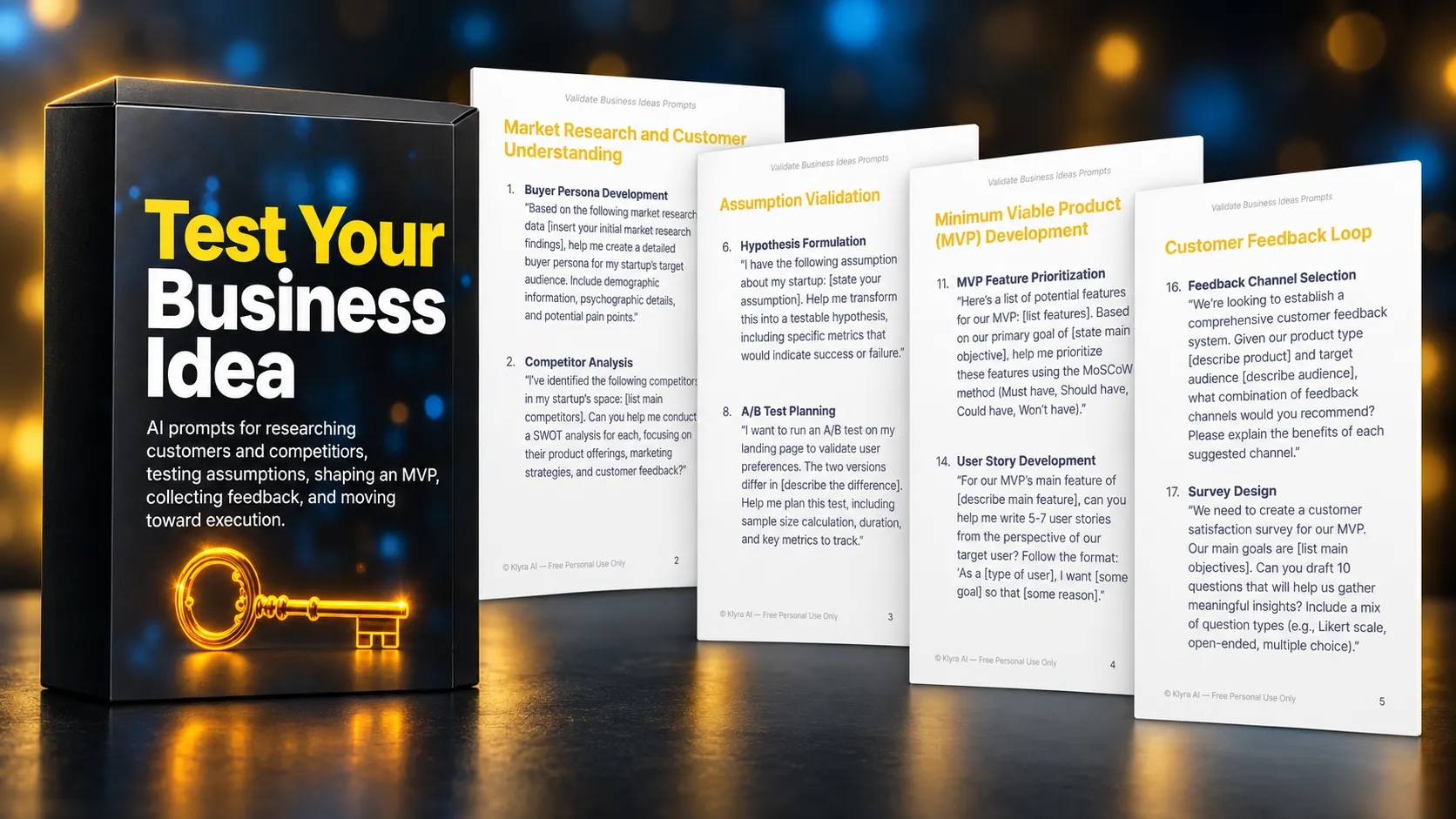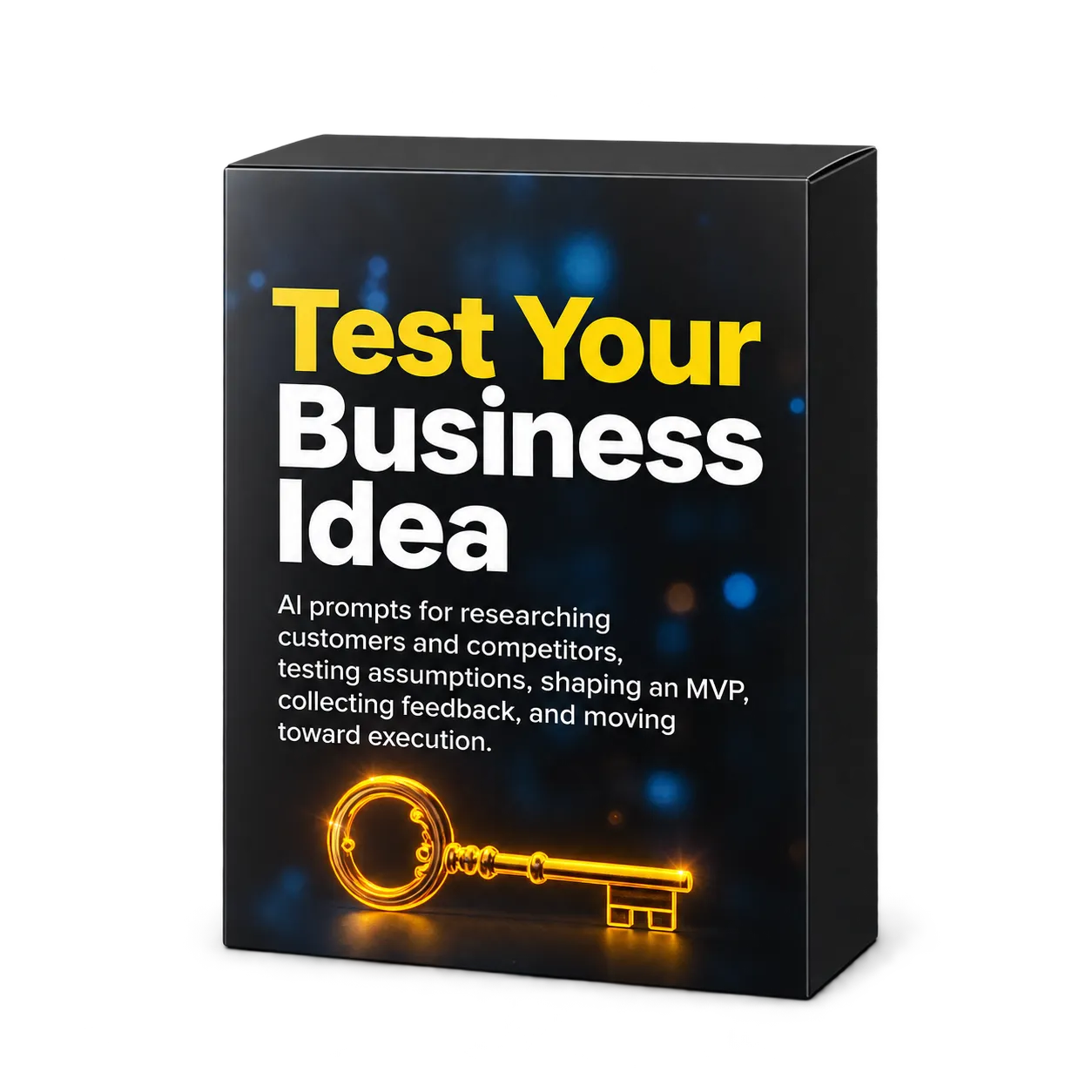
Test Your Business Idea
AI prompts for researching customers and competitors, testing assumptions, shaping an MVP, collecting feedback, and moving toward execution.
How the Prompt Collection Works
Each prompt gives an AI assistant a defined role, task, or output and then asks the reader to add details about the real situation. This structure helps move the conversation from a general question toward a response connected to the reader’s goals, audience, constraints, information, or current performance.
Before using a prompt, replace every bracketed placeholder with specific context. When a prompt asks for data, examples, competitors, habits, campaign details, or goals, provide enough information for the assistant to distinguish the situation from a generic case.
Core Areas Covered
Market Research and Customer Understanding
Build buyer personas, analyze competitors and trends, estimate the market, and identify customer pain points. The prompts in this part are designed to turn that subject into a focused analysis, plan, comparison, or set of next steps based on the information supplied by the reader.
Assumption Validation
Turn beliefs about the problem, audience, and solution into questions that can be tested. The prompts in this part are designed to turn that subject into a focused analysis, plan, comparison, or set of next steps based on the information supplied by the reader.
Minimum Viable Product Development
Define an MVP that focuses on what must be learned before broader execution. The prompts in this part are designed to turn that subject into a focused analysis, plan, comparison, or set of next steps based on the information supplied by the reader.
Customer Feedback Loop
Collect, organize, and interpret feedback so it can inform the next decision. The prompts in this part are designed to turn that subject into a focused analysis, plan, comparison, or set of next steps based on the information supplied by the reader.
Scaling and Growth
Use validated learning to consider the transition from testing to broader execution. The prompts in this part are designed to turn that subject into a focused analysis, plan, comparison, or set of next steps based on the information supplied by the reader.
Using the Prompts in Practice
- Choose the category that matches the current decision or task.
- Replace the placeholders with accurate, relevant details.
- Run the prompt with an AI assistant and review the response for fit.
- Ask follow-up questions where assumptions, recommendations, or steps need clarification.
- Apply the useful output, observe the result, and return with updated context.
Getting Better Results
The quality of the response depends on the quality of the context. State the desired outcome, describe the present situation, include constraints, and provide source information when the prompt requests it. If the first response is too broad, narrow the task or ask the assistant to work through one section at a time.
The complete downloadable resource contains the ready-to-use prompts for each category. Use this landing page to understand the scope, then download the full collection when you are ready to customize and apply the prompts.