Build a Content System Instead of Starting From Scratch
Content repurposing begins with a simple problem: valuable ideas are often trapped inside one format and distributed through one channel. A useful article remains an article. A webinar ends when the session ends. A strong video reaches only the people who encounter that particular video.
A systematic repurposing process changes this. Instead of approaching content as a collection of unrelated projects, you begin with a strong core idea and deliberately create an ecosystem around it.
The objective is not simply to publish the same material repeatedly. It is to preserve the central value of an idea while presenting it in forms that make sense for different audiences, platforms, and ways of consuming information.
Start With Ideas Worth Multiplying
Repurposing becomes more effective when the original idea is strong enough to support multiple pieces of content. The guide recommends systematically gathering ideas rather than depending on occasional inspiration.
Useful idea sources include:
- Questions and objections found in social comments
- Recurring issues found in customer support conversations
- Objections and questions raised during sales conversations
- Keyword research
- Emerging topics found through industry and trend newsletters
- Personal experiences and challenges you have overcome
These ideas can be stored in an accessible idea vault and organized by factors such as theme, audience stage, priority, impact, and repurposability.
The guide also recommends looking for evergreen potential. Ask whether an idea solves an enduring problem, is likely to remain relevant, and has meaningful search demand. Most importantly, consider whether the idea can naturally support several useful formats rather than only one isolated piece.
Validate Before Building the Pillar Asset
Not every promising idea deserves a major production investment. Before developing a substantial pillar asset, the guide recommends testing audience resonance through smaller feedback loops.
Possible validation methods include testing different hooks around the same idea, testing email subject lines, asking questions or running polls in relevant communities, and publishing teaser content before developing the complete resource.
Both quantitative and qualitative signals matter. Clicks, shares, and saves provide useful evidence, but replies, follow-up questions, direct messages, and other signs of active interest can reveal which parts of an idea actually resonate.
Create a Pillar Asset Designed for Repurposing
Once an idea has demonstrated potential, it can become a pillar asset: a substantial resource that delivers value on its own while also providing the raw material for derivative content.
The pillar should be created with repurposing in mind. Written resources can use clear sections and subheadings that work independently. Recorded content can include natural pauses that create clean editing points. Rather than producing one monolithic piece, the goal is to create modular sections that work together while still containing useful standalone ideas.
Use the 5-Beat Repurposing Framework
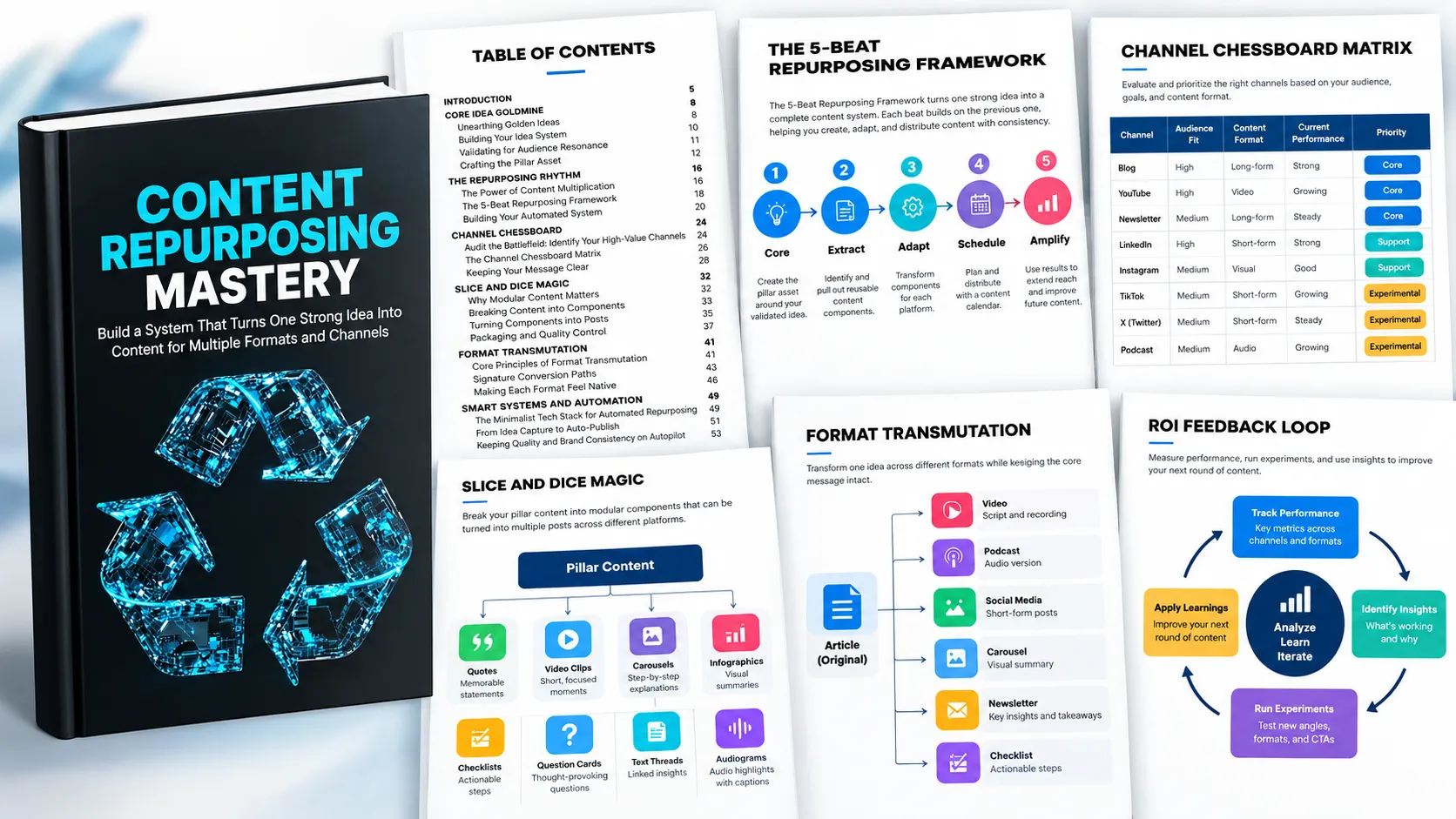
The guide organizes the repurposing workflow around five beats: Core, Extract, Adapt, Schedule, and Amplify. Together, they turn content repurposing from an occasional activity into a repeatable production rhythm.
1. Core
Create the primary asset around the validated idea. Structure it clearly and deliberately include sections, examples, insights, statistics, steps, or memorable statements that could later work independently.
2. Extract
Mine the pillar asset for reusable components. These might include quotes, statistics, stories, questions, process steps, frameworks, memorable phrases, or individual insights.
The guide recommends maintaining an extraction sheet that records each content component, where it appears in the original asset, its central message, potential platforms, and any visual requirements. For recorded content, timestamps can make later extraction considerably easier.
3. Adapt
Turn extracted components into platform-ready assets. Adaptation is more than copying information into a different template. Each piece should be reconsidered for the context in which the audience will encounter it.
A single concept could therefore become a carousel, text thread, short video, infographic, question card, audiogram, checklist, or another suitable derivative.
4. Schedule
Move completed assets into an organized distribution calendar. This turns a collection of derivatives into a coordinated publishing system rather than a folder of unused content.
5. Amplify
Use engagement and performance information to extend the reach of successful content and inform future decisions. Repurposing becomes more valuable when performance feeds back into what you create, adapt, and distribute next.
Focus on the Channels That Matter
Effective repurposing does not require publishing everywhere. The guide recommends auditing channels based on audience presence, meaningful engagement, preferred content formats, current performance, and alignment with business objectives.
Channels can then be classified into three groups. Core channels are the strongest proven platforms and receive most of the content effort. Support channels help nurture audiences at different stages. Experimental channels are used to test lightweight versions of content without spreading resources too thin.
This channel-first thinking also improves extraction. Once you know which platforms matter, you can identify the parts of a pillar asset most suitable for those specific destinations.
Turn Large Assets Into Modular Content
Repurposing becomes easier when content is treated as a collection of smaller units rather than a single finished object.
A larger resource can contain statistics, stories, quotes, questions, explanations, process steps, frameworks, and other components. Each component can potentially become an independent piece of micro-content serving a different purpose.
The guide presents several ways to package these components:
- Quotes: Turn strong statements into standalone visual or text-based posts.
- Short clips: Extract focused moments from longer video content and add captions where appropriate.
- Carousels: Structure information around a hook, several value-focused slides, and a clear next step.
- Infographics: Convert processes and structured information into visual explanations.
- Checklists: Transform procedural material into an actionable reference.
- Question cards: Use thought-provoking questions to encourage discussion.
- Data visualizations: Turn statistics and comparisons into charts or graphics.
- Text threads: Organize related points with clear sequencing and transitions.
- Audiograms: Pair useful audio excerpts with visual elements and captions.
Change the Format Without Losing the Core Message
Format transmutation means moving an idea between mediums while preserving its essential promise.
Text, audio, and video create different experiences. Written content gives readers more control over pace and navigation. Audio depends on a clear linear narrative and creates connection through voice. Video combines sound, movement, and visual information while often demanding a faster opening.
For that reason, successful repurposing is not simply a matter of transferring the same words from one format to another. Length, pace, structure, presentation, and calls to action should be adjusted to suit the destination.
The guide illustrates conversion paths such as moving from an article to a script, then to a podcast and short-form video. The central idea remains intact while its delivery changes to suit each medium.
Use Automation to Remove Repetitive Work
Automation can make the repurposing workflow more efficient, but the guide recommends a deliberately lean approach rather than accumulating unnecessary tools.
The central principle is simple: automation should remove clicks, not creativity. Technology can handle repetitive transfers, scheduling, organization, metadata, checks, and notifications while strategic and creative decisions remain human responsibilities.
A centralized asset library can also support the system. Consistent folder structures, naming conventions, and metadata for topic, platform, status, and expiration make a growing content library easier to search and maintain.
Protect Quality as Output Increases
Faster production is only useful when quality remains intact. Automated guardrails can assist with routine checks such as grammar, brand voice, alt text, links, image requirements, and approval routing.
These systems are intended to support human review rather than replace it. The guide recommends starting with one automation in the workflow, making sure it works reliably, and then adding additional automation gradually.
Measure Whether Repurposing Is Working
Producing more assets does not automatically mean the repurposing system is successful. Measurement should connect content activity with business objectives.
The guide recommends monitoring performance across the funnel, including awareness, engagement, conversion, and revenue indicators. Rather than becoming overwhelmed by dashboards, select a North Star metric representing the primary business objective and support it with a focused set of relevant KPIs.
Repurposing-specific measures can also help evaluate efficiency and performance, including the number of derivative assets produced relative to time invested, conversion by platform, relative performance across formats, sales influenced by repurposed content, and how quickly engagement declines after publishing.
Experiment, Learn, and Iterate
Measurement becomes useful when it changes what you do next. The guide recommends lightweight experiments in which one variable is changed at a time. Hooks, thumbnails, subject lines, caption length, and call-to-action placement are examples of variables that can be tested.
Results should feed into a recurring review process so that insights become actions. Over time, this creates a feedback loop in which stronger ideas, formats, channels, and distribution approaches receive greater attention.
Keep the Content Flywheel Moving
A repurposing system still requires maintenance. Content fatigue, overemphasis on metrics, and changes within a team can cause even a well-designed workflow to slow down.
The guide therefore encourages regular check-ins and small next actions. Audit an underperforming platform. Create an extraction template for the next pillar asset. Test a new conversion path. Set up one automation trigger. Define the North Star metric.
Content repurposing becomes sustainable when these practices operate as a connected system rather than isolated tactics. Strong ideas feed pillar assets. Pillar assets produce modular components. Components become native platform content. Distribution generates performance data. That information then improves the next round of content decisions.
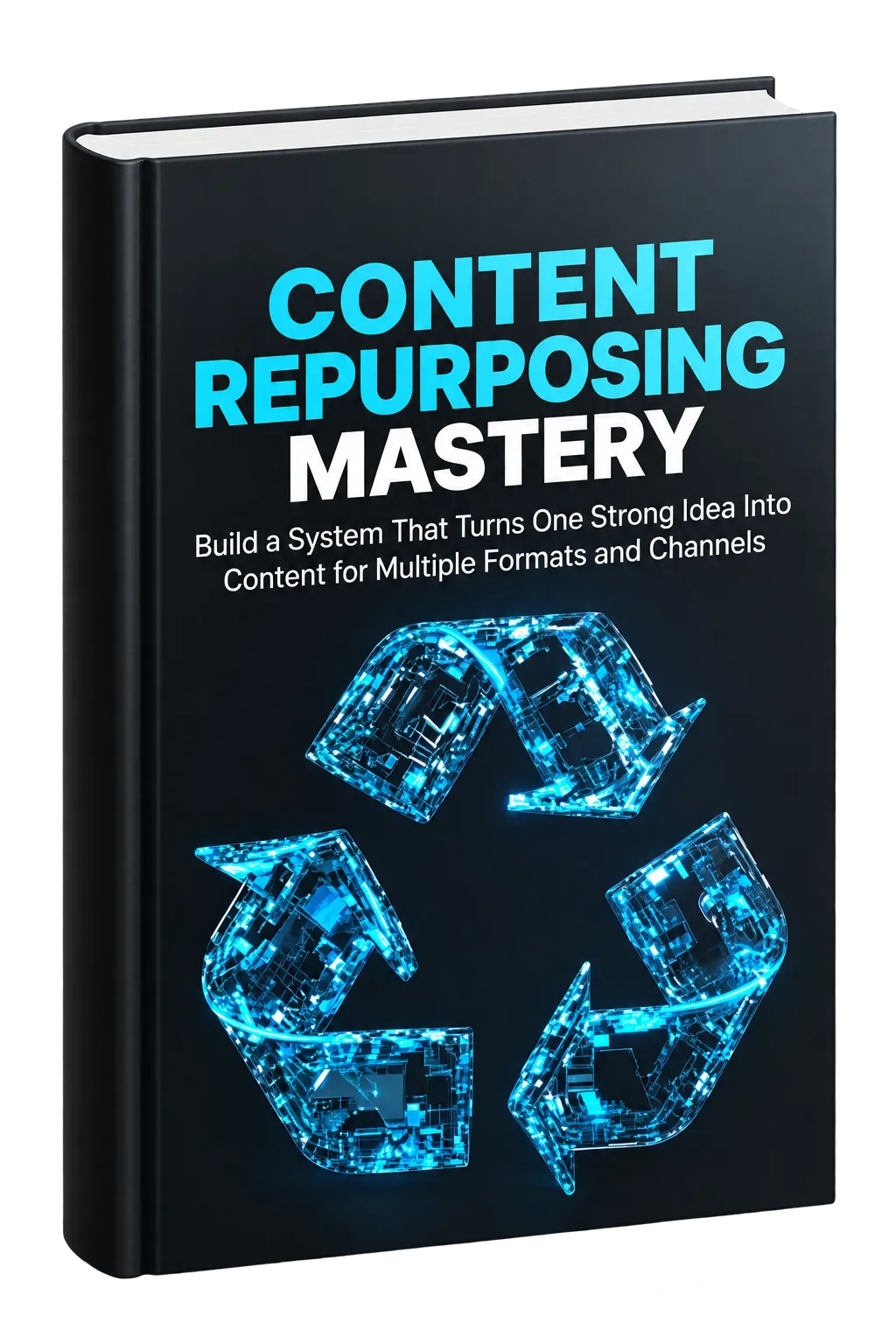
Download Content Repurposing Mastery for the complete frameworks, matrices, conversion paths, examples, workflow guidance, and practical implementation details.