Build a Sales System Before You Build a Chatbot
An automated sales chatbot should not begin with software. It should begin with understanding how your sales conversations already work.
The resource recommends mapping your process before building the automation itself. That means identifying the questions prospects regularly ask, the information required to qualify them, the objections that appear repeatedly, the progression from initial contact to sale, and the signals that indicate someone may be ready to move forward.
This approach turns existing sales knowledge into a structured conversation flow rather than constructing a chatbot without a clear blueprint.
Map the Customer Journey
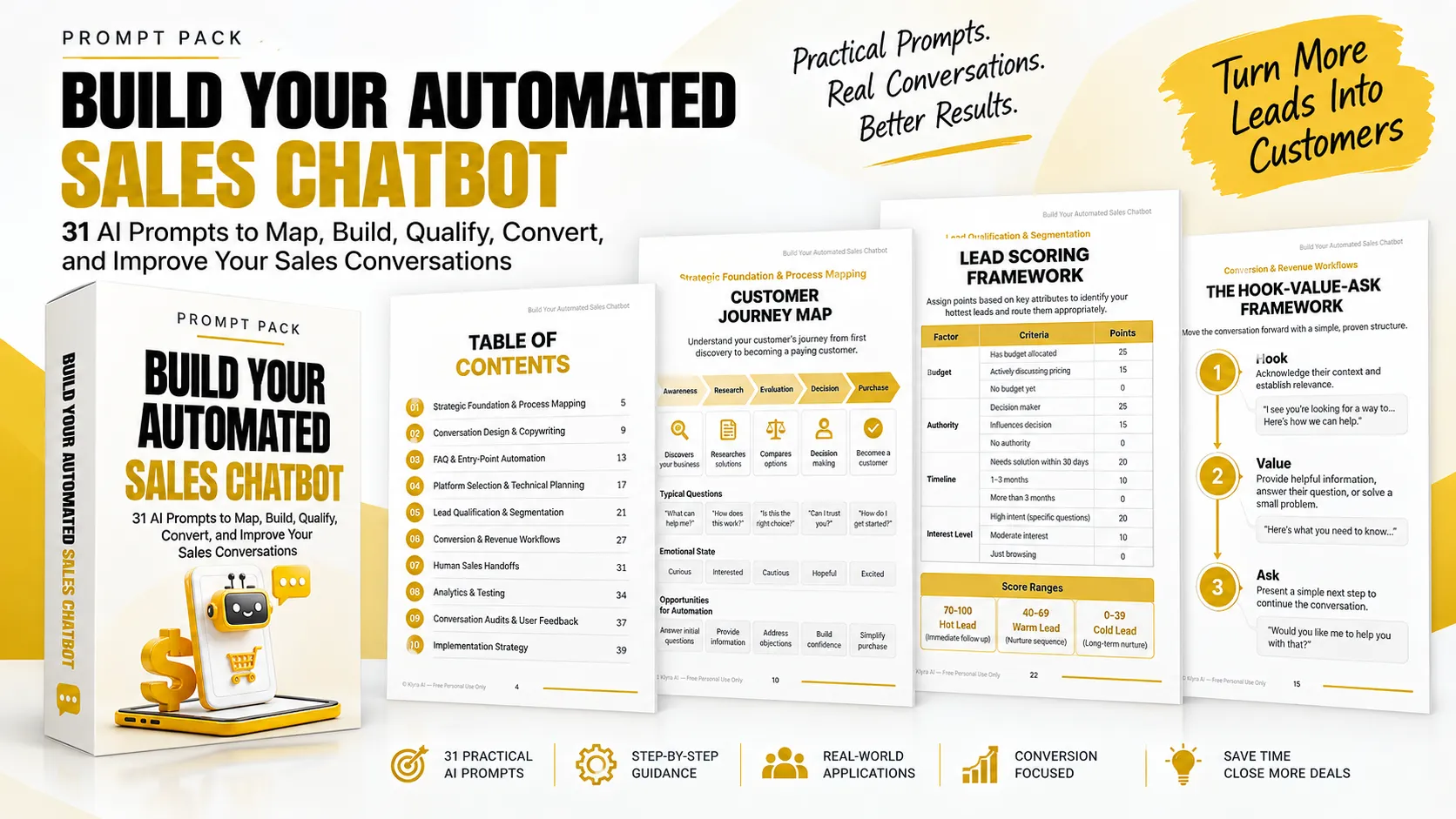
A useful chatbot needs context about where a prospect is in the buying journey. The prompts help examine the journey from the initial trigger that creates a need through research, evaluation, friction points, and the moments that can accelerate a buying decision.
This creates opportunities to decide where automation can genuinely help instead of inserting automated messages into every possible interaction.
Define Qualification Before Automation
The resource places qualification near the beginning of the process. It encourages businesses to identify criteria such as budget capability, decision-making authority, timeline, specific needs, geographic limitations, and other deal-breakers that determine whether a prospect is a suitable fit.
Qualification questions should still feel conversational and helpful. The goal is to identify fit efficiently while ensuring that prospects who do not qualify still feel assisted rather than rejected.
Design Conversations That Move One Step at a Time
One of the central frameworks in the resource is Hook-Value-Ask. Rather than trying to close a sale immediately, the chatbot moves the prospect forward through a sequence of small interactions.
- Hook: Acknowledge the context that brought the person into the conversation and establish expectations.
- Value: Provide the information, answer, or resource the person expects.
- Ask: Present a simple question that advances the conversation to the next logical step.
This principle also shapes the resource's call-to-action strategy. Instead of jumping directly from initial interest to a high-commitment request, it uses a commitment ladder that progresses from easy engagement through increasingly meaningful actions and ultimately toward the desired conversion.
Match the Conversation to the Entry Point
A person who clicked an advertisement, commented on a social post, opened a website chat, or sent a direct message did not arrive with identical context. The resource therefore recommends creating contextual greetings for different entry points.
The first message should feel like a continuation of what the person was already doing, rather than beginning every conversation with a generic greeting.
Keep Messages Designed for Mobile
The resource treats mobile readability as part of conversation design. Messages should be short enough to understand quickly, with longer explanations divided into smaller sequential messages. Lists, line breaks, buttons, and visual elements can reduce the amount of text a user needs to process at once.
The included mobile optimization prompt uses a "One Breath Rule" and asks for messages that can be understood in a single glance.
Give the Chatbot a Consistent Voice
Automation should not require abandoning brand personality. The resource includes a process for defining a bot persona based on the brand, target audience, and emotional state the conversation should create.
The resulting persona can document personality traits, formality, emoji usage, punctuation, copywriting rules, characteristic phrases, and examples of how generic messages should be rewritten in the intended voice.
Prepare for Objections and FAQs
Common questions and objections are especially suitable for structured automation because they occur repeatedly.
The objection-handling framework uses three elements: acknowledge the concern, provide a concise reframe or value reminder, and offer a small next-step question. The objective is to continue the conversation rather than argue with the prospect.
Frequently asked questions can similarly become a conversational decision tree. The resource recommends starting with broad categories, branching into specific questions, providing concise answers, linking to detailed information when needed, and retaining an option for human support when the available choices do not solve the visitor's problem.
Turn Qualification Into Routing and Segmentation
Once qualification criteria are defined, the chatbot can use them to decide what should happen next.
The resource develops this through knockout questions, lead scoring, tagging, appointment logic, and product recommendations.
Use Knockout Questions Early
The implementation principles recommend placing knockout questions within the first three to five interactions. The purpose is to identify unsuitable leads early rather than allowing both the prospect and business to spend unnecessary time moving through an irrelevant sales flow.
Responses can also trigger tags that preserve useful information about the prospect for later routing and follow-up.
Score and Segment Leads
The resource provides a prompt for constructing a 100-point lead scoring system based on the factors that indicate lead quality for a particular business. It divides resulting scores into cold, warm, and hot ranges and connects those ranges to routing and follow-up speed.
A separate tagging framework organizes information across six categories:
- Interest
- Readiness
- Budget
- Behavior
- Source
- Lifecycle stage
Combining these tags allows follow-up to reflect what prospects want, how ready they are, what they can afford, how they have behaved, where they came from, and where they are in the customer journey.
Connect Qualified Prospects to the Right Next Step
Qualification is useful only when it changes what happens next. The resource includes dedicated flows for appointment booking, product recommendations, and high-value opportunities.
An appointment flow can determine which appointment type fits a prospect, ask pre-qualification questions, provide confirmation information, schedule reminders, and define a fallback when the preferred time is unavailable.
For ecommerce scenarios, a short quiz-style recommendation flow can narrow choices through a small number of diagnostic questions and recommend a product based on the customer's answers.
Know When a Human Should Take Over
The resource does not position automation as a replacement for human selling. High-value or complex opportunities can trigger a structured handoff.
The handoff process can specify trigger conditions, alert the sales team, provide relevant context collected during the conversation, summarize the prospect's needs and urgency, and give the salesperson an opening message that continues naturally from the automated interaction.
The intended outcome is a human conversation with a prospect who is already more qualified, informed, and engaged.
Build Conversion Flows Without Losing the Customer Experience
After the core conversation and qualification system are established, the resource introduces conversion-focused workflows. These include abandoned-cart recovery, upselling and cross-selling, payment-plan conversations, scarcity and urgency, and social proof.
The order matters. The implementation strategy explicitly recommends establishing qualification logic before moving into conversion tactics.
Use Scarcity Only When It Is Real
The scarcity framework distinguishes genuine constraints from manufactured pressure. Examples of legitimate constraints include limited appointment availability, remaining inventory, and a real promotional deadline.
The resource also calls for anti-manipulation checks so scarcity claims remain verifiable and true, alongside identification of false-scarcity practices that should be avoided.
Place Social Proof Where It Addresses Uncertainty
Rather than inserting testimonials everywhere, the social-proof framework considers where credibility is needed during the conversation. Proof can appear at the opening, during evaluation, in response to a particular objection, or immediately before conversion.
Different concerns can be paired with relevant evidence, such as quality-focused testimonials for quality concerns or an appropriate case study when a prospect is evaluating return on investment.
Measure the Sales Conversation, Not Just Chat Activity
Launching the chatbot is not the end of the process. The resource dedicates its final prompt category to analytics, testing, audits, and feedback.
Its suggested performance framework includes a primary metric such as Revenue Per Conversation alongside diagnostic measures such as conversation start rate, completion rate, qualification rate, conversion rate, response time, drop-off points, and human handoff success rate.
The underlying principle is to focus measurement on business outcomes rather than impressive-looking activity that does not predict revenue.
Improve One Problem at a Time
The testing framework favors sequential A/B testing instead of complex multivariate testing. Potential tests include greeting messages, value proposition wording, CTA button copy, question sequencing, and timing between messages.
Weekly conversation audits examine drop-offs, dead ends, error messages, conversation length, copy quality, technical performance, tagging accuracy, qualification logic, and human routing.
User feedback adds another source of improvement. The resource recommends lightweight surveys, strategic check-ins, frustration detection, weekly feedback analysis, and clear rules for when repeated complaints should trigger a flow revision.
A Four-Week Path From Planning to Launch
The resource organizes implementation into a practical sequence rather than expecting all 31 prompts to be completed at once.
- Week 1: Foundation and Sales Process Mapping. Document the sales process, qualification criteria, customer journey, value proposition, and competitive positioning.
- Week 2: Conversation Design and Script Writing. Create the greeting sequence, bot persona, objection responses, mobile-friendly messages, CTA progression, FAQ flow, and contextual entry scripts.
- Week 3: Platform Setup and Lead Qualification. Address platform and technical prerequisites, then build knockout questions, lead scoring, tagging, booking logic, and recommendation flows.
- Week 4: Conversion Optimization and Launch. Add recovery and conversion flows, human handoffs, payment options, scarcity, and social proof. Test every branch before launching to a smaller traffic segment.
After launch, the process moves into ongoing measurement. Analytics, A/B testing, conversation audits, and feedback collection become recurring activities. Multi-platform expansion is considered only after the primary platform is performing consistently.
Six Principles to Guide the Entire System
The resource closes its implementation guidance with six principles that connect the individual prompts into one operating approach:
- Paper Before Pixels: Map the conversation before building it in software.
- Sell the Next Step, Not the Product: Move prospects forward through small, relevant interactions instead of trying to close immediately.
- Qualify Early: Identify fit near the beginning of the conversation so automation serves both the prospect and the business efficiently.
- Respect Messaging Windows: Design follow-up around the communication rules and timing constraints of the platform being used.
- Measure Revenue, Not Vanity: Connect chatbot performance to meaningful business outcomes.
- Treat Launch as the Beginning: Review real conversations, find the biggest source of friction, and continuously improve the flow.
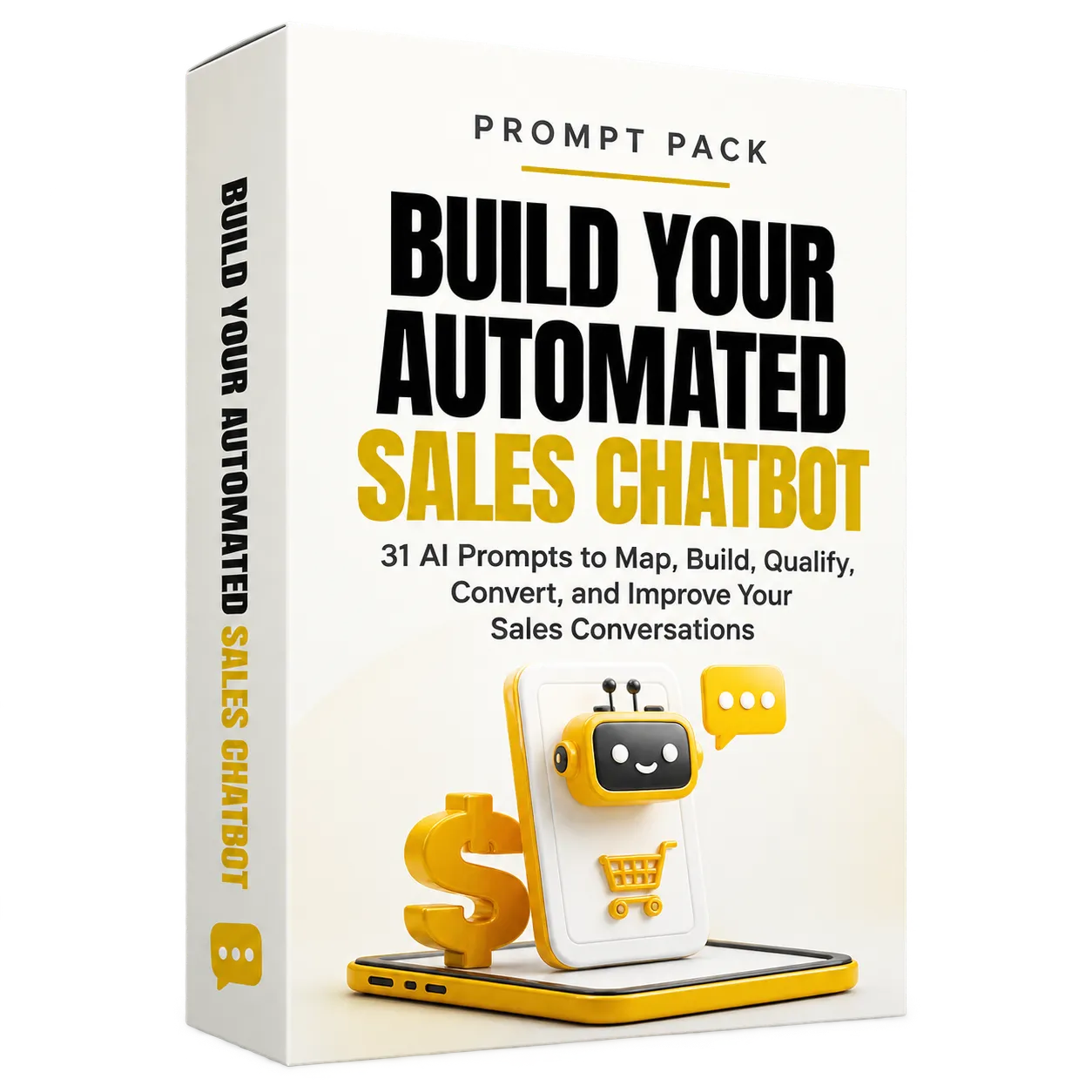
The complete resource contains all 31 prompts used to work through these stages, from extracting an existing sales process and designing conversation flows to qualification, conversion optimization, analytics, testing, and continuous improvement.