Building a Strong Foundation for AI-Assisted Content
Effective prompt engineering starts before the prompt itself. A reliable content workflow needs clear foundations that give AI enough direction to produce content aligned with the brand, audience, and intended outcome.
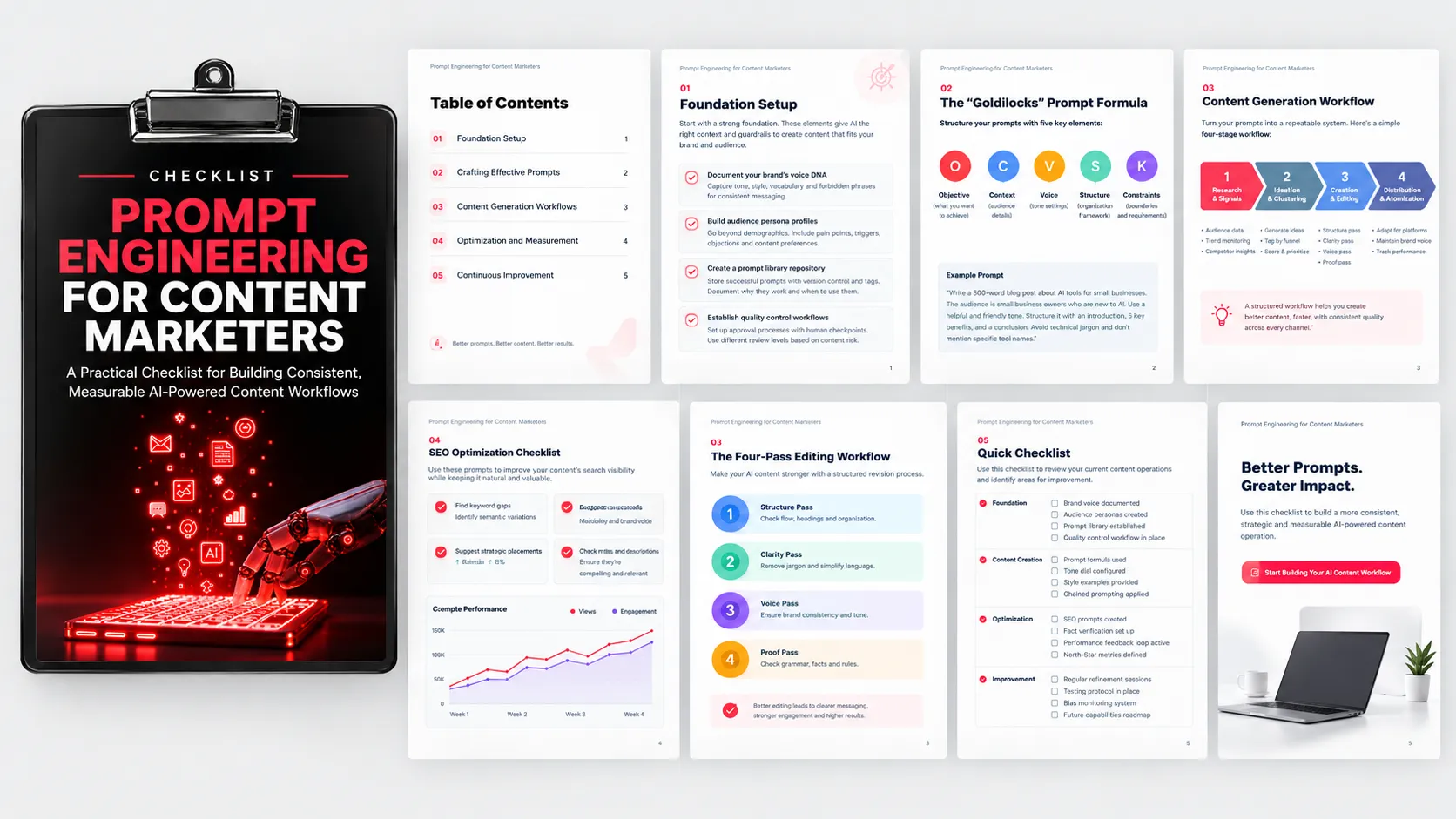
Document Your Brand's Voice DNA
Create a detailed framework that captures the brand's tone, style, vocabulary preferences, and forbidden phrases. This gives AI a defined creative boundary and helps maintain consistency across AI-generated content.
Build Audience Persona Profiles
Develop audience profiles around meaningful content signals rather than demographics alone. The checklist recommends considering pain points, trigger events, objection phrases, and content preferences. These details can then provide useful context for prompts intended for specific audience segments.
Create a Prompt Library
Store successful prompt frameworks in a central repository with version control and tagging. The goal is not simply to preserve prompts that work, but to document why they work and the conditions in which they are effective. This turns successful prompting practices into reusable institutional knowledge.
Establish Quality Control Workflows
AI-generated content still requires appropriate review. Establish approval processes with human checkpoints for accuracy, brand alignment, and strategic relevance. The checklist recommends different review levels based on content risk, distinguishing routine content from higher-risk material such as thought leadership.
Crafting More Effective AI Prompts
The checklist presents prompt construction as a structured process rather than a vague request for AI to produce content.
The "Goldilocks" Prompt Formula
Structure prompts around five elements:
- Objective: Clearly define the purpose of the task.
- Context: Provide relevant audience details.
- Voice: Specify the desired tone settings.
- Structure: Define the organizational framework.
- Constraints: Establish boundaries and requirements.
These elements provide the AI with the information needed to understand what the content should accomplish and how it should be produced.
Use Tone Dials for Greater Voice Control
Instead of relying on broad instructions such as "professional tone," specify more granular attributes. The checklist identifies formality, energy intensity, humor appropriateness, and authority positioning as useful dimensions for controlling voice.
Provide Style Primers
Sample paragraphs can demonstrate the desired writing pattern more directly than generic descriptions. Including examples allows AI to pattern-match against established approaches instead of having to infer the desired style from abstract instructions.
Apply Chained Prompting
Related prompts can be connected through shared context across a content workflow. For example, one prompt can generate keyword clusters, another can develop narrative angles, and another can suggest distribution formats. Maintaining shared context helps preserve consistency as content moves through different stages.
Designing Content Generation Workflows
Prompt engineering becomes more useful when it is integrated into a repeatable content operation rather than treated as a collection of isolated prompts.
Set Up an AI Listening Stack
Connect audience data sources such as Reddit, product reviews, and social conversations to AI processing tools. These sources can continuously provide audience insights that inform content strategy and prompt development.
Develop an Ideation Pipeline
The checklist outlines a four-stage approach to content ideation:
- Feed signals from audience research.
- Generate raw ideas.
- Cluster and tag ideas by funnel stage and persona.
- Score and schedule ideas based on business impact.
This creates a systematic path from audience signals to prioritized content ideas.
Use a Four-Pass Editing Workflow
Instead of treating editing as one broad revision step, separate it into four passes:
- Structure pass: Review flow and headings.
- Clarity pass: Remove unnecessary jargon.
- Voice pass: Check brand consistency.
- Proof pass: Check grammar, factual accuracy, and rules.
Build a Content Atomization System
Create prompts that extract standalone insights from flagship content and adapt those insights for different platforms. The objective is to maintain strategic coherence and brand voice while changing the format for different channels.
Optimizing and Measuring AI-Powered Content
A structured AI content workflow also needs mechanisms for optimization, verification, and measurement.
Create SEO Optimization Prompts
Develop prompts that examine content for keyword gaps, identify semantic variations, and recommend strategic keyword placements. These recommendations should continue to prioritize readability and consistency with the intended brand voice.
Implement Fact-Verification Protocols
Establish prompts that identify factual claims within content and associate them with confidence ratings. The checklist presents this as a way to help prevent hallucinations and misinformation while maintaining content authority.
Set Up Performance Feedback Loops
Connect analytics data back into the content improvement process. The resource specifically describes configuring systems where analytics data feeds into ChatGPT for iterative refinement recommendations based on actual user behavior rather than theoretical best practices.
Document North-Star Metrics
Define metrics that connect AI-powered content to business outcomes. The checklist gives qualified leads and sales cycle acceleration as examples, emphasizing business outcomes rather than vanity metrics.
Creating a Continuous Improvement System
Prompt engineering should evolve as content performance provides new information. The checklist recommends making refinement and experimentation part of the ongoing workflow.
Schedule Regular Prompt Refinement
Review prompts monthly using content performance data. Successful angles can inform future prompt refinements, while underperforming patterns can be retired.
Establish a Testing Protocol
Use a systematic experimentation process and test one variable at a time. This makes it easier to identify which changes are actually associated with performance improvements.
Monitor Bias
Regularly examine whether AI-generated personas and content reflect diverse perspectives or inadvertently exclude important audience segments. This helps support more inclusive content creation.
Plan for Future Capabilities
Assign responsibility for monitoring emerging AI capabilities and identifying relevant opportunities for the content strategy. The checklist specifically highlights multimodal generation, voice agents, and real-time personalization as areas to watch.
Putting the Checklist Into Practice
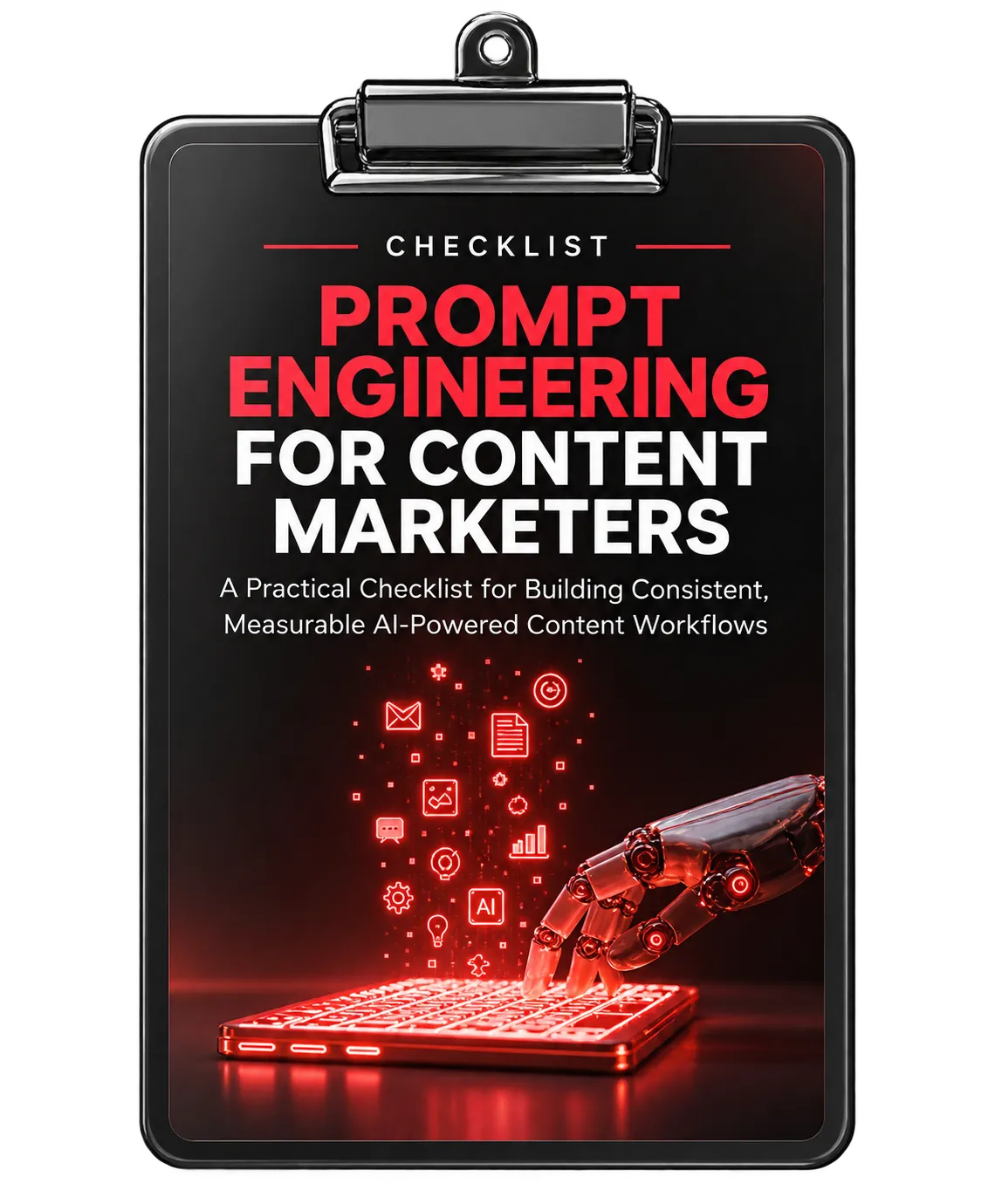
The resource provides a progression from foundational preparation to prompt construction, content workflows, optimization, measurement, and continuous improvement. Rather than treating prompt engineering as a one-time exercise, the checklist frames it as part of a broader content operating system that can be refined using audience signals, performance data, quality controls, and experimentation.
Use the complete checklist to review each area systematically, identify gaps in your current content operation, and establish a repeatable approach to AI-assisted content creation.