Find Your Niche with a Structured AI-Powered Approach
Finding and developing a specialized niche requires more than choosing a market that appears attractive. You also need to consider your existing expertise, market needs, competition, positioning, service design, and the steps required to establish and grow your position.
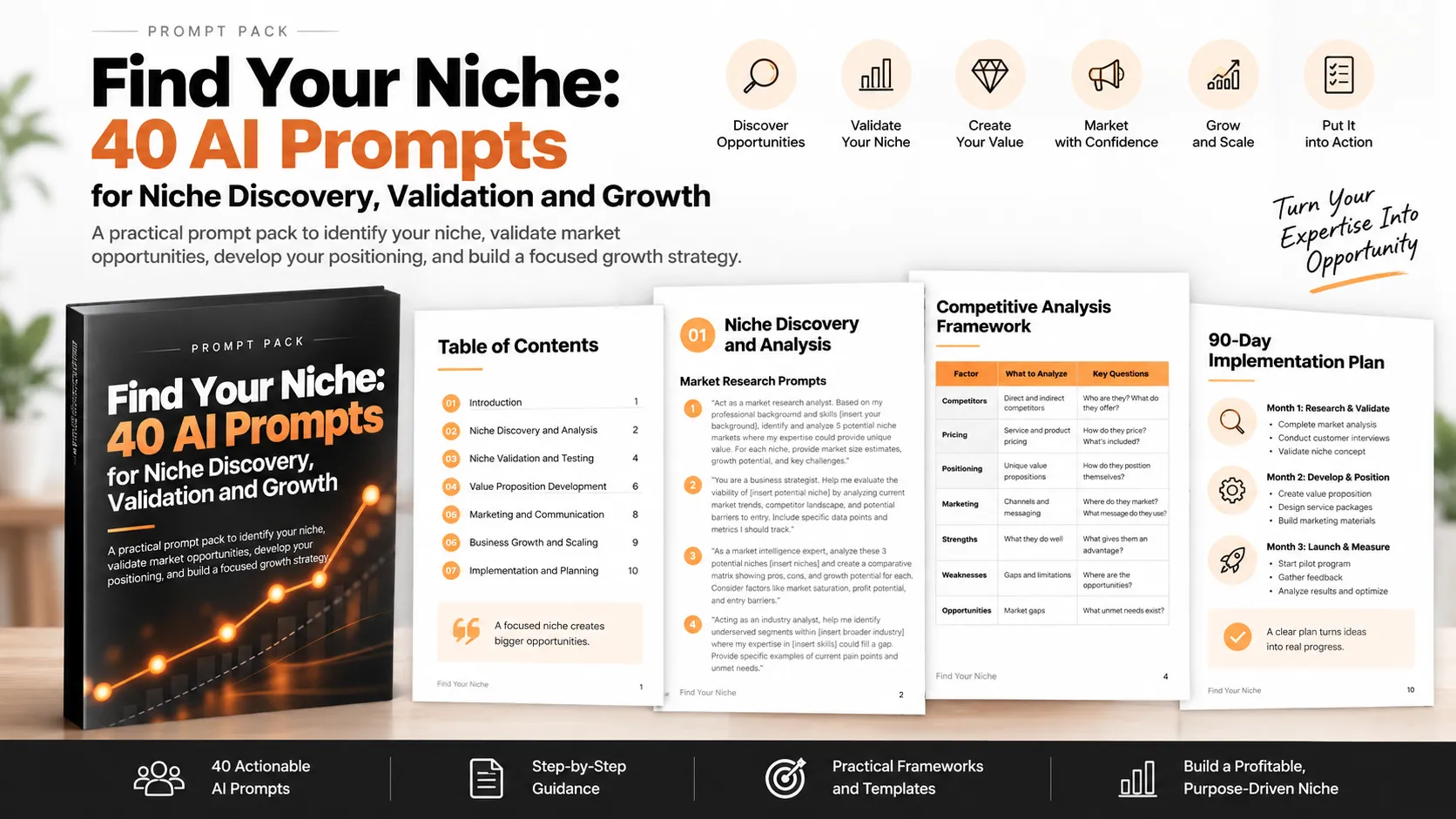
Find Your Niche brings these activities together in a collection of 40 prompts that can be used with AI assistants. The prompts are organized into six areas: niche discovery and analysis, niche validation and testing, value proposition development, marketing and communication, business growth and scaling, and implementation and evolution.
1. Discover and Analyze Potential Niches
Research the Market
The first group of prompts helps you explore potential niche opportunities based on your professional background and skills. You can ask AI to identify potential niches, evaluate market trends, examine competitors, consider barriers to entry, and identify underserved segments within a broader industry.
These prompts also encourage comparison. When you have several possible niches, AI can help create a comparative view of factors such as market saturation, profit potential, growth potential, and entry barriers.
Assess Your Skills and Expertise
Your existing experience can provide the foundation for specialization. The skills assessment prompts help identify combinations of skills that could form a specialized practice, potential industries or market segments where those skills may apply, transferable skills that could be useful in emerging niches, and areas where existing expertise could support faster authority building.
2. Validate Before Building
Once potential niches have been identified, the next step is testing whether the concept is viable. The validation prompts focus on creating structured ways to test a niche rather than relying only on assumptions.
Test the Market
You can use AI to design a validation framework with specific metrics, minimum viable offering parameters, and success criteria. Other prompts help create customer interview questionnaires covering pain points, current solutions, and willingness to pay.
The resource also includes prompts for developing pilot programs and A/B testing different positioning statements. These approaches can help turn a niche idea into something that can be tested and refined.
Analyze the Competition
Competitive analysis is another part of niche validation. The prompts can be used to examine competitor strengths and weaknesses, pricing, service offerings, marketing strategies, and unique value propositions. They also provide a starting point for systematically monitoring competitor activity and identifying opportunities for differentiation.
3. Develop Your Value Proposition
A specialized niche needs a clear explanation of the value it provides. The value proposition prompts help connect your capabilities with specific market needs and pain points.
Create Clear Positioning
You can ask AI to develop a unique value proposition for a specialized service, create multiple positioning statements, and explain the rationale and intended audience behind different positioning approaches.
A value matrix can also be created to connect specialized expertise with specific pain points while considering quantifiable benefits and competitive advantages.
Design Service Packages
The resource moves from positioning into service development. Prompts are provided for creating tiered service offerings, developing packages for different client segments, and designing premium service frameworks that bring together positioning, pricing, and delivery components.
4. Build Marketing and Communication Around the Niche
Develop an Authority-Focused Content Strategy
Once your specialization is defined, the prompts can help turn it into a content strategy. You can create a 12-month content calendar, identify topics and publishing platforms, develop an expert positioning strategy through content, and design lead magnets with delivery formats and lead nurturing sequences.
Create Consistent Messaging
The communication prompts focus on explaining specialized value to the target market. They can help develop messaging frameworks containing key messages, proof points, and communication channels.
You can also create different elevator pitches for clients, partners, and industry influencers, as well as develop communication for transitioning from a generalist position to a specialist position.
5. Turn the Niche into a Scalable Business
Develop Revenue Streams
A specialized practice can be developed beyond a single service. The revenue stream prompts help explore diversified revenue strategies involving services, products, and passive income opportunities.
Other prompts focus on creating a scalable business model, defining systems and processes, and developing premium pricing strategies with pricing tiers and value justification.
Build Systems and Processes
Growth also requires repeatable operations. The resource includes prompts for creating standard operating procedures, quality control measures, efficiency metrics, and client onboarding systems.
It also addresses maintaining and updating specialized expertise through learning resources, certification requirements, and knowledge management systems.
6. Implement, Review, and Evolve
Move from Strategy to Action
The implementation prompts help convert a niche strategy into a plan. You can create a 90-day implementation plan with milestones, actions, and success metrics, as well as develop a longer-term five-year growth strategy covering market expansion, service evolution, and capability development.
Risk management is also included, with a prompt for identifying potential threats, mitigation strategies, and contingency plans.
Keep the Strategy Adaptable
A niche strategy should not be treated as permanently fixed. The evolution prompts focus on adapting a specialized practice as market needs change, identifying and evaluating new opportunities, gathering market feedback, and using that feedback to guide service evolution.
The final strategic planning prompt focuses on expanding authority through thought leadership opportunities, partnerships, and market influence tactics.
How to Use the 40 Prompts Effectively
The resource recommends a sequential approach. Start with niche discovery and analysis, then move through validation, development, and implementation. This creates a progression from exploring opportunities to putting a focused strategy into practice.
- Provide context. Insert your professional background, skills, niche, target market, and goals wherever the prompts contain bracketed placeholders.
- Work sequentially. Progress from discovery and analysis through validation, positioning, marketing, growth, and implementation.
- Iterate on responses. Treat AI responses as starting points and use follow-up questions to request clarification, refinement, and specific examples.
- Document useful insights. Keep a record of valuable AI responses and insights so they can contribute to a broader strategy document.
- Convert ideas into actions. Turn useful insights into specific actions with timelines and measurable metrics.
- Review regularly. Revisit your strategy and update it based on market feedback and results.
Use AI as a Strategic Working Partner
The 40 prompts are designed to support a systematic process rather than a single brainstorming session. They can help you move from identifying possible niches to testing market assumptions, developing a differentiated value proposition, building services, communicating your specialization, and planning growth.
When using the prompts, provide detailed context, request specific examples and applications, ask for clarification when concepts are complex, and save useful insights for future reference. Most importantly, test and validate AI suggestions before implementing them fully.
By working through the prompts systematically, you can develop a more comprehensive strategy for establishing and growing a specialized practice while maintaining focus on your chosen niche.