Build a Sales Engine, Not Just a Chatbot
A sales automation chatbot should do more than answer basic questions. The system described in this resource acts as the first layer of the sales process: it responds to incoming interest, provides useful information, asks qualification questions, segments prospects, directs them toward an appropriate next step, and knows when a human should take over.
The central idea is to separate response time from human availability. Prospects may arrive outside business hours or while your team is occupied with higher-value work. Automation handles the predictable first-touch conversation so a salesperson does not have to repeatedly answer the same basic questions.
This does not mean removing people from sales. The resource takes the opposite approach: use automation for repetitive work so humans can concentrate on closing deals, handling complex objections, negotiating, and building relationships.
Start With the Conversation Before the Technology
One of the strongest principles in the guide is to design the sales conversation before opening a chatbot builder. Software should implement your sales logic, not determine it.
Begin by examining what your best salesperson already does. What do they ask when a new prospect arrives? What information tells them whether someone is a good fit? What questions normally come before discussing price, booking a call, or recommending a product?
Write down three to five questions that consistently appear in successful first conversations. These become the skeleton of the automation.
The goal is to make the chatbot behave more like a helpful concierge than a static form. A form immediately asks for data. A good conversation first understands what the customer needs, provides something useful, and then asks for the information or commitment required to move forward.
Map the Happy Path
Once the core questions are known, map the simplest successful journey from initial contact to the desired sales outcome. The guide calls this the Happy Path.
The Happy Path is the ideal route taken by a qualified customer when there are no unusual objections or technical problems. Designing this route first prevents the initial version of the automation from becoming overwhelmed by edge cases.
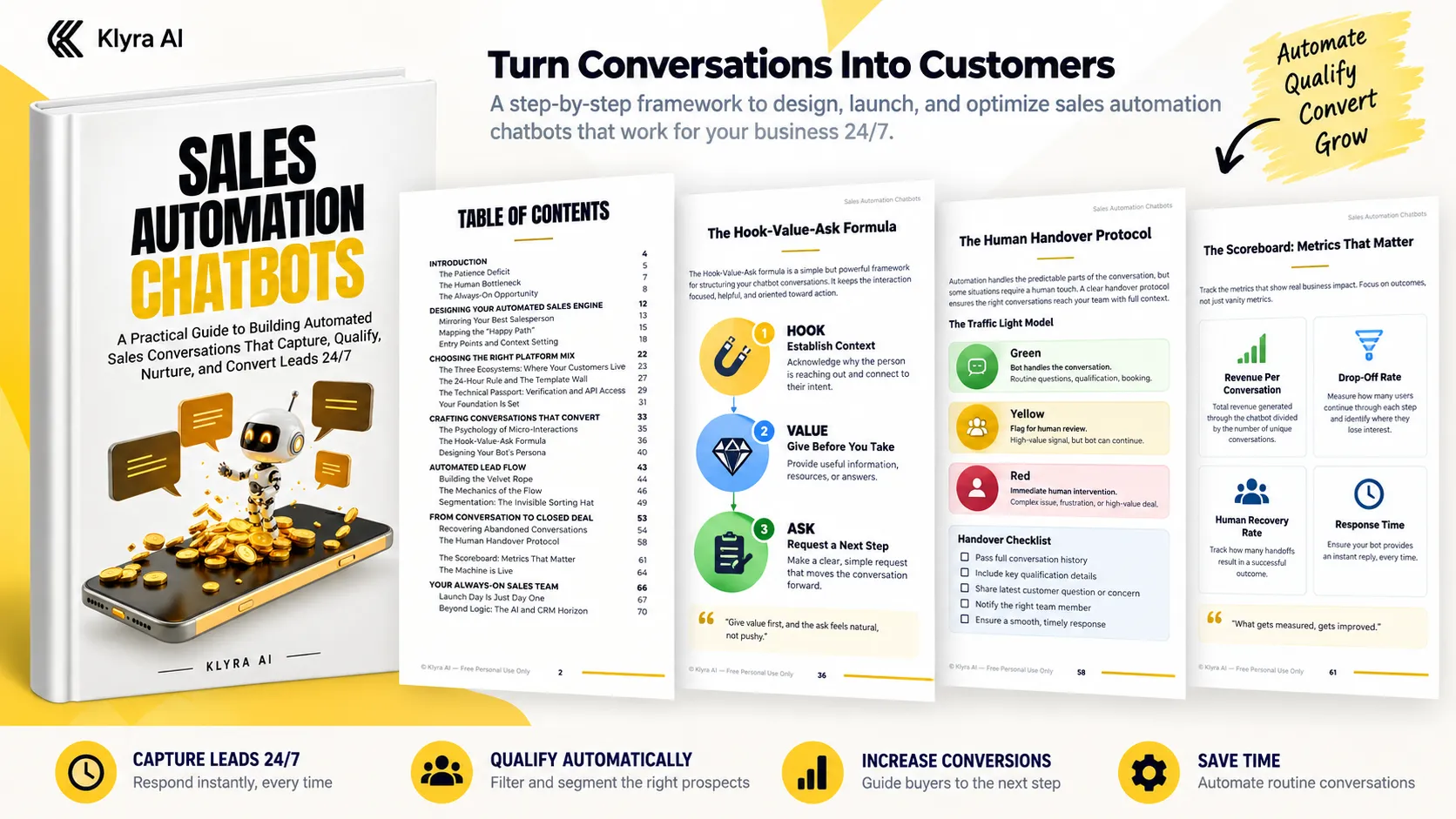
A simple Happy Path follows three stages:
- Hook: Acknowledge why the person entered the conversation and give them a reason to continue.
- Value: Provide the information, resource, answer, or assistance they expected.
- Ask: Request a small next action that advances the conversation.
Map the shortest reasonable route between the beginning of the conversation and the desired outcome. Only after that route works should you add branches for unusual situations.
Match the Greeting to the Entry Point
A conversation should also reflect what happened immediately before the user entered it. Someone who clicked an advertisement promising a resource has different expectations from someone who sent a direct message asking about shipping.
List every meaningful entry point into your automated conversation, such as an advertisement, social post, story, profile, website button, or direct message. Then write an appropriate first line for each one.
The test is simple: does the first message make sense based on what the customer was doing a few seconds earlier? If an advertisement promised a guide, deliver or acknowledge the guide. If the person asked a specific question, address that question rather than dropping them into an unrelated generic sequence.
Choose One Primary Messaging Channel First
The resource recommends resisting the urge to automate every messaging platform at once. Instead, select a primary channel where your customers already communicate with you and build a strong system there first.
Different channels create different conversational environments. The guide describes three major ecosystems:
- Instagram as the storefront: suited to discovery-oriented, visual, casual, and relatively fast interactions.
- WhatsApp as the checkout counter: suited to more direct conversations, appointments, higher-intent interactions, and sales situations that benefit from a trusted communication channel.
- Facebook Messenger as the community hub: useful for businesses connected to Facebook communities, advertising, lead generation, Marketplace, and customer-service-style conversations.
Rather than asking which platform is universally best, examine where recent customer conversations and sales have actually occurred. The platform where customers naturally communicate with the business is the logical place to begin.
Understand the Platform Rules
The guide also emphasizes that messaging automation operates within platform rules. It discusses Meta's 24-hour messaging window and the use of message templates when a conversation falls outside the permitted free-form session.
This has an important design implication: automated conversations should encourage meaningful replies rather than simply broadcast messages. A good flow continually gives the user an easy opportunity to participate.
The resource also covers the technical foundation needed for professional automation, including business administration access, business verification, address documentation, API access, and phone-number considerations for WhatsApp automation.
Write for Conversation, Not for Broadcast
Traditional marketing copy does not automatically translate into good chat copy. Long introductions, company histories, dense explanations, and large blocks of text create unnecessary friction inside a messaging interface.
The resource recommends treating chat as a sequence of micro-interactions. Each message should be easy to understand and easy to respond to.
The One Breath Rule
A practical editing technique in the guide is the One Breath Rule. Read a chatbot message aloud. If it is difficult to say comfortably in one breath, consider shortening it or breaking it into smaller messages.
This keeps the interaction visually light and closer to the rhythm of an actual conversation.
The Ping-Pong Principle
Conversation depends on turns. The chatbot sends something, then gives the customer an opportunity to reply or select an option. Sending a long sequence of messages without requiring interaction turns a conversation into a broadcast.
The resource describes this as the Ping-Pong Principle: send the ball across the table, then give the customer a simple way to return it.
Use the Hook-Value-Ask Formula
The guide turns conversational design into a reusable framework called Hook-Value-Ask.
1. Hook: Establish Context
The Hook explains why the conversation is happening. It should connect directly to the action that triggered the interaction, such as requesting a resource, replying to content, asking about availability, or clicking an advertisement.
2. Value: Give Before You Take
Before requesting information, provide something useful. This could be the requested resource, a direct answer, relevant product information, or another piece of assistance.
This prevents the chatbot from feeling like a data-collection mechanism and demonstrates that continuing the conversation is worthwhile.
3. Ask: Request a Micro-Commitment
After providing value, ask for a small next action. Instead of demanding a lengthy explanation, use a simple choice wherever possible.
For example, rather than asking someone to describe an entire project, the flow might ask them to choose between two project types. Instead of ending with "Let us know if you have questions," it can ask which of two next steps is more relevant.
The purpose of the Ask is not necessarily to close the entire sale immediately. It is to make the next step easy enough that the conversation keeps moving.
Give the Bot a Consistent and Transparent Persona
The resource recommends transparency rather than pretending the automation is human. Give the automated assistant a clear identity and maintain a consistent voice throughout the flow.
The appropriate persona depends on the business. A professional service may require concise, polite language. A fitness or fashion brand may use a more energetic and casual style.
Whatever persona is selected, consistency matters. Abruptly moving from highly casual language to formal corporate language makes the experience feel disconnected.
Use Automation to Qualify, Not Just Generate, Leads
More conversations do not automatically produce a better sales process. If every raw inquiry is handed directly to a salesperson, the team still has to spend time identifying who is relevant, who can afford the offer, who meets the service criteria, and who is merely browsing.
The guide presents the chatbot as a filtering layer. Its job is to separate qualified opportunities from conversations that do not require immediate sales attention.
Reduce Friction With Buttons and Quick Replies
Typing requires effort, particularly on mobile devices. Where appropriate, buttons and quick replies can make qualification easier while producing cleaner, more consistent data.
Instead of asking a broad question such as "What service are you interested in?", a flow can present clearly defined options. One tap moves the customer forward and gives the automation structured information for the next decision.
Build With Three Types of Logic
The guide introduces three useful building blocks for chatbot flows:
- Linear jumps: one message or step naturally proceeds to the next.
- Conditional jumps: the next step changes according to the user's answer.
- Looping jumps: the system asks again when required information has not been supplied correctly.
Thinking in pathways rather than paragraphs makes it easier to visualize how different prospects move through the sales system.
Use Knockout Questions Early
A Knockout Question identifies a condition that makes a prospect unsuitable for the main sales path. Depending on the business, this might involve service area, ownership status, budget, or another genuine requirement.
Ask these questions early. There is little value in collecting extensive contact information from someone who cannot use the service.
Disqualification should still be respectful. A prospect who does not qualify for the primary offer can be given a clear explanation and, where appropriate, directed toward a more relevant alternative.
Tag Important Answers
Qualification becomes more valuable when important answers are saved as structured information. Tags can record characteristics such as interest, budget, urgency, or other sales-relevant attributes.
By the time a qualified lead reaches a salesperson, the human should already have useful context rather than receiving only a name and a generic "new lead" notification.
Route Leads According to Fit
Qualification, tagging, and routing work together. Different types of prospects can be directed toward different outcomes, such as a self-service option, a booking flow, or a priority human conversation.
The result is a sales system that organizes demand before it reaches the team.
Recover Conversations That Stop Before Conversion
A qualified prospect may still disappear before purchasing or booking. The resource cautions against automatically interpreting silence as rejection. In mobile conversations, people are frequently interrupted.
The guide recommends creating automated recovery logic inside the available messaging window. A low-pressure follow-up can acknowledge that the customer may simply have become busy and give them an easy way to resume.
The resource describes an initial recovery message roughly one to three hours after the last interaction, followed by a final message near the end of the 24-hour session when appropriate.
The important principle is that recovery messages should help the customer continue rather than pressure them. A useful follow-up can ask whether they encountered a problem, need a different option, or simply want to resume where they stopped.
Know When a Human Should Take Over
Automation has boundaries. Complex objections, frustration, unusual questions, and high-value negotiations may require human judgment. A strong sales automation system therefore includes a deliberate Human Handover Protocol.
The guide organizes handoffs with a traffic-light model:
- Green: the chatbot continues handling routine questions, qualification, booking, and straightforward transactions.
- Yellow: the conversation contains a high-value signal worth flagging for later human review, but automation can continue.
- Red: the automation pauses and alerts a human because immediate intervention is appropriate.
Potential takeover signals described in the resource include negative or frustrated language, unusually valuable opportunities, and repeated situations where the chatbot cannot understand the customer.
Use a Silver Platter Handoff
A human takeover should preserve everything the customer has already told the system. The resource calls this the Silver Platter Handoff.
Instead of notifying a salesperson only that a new chat exists, provide context such as the lead's name, qualification status, where they became stuck, and their most recent question or concern.
This allows the salesperson to enter the conversation at the correct point rather than forcing the customer to repeat information.
Measure Sales Outcomes, Not Vanity Metrics
High message open rates alone do not prove that a chatbot is producing useful business results. The resource recommends focusing on metrics connected to revenue and progression through the sales flow.
Revenue Per Conversation
Revenue Per Conversation compares the revenue generated through the chatbot with the number of unique conversations started. This helps connect conversational activity to actual commercial output.
Find the Drop-Off Cliff
Measure how many users continue through each stage of the flow. A sudden decline between two steps is a Drop-Off Cliff.
That drop may reveal a confusing question, an unattractive part of the offer, unexpected cost, excessive friction, or another barrier. Instead of concluding that the entire chatbot is failing, identify the specific point where prospects stop progressing.
Measure Human Recovery
Track what happens after qualified conversations are handed to the sales team. If human handoffs consistently fail to convert, investigate whether the automation is passing weak leads or whether the human response process is too slow or ineffective.
Launch Is the Beginning of Optimization
The first published chatbot should not be treated as a finished system. Before launch, the flow is based largely on assumptions about how customers will behave. Real conversations provide the evidence needed to improve it.
The resource recommends a recurring feedback loop:
- Review actual chat logs.
- Identify where users stop progressing.
- Find the source of friction.
- Change the problematic step.
- Relaunch and observe the result.
Rather than rewriting the entire automation whenever performance is weak, find the largest leak first. A confusing question, broken button, poorly timed request, or unnecessary requirement may be responsible for a disproportionate amount of lost engagement.
Continuous iteration gradually makes the Happy Path easier for customers to follow.
Build the Foundation Before Expanding
Once a rules-based sales automation system is working, the resource identifies several directions for future development.
CRM integration can give the business a longer-term record of customer information and previous interactions. AI and natural language processing can expand beyond rigid buttons and keywords toward more flexible interpretation of customer questions. Omnichannel expansion can extend a proven conversation model from the original home base to additional channels.
The sequence matters. First establish the sales logic, qualification criteria, scripts, routing, handoffs, and measurement process. Advanced technology becomes more useful when it is built on top of a sales process that already makes sense.
The Complete Automated Sales Engine
The system developed throughout the resource can be summarized as a connected process:
- Document how your best salesperson handles a new prospect.
- Map the simplest Happy Path from initial contact to the desired outcome.
- Match each conversation opening to its entry point.
- Select one primary messaging channel.
- Write short conversations using Hook-Value-Ask.
- Use buttons, conditional logic, and qualification questions to reduce friction.
- Tag and segment leads according to meaningful sales criteria.
- Route each segment toward the appropriate next step.
- Recover promising conversations that stop prematurely.
- Hand complex or high-value situations to humans with full context.
- Measure revenue, drop-offs, and handoff performance.
- Review real conversations and continuously improve the flow.
The end result is not merely a chatbot that responds automatically. It is an organized conversational sales process designed to respond quickly, protect the time of the human sales team, identify stronger opportunities, and move appropriate prospects toward a purchase or sales conversation.