A Human-Centered Approach to AI Adoption
Introducing artificial intelligence tools into an organization is fundamentally different from implementing traditional software. Conventional technology rollouts often emphasize technical proficiency. AI adoption can involve additional psychological challenges, including concerns about job replacement, competence, professional identity, and trust.
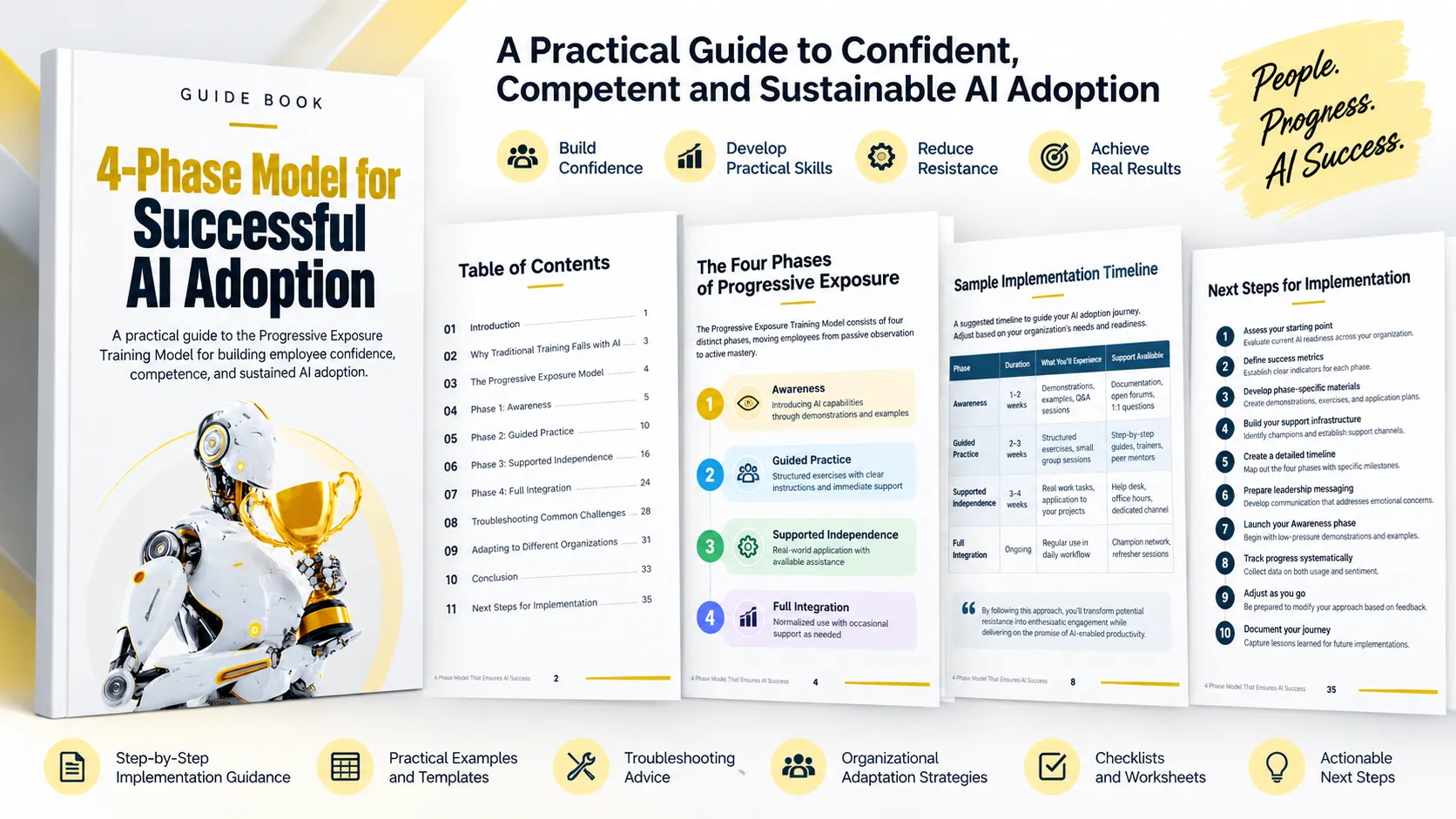
The Progressive Exposure Training Model addresses these challenges by gradually introducing AI capabilities while developing both confidence and competence. Instead of expecting employees to immediately work with complex AI systems, the model moves them through four carefully designed phases.
The approach is intended to create a sustainable progression from passive observation to active use and, ultimately, normalized AI adoption within everyday workflows.
Why Traditional AI Training Can Fall Short
Traditional training approaches may not fully address the challenges associated with AI adoption. The guide identifies four important barriers:
- Cognitive overload: AI systems can work differently from traditional software, making them more difficult for employees to conceptualize and trust.
- Identity threats: AI can challenge employees' perceptions of their professional expertise and identity in ways that standard software may not.
- Emotional barriers: Fear of replacement or appearing incompetent can create resistance that technical instruction alone does not resolve.
- Trust deficits: The "black box" nature of many AI tools means that trust needs to be developed through experience as well as instruction.
The Progressive Exposure approach responds by treating psychological readiness and technical proficiency as connected parts of the adoption process.
The Four Phases of Progressive Exposure
The model consists of four distinct phases. Each phase establishes a foundation for the next:
- Awareness: Introduce AI capabilities through demonstrations and relevant examples.
- Guided Practice: Build hands-on skills through structured exercises with clear instructions and immediate support.
- Supported Independence: Apply AI to real work while keeping assistance readily available.
- Full Integration: Normalize AI use within daily workflows while maintaining appropriate ongoing support.
The objective is not simply to complete four training stages. Each phase should be continued until employees demonstrate sufficient readiness to progress.
Phase 1: Awareness
The Awareness phase creates the foundation for AI adoption. Employees are introduced to AI capabilities without being expected to use the technology immediately. The focus is on demystifying AI, addressing concerns, and creating psychological safety.
Use Brief, Low-Pressure Demonstrations
Short demonstrations of approximately 15 to 30 minutes can introduce employees to an AI tool without creating pressure to participate immediately.
Demonstrations should focus on results rather than technical explanations. Examples should be directly relevant to participants' daily work, technical jargon should be minimized, and employees should be allowed to observe without pressure to actively participate.
Share Success Stories from Similar Roles
Examples from peers in similar positions can make AI adoption more relatable. Success stories should explain the original challenge, how the AI tool was used, the resulting improvement, and the concerns users initially had.
The guide provides a customer service example in which an AI assistant was used to draft initial responses to common inquiries before employees personalized them. The example illustrates how a specific workflow can address a practical problem while allowing employees to maintain control over the final output.
Create a Comfortable Question-and-Answer Environment
Employees need multiple ways to ask questions about AI. Organizations can provide public forums as well as private channels and make both technical and non-technical assistance available.
Concerns should be validated rather than dismissed. Common questions and answers should also be documented for future reference. Topics may include job security, sensitive data, errors, quality, and the role of human review.
Set Expectations for the Complete Journey
Employees should understand that AI adoption is a gradual process and that support will continue beyond the initial demonstration.
The guide's sample timeline uses approximately one to two weeks for Awareness, two to three weeks for Guided Practice, three to four weeks for Supported Independence, and ongoing Full Integration. These durations are examples rather than rigid requirements because progression should reflect actual readiness.
Measure Awareness Success
Before moving forward, assess attendance, engagement, sentiment, knowledge, and readiness. If employees show progress but are not yet ready to continue, the Awareness phase can be extended with additional demonstrations or more targeted examples.
Phase 2: Guided Practice
Guided Practice moves employees from observation to active participation. The focus is on developing basic skills through structured exercises in an environment where mistakes do not have real-world consequences.
Develop Step-by-Step Exercises
Exercises should break common AI tasks into small, manageable steps. Realistic but non-critical scenarios can make the practice relevant while keeping the learning environment safe.
The guide illustrates this approach with a meeting-summary exercise. Participants enter meeting information, generate a draft, review the result, make personal edits, and save the draft. The expected outcome is clearly defined so participants know what successful completion looks like.
Use Small Group Training
Small groups of approximately five to eight people can provide enough interaction while allowing trainers to give participants individual attention. Where possible, participants should be grouped with people in similar roles.
A sample session structure includes a brief reminder of the tool's purpose, a demonstration, guided practice with trainer support, and time for reflection and questions.
Create Safe Practice Environments
Training environments should prevent practice mistakes from affecting real work or data. Test accounts, sandboxed environments, sample information, and clearly labeled practice areas can help establish this safety net.
Practice data can be tailored to different functions. Examples in the guide include fictional campaign briefs for marketing, mock customer inquiries for customer service, fictional candidate profiles for HR, and dummy financial reports for finance.
Provide Immediate Feedback and Recognition
Real-time feedback can help employees recognize progress while they are learning. Trainers should address difficulties with supportive guidance rather than criticism and visibly recognize successful completion and small improvements.
Measure Guided Practice Success
Progress can be evaluated through completion, proficiency, confidence, questions, and initiative.
A useful indicator of changing confidence is a shift in the type of questions employees ask. Questions may move from basic questions about how the tool works toward questions about how it can be applied to specific scenarios.
If participants are not demonstrating sufficient progress, additional guided practice should focus on the areas where they continue to struggle.
Phase 3: Supported Independence
Supported Independence introduces AI into actual work while maintaining a readily available support system. The goal is to build confidence through real-world application without removing the safety net too early.
Develop Real-World Application Plans
Each person or team should have a practical plan for applying AI to their work. The guide recommends starting with low-risk, high-value tasks and defining success metrics relevant to each role.
An application plan can identify initial tasks, expected time or quality improvements, an implementation schedule, measurable outcomes, subjective improvements, available support, documentation, and a checkpoint for reviewing progress.
Establish Multiple Support Channels
Support should be available through several channels. Scheduled and on-demand options can be combined with peer assistance and expert support.
Examples include help desks for technical troubleshooting, office hours for scheduled questions and demonstrations, peer champions for everyday usage tips, digital chat for urgent or after-hours issues, and documentation libraries for self-guided learning.
Implement Regular Check-Ins
Regular check-ins help identify obstacles before they become adoption barriers. The guide recommends starting with frequent check-ins, such as daily or twice-weekly sessions, and gradually reducing the frequency as confidence grows.
Check-ins should focus on problem-solving rather than simply collecting status updates. A useful structure covers successes, challenges, insights, additional needs, and specific next steps.
Create Peer Learning Opportunities
Employees can accelerate adoption by learning from one another. Organizations can pair advanced users with developing users, create forums for sharing discoveries, recognize knowledge sharing, and document user-discovered techniques.
Possible formats include buddy systems, tip exchanges, use-case showcases, and problem-solving circles.
Measure Supported Independence
Before moving to Full Integration, evaluate usage frequency, support utilization, problem-solving ability, confidence, and value perception.
The objective is not to eliminate support entirely. Instead, support should increasingly move away from basic usage questions toward more advanced applications while employees become more comfortable handling standard tasks independently.
Phase 4: Full Integration
Full Integration establishes AI as a normal part of the workflow. At this stage, the focus shifts from intensive training toward sustainable support, more sophisticated use cases, continuous improvement, and recognition of mastery.
Transition to Sustainable Support
Dedicated support should be reduced gradually rather than removed abruptly. Knowledge can be transferred to internal teams and champions, escalation paths can be established, and regular maintenance and refresher training can be scheduled.
The guide provides an example support transition that gradually moves from daily office hours and full help desk support toward less frequent office hours, standard help desk assistance, champion networks, and increasingly comprehensive self-service resources.
Expand Usage to More Complex Applications
Once basic AI usage is stable, organizations can introduce advanced features and more sophisticated applications. Skill progression should be structured, and innovative applications should be recognized and shared.
The guide provides examples across functions. Marketing can progress from generating social media ideas toward coordinated multi-channel campaign concepts. Sales can progress from summarizing customer meeting notes toward analyzing patterns across interactions. HR can move from drafting standard communications toward customized learning pathways based on performance data. Product teams can move from simple product descriptions toward comprehensive feature comparisons.
Build Continuous Feedback and Improvement Cycles
AI adoption should continue to evolve after implementation. Simple feedback mechanisms can be incorporated into regular workflows, with periodic reviews used to identify patterns and opportunities.
The guide's feedback cycle consists of six steps:
- Collect: Gather feedback through surveys, usage data, and conversations.
- Analyze: Identify patterns, common challenges, and improvement opportunities.
- Prioritize: Determine which improvements are likely to have the greatest impact.
- Act: Implement changes to tools, training, or processes.
- Communicate: Share what changed as a result of feedback.
- Verify: Check whether the improvements addressed the original concerns.
Recognize and Celebrate Mastery
Recognition can reinforce advanced usage and encourage knowledge sharing. The guide suggests certification or badging programs, publicly sharing success metrics, mentoring opportunities, and connections between AI mastery and career development pathways.
Examples include an AI Champion Program, Case Study Spotlight, Innovation Awards, and structured Certification Levels.
Measure Full Integration
Full Integration can be assessed by examining whether AI is normalized within everyday work, whether teams independently discover new applications, whether support questions are becoming more advanced, and whether measurable improvements in efficiency, quality, or other relevant outcomes are being achieved.
The guide also identifies cultural shift as an important indicator: whether employees increasingly view AI as a valuable partner rather than a threat or burden.
Troubleshooting Common Adoption Challenges
Challenges can occur at every stage, and the guide recommends addressing them according to the phase where they appear.
Awareness Challenges
- Low attendance: Make demonstrations shorter, more targeted, and more relevant to specific roles.
- Job replacement anxiety: Address concerns directly using concrete examples of how roles may evolve.
- Skepticism: Use before-and-after examples from similar organizations to demonstrate practical benefits.
- Information overload: Break content into smaller sections and focus on benefits rather than technical details.
Guided Practice Challenges
- Difficulty following exercises: Simplify the steps, provide more visual guidance, and slow the pace.
- Different skill levels: Create training groups based on technical comfort levels.
- Fear of mistakes: Reinforce that practice environments are designed to make errors safe and useful for learning.
- Low exercise completion: Allocate dedicated practice time and make completion visible to managers.
Supported Independence Challenges
- Returning to old methods: Establish clear expectations around minimum usage requirements.
- Inconsistent application: Have champions demonstrate successful use cases to colleagues who remain hesitant.
- Overloaded support resources: Identify recurring questions and create targeted resources for them.
- Difficulty applying AI to real work: Develop more role-specific examples and templates.
Full Integration Challenges
- Usage plateauing at basic levels: Introduce advanced feature workshops tied to specific business benefits.
- Support knowledge concentrated in a few people: Create structured knowledge-transfer sessions and documentation.
- New employees missing training: Develop streamlined onboarding programs for AI tools.
- AI evolving faster than training materials: Establish regular review cycles for training content.
Adapting the Model to Different Organizations
The Progressive Exposure Model is designed to be customized according to organizational context.
Small Organizations
Organizations with fewer than 50 employees can consider combining Awareness and Guided Practice, using informal mentoring instead of formal training structures, simplifying documentation, and incorporating training into existing meetings.
Large Enterprises
Organizations with 1,000 or more employees can use a wave-based approach, beginning with pilot groups before expanding. Departmental variations, train-the-trainer programs, and robust governance structures can support larger-scale implementation.
Technical Teams
Technical teams may move through the phases more quickly. The guide recommends emphasizing advanced capabilities earlier, encouraging experimentation through sandboxes, and showing how AI connects with existing technical workflows.
Non-Technical Teams
Non-technical teams may benefit from spending more time in Awareness and Guided Practice. Initial interactions should be simple and intuitive, AI concepts can be connected to familiar tools and processes, and training should emphasize outcomes rather than how the technology works.
Principles for Successful AI Adoption
The guide concludes with several principles that should remain central throughout implementation:
- Respect the emotional journey of AI adoption as well as the technical learning curve.
- Meet people where they are rather than assuming everyone begins at the same level of readiness.
- Celebrate progress at every stage, including small improvements.
- Adjust the pace according to actual readiness rather than ideal timelines.
- Build support systems that evolve as employee needs change.
Next Steps for Implementation
The guide recommends turning the model into a practical implementation plan by following these steps:
- Assess your starting point: Evaluate current AI readiness across the organization.
- Define success metrics: Establish indicators for each phase.
- Develop phase-specific materials: Prepare demonstrations, exercises, and application plans.
- Build support infrastructure: Identify champions and establish support channels.
- Create a detailed timeline: Map the four phases and their milestones.
- Prepare leadership messaging: Develop communication that addresses emotional concerns.
- Launch Awareness: Begin with low-pressure demonstrations and relevant examples.
- Track progress systematically: Collect information about both usage and sentiment.
- Adjust as you go: Modify the approach based on feedback and actual readiness.
- Document the journey: Capture lessons learned for future technology implementations.
The Progressive Exposure Training Model provides a structured yet flexible path for introducing AI. By combining gradual capability development with psychological support, organizations can help employees build confidence alongside competence and move toward AI becoming a normal part of how work gets done.