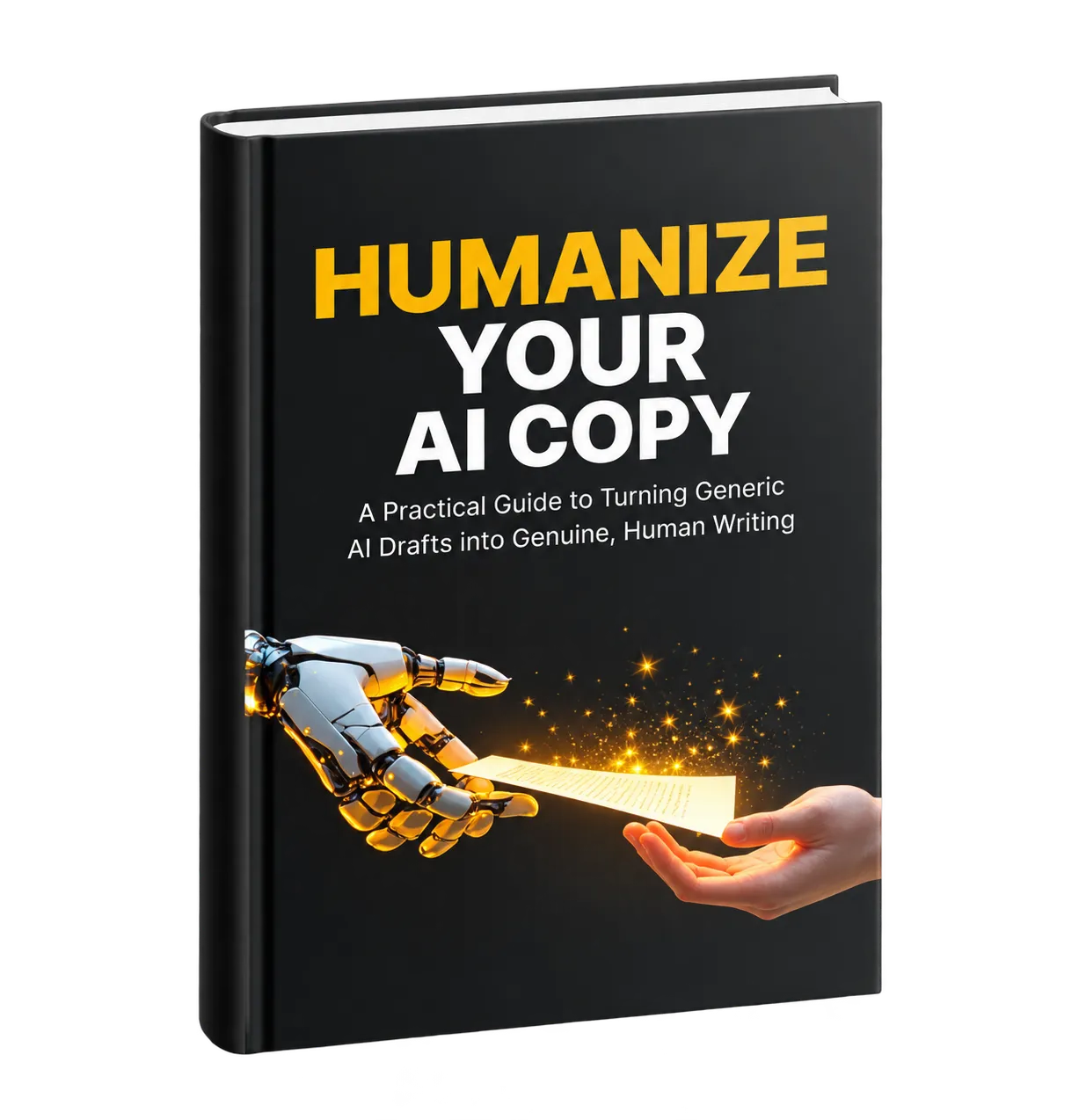
Humanize Your AI Copy
AI can produce polished writing quickly. But polished does not automatically mean distinctive.
One of the central ideas in this resource is that the value of writing is changing. When clean, coherent text can be generated almost instantly, simply producing more words becomes less meaningful. The advantage shifts toward judgment, taste, perspective, and the ability to create a connection with the reader.
That creates a problem for anyone using AI to write. A generic prompt can produce a generic result. Even when the grammar is perfect and the structure is logical, the writing can feel flat, predictable, and disconnected from the person or brand behind it.
The solution presented in this resource is not to reject AI or surrender the entire writing process to it. It is to combine AI's speed with human judgment.
The Cyborg Mindset: AI as Your Junior Partner
The resource describes two extremes that writers and marketers can fall into.
The Burnout Purist
The Burnout Purist treats AI as a threat to the craft and refuses to use it, even for tasks such as rough drafting or brainstorming. The result can be unnecessary pressure and an unwillingness to use tools that could reduce low-value work.
The Lazy Automator
The Lazy Automator takes the opposite approach. They give AI a generic prompt, copy the response, and publish it without meaningful review. The result may be efficient, but it can also become indistinguishable from the mass of generic AI-generated content.
The Middle Ground
The resource proposes the Cyborg Mindset as the alternative. AI becomes a junior partner rather than a replacement for human thinking.
- AI drafts, humans refine. AI helps conquer the blank page, but the human owns the final polish.
- AI structures, humans voice. AI can organize ideas and logic while the human supplies vocabulary, rhythm, and perspective.
- AI predicts, humans surprise. AI tends toward likely patterns, while the human can deliberately introduce the unexpected detail, phrase, or idea.
This changes the role of the writer. Instead of focusing entirely on producing words, the writer becomes responsible for vision, direction, curation, and quality.
Why AI Writing Can Sound Robotic
Before improving AI-generated writing, it helps to understand why it often feels generic in the first place.
The Probability Trap
The resource explains AI language generation through the idea of next-token prediction. Rather than approaching a writing task with personal experience or human intuition, a language model predicts what text is statistically likely to come next based on the context it has received.
This helps explain why vague prompts often produce safe and predictable answers. If the instruction is broad, there is little information directing the model toward a particular voice, audience, perspective, or outcome.
The result can be grammatically correct but lacking in friction, surprise, or personality.
Common Vocabulary Signals
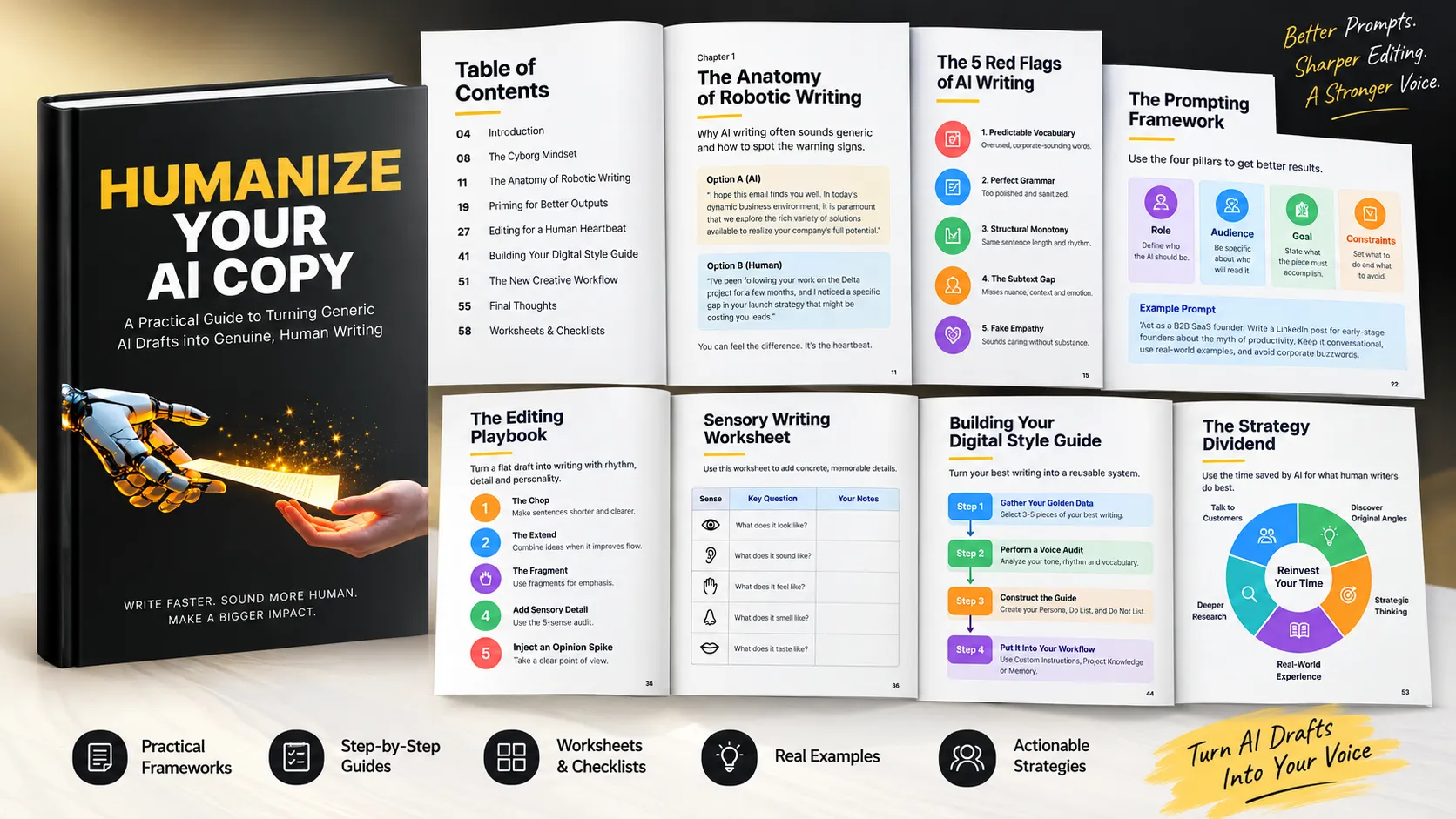
The resource identifies certain types of language as warning signs of generic AI writing. Examples include words such as delve, tapestry, unlock, unleash, landscape, and testament.
The point is not that these words are always wrong. The problem is that relying on predictable vocabulary can make writing sound like an average piece of corporate or AI-generated prose.
Perfect Grammar
Human writing is not always perfectly symmetrical. People use fragments, informal constructions, and sentence structures that break conventional rules for emphasis.
AI often produces cleaner and more consistent grammar. When every sentence follows the same polished pattern, the result can feel overly sanitized.
Structural Monotony
Another warning sign is sentence rhythm. AI-generated writing can fall into a repetitive medium-length cadence where sentences have similar structure and complexity.
The resource describes this as a kind of flatline. Human writing naturally varies its rhythm. Some thoughts are short. Others are longer. A fragment can create emphasis. Changing the pace helps maintain attention.
The Subtext Gap
Perhaps the more difficult problem is what AI cannot directly see in the words themselves.
Human communication contains context, irony, shared history, emotion, and implied meaning. A sentence can technically say one thing while communicating something completely different through tone or context.
The resource uses sarcasm as an example. A person may immediately recognize that apparently positive words actually communicate frustration. A language model can instead respond to the literal wording and miss the underlying message.
The same problem can appear in artificial expressions of empathy. Phrases that sound caring can feel hollow when they are disconnected from genuine human experience.
Prime the AI Before It Writes
If generic input produces generic output, the answer is not necessarily more editing. The resource argues that better preparation can improve the first draft.
Context Injection
Context Injection means giving the AI enough information to narrow the range of possible outputs.
The resource recommends four pillars:
- Role: Define who the AI should act as and what perspective it should bring.
- Audience: Explain who will read the content and identify their relevant needs or pain points.
- Goal: Specify what the piece must accomplish.
- Constraints: Establish what the AI should and should not do, including stylistic boundaries where necessary.
Compare a vague instruction such as asking for a LinkedIn post about meetings with a much more specific brief that defines the audience, position, desired outcome, tone, and forbidden language.
The second approach gives the model a much clearer map. The AI has not suddenly become more intelligent. It simply has more useful context from which to generate the response.
Few-Shot Prompting
Describing a style with adjectives can be unreliable because words such as witty, professional, or friendly can mean different things to different people.
Few-Shot Prompting takes another approach: show the AI examples.
The resource recommends creating a Shot Library containing strong examples of your own writing. It identifies three useful categories:
- The Opener: Examples of effective hooks and introductions.
- The Value Delivery: Examples showing how you explain ideas, concepts, or information.
- The Closer: Examples of how you conclude content or present calls to action.
Instead of hoping the AI interprets your description of a writing style correctly, examples give it an actual pattern to follow.
The Pre-Flight Check
Even a detailed prompt can be misunderstood.
The resource therefore recommends checking the AI's direction before requesting the complete draft. Ask it to outline the argument, identify the intended audience, and state the main takeaway.
If the AI has misunderstood the assignment, the mistake can be corrected before a long draft is produced.
Only after the proposed direction matches your intention should you ask for the complete piece.
Inject Humanity Into the Draft
Better prompting can produce a stronger first draft, but the resource argues that human editing remains essential.
The objective is not to rewrite everything from scratch. Instead, think of the AI output as raw material that needs targeted editorial intervention.
Break the Hypnotic Rhythm
One practical technique is to deliberately vary sentence length.
The resource calls this the Short-Long-Fragment technique. The basic idea is to create movement in the writing by combining different sentence lengths and occasionally using fragments for emphasis.
The editing process includes three moves:
- The Chop: Break a medium-length sentence into a shorter, simpler statement.
- The Extend: Combine ideas using connecting words such as because, although, or while when a longer sentence improves the flow.
- The Fragment: Finish a paragraph with a deliberate fragment, thought, reaction, or single word where appropriate.
The goal is not to change the underlying idea. It is to change the rhythm in which the idea reaches the reader.
Replace Teflon Words With Velcro Words
AI is comfortable with abstract concepts such as efficiency, collaboration, and success. These words can communicate information, but they may not create a memorable image.
The resource calls these Teflon Words because they slide off the reader's memory.
Velcro Words, by contrast, connect an abstract idea to something physical or sensory.
Instead of simply saying that a team was stressed, the writing might describe the team staring silently at their screens. Instead of describing a beverage as refreshing, it might describe jasmine steam fogging someone's glasses.
The technique is called Grounding: take an abstract statement and ask what it actually looks, sounds, feels, smells, tastes, or moves like in the real world.
Use the 5-Sense Audit
The resource recommends checking a draft for concrete sensory details:
- Sight: Add a specific object, shape, color, or visual detail.
- Sound: Identify a real sound rather than describing something simply as noisy.
- Touch: Use a physical texture or sensation where appropriate.
- Smell or taste: Use these selectively when they strengthen the scene.
- Motion: Replace static descriptions with stronger, more active verbs when appropriate.
The resource cautions against turning every sentence into poetry. The purpose is not decoration. It is to ground abstract ideas in physical reality.
Add an Opinion Spike
AI often tries to remain neutral and balanced. That can make informational writing feel safe but interchangeable.
The resource calls this the Subjectivity Gap.
Human writers can take a position. They can explain what they believe, what they have experienced, what they disagree with, or which commonly accepted idea they think is wrong.
One way to introduce this is through a Hot Take Insertion. Find a neutral section of the AI's argument and add a specific human point of view.
Look for hedging phrases such as typically, can be, some argue, or it is important to consider. Where appropriate, replace neutrality with a clearly owned perspective such as In my experience or Here is the hard truth.
The AI can do much of the explanatory work. The human editor adds the part that actually belongs to the person behind the content.
From Content to Writing
The resource draws an important distinction between content and writing.
Content communicates information. AI is highly useful for organizing, summarizing, listing, and explaining information.
Writing goes further. It communicates perspective and creates a connection between people.
That is why the resource treats rhythm, sensory detail, and opinion as three important layers of human editing. Together, they move a draft beyond simply transferring information and toward expressing a recognizable point of view.
Build a Digital Style Guide
Manually fixing the same problems in every AI draft eventually becomes repetitive. If you always want shorter sentences, stronger opinions, direct reader address, or fewer buzzwords, those preferences should become part of a reusable system.
The resource calls this system a Digital Style Guide.
Unlike a traditional brand guide that might focus on visual identity, the Digital Style Guide is designed to tell an AI how to produce language that reflects your particular writing style.
Step 1: Gather Your Golden Data
Start with three to five pieces of writing that represent your strongest work and best capture your preferred tone.
The resource recommends choosing examples that already contain the qualities you want, including rhythm changes, sensory details, and clear opinions.
Step 2: Perform a Voice Audit
Instead of describing your style with vague words such as professional, friendly, or witty, use your own writing as evidence.
The resource introduces the Mirror Prompt, which asks an AI to analyze your writing as a linguistic analyst. The analysis should examine areas such as sentence structure, rhythm, tone, vocabulary, jargon, and formatting habits.
The purpose is to convert an intuitive sense of style into specific instructions.
Step 3: Construct the Guide
The Digital Style Guide contains three core components:
- The Persona: Define who the AI is supposed to be and the perspective it should adopt.
- The Do List: Specify the positive characteristics the writing should follow.
- The Do Not List: Explicitly identify unwanted habits, words, structures, and stylistic behaviors.
Positive instructions might specify sentence length, direct reader address, active voice, or the use of sensory metaphors.
Negative constraints might prohibit corporate buzzwords, certain predictable words, unnecessary transitional adverbs, or excessive hedging.
The key principle is specificity. The more clearly the guide translates your actual writing behavior into instructions, the more useful it becomes as a reusable writing system.
Step 4: Put the Guide Into Your AI Workflow
A style guide becomes more useful when it is available inside the tools you already use.
The resource discusses features such as Custom Instructions, Project Knowledge, and Memory as ways of placing persistent information into an AI system's context.
The recommended approach separates identity from stylistic rules. The Persona establishes what the AI should know about you, while the Do and Do Not lists establish how it should communicate.
Some systems impose character limits. In that situation, the resource presents a Compression Hack: use AI to compress a detailed style guide into a dense set of instructions while retaining the important constraints.
The New Creative Workflow
The final part of the resource moves beyond prompts and editing to consider how AI changes the role of the writer.
From Writer to Editor-in-Chief
If AI can handle much of the initial drafting work, the value of the human shifts toward direction, taste, curation, and quality control.
The resource compares this role to a film director. A director does not personally perform every production task, but remains responsible for the vision and final result.
In the same way, AI can handle execution while the human remains responsible for the creative direction.
The resource describes taste as increasingly important because generic production becomes easier. The value moves toward the angle selected, the stories included, and the voice applied.
The Strategy Dividend
There is another danger after adopting AI: using the time saved by automation simply to produce more content.
The resource calls this the Efficiency Paradox.
If a task becomes faster, the answer is not automatically to perform that task more times. The saved time can instead be reinvested into activities AI cannot perform in the same way: talking to customers, discovering pain points, researching original angles, and thinking deeply about a brand's point of view.
This is the Strategy Dividend.
The objective is not to become a content factory. It is to use AI to create more room for strategic thinking and authentic input.
The Uncopyable Advantage
The resource ends with a simple idea: your personal experiences are difficult to reproduce because they belong to you.
An AI system can process enormous amounts of existing information, but it does not possess your memories, your specific experiences, your conversations, your failures, or the lessons you have personally learned.
Those experiences can become the raw material for distinctive writing.
This is why the resource argues that AI should be used to distribute your humanity rather than replace it. Your Voice Profile can evolve as you gain new experiences and insights.
Putting It All Together
The complete workflow can be viewed as a progression:
- Understand the problem. Recognize probability-driven language, predictable vocabulary, structural monotony, and missing subtext.
- Prime the AI. Give it role, audience, goal, and constraints before asking for a draft.
- Show it examples. Use Few-Shot Prompting and maintain a Shot Library containing strong openers, value delivery examples, and closers.
- Check the direction. Use a Pre-Flight Check before requesting a full draft.
- Edit for rhythm. Break repetitive sentence patterns using short, long, and fragment structures.
- Add concrete detail. Replace abstract language with sensory and physical details where appropriate.
- Add perspective. Introduce opinions, experiences, and specific points of view.
- Systemize your voice. Build a Digital Style Guide from your strongest writing.
- Reinvest the time saved. Use AI efficiency to create more space for customer conversations, original thinking, strategy, and real-world experience.
The central lesson is consistent throughout the resource: AI can make writing faster, but speed alone does not make writing valuable.
The human contribution is the direction, judgment, experience, taste, and perspective that transform an otherwise generic draft into something recognizable as yours.
Use AI for the heavy lifting. Keep the voice human.