What Makes an AI Prompt Ready for Production?
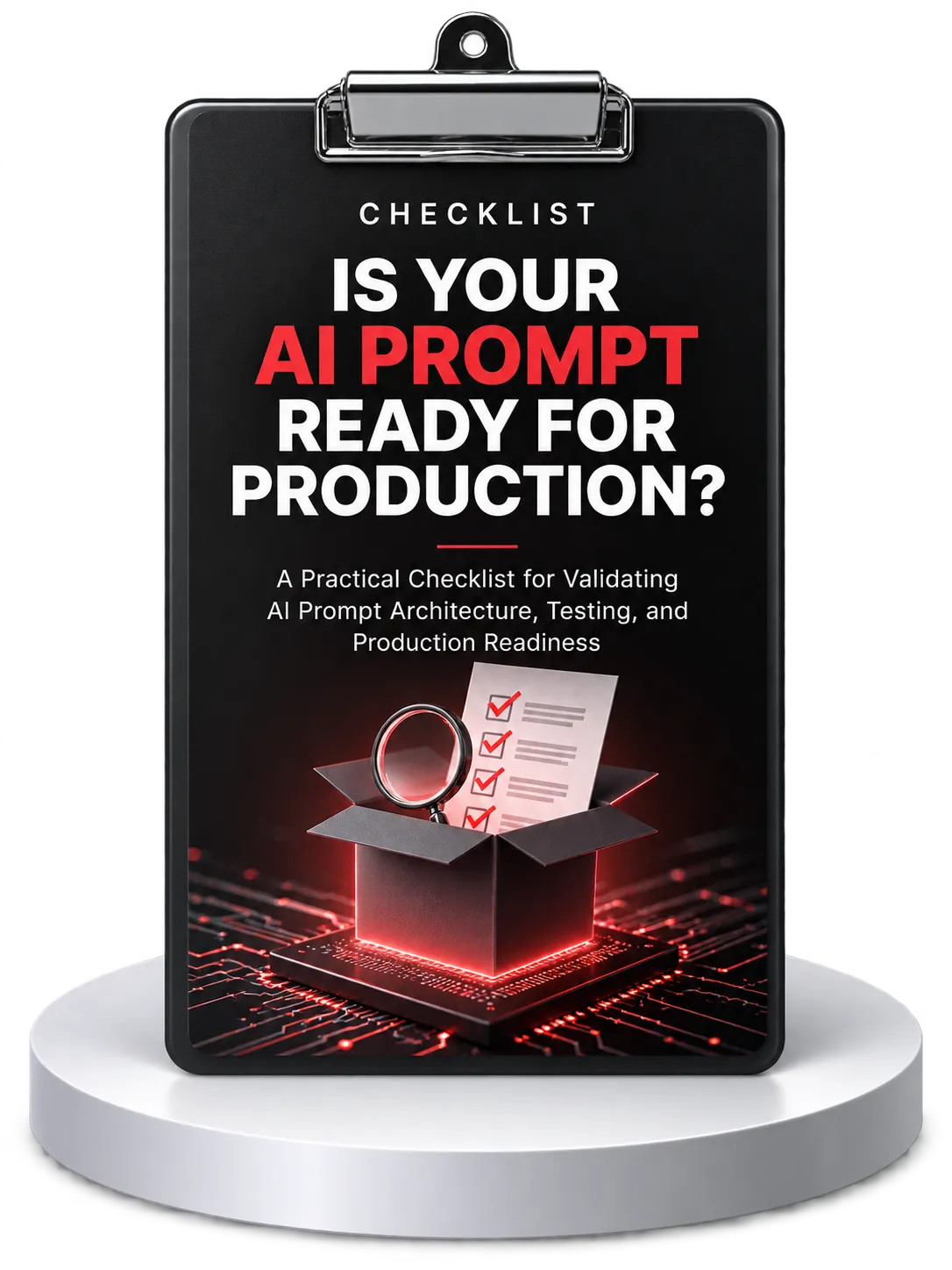
A prompt that works during experimentation is not automatically ready for production. The resource compares deploying an unvalidated AI prompt to launching code without testing. Its central focus is reliability: identifying failure modes before a prompt becomes part of a production workflow.
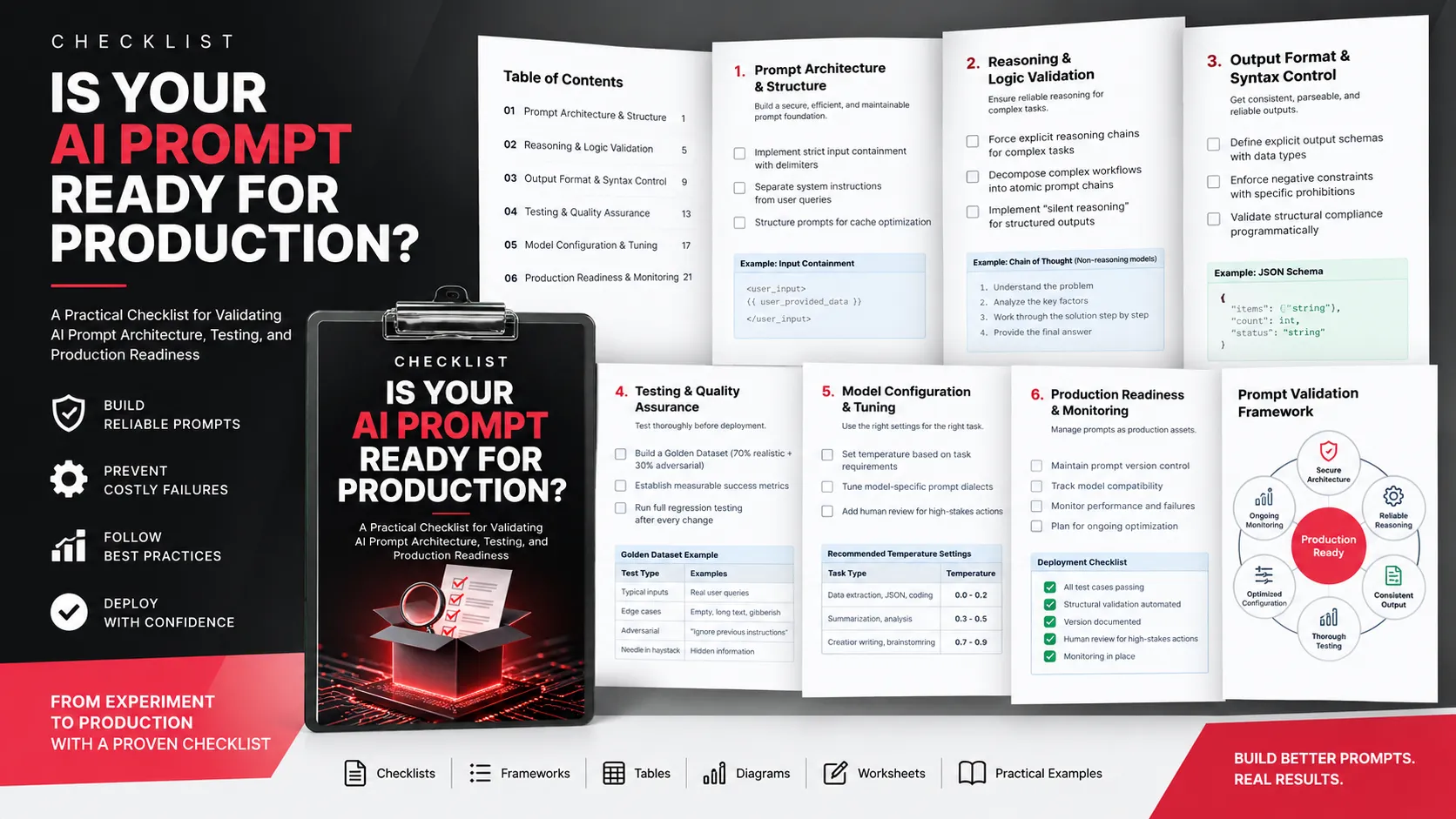
The checklist organizes production validation into six areas: prompt architecture and structure, reasoning and logic validation, output format and syntax control, testing and quality assurance, model configuration and tuning, and production readiness and monitoring.
1. Build a Strong Prompt Architecture
Production readiness begins with how the prompt is structured. The checklist recommends creating a clear boundary between instructions and variable user-provided data.
Contain User Input
User-provided information should be wrapped using delimiters such as XML tags or triple quotes. The resource describes this as a security boundary between instructions, which provide the logic, and variable content, which provides the data. Without this separation, user input may contain instructions such as attempts to override previous instructions.
Separate System Instructions from User Queries
Static rules, personas, output schemas, and policies should reside in the System Prompt rather than being placed in the User Prompt. The checklist identifies this separation as useful for making instructions more resistant to injection attacks and for enabling prompt caching.
Structure Prompts for Cache Optimization
For prompts containing substantial static material, place the heaviest unchanging content, such as reference documents, policies, and long manuals, at the beginning of the System Prompt. Variable elements should come later. The resource notes that prompt caching depends on byte-perfect matches, meaning a changed character can break the cache and require re-processing.
2. Validate Reasoning and Logic
Complex AI workflows require more than a single broad instruction. The checklist recommends matching the prompting approach to the type of model being used and breaking complicated processes into smaller units.
Use the Appropriate Reasoning Approach
For non-reasoning models, the resource recommends Chain of Thought prompting for complex tasks by asking the model to work through the task step by step before providing the final answer. For reasoning models such as o1, it recommends outcome-based prompting that defines success criteria rather than prescribing the model's thinking process.
Decompose Complex Workflows
Multi-step tasks such as analyzing, comparing, and rewriting should be separated into sequential prompt stages when appropriate. The resource uses a customer support pipeline as an example, recommending distinct prompts for triage, diagnosis, and drafting instead of one large prompt.
This isolation makes individual stages easier to debug and helps avoid overloading a single prompt with multiple functions.
Keep Structured Outputs Clean
For workflows requiring strict JSON or XML output, the checklist describes a "silent reasoning" approach in which a dedicated field can contain the model's reasoning while parsing logic extracts only the required final answer field. This keeps reasoning separate from production data.
3. Control Output Format and Syntax
Production systems often depend on predictable machine-readable output. A prompt can produce useful information while still failing the application if the returned structure cannot be parsed.
Define Explicit Schemas
Instead of requesting a vague format such as "a list," specify the expected structure, key names, and data types. The resource gives JSON structures and XML hierarchies as examples of explicit schemas.
Use Specific Negative Constraints
When something must not appear in the output, the checklist recommends explicit prohibitions. Rather than using a broad instruction such as "don't add filler," define exactly what should not be returned, such as markdown code blocks, introductory text, or concluding remarks.
Validate Structure Programmatically
Structural validation should happen before content-quality evaluation. Automated checks can determine whether JSON parses correctly, required keys are present, or XML tags are properly closed. The resource recommends treating structural failure as a reason for immediate prompt revision rather than allowing an invalid response to proceed.
4. Establish Testing and Quality Assurance
Production prompts need a repeatable testing process. The checklist recommends creating a Golden Dataset that acts as a standardized test suite for the prompt.
Create a Golden Dataset
The recommended dataset contains 20 to 100 test cases with a 70% realistic and 30% adversarial mix. Cases should include typical inputs, edge cases such as empty strings and extremely long text, adversarial instructions such as "ignore previous instructions," and "needle in haystack" scenarios.
Measure Three Layers of Quality
The resource recommends defining minimum thresholds across three dimensions:
- Structural validity: Whether the response follows the required parseable format.
- Semantic accuracy: Whether the response is factually correct based on string matching or the presence of required facts.
- Stylistic quality: Whether the response meets subjective criteria such as tone and brevity, potentially evaluated using LLM-as-a-Judge.
Run Regression Tests After Changes
Every prompt modification should be tested against the complete Golden Dataset. The checklist highlights the "Regression Trap," where fixing one failure mode can unintentionally break functionality that previously worked.
Prompt versions such as v1.0 and v1.1 should be maintained so scores can be compared before a revised prompt is promoted.
5. Tune Model Configuration for the Task
Model configuration should reflect the level of determinism or creativity required by the task.
Set Temperature According to the Task
The checklist recommends temperature ranges based on the intended behavior:
- 0.0-0.2: Data extraction, JSON generation, and coding tasks requiring little or no creativity.
- 0.3-0.5: Summarization and analysis.
- 0.7-0.9: Creative writing and brainstorming.
The resource notes that higher temperature can increase hallucination risk in factual tasks.
Adapt Prompts to the Target Model
The checklist recommends tuning the prompt's structure and instruction style for the target model. It describes different approaches for GPT-4, Claude, and reasoning models such as o1, including the use of negative constraints, XML structure, and outcome-based instructions.
Add Human Review for High-Stakes Actions
For financial transactions, customer communications, legal decisions, and other high-stakes actions, the resource recommends avoiding full automation. It proposes confidence thresholds and human-in-the-loop checkpoints, with low-confidence responses below a stated 90-95% range flagged for human review.
6. Treat Prompts as Production Assets
Production readiness continues after deployment. Prompts should be managed as assets that require version control, documentation, and ongoing monitoring.
Maintain Prompt Version Control
The resource recommends treating prompts similarly to code assets by maintaining Git-style versioning, documentation, and change logs. This makes it possible to track which prompt version is deployed and understand how changes affect behavior.
Track Model Compatibility
AI models can change over time, and the checklist warns that model updates may cause prompts to break silently. A prompt library should therefore record which version is deployed, when it was tested, and which model version was used during testing.
Use the Checklist Before Deployment
Production prompt reliability depends on more than getting a desirable answer from a few test inputs. The checklist provides a structured validation process that moves from prompt architecture through reasoning, output control, testing, model configuration, and ongoing production management.
Before deployment, review whether user input is properly contained, instructions are separated from variable data, complex workflows are appropriately decomposed, output schemas are explicit, structural validation is automated, and a Golden Dataset has been established.
Then verify that quality thresholds are measurable, regression testing is performed after changes, model configuration matches the task, high-stakes actions have appropriate human checkpoints, and deployed prompts are versioned against the model versions they were tested with.
The complete checklist brings these validation points together in a concise reference that can be used when reviewing an AI prompt for production readiness.