Using AI to Make Teaching More Manageable
Teaching involves far more than standing in front of a classroom. Educators spend substantial time preparing lessons, creating materials, adapting instruction, grading assignments, communicating with families, and responding to different student needs.
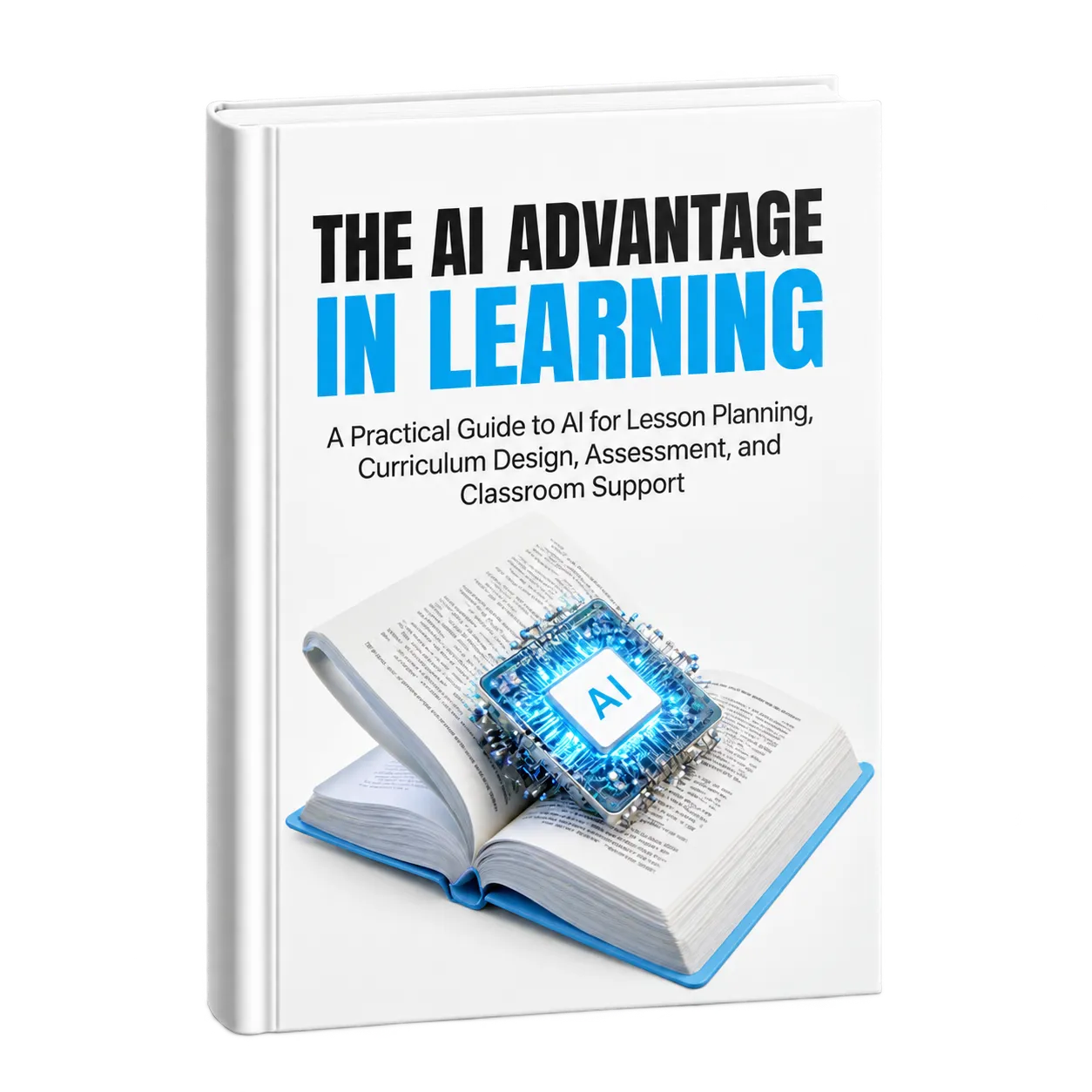
The AI Advantage in Learning explores how artificial intelligence can help reduce some of this routine workload while giving teachers more capacity to focus on the parts of education that require human judgment, relationships, creativity, and responsiveness.
The resource presents AI as a practical teaching assistant rather than a replacement for educators. AI can generate ideas, organize information, create starting points, suggest alternatives, and help identify patterns. The teacher remains responsible for evaluating those suggestions and deciding what belongs in the classroom.
From Overwhelmed to Empowered
The guide begins with the everyday pressures facing teachers. Lesson preparation, grading, differentiation, student engagement, and communication can consume substantial amounts of time. At the same time, teachers are expected to respond to different ability levels, changing requirements, and individual learning needs.
AI can help address specific pain points, but the resource does not suggest that teachers need to transform everything at once. Instead, it recommends identifying the areas where assistance would be most valuable and beginning with manageable experiments.
AI as a Teaching Multiplier
The resource describes AI as a form of assistance intelligence. It can work quickly on repetitive or preparatory tasks while the teacher provides context, judgment, and direction.
This distinction is important. AI can generate a lesson idea, activity, assessment, explanation, or communication draft, but the educator must determine whether the result is appropriate for the students, learning objectives, classroom environment, and available resources.
Start With a Real Teaching Challenge
The guide recommends beginning with a specific problem rather than trying to learn every AI capability available. A teacher might start with formative assessments, differentiated worksheets, lesson preparation, grading, instructional materials, or another recurring task.
Once one application becomes comfortable and useful, additional uses can be introduced gradually. The resource emphasizes that the goal is not to become a technology expert overnight. The goal is to find practical ways AI can make teaching more effective and manageable.
AI-Powered Lesson Planning
Lesson planning is one of the central applications explored in the guide. Traditional preparation can involve reviewing standards, searching for activities, adapting materials for different learners, creating assessments, and assembling supplementary resources.
AI can provide structured starting points by processing information such as learning objectives, grade level, subject matter, and student needs. It can then generate lesson structures containing activities, assessments, and differentiation ideas.
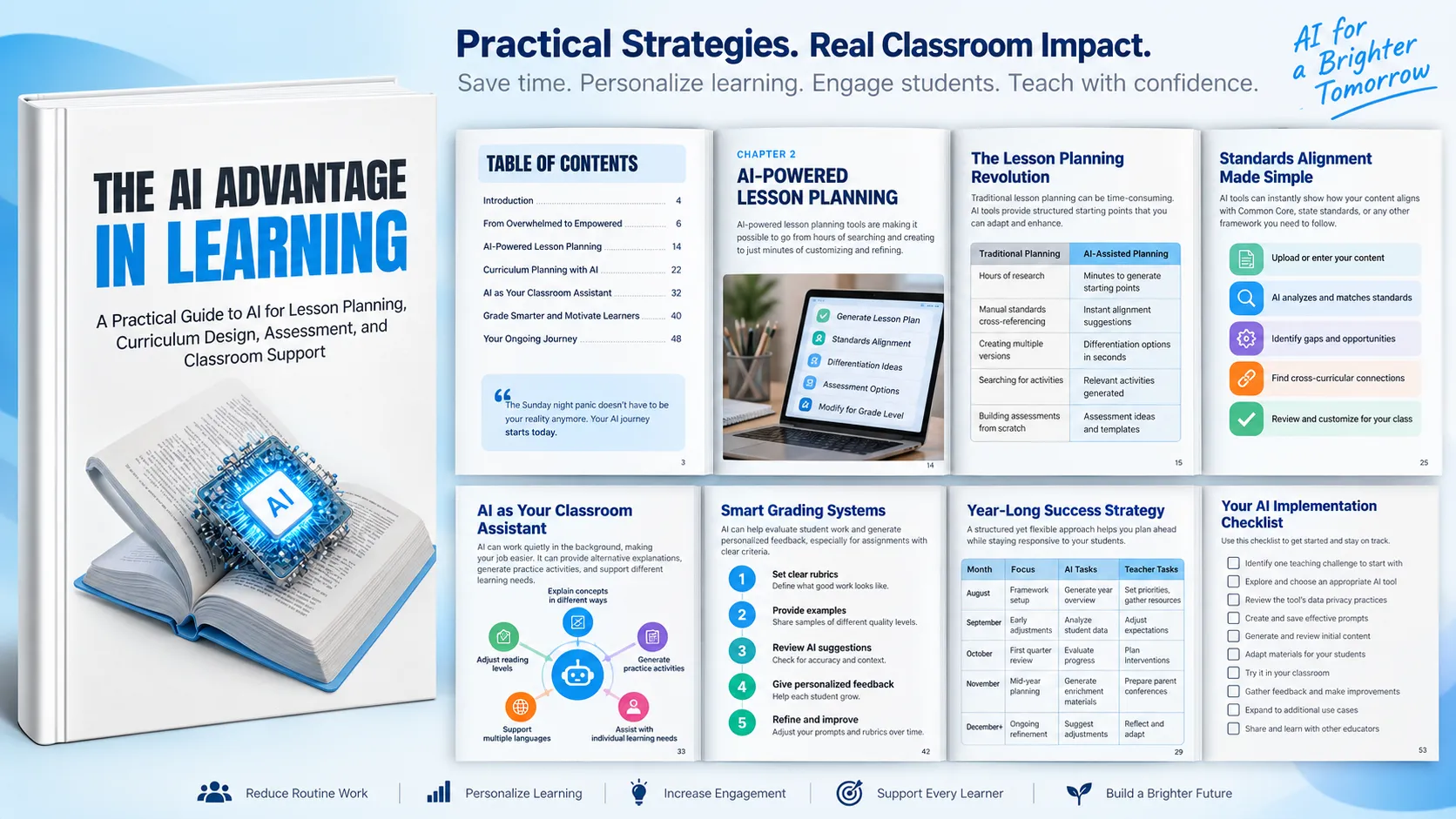
The ebook cites research published by Impact stating that teachers using AI tools such as ChatGPT for lesson planning saved an average of 25 minutes per week, described as approximately a 31% reduction in lesson preparation time compared with teachers who did not use generative AI.
Planning With AI as a Starting Point
AI-generated lesson plans should be treated as starting points rather than finished instructional products. Teachers need to adapt the material to their students, classroom resources, teaching approach, and learning objectives.
The resource discusses tools such as LessonPlans.ai, MagicSchool AI, and Auto Classmate as examples of AI-assisted educational platforms serving different planning needs. Their roles described in the ebook include standards-aligned lesson generation, personalized curriculum development, assessment support, and instructional coaching.
Personalization and Implementation
A useful approach is to begin with one lesson per week and gradually increase usage. Saving effective prompts and templates allows teachers to reuse successful approaches across subjects and topics.
Batch planning can also be useful. Teachers can use AI to plan weeks or entire units, creating stronger connections between lessons and identifying opportunities to reinforce concepts over time.
Quality Control Matters
Every AI-generated lesson component needs professional review. Teachers should verify that activities are age-appropriate, instructions are clear, assessments measure the intended objectives, and suggested activities are realistic given classroom resources and available time.
The resource recommends treating AI as a collaborative brainstorming partner. Teachers can modify AI suggestions to fit classroom management approaches, pacing, student needs, and personal teaching style.
Curriculum Planning With AI
Curriculum planning requires thinking beyond individual lessons. Teachers must consider how concepts connect across weeks and months, how students progress through material, and how instruction can adapt when students move faster or slower than expected.
The guide proposes using AI to help create flexible curriculum frameworks rather than rigid scripts. AI can help organize standards, identify learning objectives, suggest sequences, and surface connections between subjects.
Building an AI-Enhanced Curriculum
One important principle is flexibility within structure. An AI-assisted curriculum can provide a clear framework while leaving room for teachers to respond to what actually happens in the classroom.
If students master a concept quickly, AI can help generate enrichment activities. If they need more support, it can suggest additional scaffolding and practice while keeping instruction connected to the broader learning goals.
Standards Alignment
The resource also discusses using AI to help connect instructional content with standards. AI can process standards documents, identify learning objectives, and help teachers find potential gaps or connections.
The ebook presents standards alignment as an area where AI can reduce manual work, while still requiring teachers to review the resulting alignment for accuracy and relevance.
Planning Across the School Year
Long-term curriculum planning can follow a rhythm that moves from broad planning toward increasingly specific instructional decisions. The resource describes early planning around instructional goals and AI readiness, followed by standards and course planning, then ongoing lesson development and adjustment throughout the year.
AI can also support an ongoing feedback loop. Student performance information can be used to identify gaps, suggest adjustments, generate enrichment or remediation materials, and help teachers refine their curriculum over time.
AI as a Classroom Assistant
The guide moves beyond preparation and explores how AI can support educators during classroom activities.
AI can help generate alternative explanations, create practice activities at different levels, support communication across languages, adjust reading levels, and provide text-to-speech or other forms of accessible content.
The resource discusses examples such as Brisk Teaching, DreamBox, and MagicSchool AI to illustrate different approaches to classroom and instructional support. These examples include adapting assignments, adjusting reading levels, providing personalized mathematics challenges, and generating instructional resources.
Supporting Different Learners
AI can help teachers create different forms of the same instructional material. Students who need more time can receive additional practice, while advanced learners can receive enrichment activities and deeper questions.
The guide also describes potential support for different learning preferences, including visual resources, audio explanations, text resources, writing prompts, and hands-on activities.
Integration Without the Technology Overload
The resource recommends starting small rather than attempting a complete classroom transformation. Teachers can select one useful application, learn how it works, demonstrate its purpose to students, and gradually expand their use.
Students may resist unfamiliar technology because they do not understand how it benefits them. Explaining the practical purpose of a tool from the student's perspective can make adoption easier.
Always Have a Backup Plan
Technology can fail. Internet connections can go down, applications can stop working, and AI-generated suggestions may not be useful. The guide recommends maintaining traditional materials and ensuring lessons can continue without digital assistance when necessary.
Smarter Assessment and Feedback
Assessment and feedback are another major area explored in the resource. AI can assist educators with creating assessments, analyzing student work, generating feedback, and supporting grading processes.
The objective is not to remove the teacher from assessment. Instead, AI can help handle repetitive parts of the process while teachers retain responsibility for evaluating student learning and making final decisions.
Smart Grading Systems
The resource recommends beginning with assignments that consume significant time but follow relatively clear patterns, such as recurring homework or quizzes. Clear rubrics help establish what the system should evaluate.
Teachers can provide examples representing different levels of quality and review AI suggestions before finalizing grades. This review process helps educators identify mistakes, understand how the system interprets instructions, and improve prompts and rubrics over time.
Motivating Learners With AI and Gamification
The guide also examines gamification as a way to support engagement. AI-generated game elements should connect directly to genuine learning objectives rather than being added simply because they appear entertaining.
Progress visualization can help students see their improvement. Collaborative challenges can introduce teamwork and healthy competition, while social learning features can encourage students to support one another.
The resource notes that different age groups may respond to different approaches. Elementary students may benefit from visual progress indicators, team challenges, and story-based learning. Middle school students may respond to goal-setting, collaboration, and choices within challenges.
The guide recommends beginning with a single element, such as a progress tracker or point system, observing student responses, and only then considering more complex mechanics.
Developing Your AI Teaching Practice
Using AI effectively is presented as an ongoing professional development process. Teachers need to understand what different AI systems can do, recognize their limitations, create effective prompts, evaluate outputs critically, and combine AI-generated material with professional expertise.
The resource encourages educators to align AI with their existing teaching philosophy rather than changing their philosophy to accommodate technology. A teacher focused on creativity might use AI for brainstorming and multimedia activities, while a data-oriented educator might explore student work patterns and targeted interventions.
Responsible and Ethical AI Use
Responsible implementation is a central part of the guide. Student privacy should be considered before adopting an AI platform. Teachers are encouraged to investigate what information a tool collects, how that information is processed, who can access it, and how long it is retained.
The resource also discusses algorithmic bias and the possibility that AI systems can produce outputs that do not serve all students equally. It recommends monitoring how different groups respond to AI-generated materials and being willing to modify or discontinue tools that produce inequitable outcomes.
Transparency Builds Trust
Communication with students, parents, and administrators is another part of responsible implementation. Educators should be able to explain how AI is being used and how it supports learning without overwhelming stakeholders with unnecessary technical detail.
Sustainable Professional Growth
The guide emphasizes gradual, sustainable learning rather than trying to follow every development in educational AI.
Teachers can experiment with one new capability at a time, connect with other educators, document successful applications and prompts, and share useful practices with colleagues. Keeping records of what works can make successful approaches easier to reproduce and improve.
As educators become more experienced, the resource suggests that they can contribute to broader conversations around educational AI by sharing their experiences, participating in feedback opportunities, and helping colleagues understand practical applications.
Keeping Up With the Future of AI in Education
AI in education continues to evolve, and the guide recommends a focused approach to staying informed. Rather than attempting to monitor every new tool and development, educators can follow a small number of high-quality sources and pay attention to developments that are relevant to their teaching context.
Regular reflection is also important. Teachers can consider whether AI-enhanced lessons are improving engagement, whether differentiated materials are helping students understand concepts, and whether AI-assisted feedback is becoming more timely and specific.
The Core Principle: AI Supports the Teacher
The central message throughout The AI Advantage in Learning is that AI works best when it enhances an educator's existing abilities rather than attempting to replace them.
Effective implementation combines technology with professional judgment. AI can provide possibilities, but teachers decide which possibilities are appropriate for their students.
The guide therefore recommends a practical progression: identify a real teaching challenge, start with a small application, learn through experimentation, review AI-generated results carefully, document what works, and expand gradually.
The ultimate goal is not to add technology for its own sake. It is to create a more responsive and manageable teaching environment while preserving the human connection that makes education meaningful.