Making AI Transformation Work
AI implementation is not only a technology challenge. Organizations also need to navigate leadership alignment, employee concerns, changing workflows, new skills, communication, training, trust, measurement, and long-term adoption.
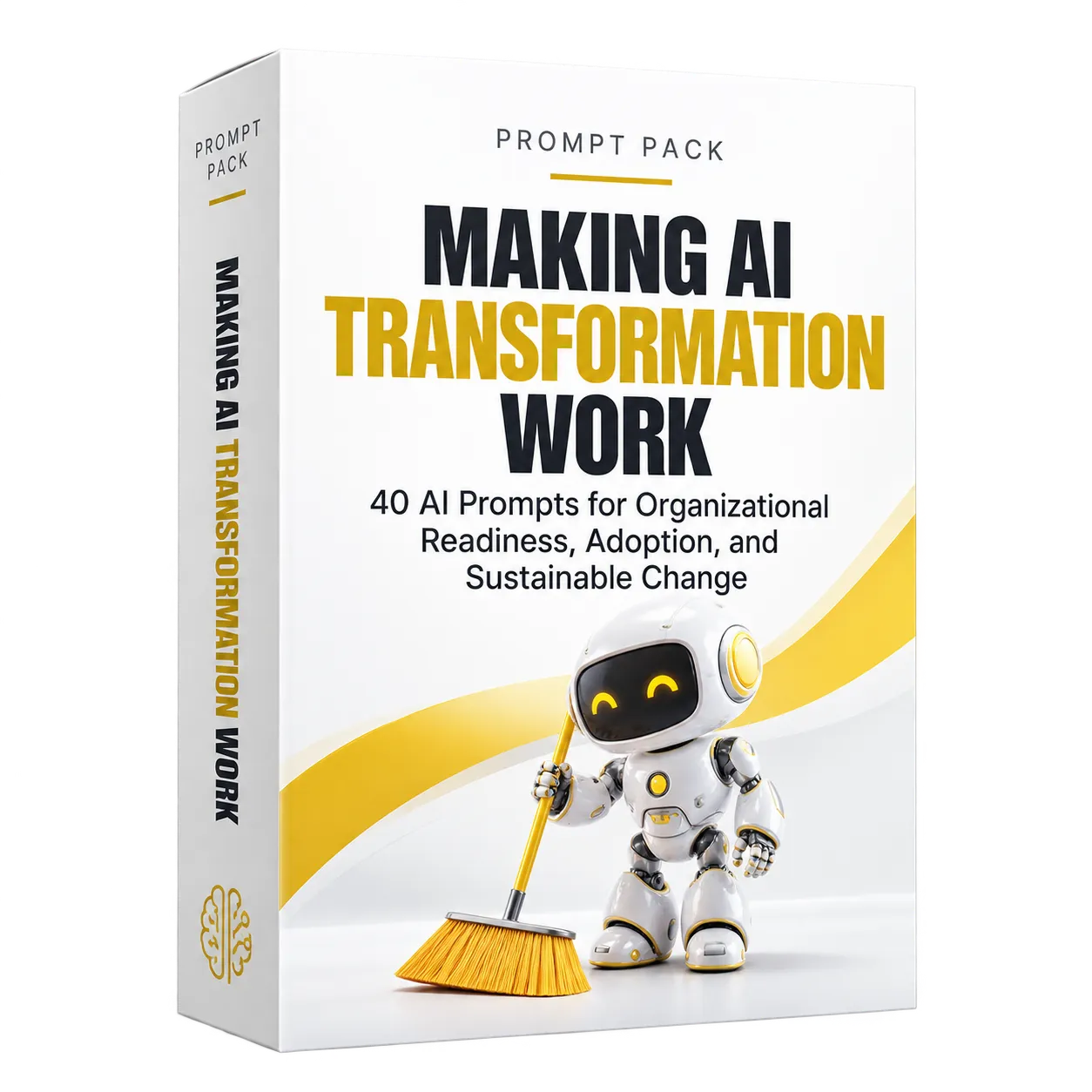
Making AI Transformation Work provides 40 practical AI prompts designed to help consultants, change management professionals, and organizational leaders work through these challenges. The prompts can be used with an AI assistant to develop customized strategies, communication plans, implementation frameworks, assessments, workshops, and support systems.
What the Resource Covers
1. Assess Organizational Readiness
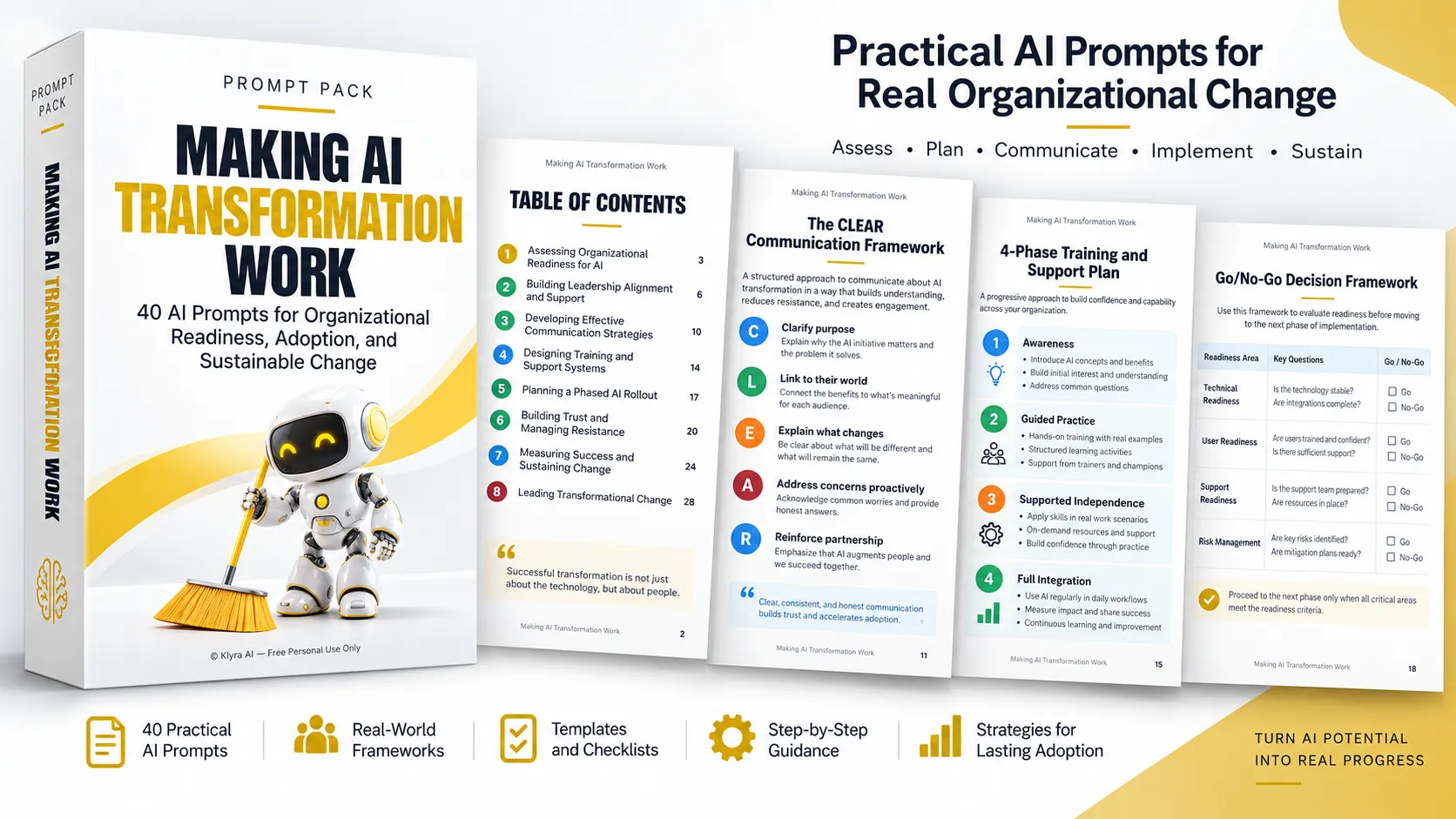
The resource begins by helping organizations understand their starting point before moving into implementation. One readiness assessment prompt covers five dimensions of AI readiness: leadership commitment, cultural openness, workforce capability, process flexibility, and technology infrastructure.
Other prompts help examine resistance patterns, identify potential AI champions, map department-specific resistance, and assess leadership readiness. Together, these prompts provide a foundation for understanding where an organization may need additional preparation.
2. Build Leadership Alignment and Support
Leadership plays a central role in AI transformation. The prompts in this section help organizations create alignment before implementation moves forward.
- Design a three-hour leadership alignment workshop.
- Create a 90-day executive communication strategy.
- Develop leadership success metrics.
- Prepare for difficult conversations about job concerns, AI mistakes, and previous technology initiatives.
- Create an ROI analysis framework covering productivity, error reduction, employee experience, and competitive advantage.
The emphasis is on helping leaders understand the transformation, communicate consistently, support employees, and evaluate progress.
3. Develop Effective Communication Strategies
AI transformation requires communication that connects the implementation to the people affected by it. The resource introduces the CLEAR communication method:
- Clarify purpose
- Link to their world
- Explain what changes
- Address concerns proactively
- Reinforce partnership
Prompts based on this approach can be used to develop communication campaigns, role-specific value messaging, FAQs, success-story templates, and resistance response playbooks.
4. Design Training and Support Systems
Adoption depends on more than introducing a new AI tool. Employees need opportunities to learn, practice, receive support, and demonstrate proficiency.
The resource provides prompts for creating a progressive exposure training plan with four phases:
- Awareness
- Guided practice
- Supported independence
- Full integration
Additional prompts address peer mentoring, safe practice scenarios, support escalation, and learning verification. These approaches help organizations structure the learning experience and identify where additional support may be needed.
5. Plan a Phased AI Rollout
Rather than treating implementation as a single event, the prompts support a phased rollout approach. Organizations can use them to select pilot groups, create wave-based deployment plans, establish Go/No-Go decisions, design an implementation command center, and prepare contingency plans.
The Go/No-Go framework considers areas including technical readiness, user readiness, support readiness, and risk management. The contingency planning prompt focuses on potential technical failures, adoption resistance, support overwhelm, and unexpected business disruptions.
6. Build Trust and Manage Resistance
Employee reactions to AI can include concerns about job replacement, cognitive overload, professional identity, practical workflow changes, and confidence in AI systems.
The prompts provide structured ways to analyze and respond to these concerns. They include resistance typologies, observation guides, response approaches, escalation guidance, trust-building activities, and strategies for demonstrating reliability, maintaining human oversight, communicating limitations, and showing how feedback contributes to improvement.
The resource also includes prompts for recognition and gamification, identity transition workshops, and emotional journey mapping so organizations can address the human experience of transformation rather than focusing exclusively on technical deployment.
7. Measure Success and Sustain Change
Successful implementation needs ongoing measurement and improvement. The resource includes prompts for designing adoption metrics dashboards that combine technical, behavioral, and sentiment measures.
It also addresses continuous improvement, capability transfer, long-term sustainability assessment, and systematic collection of AI transformation success stories. These prompts help organizations establish mechanisms for learning from implementation and gradually building internal capability.
8. Lead Transformation Over the Long Term
The final group of prompts focuses on transformational leadership and organizational evolution. It includes leadership coaching, change narrative development, stakeholder engagement, cultural evolution, and transformation retrospectives.
One prompt specifically proposes an 18-month cultural evolution roadmap, while another provides a framework for documenting the transformation journey and turning key learnings into a playbook for future technology adoption.
How to Use the Prompts
The resource recommends using the prompts as a connected sequence rather than as isolated exercises.
Start With Assessment
Begin with organizational readiness prompts to understand the current state and identify priority areas. The resulting information can then guide which subsequent prompts are most useful.
Customize Before Submitting
Many prompts contain bracketed sections for organizational information. These should be replaced with specific details about the organization, implementation plans, teams, workflows, and context. The resource emphasizes that more specific information can produce more tailored and actionable AI responses.
Build Sequentially
The prompts are designed around a logical implementation sequence. Foundational work such as readiness and leadership alignment comes before execution activities such as communication, training, and implementation.
Iterate and Refine
Initial AI outputs can be refined through follow-up requests. For example, a communication plan can be adapted to address concerns expressed by a particular team or department.
Combine Outputs Strategically
Individual prompt responses can be connected into a broader transformation approach. The resource encourages users to cross-reference and integrate outputs rather than treating every response as a standalone deliverable.
Maximize the Value of AI Assistance
The resource also provides practical guidance for getting better results from an AI assistant.
- Provide context about previous work: Give the AI enough background to build on earlier outputs instead of creating disconnected materials.
- Request specific formats: Specify whether the desired deliverable is a slide deck, one-pager, workshop agenda, or another format.
- Ask for implementation guidance: Use follow-up questions to explore challenges and adaptation strategies.
- Seek simplification when needed: Ask for streamlined versions when an approach is too complex for the organization's available resources.
- Request examples and templates: Turn abstract strategies and frameworks into concrete materials that can be used in practice.
A Four-Phase Implementation Approach
The resource concludes with a phased approach for using the prompts across an AI transformation.
Phase 1: Assessment and Foundation — Weeks 1–4
- Assess organizational readiness.
- Develop leadership alignment and commitment strategies.
- Create communication and resistance management foundations.
Phase 2: Planning and Preparation — Weeks 5–8
- Design training and support systems.
- Develop the phased implementation approach.
- Create trust-building and resistance management toolkits.
Phase 3: Implementation and Adjustment — Weeks 9–16
- Execute the communication campaign.
- Implement training and support systems.
- Collect feedback and make adjustments.
Phase 4: Sustainability and Evolution — Ongoing
- Measure adoption and impact.
- Implement continuous improvement mechanisms.
- Transfer capabilities to internal teams.
Use the Prompts as Living Tools
The central approach of the resource is to treat AI transformation as an evolving process. The prompts are intended to help organizations assess, plan, communicate, implement, learn, and adjust as they gain more understanding of their specific needs and responses to AI implementation.
Used together, the 40 prompts provide a structured way to address both the technological and human dimensions of AI transformation, from initial readiness through long-term sustainability and organizational evolution.