Cold Email Marketing with AI
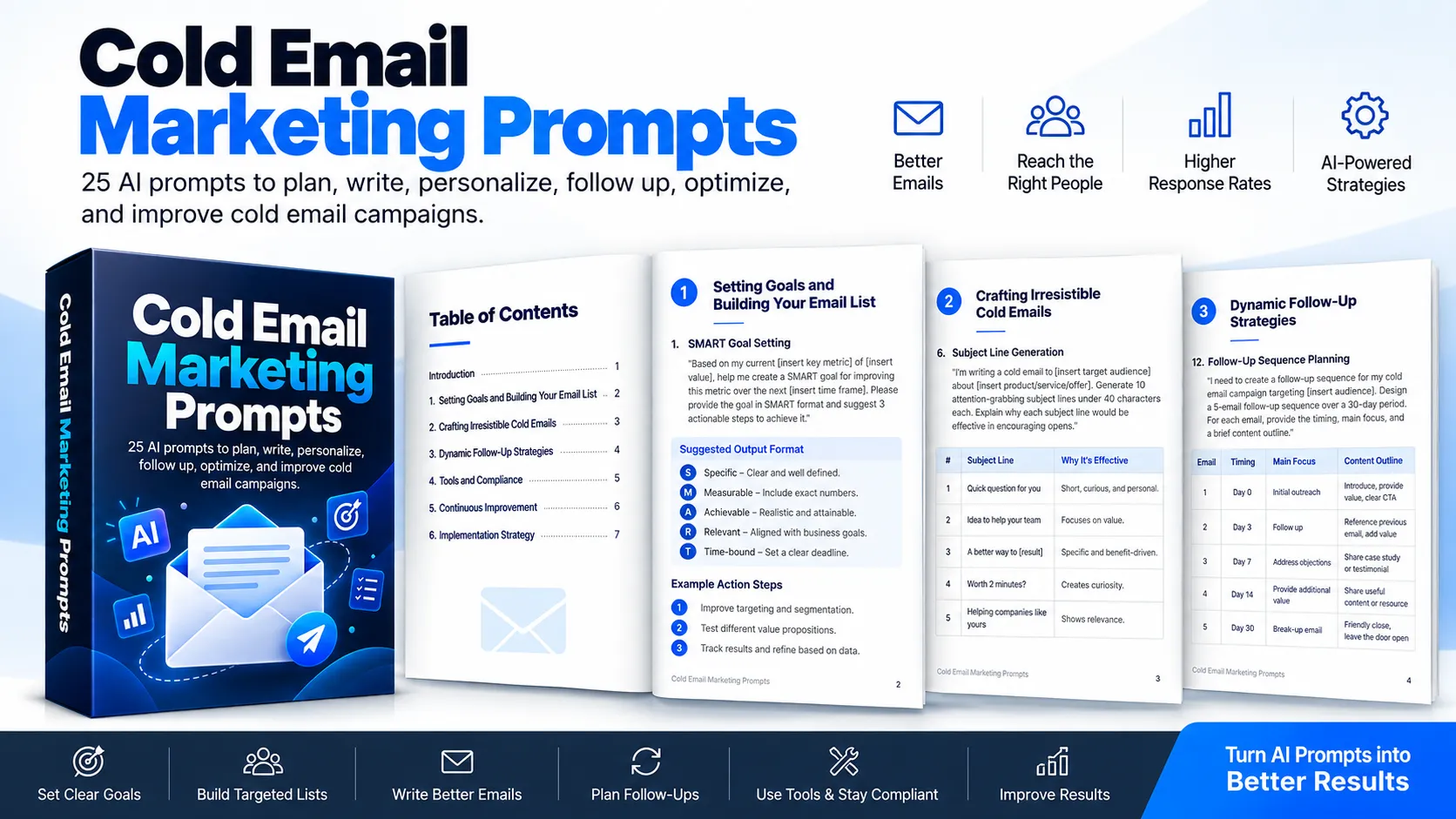
Cold email marketing involves more than writing an email and sending it to a list. Effective outreach requires clear goals, a relevant audience, thoughtful messaging, follow-up planning, appropriate tools, compliance awareness, and continuous improvement.
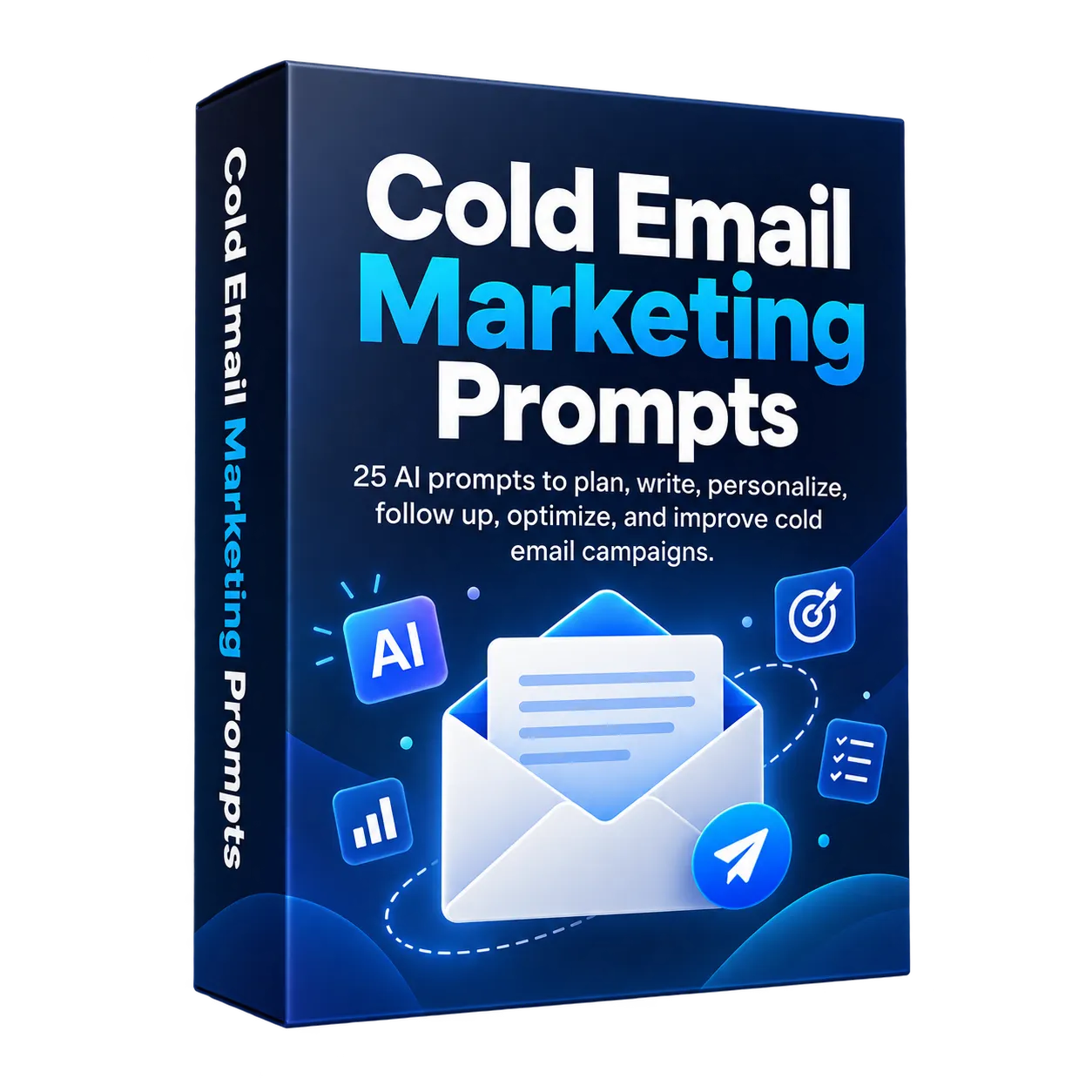
This resource provides 25 AI prompts organized around those areas. Each prompt is designed to give an AI assistant enough direction to produce a useful starting point while leaving room for the marketer to add business-specific context.
1. Set Goals and Build a Better Email List
A strong cold email campaign starts with clarity about what you are trying to improve and who you are trying to reach.
Set SMART Goals
The first prompt helps turn a current marketing metric into a SMART goal and identifies three actionable steps for improving it over a defined period. This provides a structured starting point instead of approaching campaign improvement without a specific objective.
Develop Buyer Personas
The buyer persona prompt helps organize information about a target audience, including demographics, job titles, industries, goals, challenges, and preferred communication channels. This context can help make subsequent email messaging more relevant.
Develop Lead Magnets
The lead magnet prompt generates potential resources for attracting a specific target audience based on their interests. Each suggested idea is accompanied by a brief explanation of its potential value.
Segment the Email List
When contacts come from different industries or job roles, segmentation can help create more targeted communication. The segmentation prompt asks for five ways to group contacts and connects each method with tailored content.
Plan CRM Integration
The CRM integration prompt helps identify three potentially suitable CRM systems based on business focus. It asks the AI to consider key features, email marketing usefulness, and possible integration challenges.
2. Craft More Effective Cold Emails
Once the audience and campaign objectives are clearer, the next group of prompts focuses on the actual email.
Generate Subject Lines
The subject line prompt asks AI to create multiple attention-grabbing options within a defined character limit and explain the reasoning behind each option.
Create Personalized Opening Lines
The opening-line prompt uses information about a recipient or their company, such as recent news or an achievement, to create personalized introductions. It also asks for an explanation of why each opening may capture attention.
Clarify the Value Proposition
A cold email needs to communicate the benefit of the product or service clearly. The value proposition prompt helps express the main benefit concisely and provides alternative ways to communicate it within the email.
Optimize the Call to Action
The CTA prompt starts with the desired outcome, such as scheduling a demo or downloading a resource. It then generates several CTA options and considers where each could be placed within the email.
Structure the Email Body
The email body prompt helps organize three or four key points into a concise structure focused on benefits. This can help prevent the message from becoming unfocused.
Go Beyond Basic Personalization
The personalization prompt explores ways to personalize cold emails beyond simply using a recipient's name. It asks for five advanced techniques and examples of how they could be implemented.
3. Build Dynamic Follow-Up Strategies
Cold email outreach can require a sequence rather than a single message. The follow-up prompts help structure that process.
Plan a Follow-Up Sequence
The sequence planning prompt creates a five-email follow-up sequence across a 30-day period. For each email, it identifies timing, the main focus, and a brief content outline.
Handle Prospect Objections
When prospects raise recurring objections, the objection-handling prompt creates different response approaches. The responses are designed to acknowledge the prospect's concern while offering a solution or alternative perspective.
Add Value to Follow-Ups
Rather than treating follow-ups as repeated requests for a response, the value-adding prompt identifies five types of useful content that could be included in follow-up messages.
Optimize Automated Sequences
If an automated sequence already exists, the optimization prompt analyzes its current structure and identifies three potential improvements. It also asks the AI to explain the possible effect on engagement.
Create a Professional Break-Up Email
The break-up email prompt helps create a courteous final message for prospects who have not engaged after multiple follow-ups. The objective is to close the sequence professionally while leaving the possibility of future communication open.
4. Use Tools and Protect Deliverability
Cold email strategy also depends on the systems and practices surrounding the messages themselves.
Evaluate Email Automation Tools
The tool-selection prompt considers business size, business type, and specific requirements before asking for three suitable email automation options. It also considers features, pricing, alignment with needs, and potential integration challenges.
Review GDPR Requirements
The GDPR compliance prompt creates a checklist focused specifically on email marketing. It asks for an explanation of why each requirement matters and a practical implementation tip.
Identify Potential Spam Trigger Language
The spam-trigger prompt reviews an existing email for potentially problematic words or phrases and suggests alternative wording while attempting to preserve the original message.
Set Up Email Authentication
The email authentication prompt focuses on SPF, DKIM, and DMARC. It asks for a step-by-step setup guide, an explanation of the importance of each method, and potential implementation challenges.
Maintain Email List Hygiene
The list hygiene prompt develops a strategy for maintaining a clean and engaged email list. It considers specific actions, recommended frequency, and tools that can support the process.
5. Improve Campaign Performance Continuously
Cold email marketing should be treated as an ongoing process of testing, learning, and adaptation. The final group of prompts focuses on advanced improvement.
Develop A/B Testing Plans
The A/B testing prompt identifies five elements that could be tested and creates a plan for each. The requested structure includes a hypothesis, the variable being changed, metrics to measure, and a testing timeline.
Apply Advanced Personalization
The advanced personalization prompt uses available data sources, such as a CRM or social media, to develop a more personalized email strategy. It also asks for three specific examples using different data points.
Connect Multiple Marketing Channels
The multi-channel integration prompt explores how cold email can work alongside two or three other marketing channels, such as LinkedIn or content marketing, to support the broader campaign.
Analyze Emerging Trends
The trend analysis prompt examines emerging cold email marketing trends for a particular industry and asks for implementation ideas and potential campaign impact.
6. A Practical Implementation Process
The prompts are most useful when applied systematically rather than all at once. The resource recommends a structured approach to implementation.
- Prioritize your goals. Review the prompts and begin with the areas most closely connected to your current priorities.
- Provide context. Include relevant information about your business, audience, and specific situation so the AI can produce more tailored responses.
- Iterate and refine. Treat AI-generated responses as starting points and adapt them using your own expertise and business knowledge.
- Implement gradually. Start with one or two areas, measure the results, and then move to additional areas rather than changing everything simultaneously.
- Combine AI insights with human judgment. Use your own judgment and industry knowledge when making final decisions based on AI suggestions.
- Review and adapt regularly. Revisit your cold email strategy as the business evolves and new campaign data becomes available.
- Put compliance first. Prioritize compliance and ethical practices when developing and implementing cold email campaigns.
- Measure and analyze. Use metrics and analysis prompts regularly to track progress and identify areas that need improvement.
- Keep learning. Use prompts related to trends and emerging techniques to continue adapting to changes in cold email marketing.
Turning Prompts into a Repeatable Workflow
The value of an AI prompt pack comes from how consistently it is applied. The 25 prompts can be used across different stages of a campaign, from defining the initial objective and understanding the audience to developing messaging, planning follow-ups, checking operational considerations, and analyzing opportunities for improvement.
The prompts are also designed to be adapted. Most include placeholders for information such as the target audience, product or service, business focus, current metrics, objections, campaign structure, data sources, and other relevant context. Supplying that information gives the AI a clearer foundation for generating useful suggestions.
AI should support the marketing process rather than replace human decision-making. The implementation guidance emphasizes refining AI responses, applying business expertise, measuring results, and adapting the strategy over time.
Used systematically, this prompt collection provides a practical framework for using AI across cold email marketing, from initial planning and email creation through follow-up, compliance, testing, and continuous improvement.