From Conversation to Engineering
Prompt engineering becomes much more important when AI moves from casual experimentation into a real application, workflow, or business process. A person using an AI assistant can usually correct an imperfect answer manually. A production system does not have that luxury. If an automated workflow produces inconsistent results, the cost of reviewing and correcting those outputs can quickly outweigh the benefit of automation.
The central idea of this resource is to stop treating the prompt as a casual conversation and start treating it as an engineering interface. The objective is not simply to make an AI model produce an impressive answer once. The objective is to design instructions that produce an appropriate result consistently across different inputs.
This requires a different mindset. Instead of asking only whether an output “looks good,” prompt engineers need to think about structure, constraints, failure modes, evaluation, security, and repeatability.
Understanding the Probability Engine
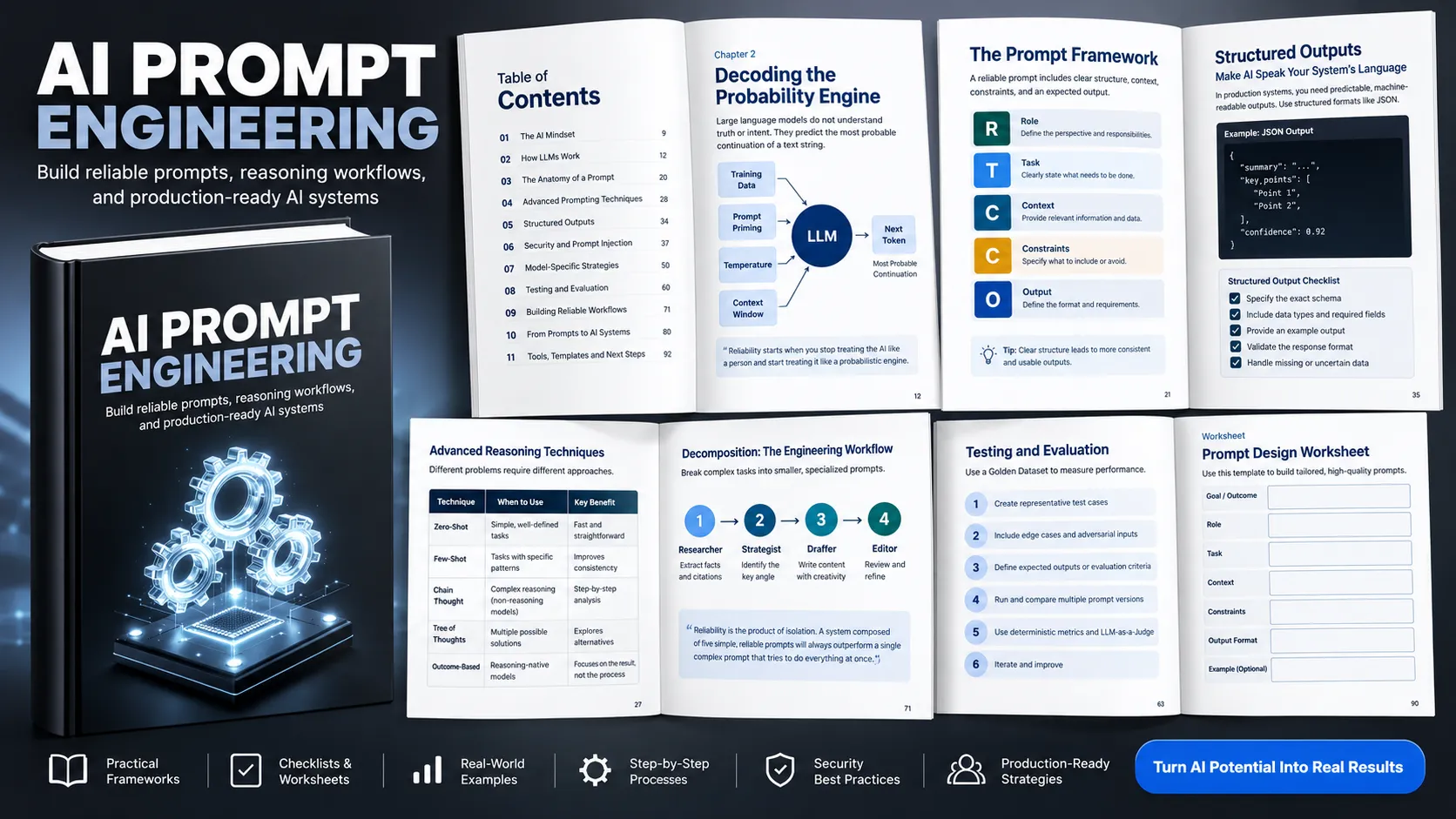
The resource begins by challenging the common mental model that an AI model understands a request in exactly the same way a person does. Large language models generate text through statistical prediction. The words used in a prompt influence the probability distribution from which subsequent tokens are selected.
This explains why seemingly small changes to a prompt can produce substantially different outputs. Several factors influence this behavior, including training data, prompt wording, and decoding parameters such as temperature.
Prompt Priming
The language used in a prompt changes the type of output the model is more likely to produce. Formal instructions can encourage a formal response, while casual language can encourage a more conversational result.
Temperature
Temperature controls the degree of randomness in generation. Lower settings generally make outputs more deterministic, while higher settings allow more variation. The appropriate setting depends on the task. Structured extraction and other consistency-sensitive tasks generally benefit from less randomness, while creative work may benefit from greater variation.
The Prompt, Context Window, and Tokens
A prompt is more than the sentence a user types. It can include system instructions, contextual information, examples, policies, and the user's request. The context window determines how much information the model can consider at once, while tokens represent the units processed by the model.
Understanding these limitations matters because large inputs consume context and can increase processing requirements. Prompt engineering therefore involves deciding not only what information to provide, but also what information should be provided and where it should be placed.
Building the Prompt Architecture
A reliable prompt needs more structure than a simple command. The resource presents prompting as an architecture in which the model receives clearly defined responsibilities, relevant information, constraints, and an expected result.
Role and Responsibility
Defining a role can establish the perspective and behavior expected from the model. The role should support the task rather than simply adding decorative persona language.
Task
The task should clearly identify what the model needs to accomplish. Ambiguous instructions make evaluation difficult because there is no precise definition of success.
Context
Relevant information gives the model the material required to perform the task. Context can include documents, data, examples, policies, or other reference material.
Constraints
Constraints define what the model should or should not do. They can control tone, length, allowed information, formatting, prohibited behavior, or handling of missing information.
Output Requirements
The expected output should be explicit. If software needs machine-readable information, conversational prose is not enough. The output needs a predictable structure that downstream systems can process.
From Simple Prompts to Reasoning Techniques
The resource examines several prompting techniques and explains that different problems require different levels of structure.
Zero-Shot Prompting
Zero-shot prompting provides an instruction without demonstrations. It can be appropriate for straightforward tasks where the desired behavior is already sufficiently clear.
Few-Shot Prompting
Few-shot prompting provides examples that demonstrate the desired behavior. Examples can help a model understand classification rules, formatting expectations, or how ambiguous cases should be handled.
The resource also emphasizes that prompting techniques should not be treated as universal recipes. As model capabilities evolve, techniques that were useful for earlier models may become unnecessary or even counterproductive for newer reasoning-oriented models.
Chain of Thought
Chain of Thought prompting historically became associated with asking models to work through a problem step by step. The resource explains that this can improve certain reasoning tasks, particularly with models that do not already provide strong native reasoning capabilities.
However, the guide highlights an important evolution: reasoning-native models can behave differently. Rather than automatically forcing a manually prescribed reasoning process, prompt engineers should focus increasingly on defining the desired result and the constraints that determine whether the result is acceptable.
Tree of Thoughts
Tree of Thoughts extends linear reasoning by considering multiple possible paths before selecting a promising one. This can be useful for problems where committing immediately to the first plausible path may produce an incorrect result.
Decomposition: Do Not Make One Prompt Do Everything
One of the resource's strongest engineering principles is decomposition. Complex tasks should not necessarily be compressed into one enormous prompt.
A single request might ask an AI system to retrieve information, analyze it, make a strategic decision, write content, and format the final answer. Combining all of these responsibilities increases complexity and makes failures difficult to diagnose.
Instead, the workflow can be divided into smaller components. One component can research or extract information. Another can develop a strategy. Another can draft content. A final component can review the result against defined requirements.
This modular approach creates an important engineering benefit: when something goes wrong, the failure can be traced to a particular stage. The system becomes easier to debug, improve, and maintain.
Structured Outputs: Make AI Speak Your System's Language
AI-generated prose is often unsuitable as a direct interface between components of a software system. Production workflows need predictable data structures.
The resource therefore treats structured output as an important part of prompt architecture. Formats such as JSON or clearly defined XML structures can provide boundaries between instructions and data while making outputs easier for software to consume.
Separate Data From Instructions
One important security principle is to distinguish between the instructions controlling the model and the information the model is being asked to analyze.
User messages, documents, retrieved information, and external content should be treated as data rather than automatically trusted as instructions. Clear containers and explicit instructions can help prevent untrusted content from changing the behavior of the system.
Prompt Injection and AI Security
When AI systems process external or user-controlled information, prompt injection becomes an important concern. Malicious text can attempt to override instructions, manipulate the model, or cause it to expose information or perform unintended actions.
The resource recommends designing explicit boundaries between logic and data. System-level instructions should contain important rules, guardrails, and structural requirements, while dynamic user information should remain separated from those controls.
System Prompts as Architecture
The system prompt should not be viewed merely as a place to define a personality. In a production application, it can establish durable rules, output requirements, safety constraints, and other application-level behavior.
The resource also discusses prompt caching. When a large system prompt remains unchanged across many requests, caching mechanisms offered by model providers can potentially reduce repeated processing and improve latency and cost characteristics.
Model-Specific Prompt Engineering
Different model families can respond differently to the same prompt architecture. The resource therefore argues against assuming that one prompting style is universally optimal.
Conversational Generalist Models
The resource describes GPT-class models as versatile and conversational, while noting that explicit constraints can be useful when the application requires concise, machine-oriented responses.
Structured Analytical Models
It describes Claude-class models as particularly responsive to visually structured instructions and XML-style boundaries. Separating context, tasks, and output requirements can help create clearer instruction hierarchies.
The broader lesson is more durable than any specific model recommendation: prompt engineering should account for the characteristics of the model being used rather than assuming every model interprets instructions identically.
Reliability Requires Testing
A prompt that works once is not necessarily a reliable prompt. The resource compares this to software engineering: developers would not normally deploy software after testing a single input, yet AI systems are often evaluated informally by reading a few outputs and deciding that they “look good.”
Reliable prompt engineering requires repeatable evaluation.
The Golden Dataset
A Golden Dataset is a curated collection of representative inputs and expected outputs that acts as a testing ground for a prompt or AI workflow.
Each test case should establish the input context, the prompt version being evaluated, and the expected output or ground truth. This creates a repeatable way to compare different prompt versions and identify regressions.
Test Beyond the Happy Path
A strong test suite should not consist only of ideal inputs. The resource recommends deliberately including difficult cases that expose weaknesses in the system.
- Empty Input: Test how the system behaves when required information is missing.
- Needle in the Haystack: Test whether important information can still be found when surrounded by substantial irrelevant content.
- Adversarial Input: Test whether malicious instructions inside user-controlled content can override the system's intended behavior.
- Gibberish Input: Test how the system handles meaningless or malformed requests.
The resource proposes a rough 70/30 balance between representative real-world tasks and edge cases designed to break the system.
Measuring AI Output Quality
Testing becomes useful only when outputs can be evaluated consistently. The resource divides evaluation into different types of metrics.
Deterministic Metrics
Some outputs can be evaluated directly with code. Examples include checking whether required fields exist, whether JSON is valid, whether a value falls within an allowed range, or whether specific structural requirements are satisfied.
Semantic Metrics
Other tasks require evaluating whether the response contains the correct information or meaning. These cases can require comparison against reference answers or other evaluation methods.
LLM-as-a-Judge
Subjective characteristics such as tone, helpfulness, accuracy, and brevity are harder to evaluate using simple rules. The resource introduces the LLM-as-a-Judge pattern, where a separate capable model evaluates the candidate output against a defined rubric.
A useful evaluation can provide the original input, the candidate response, and explicit grading criteria. The evaluator can then return a structured score and explanation.
Prompt Engineering as a Production Discipline
Once prompts become part of an application, they should be treated as software assets rather than disposable pieces of text.
The resource recommends maintaining a Prompt Library and versioning important instruction sets. This makes it possible to identify which prompt produced a particular result and compare new versions against established test cases.
Continuous testing becomes particularly important because AI models change. A prompt that behaves reliably with one model version may behave differently after a provider updates the underlying model. A production prompt therefore needs ongoing validation rather than a single approval.
From Prompt Engineering to AI Systems
The resource ultimately expands the idea of prompt engineering into systems architecture. A sophisticated AI workflow may consist of multiple specialized prompts connected together, with structured outputs serving as the interface between stages.
For example, a content workflow can separate research, strategy, drafting, and editing into distinct components. Each component has a narrower responsibility, making the overall workflow easier to understand and debug.
This approach also provides a foundation for agentic systems. An agent can combine a loop, memory, and tools to pursue a goal rather than simply executing one fixed sequence. The system can evaluate intermediate results, use external capabilities, and repeat actions until a defined condition is reached.
Outcome-Based Prompting
A major conclusion of the resource is the shift toward outcome-based prompting for increasingly capable reasoning models.
Instead of micromanaging every internal reasoning step, define what a successful result looks like. Specify the desired output, constraints, quality criteria, and acceptance conditions.
For example, a coding task can focus on producing a function that satisfies defined tests rather than requiring the model to expose or follow a prescribed sequence of reasoning steps.
This represents a broader principle: the prompt engineer's job is not necessarily to control every internal operation of the model. The job is to create an environment in which the model has a clear objective, sufficient context, appropriate constraints, and a measurable definition of success.
The Engineering Mindset
Reliable AI does not come from finding a magical prompt. It comes from disciplined design.
The resource's approach can be summarized as a continuous engineering cycle:
- Define the outcome: Establish exactly what a successful result looks like.
- Structure the instructions: Separate roles, tasks, context, constraints, and output requirements.
- Separate data from logic: Keep untrusted content from being confused with system instructions.
- Decompose complex work: Break large tasks into smaller, specialized stages where appropriate.
- Use structured outputs: Give downstream systems predictable data to consume.
- Build a Golden Dataset: Establish representative examples and expected results.
- Test edge cases: Deliberately search for inputs that cause the system to fail.
- Measure results: Combine deterministic checks with semantic and rubric-based evaluation.
- Version prompts: Track changes so improvements and regressions can be identified.
- Continuously maintain: Re-test prompts as models, workflows, and requirements evolve.
The lasting lesson is that prompt engineering is less about clever wording and more about architecture. As AI models become more capable, the most durable skills are the ability to define outcomes, manage context, separate data from instructions, decompose workflows, enforce reliable interfaces, evaluate performance, and continuously improve the system.