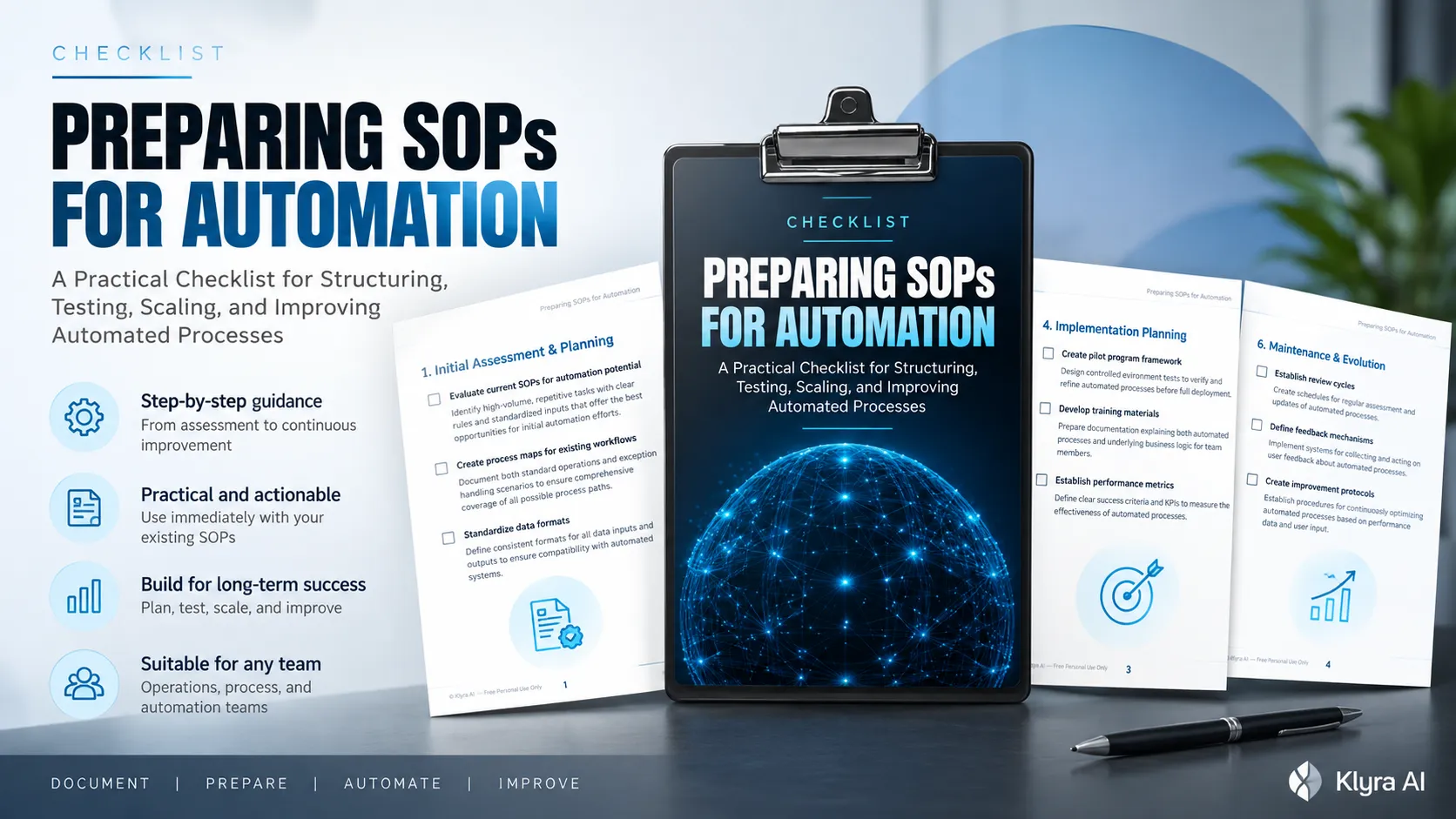
Preparing Standard Operating Procedures for Automation
Preparing an SOP for automation involves more than transferring an existing process into an automated system. The underlying workflow needs to be evaluated, documented, standardized, tested, and prepared for ongoing monitoring and improvement.
This checklist organizes that preparation into six areas: initial assessment and planning, documentation enhancement, technical preparation, implementation planning, scalability considerations, and maintenance and evolution.
1. Assess the Process Before Automating It
The first step is determining whether the current SOP presents a suitable opportunity for automation. The checklist prioritizes high-volume, repetitive tasks with clear rules and standardized inputs as strong candidates for initial automation efforts.
Map the Existing Workflow
Create process maps that document how the workflow currently operates. These maps should cover both normal operations and exception-handling scenarios. Capturing alternative process paths helps create a more complete representation of what the automated process may need to handle.
Standardize Inputs and Outputs
Data consistency is another part of automation preparation. Define consistent formats for the data entering and leaving the process so that inputs and outputs are structured appropriately for automated systems.
2. Strengthen the SOP Documentation
Once the process has been assessed, the documentation needs enough detail to define how individual steps should behave, how results should be checked, and what should happen when normal processing cannot continue.
Define Validation Rules
Specify exact validation requirements for each process step. This includes documenting acceptance criteria and the methods that will be used to verify whether those criteria have been met.
Document Error Handling
Exceptions should be part of the documented process rather than treated as an afterthought. Create detailed protocols for handling errors, unusual situations, and circumstances that require human intervention.
Establish Quality Control Checkpoints
Identify critical stages where quality checks should occur. These checkpoints provide defined opportunities to verify accuracy as work moves through the process.
3. Prepare the Technical Requirements
With the workflow and documentation established, the next stage is determining how the SOP could translate into an automated environment.
Evaluate Potential Automation Solutions
Map the SOP to potential automation tools by creating an evaluation matrix. Compare possible solutions against the specific requirements of the process and their compatibility with those requirements.
Assess Integration Requirements
Document how the automated process will interact with existing systems and workflows. This makes integration requirements part of the planning process rather than something discovered only during implementation.
Design Test Scenarios
Develop testing procedures that go beyond the standard workflow. The checklist recommends covering:
- Standard operations
- Edge cases
- Potential failure points
Testing these different conditions provides a broader way to evaluate how the automated process behaves.
4. Plan the Implementation
Automation should be verified and refined before full deployment. The implementation stage therefore includes controlled testing, team preparation, and clear measures of effectiveness.
Create a Pilot Program
Design controlled-environment tests that allow the automated process to be verified and refined before it is deployed more broadly.
Prepare Training Materials
Develop documentation for team members that explains both the automated process and the business logic behind it. This gives people context for how the process operates rather than documenting only the automated steps.
Define Performance Metrics
Establish clear success criteria and key performance indicators for measuring the effectiveness of the automated process. These metrics provide a defined basis for evaluating performance after implementation.
5. Prepare Automation for Scale
Automation planning should account for future operational growth rather than focusing exclusively on the initial deployment.
Consider Multiple Locations and Departments
Plan for processes that may eventually need to operate across different locations or departments. The automated workflow should be able to accommodate this type of growth where required.
Document Infrastructure Requirements
Specify the technical resources and capabilities necessary to support scaled operations. This helps make infrastructure needs visible as part of the SOP preparation process.
Create Monitoring Protocols
Develop systems for tracking the performance of automated processes and identifying potential issues. Monitoring provides the information needed to understand how automation is performing once it is operating in practice.
6. Maintain and Improve Automated Processes
Preparing an SOP for automation does not end when the automated process is deployed. The checklist includes an ongoing maintenance and evolution stage built around review, feedback, and improvement.
Establish Regular Review Cycles
Create schedules for periodically assessing and updating automated processes. Regular reviews provide defined opportunities to determine whether processes continue to operate as intended.
Collect and Act on Feedback
Define mechanisms for collecting user feedback about automated processes and acting on that feedback. This brings the experience of people interacting with the process into ongoing evaluation.
Create Improvement Protocols
Establish procedures for continuously optimizing automated processes using both performance data and user input. Together with monitoring and scheduled reviews, these protocols create a structured approach to maintaining and evolving automation over time.
A Structured Path from SOP to Automation
The checklist presents automation preparation as a progression rather than a single implementation task. Start by identifying suitable processes and documenting how they work. Strengthen the SOP with validation, error handling, and quality controls. Then evaluate technical requirements, test the process, prepare implementation, and consider how the automation will scale.
Finally, establish monitoring, review cycles, feedback mechanisms, and improvement protocols. This creates a repeatable preparation process that considers not only how automation begins, but also how automated processes can be assessed and refined after deployment.
Download the complete checklist to work through each preparation step as you review SOPs for automation.