A Structured Prompt Library for B2B Lead Generation
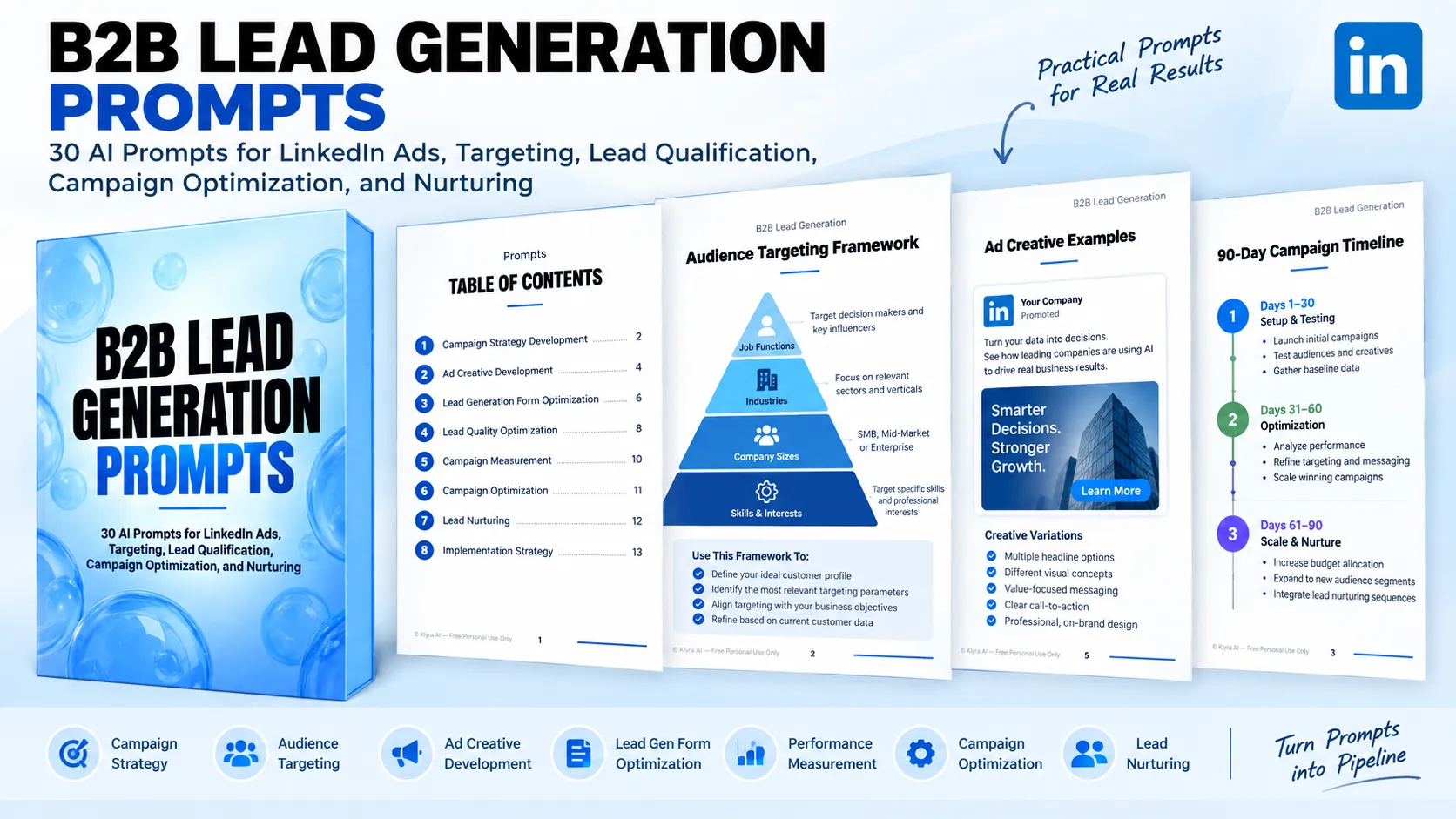
B2B lead generation through LinkedIn advertising involves more than creating an ad and choosing an audience. Campaign strategy, targeting, creative development, lead capture, qualification, measurement, optimization, and nurturing all contribute to the overall process.
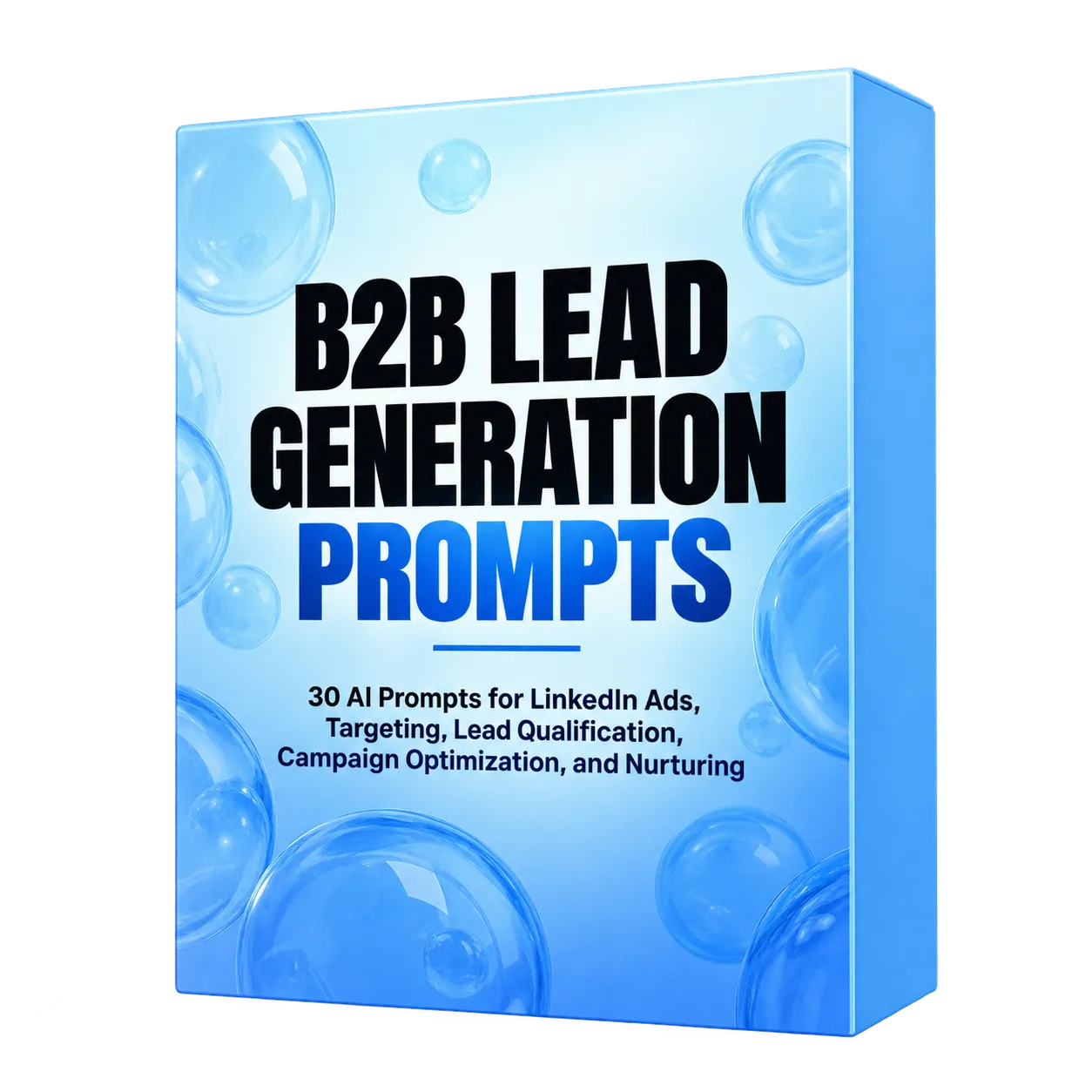
This resource organizes 30 AI prompts around those areas so that AI assistance can be applied to specific B2B marketing tasks rather than approached as a single general-purpose conversation.
The prompts are customizable. Bracketed sections allow you to supply information about your product or service, ideal customer profile, business objectives, target accounts, audience segments, campaign performance, budgets, existing processes, and other relevant context.
Build the Campaign Strategy Before Launching
The first group of prompts focuses on campaign strategy development. It starts with the audience and then moves into campaign structure, budget allocation, and timeline planning.
Develop Professional Audience Targeting
The targeting prompts help structure decisions around the professional audiences a LinkedIn campaign should reach. They cover job functions, industries, company sizes, skills, customer characteristics, business objectives, and audience pain points.
The resource includes prompts for three distinct targeting tasks:
- Professional targeting strategy: Develop targeting around an ideal customer profile and existing customer information.
- Account-based marketing: Build a framework for targeting selected key accounts, including targeting parameters, content themes, and engagement metrics.
- Audience segmentation: Create distinct audience segments with targeting criteria, pain points, and relevant value propositions.
Structure Campaigns Around Clear Objectives
Once the audience is defined, the resource moves into campaign organization. Prompts help design a LinkedIn campaign hierarchy, distribute budgets across campaigns and audience segments, and create a 90-day campaign timeline.
The budget allocation prompt incorporates testing budgets and performance thresholds, while campaign timeline planning considers milestones, testing phases, optimization points, business events, and seasonality factors.
Develop LinkedIn Ad Creative and Messaging
The next stage addresses both the visual and written components of LinkedIn advertising.
Plan Professional Ad Visuals
Visual-content prompts can be used to establish guidelines for images, colors, typography, branding, sizing, text placement, and visual hierarchy. They also support the development of multiple sponsored-content concepts with headline variations, visual descriptions, and calls to action.
Mobile considerations are included through a dedicated prompt for defining mobile-first creative requirements based on the campaign type and available performance metrics.
Strengthen Ad Copy
The copy-development prompts focus on communicating the value proposition, developing professional headlines, and selecting calls to action for different stages of the B2B buying journey.
These prompts can help organize primary benefits and proof points, combine problem recognition with solution-focused benefits, and create CTA variations that can be tested according to campaign objectives.
Improve Lead Generation Forms and Lead Quality
Generating responses is only part of B2B lead generation. The resource dedicates six prompts to improving how information is collected and how leads are evaluated.
Optimize LinkedIn Lead Gen Forms
Prompts address Lead Gen Form architecture, progressive profiling, and testing. They can be customized to explore field progression, required and optional fields, mobile considerations, field sequencing, qualification criteria, testing variables, success metrics, and optimization schedules.
Develop a More Structured Qualification Process
The lead-quality prompts extend beyond form design into lead evaluation. They cover:
- Lead scoring based on behavioral signals, professional attributes, and engagement metrics.
- Qualification matrices using explicit and implicit signals across professional segments.
- Automated quality filters that incorporate disqualification criteria and routing rules.
Providing details about your current qualification and lead-handling processes gives the AI additional context for these prompts.
Measure and Optimize Campaign Performance
Another group of prompts focuses on understanding performance and establishing a repeatable optimization process.
Create Measurement Frameworks
The resource provides prompts for designing KPI dashboards, developing multi-touch attribution models, and creating ROI calculation frameworks.
These prompts address leading and lagging indicators, benchmarks, visualization recommendations, conversion paths, attribution across channels, and direct and indirect value metrics.
Turn Optimization Into an Ongoing Process
Campaign optimization is treated as a systematic activity rather than a one-time adjustment. The prompts can be used to establish daily, weekly, and monthly optimization tasks with decision thresholds.
A dedicated 90-day A/B testing calendar prompt covers hypotheses, variables, sample sizes, and success criteria. Another prompt focuses on automated budget optimization rules based on campaign metrics, threshold triggers, and adjustment parameters.
Nurture Leads Beyond the Initial Campaign
The final prompt category focuses on what happens after leads have been generated. It addresses nurture sequences, personalization, content mapping, engagement escalation, professional relationship building, and ongoing value-add communication.
Design the Nurture Journey
The nurture prompts help structure multi-touch sequences by considering content types, timing, progression triggers, audience segments, professional context, and engagement signals.
Content can also be mapped between LinkedIn advertising and individual nurture stages so that available assets and delivery methods support the broader journey.
Develop Professional Relationships
Additional prompts address the transition from lead nurturing toward sales opportunities. They can help define trigger events, communication channels, responsibility handoffs, automated and personal interactions, content themes, and engagement opportunities throughout the buying journey.
How to Use the 30 Prompts Effectively
The resource concludes with an implementation strategy built around four stages: preparation, execution, optimization, and integration.
1. Preparation
- Gather relevant data and context before using the prompts.
- Define a clear objective for each prompt interaction.
- Have current performance metrics and benchmarks available.
2. Execution
- Use prompts sequentially within each category where appropriate.
- Provide detailed information in the bracketed sections.
- Save and document useful AI responses for future reference.
3. Optimization
- Iterate prompts based on the results you receive.
- Combine multiple prompts when addressing more complex challenges.
- Update prompt context as new data and learnings become available.
4. Integration
- Connect useful AI outputs with existing systems and processes.
- Share relevant insights across team members.
- Document successful prompt patterns for future use.
Specific context, clear objectives, relevant data, examples, and continued refinement are central to the approach presented in the resource. The complete prompt pack provides all 30 customizable prompts across the B2B LinkedIn lead generation workflow.