Turning Written SOPs Into Practiced Routines
Successfully implementing Standard Operating Procedures requires more than documenting how work should be performed. Procedures also need to be introduced, taught, practiced, assessed, supported, and refined until they become part of daily operations.
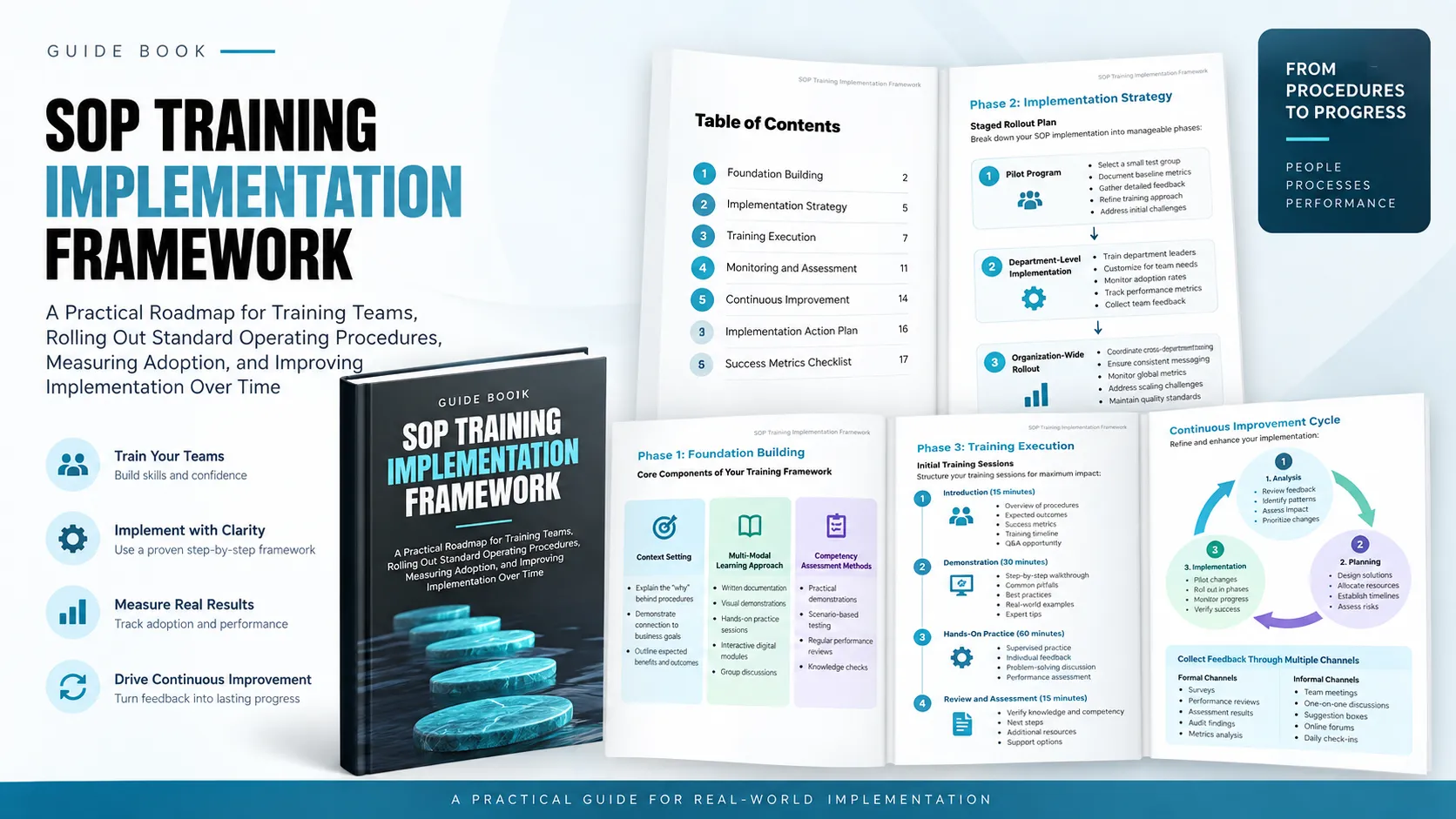
The SOP Training Implementation Framework organizes this process into five connected phases:
- Foundation Building: Establish the training framework, learning materials, and assessment methods.
- Implementation Strategy: Introduce procedures through a staged rollout and establish support systems.
- Training Execution: Combine explanation, demonstration, hands-on practice, and assessment.
- Monitoring and Assessment: Track training, performance, and adoption at multiple levels.
- Continuous Improvement: Gather feedback, analyze results, and systematically refine the implementation.
Phase 1: Build the Training Foundation
Before launching SOP training, establish a framework that accommodates different learning preferences and experience levels. The resource identifies three core components: context setting, multi-modal learning, and competency assessment.
Start by explaining why the procedure matters
Training should provide context rather than presenting instructions in isolation. Explain the reason behind the procedure, connect it to business goals, and outline the expected benefits and outcomes.
Use multiple forms of learning
The framework recommends combining written documentation with visual demonstrations, hands-on practice sessions, interactive digital modules, and group discussions. Training materials can then be adapted to different learning preferences.
- Visual learning: Flowcharts, process maps, instructional videos, step-by-step photo guides, and infographics.
- Auditory learning: Recorded explanations, discussion sessions, verbal walkthroughs, Q&A sessions, and audio guides.
- Kinesthetic learning: Simulation exercises, practice stations, role-playing scenarios, interactive workshops, and hands-on demonstrations.
Assess competency, not just participation
The framework recommends practical demonstrations, scenario-based testing, regular performance reviews, and knowledge checks. These methods help determine whether employees can apply the procedure rather than simply whether they attended training.
Phase 2: Roll Out SOPs in Stages
Instead of immediately introducing a new SOP across the entire organization, the framework uses a three-stage rollout.
Stage 1: Pilot Program
Begin with a small test group. Document baseline metrics, gather detailed feedback, identify initial challenges, and use what you learn to refine the training approach.
Stage 2: Department-Level Implementation
After the pilot, train department leaders and adapt the approach to team needs. Monitor adoption rates and performance metrics while continuing to collect feedback.
Stage 3: Organization-Wide Rollout
Expand the implementation across departments while maintaining consistent messaging and quality standards. At this stage, monitoring should include organization-wide metrics and challenges that emerge as the program scales.
Build support around the rollout
Training should be supported after the initial sessions. The framework recommends three support mechanisms:
- Mentorship: Pair experienced staff with new learners and use regular check-ins, feedback loops, progress tracking, and performance coaching.
- Resource library: Maintain a digital SOP repository alongside training videos, quick-reference guides, troubleshooting manuals, and best-practice examples.
- Help desk support: Provide a dedicated support function with issue tracking, a knowledge base, regular updates, and FAQ documentation.
Phase 3: Structure SOP Training Around Practice
The resource provides a practical structure for an initial training session that moves participants from understanding the procedure to demonstrating competency.
- Introduction, 15 minutes: Cover the procedure, expected outcomes, success metrics, training timeline, and questions.
- Demonstration, 30 minutes: Walk through the procedure step by step while covering common pitfalls, best practices, examples, and expert tips.
- Hands-On Practice, 60 minutes: Let participants perform the procedure under supervision, receive individual feedback, discuss problems, and complete a performance assessment.
- Review and Assessment, 15 minutes: Verify knowledge and competency, establish next steps, share resources, and explain available support.
Use practical exercises to reinforce learning
Practice should reflect situations employees may encounter when performing the SOP. The framework recommends simulated scenarios covering real-world situations, common challenges, error handling, decision-making, and time management.
Role-playing can be used for customer interactions, team collaboration, problem resolution, communication practice, and leadership scenarios. Technical practice can cover system navigation, data entry, quality checks, exception handling, and troubleshooting.
Phase 4: Measure Training, Performance, and Adoption
Completing training does not by itself demonstrate successful SOP implementation. Monitoring should examine whether people completed the training, whether their performance changed, and whether the procedure is actually being adopted.
Training completion metrics
- Attendance rates
- Module completion
- Assessment scores
- Certification status
- Time to competency
Performance indicators
- Error rates
- Processing times
- Quality scores
- Customer feedback
- Compliance rates
Adoption metrics
- Usage patterns
- Adherence rates
- Exception frequency
- Innovation suggestions
- Support requests
Evaluate impact at three levels
The framework expands evaluation beyond individual performance. At the individual level, organizations can examine task completion, errors, speed, quality, and innovation contribution. At the team level, evaluation can include collaboration, cross-training, productivity, knowledge sharing, and process improvement.
At the organizational level, the framework recommends examining efficiency gains, cost reduction, quality improvement, customer satisfaction, and employee engagement.
Phase 5: Make SOP Implementation an Ongoing Improvement Process
SOP implementation is presented as an ongoing process rather than a one-time training event. Organizations should continue gathering input, examining results, and refining their approach.
Collect feedback through multiple channels
Formal channels can include surveys, performance reviews, assessment results, audit findings, and metrics analysis. Informal channels can include team meetings, one-on-one discussions, suggestion boxes, online forums, and daily check-ins.
Follow a systematic refinement cycle
The framework organizes improvement into three stages:
- Analysis: Review feedback and metrics, identify patterns, assess impact, and prioritize potential changes.
- Planning: Design solutions, allocate resources, establish timelines, communicate with stakeholders, and assess risks.
- Implementation: Pilot proposed changes, roll them out in phases, monitor progress, make adjustments, and verify success.
A Practical SOP Implementation Timeline
The guide concludes with an action plan for moving from preparation to organization-wide implementation.
Week 1: Foundation Building
Assess current training needs, create multi-modal training materials, design the assessment framework, establish support systems, and prepare resources.
Week 2: Pilot Program
Select a test group, conduct the initial training, gather feedback, make adjustments, and document lessons from the pilot.
Weeks 3-4: Department Rollout
Train team leaders, monitor adoption, provide support, track relevant metrics, and address issues as they appear.
Month 2: Organization-Wide Implementation
Execute the full rollout, monitor progress, maintain support systems, collect data, and continue refining the approach.
Continue after the rollout
Ongoing activities include regular assessments, continuous improvement, performance tracking, system updates, and recognition of success.
Start Putting the Framework Into Practice
The resource recommends beginning with five practical actions: assess current training needs, create multi-modal training materials, select a pilot group, schedule the first training session, and begin tracking key metrics.
The complete SOP Training Implementation Framework provides the structured roadmap, training components, exercises, measurement framework, improvement process, action plan, and success metrics checklist needed to guide implementation from initial preparation through ongoing improvement.