A Practical System for Creating Your First SOP
Creating a Standard Operating Procedure can feel overwhelming when an important process exists mainly in someone's experience or memory. The purpose of an SOP is to convert that knowledge into clear documentation that another person can follow.
This resource organizes SOP creation into seven connected stages:
- Select the right process to document.
- Define the SOP's purpose and scope.
- Gather the required resources.
- Document the process step by step.
- Add quality control measures.
- Test and refine the procedure.
- Implement the SOP and train its users.
Each stage contributes to a procedure that is not only documented, but also practical to use, evaluate, and improve.
Choose the Right Process to Document
The first SOP should focus on a process where documentation can provide a meaningful operational benefit. The guide recommends evaluating possible processes according to five criteria:
- Impact on core business functions: Consider which processes directly affect product or service quality.
- Frequency of use: Identify the tasks performed most often.
- Error rates: Look for processes that regularly result in mistakes.
- Training requirements: Consider which activities take the longest to teach to new employees.
- Compliance needs: Identify procedures that must satisfy regulatory standards.
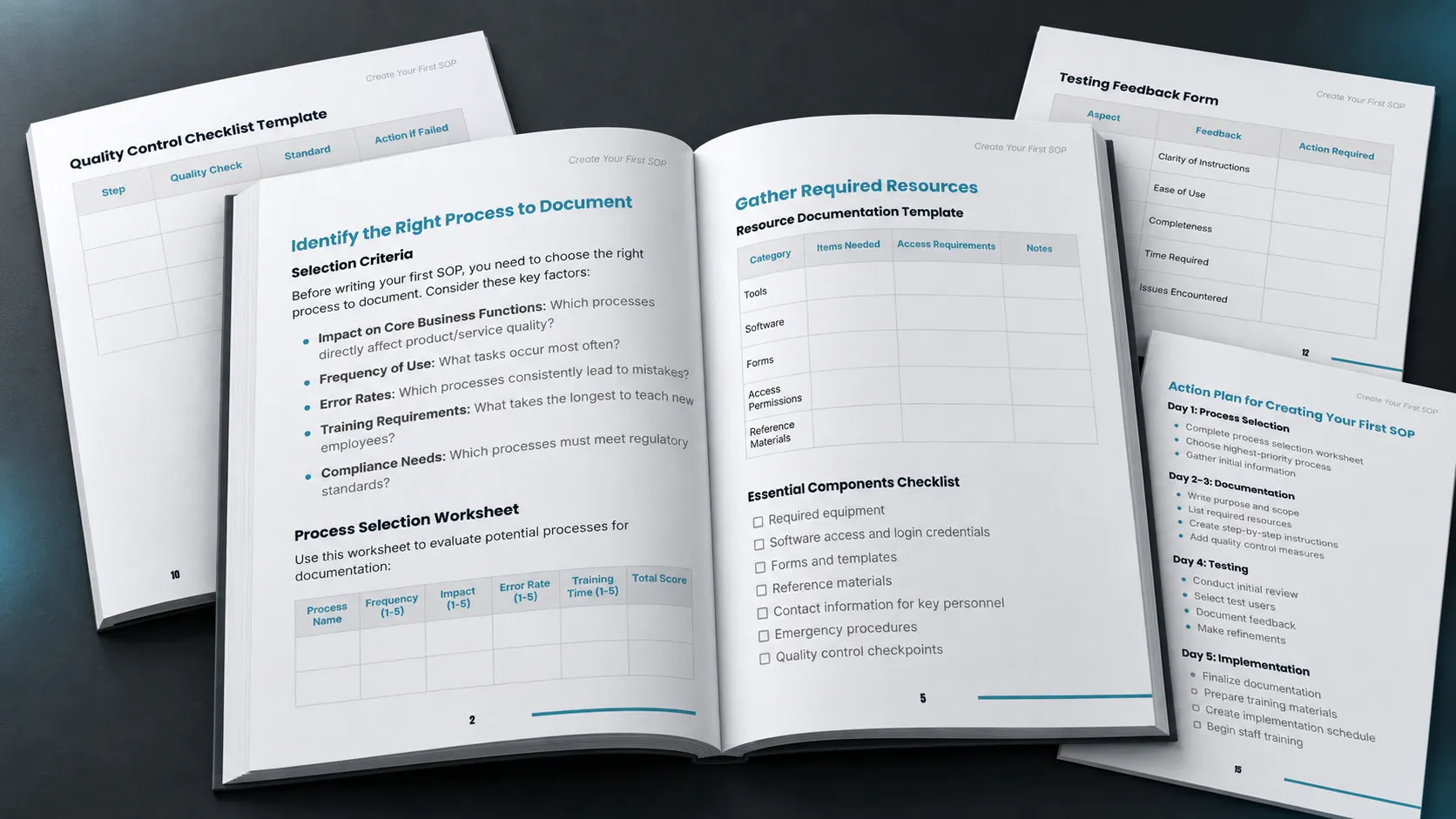
The included process selection worksheet helps compare candidates by scoring frequency, impact, error rate, and training time from one to five. The process with the highest total score becomes the recommended priority.
Define the Purpose and Boundaries
Before writing instructions, establish what the SOP is intended to achieve. A clear purpose statement should answer three questions:
- What is the SOP trying to achieve?
- Who will use the procedure?
- Why is the procedure necessary?
The scope then establishes the boundaries of the procedure. This includes the activities covered, the starting and ending points, the departments or roles involved, any prerequisites, and anything specifically excluded.
Defining these elements early helps keep the SOP focused and prevents unrelated activities from being added to the procedure.
Gather Everything the User Will Need
An effective SOP must identify the resources required to complete the process. The guide provides a resource documentation template covering tools, software, forms, access permissions, and reference materials.
Depending on the process, the required resources may include:
- Equipment
- Software access and login credentials
- Forms and templates
- Reference materials
- Contact information for key personnel
- Emergency procedures
- Quality control checkpoints
For each resource, document what is needed, how it can be accessed, and any relevant notes. This reduces the likelihood that a user will reach a step without the information or access required to continue.
Write Clear Step-by-Step Instructions
The guide recommends writing in active voice, keeping sentences short, and limiting each step to one action. Terminology should remain consistent throughout the procedure, with visual aids added where they improve understanding.
Organize the Procedure into Three Parts
Preparation steps should explain prerequisites, safety considerations, and required materials.
Main process steps should present the numbered sequence, required actions, decision points, and quality checks.
Completion steps should cover verification, documentation requirements, and any clean-up procedures.
Select the Appropriate Format
A simple checklist can support a short, straightforward task. A hierarchical format can divide major steps into smaller sub-steps. When a process contains several decisions or possible paths, a flowchart can show start and end points, decisions, process steps, and the connections between them.
Build Quality Control into the Procedure
Quality control should be part of the SOP rather than an afterthought. The guide divides quality control into three areas.
Verification Points
For each important checkpoint, specify what must be checked, how it should be checked, when the check occurs, and who is responsible.
Error Prevention
Document warning signs, common mistakes, prevention methods, and the corrective action to follow when something goes wrong.
Success Criteria
Define measurable standards, acceptable ranges, pass or fail conditions, and any required documentation. The included quality control template provides fields for the process step, quality check, expected standard, and action to take if the standard is not met.
Test the SOP Before Implementation
A completed draft still needs to be tested. The guide recommends a three-part testing protocol.
- Conduct an initial review: Check technical accuracy, completeness, formatting consistency, and language clarity.
- Run user testing: Select test users, observe them performing the procedure, document their feedback, and note completion times.
- Refine the SOP: Gather the feedback, identify recurring issues, revise the procedure, and test the changes again.
The testing feedback form helps evaluate clarity, ease of use, completeness, time required, and issues encountered. This creates a structured basis for revision instead of relying on general impressions.
Prepare for Implementation and Training
Implementation begins by finalizing the documentation, preparing training materials, setting an implementation date, and notifying the affected staff.
Training should include an overview, hands-on practice, opportunities for questions, and a performance evaluation. After implementation, the monitoring period should track adherence, collect feedback, address problems, and support further adjustments.
The guide also includes a training effectiveness checklist covering the overview presentation, hands-on practice, question-and-answer session, performance test, and follow-up review.
Follow the Five-Day SOP Action Plan
The resource turns the complete method into a focused five-day plan:
- Day 1: Complete the selection worksheet, choose the priority process, and gather initial information.
- Days 2 and 3: Define the purpose and scope, list required resources, write the instructions, and add quality controls.
- Day 4: Review the draft, select test users, collect feedback, and refine the procedure.
- Day 5: Finalize the SOP, prepare training materials, create an implementation schedule, and begin training.
Address Common SOP Creation Challenges
If the document contains too much detail, begin with the core steps and place supporting information in supplementary sections or appendices. If people resist documentation, start with a high-impact process where the benefits are easier to see.
Templates and standardized formats can help maintain consistency across procedures. When time is limited, divide SOP creation into smaller tasks completed over several days.
Start with One Important Process
The first practical action is to select a process using the evaluation worksheet. From there, schedule dedicated documentation time, gather the necessary materials, write the first draft, identify test users, plan training, and establish a future review date.
Download the complete guide to access the process selection worksheet, resource template, quality control checklist, testing feedback form, training checklist, and five-day action plan.